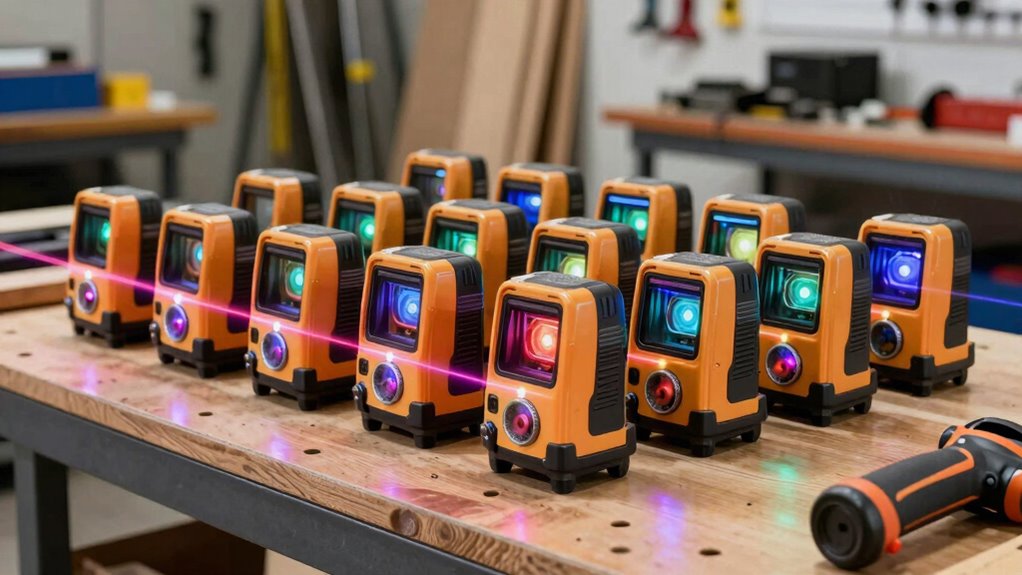

Choosing the right rotary laser level depends heavily on whether your work involves interior framing or exterior grading, as range and visibility vary dramatically between these applications. The Topcon RL-H5A stands out as the best overall pick for professionals needing extreme durability and long-range accuracy, while the Johnson Level & Tool JRT300-RDHV-S offers superior dual-slope capabilities for complex grading tasks. For those prioritizing budget without sacrificing basic functionality, the VEVOR Rotary Laser Level Kit provides a compelling entry point, though it lacks the refined stability of premium models. The main tradeoff you will face is between cost and long-term reliability, particularly regarding self-leveling mechanisms and battery life under harsh conditions. Continue reading to see how these twelve options stack up against specific job site demands.

Get business pricing on tools and workshop supplies
- Business-only prices and quantity discounts
- Tax-exempt purchasing
- Multiple users, one account, clear invoices
Complete the kit


Key Takeaways
- Green beam lasers, like the Klein Tools 93RLS, offer significantly better visibility in bright daylight than red beam alternatives, making them superior for outdoor work.
- Dual-slope capabilities are rare in budget kits; if your work involves pitched concrete or drainage, you must look at Johnson Level & Tool premium models.
- Self-leveling range is a critical differentiator; many budget kits fail to auto-level if the tripod is off by more than 4 degrees, leading to constant manual adjustments.
- IP54 waterproofing is the minimum standard for outdoor rotary levels, yet several lower-cost options in this roundup lack adequate dust and moisture sealing.
- Receiver sensitivity varies widely; pairing a high-end laser with a low-quality receiver negates the accuracy benefits, so matching components is essential.


| rotary laser level | Model | Brand |
|---|---|---|
| Topcon RL-H5A Self-Leveling Co | 1021200-07 | Topcon |
| VEVOR Rotary Laser Level Kit w | LRE205 | — |
| Firecore FRL300R Rotary Laser | — | — |
| VEVOR Rotary Laser Level Kit | LRE204 | — |
| Lipril 360° Self-Leveling Rota | 205 | — |
| Johnson Level & Tool 99-027K S | 99-027K | Johnson Level & Tool |
| Johnson Level & Tool JRT300-RD | JRT300-RDHV-S | Johnson Level & Tool |
| Johnson Level & Tool 99-028K E | 99-028K | Johnson Level & Tool |
| LotaTools Self-Leveling Rotary | RL | LotaTools |
| Klein Tools 93RLS Green Self-L | 93RLS | Klein Tools |
| H-YEEU 360° Self-Leveling Red | LRE203 | H-YEEU |
| Johnson Level & Tool 40-6517 S | 40-6517 | Johnson Level & Tool |
More Details on Our Top Picks
Topcon RL-H5A Self-Leveling Construction Laser with LS-80 Receiver
The Topcon RL-H5A is the strongest fit here for crews that need a rotary laser to cover a large work area day after day. Its 800 m range, ±10 arc-second accuracy and included LS-80 receiver suit grading and excavation work where reliable readings across a site matter more than a light kit. Compared with the Firecore FRL300R, the Topcon offers longer stated range and up to 100 hours of battery life, though Firecore has a rechargeable battery and a broader accessory bundle. The RL-H5A’s IP66 protection gives it an advantage over the IP54-rated VEVOR kits in dusty or wet conditions. The tradeoff is its 12.3 lb weight; it is less appealing for frequent carrying between small rooms or jobs.
Pros:- 800 m maximum range supports leveling across large job sites.
- ±10 arc-second accuracy suits precise construction layout.
- IP66-rated housing resists dust and heavy rain.
- Up to 100 hours of battery life reduces charging or battery-change interruptions.
Cons:- At 12.3 lb, the unit is heavy for frequent transport.
- The supplied kit is less accessory-heavy than options such as the Firecore FRL300R.
Best for: Construction and grading crews working across large, exposed sites who value long runtime, accuracy and weather resistance.
Not ideal for: DIY remodelers or mobile crews who need a lightweight kit that is easy to carry between short indoor tasks.
- Brand:Topcon
- Model:1021200-07
- Self-leveling range:±5°
- Accuracy:±10 arc seconds
- Maximum range:800 m (2,626 ft)
- Battery life:Up to 100 hours
- Included components:RL-H5A laser, LS-80 receiver, sensor holder and carry case
- Weight:12.3 lb
Our verdict“Choose the RL-H5A for large, demanding sites where accuracy, long runtime and IP66 protection matter more than carrying weight.”
VEVOR Rotary Laser Level Kit with Tripod, Receiver, and Remote Control
This VEVOR kit makes sense for buyers who want the core site accessories in one package: tripod, receiver, remote and hard case. Its stated 1,650 ft working range reaches farther than the 984 ft VEVOR LRE204, making this the better match of the two for larger layouts. The tradeoff is less precision on paper: its ±1/16 in per 100 ft specification is not as tight as the Lipril 205’s stated accuracy. An IP54 housing offers protection against dust and water, but not the higher IP66 rating listed for the Topcon RL-H5A. Runtime is 8–12 hours, so it will need more frequent charging or battery changes than the Topcon. Also, 23.36 lb net weight makes the full kit cumbersome to move around.
Pros:- 1,650 ft working range suits broad outdoor work areas.
- Includes a tripod, receiver, remote control and hard case.
- Rechargeable NiMH batteries provide 8–12 hours of runtime.
- IP54 housing offers dust and water protection for job-site use.
Cons:- The 23.36 lb kit weight makes transport and setup less convenient.
- Red laser visibility can be limited in very bright conditions.
- Requires four C-type NiMH batteries rather than a more common AA setup.
Best for: Small construction crews that need a long-range rotary laser with tripod, receiver and remote included for grading or outdoor layout.
Not ideal for: Users who carry equipment between floors or need a compact kit, or crews that prioritize the tighter stated accuracy of the Lipril 205.
- Model:LRE205
- Laser color:Red
- Working range:1,650 ft
- Leveling accuracy:±1/16 in per 100 ft
- Power supply:4 x C-type NiMH batteries
- Runtime:8–12 hours
- Mounting thread:5/8 in-11
- Net weight:23.36 lb
Our verdict“Pick this VEVOR when a broad working range and a ready-to-use accessory bundle outweigh portability and all-day runtime.”
Firecore FRL300R Rotary Laser Level Kit – 360° Self-Leveling Horizontal Laser with Receiver, Rechargeable Battery, Rod Clamp & Remote Control
The Firecore FRL300R balances range, accuracy and practical kit features without leaning as heavily toward site scale as the Topcon RL-H5A. Its 600 m coverage diameter and ±1/8 in at 100 ft accuracy suit many construction and landscaping jobs, while the 15-hour rechargeable Li-ion battery avoids the AA or C-cell constraints of the VEVOR LRE204 and LRE205. The receiver, rod clamp and remote make it a more complete field setup than the Topcon’s simpler included component list. Firecore also specifies IP55 protection and a 3.3 ft drop resistance, useful for routine job-site exposure. Its limitation is the shorter runtime and range versus Topcon, and its vibration mode disables self-leveling, so that setting calls for manual adjustment.
Pros:- 600 m coverage diameter supports broad outdoor layouts.
- Rechargeable Li-ion battery runs for up to 15 hours.
- Includes receiver with rod clamp, remote, target plate and hard case.
- IP55 protection and specified drop resistance suit job-site handling.
Cons:- Range and runtime are below the Topcon RL-H5A’s stated figures.
- Vibration mode disables self-leveling and requires manual adjustment.
- The robust unit and accessory bundle add bulk to transport.
Best for: Contractors and landscapers who want a rechargeable, accessory-rich rotary laser for medium-to-large work areas.
Not ideal for: Crews requiring the longest range or longest battery life, or users who expect vibration mode to keep self-leveling active.
- Coverage diameter:600 m (1,969 ft)
- Accuracy:±1/8 in at 100 ft
- Laser class:Class II (≤1 mW)
- Self-leveling range:Up to 5°
- Self-leveling time:15 seconds
- Battery runtime:Up to 15 hours
- Charging port:USB Type-C
- Ingress protection:IP55
- Drop resistance:3.3 ft onto concrete
Our verdict“Choose the FRL300R for a rechargeable, well-equipped rotary laser that balances broad coverage with practical field accessories.”
VEVOR Rotary Laser Level Kit – 984 ft, 360° Self-Leveling Red Horizontal Laser with Tripod, Receiver, Remote, Scale, Toolcase, IP54 Waterproof, ±1/8 in per 100 ft Precision
The LRE204 is a practical entry point for buyers who want a rotary laser and setup accessories together, without stepping up to the longer-range VEVOR LRE205. Its 984 ft range, ±5° self-leveling and ±1/8 in per 100 ft accuracy are suited to typical renovation, landscaping and smaller construction jobs. The kit includes a tripod, receiver, remote, scale and hard case, so a first-time buyer has more of the basic setup in hand than with the Topcon RL-H5A package. Five rotation speeds and scan angles add flexibility for different tasks. In exchange, its red beam is less visible in bright conditions, and the 8–12-hour battery runtime is modest beside Firecore’s 15 hours. The remote’s stated range is about 65 ft.
Pros:- Includes tripod, receiver, remote, scale and hard case.
- ±5° self-leveling helps speed setup on uneven surfaces.
- Five rotation speeds and scan angles support varied tasks.
- IP54-rated housing provides dust and water protection.
Cons:- 984 ft range is shorter than the LRE205 and Firecore FRL300R.
- Red beam visibility can suffer in bright outdoor conditions.
- Remote control range is limited to about 65 ft.
Best for: First-time rotary laser buyers and remodelers who need an accessory-rich kit for indoor and moderate-range outdoor work.
Not ideal for: Large-site crews who need more than 984 ft of range, or users who rely on remote operation from farther away than about 65 ft.
- Model:LRE204
- Working range:984 ft
- Leveling accuracy:±1/8 in per 100 ft
- Auto-leveling range:±5°
- Laser color:Red
- Power supply:4 x AA NiMH batteries, 1.2 V each
- Runtime:Up to 12 hours
- Tripod height range:24.4–57.9 in
- Weight with accessories:16.5 lb
Our verdict“The LRE204 suits new users who want a complete, adaptable kit for moderate-range work and do not need the longest reach.”
Lipril 360° Self-Leveling Rotary Laser Level Kit
The Lipril 205 stands out for its stated ±1/16 in at 100 ft accuracy and unusually long 2,296 ft working range, giving it the strongest range-and-precision combination in this batch on the supplied specifications. It is a step up from the VEVOR LRE204’s 984 ft range and ±1/8 in accuracy, while remaining less established in the product details than the Topcon RL-H5A, which specifies ±10 arc seconds and IP66 protection. Lipril’s kit includes a receiver, tripod, surveying rod, remote and target board, helping buyers assemble a field setup quickly. Its IP54 rating is suitable for ordinary dust and water exposure, but the battery restriction is a real limitation: it accepts AA dry or Ni-MH cells, not lithium batteries. The red beam may also be harder to see in bright conditions.
Pros:- 2,296 ft working range is the longest stated in this batch.
- ±1/16 in at 100 ft accuracy is tighter than the VEVOR LRE204 specification.
- Includes receiver, tripod, surveying rod, remote, glasses and target board.
- Accepts AA dry or Ni-MH batteries.
Cons:- Lithium batteries are not supported.
- Red beam can be difficult to see in bright conditions.
- Runtime and self-leveling range are not specified in the supplied product data.
Best for: Buyers seeking long stated range and tighter stated accuracy who want a broad accessory kit and can work with AA dry or Ni-MH batteries.
Not ideal for: Users who depend on lithium batteries, need a green beam for bright settings, or prefer a model with specified battery runtime and self-leveling range.
- Model:205
- Working range:2,296 ft
- Accuracy:±1/16 in at 100 ft
- Laser class:Class II, ≤5 mW
- Laser color:Red
- Ingress protection:IP54
- Battery compatibility:4 AA dry or Ni-MH batteries; lithium batteries not supported
- Dimensions:6.8 × 4.5 in
- Included components:Laser level, receiver, tripod, surveying rod, remote control, glasses, four AA dry batteries and target board
Our verdict“Choose the Lipril 205 for its long stated reach and tighter stated accuracy if AA batteries and a red beam fit your work conditions.”
Johnson Level & Tool 99-027K Self-Leveling Rotary Laser System
The 99-027K is a practical choice when the main job is establishing level across a large site, rather than setting grade. Its 2,000-foot working diameter and included detector, tripod, and 13-foot grade rod support one-person layout across broad areas. Compared with the Johnson JRT300-RDHV-S, it gives up dual-slope capability and the longer 4,000-foot range, but its simpler setup suits buyers who do not need those advanced functions. The IP66 housing is built for dusty or wash-down conditions, a useful advantage on demanding work sites. The tradeoff is its red beam, which can be harder to see in bright sunlight, and the lack of slope functionality limits its usefulness for drainage or graded surfaces.
Pros:- 2,000-foot working diameter supports large site layouts.
- IP66-rated housing resists dust and wash-down exposure.
- Included heavy-duty tripod, detector, and 13-foot grade rod support one-person operation.
- Hard-shell carrying case and accessories make it a ready-to-use kit.
Cons:- No slope functionality for drainage or graded work.
- Red laser can be difficult to see in bright sunlight.
- Its stated accuracy is 3 inches per 100 feet, less precise than the LotaTools RL’s stated ±1/8 inch per 100 feet.
Best for: Contractors handling broad, mostly level outdoor layouts who want a complete kit for detector-based, one-person work.
Not ideal for: Drainage and grading crews that need slope control, or buyers who regularly work in bright sunlight and prefer a more visible green beam.
- Brand:Johnson Level & Tool
- Model:99-027K
- Working diameter:2,000 ft
- Accuracy:3 in per 100 ft
- Laser:Red, Class IIIa, ≤5 mW
- Included accessories:Detector with clamp, heavy-duty tripod, 13 ft grade rod, magnetic target, tinted glasses, and hard-shell case
- Warranty:3 years
Our verdict“Choose the 99-027K for large, level layouts and rugged site conditions, but pick a dual-slope model if grade setting is part of the job.”
Johnson Level & Tool JRT300-RDHV-S Self-Leveling Red Dual Slope Rotary Laser System
For large projects that need both reach and grade control, the JRT300-RDHV-S has the broadest stated range in this group: 4,000 feet of horizontal/vertical coverage, with a remote that works up to 400 feet away. Its dual-slope function and five rotational-speed settings give crews more control over grading tasks than the slope-free Johnson 99-027K. The kit also includes a tripod, detector, and 13-foot grade rod, reducing the need to source core setup equipment separately. Protection is another strength: IP67 construction and impact resistance to 6-foot drops suit rougher site conditions than many basic rotary kits. That capability comes with a tradeoff: the remote’s 400-foot limit is far shorter than the laser’s stated range, and the supplied red beam may be less visible than the green beam on the Klein 93RLS.
Pros:- 4,000-foot stated range supports unusually large work areas.
- Dual-slope capability and five rotational speeds support varied grading tasks.
- IP67 protection and 6-foot impact resistance suit rough jobsite handling.
- Kit includes lithium-ion batteries, remote, detector, tripod, and 13-foot grade rod.
Cons:- Remote range is limited to 400 feet, so operation may require walking closer.
- Red beam can be less visible than the Klein 93RLS’s green beam.
- Its extensive range and features may be unnecessary for smaller or mainly indoor jobs.
Best for: Earthwork and construction crews covering very large sites that need dual-slope capability, rugged protection, and remote operation.
Not ideal for: Small indoor crews that will not use the extended range or slope features, or buyers who want a green beam for visual visibility.
- Brand:Johnson Level & Tool
- Model:JRT300-RDHV-S
- Range:4,000 ft
- Remote range:400 ft
- Rotational speeds:0, 100, 300, 600, and 1,200 RPM
- Laser:Red, Class 3R, 5 mW
- Protection:IP67; impact resistant to 6 ft
- Power source:Lithium-ion batteries
- Included accessories:Magnetic target, detector, remote control, tripod, and 13 ft grade rod
Our verdict“Pick the JRT300-RDHV-S when long-range dual-slope work and jobsite durability matter more than a green beam or a longer-range remote.”
Johnson Level & Tool 99-028K Electronic Self-Leveling Dual Slope Rotary Laser System
The 99-028K is the more targeted pick for crews that need programmable dual slope alongside electronic self-leveling. Its horizontal and vertical self-leveling modes add flexibility for construction layouts, while the slope function supports drainage and landscaping tasks that the Johnson 99-027K cannot handle. Visual and audible alarms provide an extra warning when setup or operating conditions could affect the work. The included detector, remote, tripod, 13-foot grade rod, and hard-shell case make this a substantial system kit. Unlike the JRT300-RDHV-S, however, the supplied data does not give this model a long-range figure or impact rating, so buyers comparing solely on documented range and ruggedness have less to go on. Its red laser can also be harder to see in bright outdoor conditions, and backup alkaline batteries are not included.
Pros:- Programmable dual-slope function supports grade and drainage work.
- Self-levels horizontally and vertically for varied layout tasks.
- Visual and audible alarms alert users to potential setup or accuracy issues.
- Includes rechargeable battery pack, remote, detector, tripod, grade rod, and hard-shell case.
Cons:- Red beam may be difficult to see in bright outdoor sunlight.
- Alkaline backup batteries are not included.
- Supplied specifications do not state a working range, making direct range comparisons with the JRT300-RDHV-S difficult.
Best for: Landscape, drainage, and construction professionals who need programmable dual slope plus horizontal and vertical self-leveling.
Not ideal for: Buyers who need a documented extra-long working range, strong impact specifications, or better beam visibility in bright sunlight.
- Brand:Johnson Level & Tool
- Model:99-028K
- Laser:Red, Class IIIa, ≤5 mW
- Self-leveling:Horizontal and vertical
- Dual slope:Yes, 5°
- Power:NiMH rechargeable battery pack; alkaline battery compartment
- Included accessories:Charger, remote, detector with clamp, tripod, 13 ft grade rod, magnetic target, tinted glasses, and hard-shell case
- Warranty:3 years
Our verdict“Choose the 99-028K for dual-slope landscaping and drainage work when its complete kit matters more than a clearly stated long-range rating.”
LotaTools Self-Leveling Rotary Laser Level Kit with Aluminum Tripod and Grade Rod
The LotaTools RL stands out for pairing a full setup kit with a clearly stated ±1/8-inch accuracy at 100 feet. That figure gives buyers a useful reference point that the Johnson 99-027K’s stated 3 inches per 100 feet does not match, though accuracy specifications should be compared carefully across manufacturers and conditions. With the included receiver, the RL is listed for up to 2,000 feet, and its IP66 rating fits demanding dusty or wet sites. The aluminum tripod, five-section grade rod, remote, wall mount, and carrying case make it a flexible package for a crew building out its equipment. It does not offer the Johnson 99-028K’s programmable dual-slope feature, and its ±5° self-leveling range means steep setups need manual adjustment. The red beam also has limited visibility in direct sun without the receiver.
Pros:- States ±1/8-inch accuracy at 100 feet.
- Up to 2,000-foot working range when used with the included receiver.
- IP66-rated housing is suited to dusty and wet jobsite conditions.
- Kit includes aluminum tripod, grade rod, receiver, remote, wall mount, and case.
Cons:- Self-leveling is limited to ±5°, requiring manual adjustment on steeper setups.
- Red beam visibility can be limited in direct sunlight without the receiver.
- Does not list dual-slope capability, unlike the Johnson 99-028K.
Best for: Independent contractors and small construction crews seeking a complete receiver-based kit with stated accuracy and a 2,000-foot working range.
Not ideal for: Crews that need programmable dual-slope control, regularly set up on steep ground, or rely on seeing the beam in direct sunlight without a receiver.
- Brand:LotaTools
- Model:RL
- Accuracy:±1/8 in at 100 ft
- Working range:Up to 2,000 ft with receiver
- Self-leveling range:±5°
- Laser:Class II, 635 nm, <5 mW
- Protection:IP66
- Included accessories:Receiver, remote, target plate, laser glasses, five-section grade rod, 5.5 ft aluminum tripod, wall mount, and carrying case
Our verdict“The LotaTools RL makes sense for buyers who want a complete long-range kit and clearly stated accuracy, but not for jobs that require dual-slope control.”
Klein Tools 93RLS Green Self-Leveling Rotary Laser Level Kit
The Klein 93RLS takes a different approach from the red-beam Johnson and LotaTools models: its green rotary laser can be easier to spot by eye in suitable conditions, while a detector supports its stated 1,150-foot range. That makes it a strong fit for crews doing a mix of outdoor layout and indoor work, where the integrated plumb spot is useful for ceiling alignment. Its rechargeable battery is rated for up to 24 hours, and the IP66 rating adds protection against dust and water. Compared with the LotaTools RL, the Klein has a shorter stated range but offers a green beam and specified long runtime. The main limitation is power flexibility: its battery is integrated and non-removable, so a depleted pack cannot be swapped for a spare. Only one detector is included.
Pros:- Green laser beam can be easier to see than the red beams on the Johnson models.
- Up to 24 hours of stated runtime on the integrated rechargeable battery.
- IP66 rating provides dust and water resistance.
- Includes detector, grade rod, tripod, mounting hardware, and carrying case.
Cons:- The integrated battery is non-removable, so users cannot swap in a spare.
- One detector is included; additional detectors must be purchased separately.
- Its 1,150-foot range is shorter than the 2,000-foot LotaTools RL and 4,000-foot Johnson JRT300-RDHV-S.
Best for: Finish, ceiling, and general construction crews who value a green beam, plumb reference, and long rechargeable runtime in a self-contained kit.
Not ideal for: Teams needing the longest available range, swappable batteries for continuous shifts, or multiple detectors for simultaneous work areas.
- Brand:Klein Tools
- Model:93RLS
- Laser:Green, Class 3R, ≤5 mW
- Range:1,150 ft with detector
- Battery runtime:Up to 24 hours
- Power source:Integrated rechargeable battery
- Coverage:360° horizontal and vertical, with integrated plumb spot
- Weight:4.4 lb
- Included accessories:Detector, detector mount, 9 ft grade rod, charging cable, carrying case, and heavy-duty tripod
Our verdict“Choose the Klein 93RLS for green-beam visibility, ceiling layout, and long runtime, but select another model if maximum range or swappable batteries are priorities.”
H-YEEU 360° Self-Leveling Red Beam Rotary Laser Level Kit with Tripod and Grade Rod
The H-YEEU stands out for pairing a 500 m working distance with receiver and a broad accessory bundle, making it a practical fit for larger outdoor layouts where repeated setups slow work. Its adjustable rotation speeds and scan angles let me tailor the laser display to the task, while automatic self-leveling reduces manual alignment. Compared with the Johnson 40-6517, which adds horizontal and vertical operation plus out-of-level alarms, this kit puts more emphasis on configurable scanning and stated working range. The IP54-rated metal and tempered-glass rotor is built for dusty or damp sites, but the red beam can be harder to pick out in bright daylight than the green beam on the Klein 93RLS. The included tripod, grade rod, remote, and case add convenience, though components may arrive in separate shipments.
Pros:- Automatic self-leveling cuts down on manual alignment during setup.
- 500 m working distance with receiver suits larger layout areas.
- Five rotation speeds and five scan-angle settings offer task flexibility.
- Kit includes rechargeable remote, 1.65 m tripod, 5 m grade rod, and carrying case.
Cons:- Red beam can be difficult to see in bright outdoor conditions compared with a green laser.
- Separate shipments of kit components may delay having the full setup ready.
- The product data does not specify a precision tolerance, making accuracy comparisons difficult.
Best for: Outdoor contractors and property crews who need a receiver-supported laser with long stated range, adjustable scanning, and a bundled tripod and grade rod.
Not ideal for: Buyers working mainly in bright sunlight without a receiver, or those who need vertical leveling and explicit out-of-level alarms.
- Brand:H-YEEU
- Model:LRE203
- Laser class:Class 1 (IEC 60825-1:2014)
- Power output:5 mW
- Working distance:500 m with receiver
- Scanning speeds:0, 60, 120, 300, and 600 rpm
- Scanning angles:0°, 10°, 45°, 90°, and 180°
- Kit contents:12 items; includes rechargeable remote, 1.65 m aluminum tripod, 5 m grade rod, and carrying case
Our verdict“Choose the H-YEEU if long receiver-assisted reach and a configurable, bundled setup matter more than a green beam or specified accuracy tolerance.”
Johnson Level & Tool 40-6517 Self-Leveling Rotary Laser System
I’d pick the Johnson 40-6517 for smaller construction jobs that need both horizontal and vertical self-leveling, rather than the H-YEEU’s greater stated reach and adjustable scan angles. Its visual and audible out-of-level alarms help flag a disturbed setup before layout marks are carried forward, and the locking compensator protects the pendulum during transport. The accessory package is notably job-ready: it includes a detector, tripod, mount, grade rod, and hard-shell case. That makes it a more versatile choice for deck installers or builders moving between different layout tasks than a basic horizontal-only system. The tradeoffs are its bulky kit for compact jobs and the need to source batteries separately; the listed rechargeable Ni-MH pack is not included. Its 200, 400, and 600 RPM settings are useful, though fewer than the H-YEEU’s five listed speeds.
Pros:- Supports horizontal and vertical self-leveling for varied layout work.
- Visual and audible alarms alert the user when the unit is out of level.
- Accessory kit includes detector with clamp, tripod, mount, grade rod, and hard-shell case.
- Three-year warranty includes 24-hour repair or replacement service.
Cons:- Batteries are not included, so the system may require an extra purchase before use.
- Bulky, heavy kit is less convenient for small projects or frequent transport.
- Only three listed rotation speeds, compared with the H-YEEU’s five settings.
Best for: Deck installers, builders, and small-site contractors who need horizontal and vertical leveling, setup alarms, and a detector-ready accessory package.
Not ideal for: Solo DIY users with very small projects or buyers who want a compact kit ready to use without sourcing batteries.
- Brand:Johnson Level & Tool
- Model:40-6517
- Laser classification:Class IIIa
- Maximum power output:≤5 mW
- Leveling modes:Horizontal and vertical self-leveling
- Rotation speeds:200, 400, and 600 RPM
- Included components:Wall/ceiling mount, 8-ft grade rod, detector with clamp, tinted glasses, magnetic target, elevating tripod, hard-shell case, and rechargeable Ni-MH battery pack
- Warranty:3 years
Our verdict“Choose the Johnson 40-6517 when vertical as well as horizontal layout and out-of-level alerts matter more than compactness or a wider selection of rotation speeds.”

How We Picked
I evaluated these rotary laser levels based on three core pillars: accuracy consistency, environmental resilience, and workflow integration. Accuracy was judged not just by the stated tolerance (e.g., ±1/8 inch per 100 feet) but by the stability of the self-leveling mechanism when subjected to minor vibrations or uneven tripod setups. I prioritized models with robust motorized leveling over pendulum systems, which are prone to wear and drift over time.
Environmental resilience involved examining ingress protection ratings and battery compartment seals, as dust and rain are constant threats on construction sites. Workflow integration considered the ease of switching between modes, the intuitiveness of remote controls, and the compatibility of included accessories like tripods and receivers. Products that required excessive manual calibration or had poor battery life were ranked lower, regardless of their initial price point.
| rotary laser level | Brand |
|---|---|
| Topcon RL-H5A Self-Leveling Co | Topcon |
| VEVOR Rotary Laser Level Kit w | — |
| Firecore FRL300R Rotary Laser | — |
| VEVOR Rotary Laser Level Kit | — |
| Lipril 360° Self-Leveling Rota | — |
| Johnson Level & Tool 99-027K S | Johnson Level & Tool |
| Johnson Level & Tool JRT300-RD | Johnson Level & Tool |
| Johnson Level & Tool 99-028K E | Johnson Level & Tool |
| LotaTools Self-Leveling Rotary | LotaTools |
| Klein Tools 93RLS Green Self-L | Klein Tools |
| H-YEEU 360° Self-Leveling Red | H-YEEU |
| Johnson Level & Tool 40-6517 S | Johnson Level & Tool |
Factors to Consider When Choosing Rotary Laser Level
Selecting a rotary laser level requires matching the tool’s technical specifications to your specific trade. A framer has different needs than a landscape architect, and understanding these distinctions prevents expensive mistakes.
Beam Color and Visibility
The choice between red and green beams is often the most significant factor for outdoor usability. Green beams are perceived by the human eye as roughly 50% brighter than red beams at the same power output, making them far easier to see in direct sunlight. If you primarily work outdoors or in brightly lit warehouses, investing in a green laser reduces eye strain and speeds up setup time. However, green lasers typically consume more power and cost more to manufacture. For indoor work in controlled lighting, a red beam remains a cost-effective and sufficient choice, provided you have a reliable detector for long distances.
Self-Leveling vs. Manual Leveling
Self-leveling mechanisms automatically correct the laser’s position within a specific range, usually 4 to 5 degrees. This feature saves time but adds complexity and potential points of failure. Motorized self-leveling is more robust and accurate than pendulum systems, which can suffer from magnetic interference or physical wear. If you work on uneven terrain where tripod stability is challenging, a motorized unit is worth the premium. Conversely, if you have a perfectly stable platform and need maximum battery life, a manual leveling unit with a fine-adjustment knob might offer better long-term reliability and lower maintenance costs.
Range and Receiver Compatibility
Stated range often refers to the maximum distance the detector can pick up the beam, not necessarily the distance at which the naked eye can see it. For distances beyond 100 feet, a laser receiver is mandatory. Not all receivers are compatible with all lasers; some use specific frequency modulations. When comparing kits, check if the included receiver is high-quality and if the laser supports external receivers from other brands. A mismatched system leads to false readings or no signal, rendering the tool useless for large-scale grading or foundation work.
Durability and Ingress Protection
Construction sites are hostile environments filled with concrete dust, rain, and accidental drops. Look for units with an IP54 rating or higher, which indicates protection against dust accumulation and water splashes. Budget models often skip proper sealing, leading to internal damage after a few uses. Rubberized bumpers and reinforced housings are not just marketing fluff; they prevent shock damage to the delicate optical components inside. If you drop a laser frequently, the cost of replacement often outweighs the initial savings of buying a cheaper, less durable unit.
Battery Life and Power Options
Running out of power mid-job is a major disruption. Rechargeable lithium-ion batteries offer consistent voltage output, which helps maintain beam brightness throughout the charge cycle. Alkaline batteries are easier to replace in remote areas but suffer from voltage drop as they deplete, potentially affecting self-leveling speed. Some premium models allow hot-swapping batteries without losing calibration, a feature that saves significant time on large sites. Consider your typical workday length and whether you have access to power sources when deciding between rechargeable and disposable power systems.
Slope Capabilities
Standard rotary levels project a single horizontal plane. Dual-slope models can tilt the laser plane in two axes, allowing you to lay out pitched roofs, drainage ditches, and ramps with precision. This feature is indispensable for civil engineering and landscaping but adds significant cost and complexity to the control interface. If you only do flat concrete pours or interior framing, dual-slope features are unnecessary overhead. However, for contractors who bid on mixed projects, having one tool that handles both flat and sloped applications reduces equipment inventory and training time.
Frequently Asked Questions
Can I use a rotary laser level for indoor framing without a detector?
For most indoor framing tasks within 50 to 100 feet, you can see the red beam line clearly enough to mark studs and plates without a detector. However, if you are working in large warehouses or bright showrooms, the beam may wash out. Green beam models improve visibility indoors, but a detector is still recommended for long runs to ensure you are hitting the exact height. Relying solely on naked-eye visibility in large spaces introduces human error and slows down the workflow compared to using a receiver with audible alerts.
How often should I calibrate my rotary laser level?
Most high-quality rotary levels hold their calibration well, but construction sites are harsh on optics and internal mechanisms. I recommend checking your level’s accuracy every three to six months, or immediately after a significant drop or impact. You can perform a simple field check by setting up the laser, marking a height on two points 100 feet apart, rotating the laser 180 degrees, and checking if the height remains consistent. If the discrepancy exceeds the manufacturer’s tolerance, send the unit to an authorized service center for professional calibration.
Is a tripod included in the kit enough for professional work?
Many budget kits include basic tripods that may lack stability or fine-adjustment capabilities. For professional grading or foundation work, a dedicated surveyor’s tripod with a leveling base is often necessary to achieve the required precision. Cheap tripods can flex under wind or vibration, causing the laser plane to shift slightly during critical measurements. If the included tripod feels flimsy or lacks a built-in bubble level, plan to purchase a higher-quality tripod separately to maximize the accuracy of your laser.
Why does my laser fail to self-level even on a flat surface?
This issue often stems from the surface not being level enough for the self-leveling range, which is typically limited to 4 to 5 degrees. If your tripod is set up on a steep slope, the internal mechanism cannot correct the angle, and the unit will blink an error code. Another common cause is magnetic interference from nearby steel structures or power tools, which can disrupt pendulum-based systems. Always use the tripod’s leveling legs to get the unit as close to level as possible before engaging the self-leveling function.
Do I need a grade rod with my rotary laser level?
A grade rod is essential for tasks like establishing elevation for foundations, drainage, or concrete pours. While a standard tape measure can work for short distances, a telescoping grade rod with a laser target allows one person to read heights quickly and accurately from a distance. The rod provides a stable, vertical reference point that is easier to read than a tape measure held by hand. For professional grading work, a high-visibility grade rod with clear markings is as important as the laser itself for maintaining workflow efficiency.
Conclusion
To make the final decision, match the tool to your primary work environment. The Topcon RL-H5A is the best overall choice for general contractors who need a rugged, reliable workhorse for both indoor and outdoor tasks. If your work heavily involves landscaping, drainage, or pitched concrete, the Johnson Level & Tool JRT300-RDHV-S is the best premium pick due to its advanced dual-slope features. For those on a tight budget or occasional DIYers, the VEVOR Rotary Laser Level Kit offers the best value, provided you understand its limitations in extreme weather. If you work primarily outdoors in bright sunlight, the Klein Tools 93RLS is the best choice for visibility thanks to its green beam technology. Finally, for beginners looking for a simple, all-in-one starter kit, the Lipril 360° Self-Leveling Rotary Laser Level Kit provides an accessible entry point with decent accuracy for residential projects.