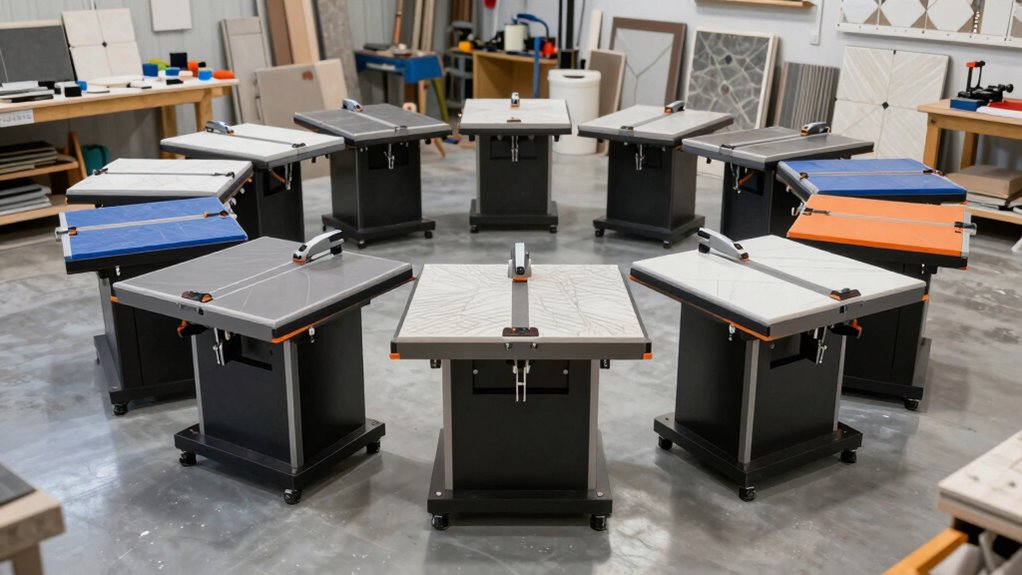

A tile saw table gives you a stable platform for making accurate, water-cooled cuts, but the right choice depends on tile size, job frequency, and how much setup you can manage. My best overall pick is the DEWALT D24000S, which pairs a 10-inch saw with a stand for demanding work and larger-format cuts. The RUBI DC-250 Python 1200 stands out for buyers who need an extended cutting setup, while the SKIL 3550-02 favors tidier home projects with its HydroLock water-containment system. The main tradeoffs are cutting capacity and stability versus portability, water management, and a simpler setup. Read on for the full breakdown of all eight options and the factors that matter before choosing a tile saw table.

Get business pricing on tools and workshop supplies
- Business-only prices and quantity discounts
- Tax-exempt purchasing
- Multiple users, one account, clear invoices
Complete the kit


Key Takeaways
- The DEWALT D24000S is the strongest all-around choice in this lineup for buyers who want a 10-inch saw and included stand; its larger setup makes less sense for occasional, space-constrained work.
- The RUBI DC-250 Python 1200 serves a different priority: its extended cutter format suits long cuts, while buyers should weigh that specialized design against the more familiar stand-mounted saws.
- Water control separates home-friendly options from jobsite-oriented ones. The SKIL 3550-02’s HydroLock system is designed to limit splash, whereas a wet saw still needs a suitable work area and cleanup plan.
- Seven-inch saws are the compact end of this group. The PORTER-CABLE PCE980, SKIL 3540-02, and 7-inch VEVOR are worth comparing for routine tile work, but they are not direct substitutes for a 10-inch setup when larger cuts are frequent.
- An included stand changes the buying decision. The VEVOR 10-inch and Hoteche 8-inch models bundle a work platform, while buyers choosing a saw without one need to account for a stable, level support surface.
| VEVOR 10-Inch Wet Tile Saw with Stand |  | Best for Long, Beveled Cuts | Model: TC250Ⅵ-Ⅰ | Power: 120 V corded electric; 1200 W | Motor speed: 4500 rpm | VIEW ON AMAZON | See Our Full Breakdown |
| SKIL 3550-02 7-Inch Wet Tile Saw with HydroLock Water Containment System |  | Best for Cleaner Small-Space Cutting | Model: 3550-02 | Power: 120 V corded electric; 600 W | Speed: 3600 rpm | VIEW ON AMAZON | See Our Full Breakdown |
| PORTER-CABLE PCE980 7-Inch Wet Tile Saw |  | Best for Guided Straight Cuts | Model: PCE980 | Power: 120 V corded electric; 1.0 HP; 1300 W | Speed: 2850 rpm | VIEW ON AMAZON | See Our Full Breakdown |
| DEWALT 10-Inch Corded Wet Tile Saw with Stand (D24000S) |  | Best Premium Jobsite Table | Model: D24000S | Power: 120 V corded electric; 1.5 HP | Blade diameter: 10 inches | VIEW ON AMAZON | See Our Full Breakdown |
| SKIL 7-Inch Wet Tile Saw, Model 3540-02 |  | Best Compact Starter Saw | Model: 3540-02 | Power: 120 V corded electric; 4.2 A | Speed: 3600 rpm | VIEW ON AMAZON | See Our Full Breakdown |
| RUBI DC-250 Python 1200 Electric Tile Cutter and Miter Saw |  | Best for Long, Precise Porcelain Cuts | Power: 1103 W, corded electric | Voltage: 120 V | Cutting length: 47.6 in | VIEW ON AMAZON | See Our Full Breakdown |
| VEVOR 7-Inch Wet Tile Saw with 65Mn Steel Blade |  | Best Compact Bench-Top Pick | Power: 750 W, corded electric | Voltage: 120 V | Motor speed: 3500 RPM | VIEW ON AMAZON | See Our Full Breakdown |
| Hoteche 8-Inch Wet Tile Saw with Stand |  | Best for Buyers Who Want a Stand Included | Power: 800 W, 8 A | Voltage: 120 V | No-load speed: 3550 RPM | VIEW ON AMAZON | See Our Full Breakdown |
| tile saw table | Power | Model | Weight | Blade diameter |
|---|---|---|---|---|
| VEVOR 10-Inch Wet Tile Saw wit | 120 V corded electric; 1200 W | TC250Ⅵ-Ⅰ | 20.2 pounds | 10 inches |
| SKIL 3550-02 7-Inch Wet Tile S | 120 V corded electric; 600 W | 3550-02 | 22.1 pounds | 7 inches |
| PORTER-CABLE PCE980 7-Inch Wet | 120 V corded electric; 1.0 HP; 1300 W | PCE980 | 32 pounds | — |
| DEWALT 10-Inch Corded Wet Tile | 120 V corded electric; 1.5 HP | D24000S | — | 10 inches |
| SKIL 7-Inch Wet Tile Saw | 120 V corded electric; 4.2 A | 3540-02 | 18 pounds | 7 inches |
| RUBI DC-250 Python 1200 Electr | 1103 W, corded electric | — | — | — |
| VEVOR 7-Inch Wet Tile Saw with | 750 W, corded electric | — | — | — |
| Hoteche 8-Inch Wet Tile Saw wi | 800 W, 8 A | — | 60 lb | — |
More Details on Our Top Picks
VEVOR 10-Inch Wet Tile Saw with Stand
The 10-inch blade and 36-inch maximum tile size make this VEVOR a fit for larger ceramic pieces that exceed the working range of the SKIL 3550-02. Its 0–45-degree angle adjustment adds flexibility for bevel work, while the removable water reservoir helps manage cutting dust and debris. Infrared guidance and a built-in scale offer useful visual references for lining up cuts; they are distinct from the PORTER-CABLE PCE980’s miter square and onboard guide. At 20.2 pounds with wheels, it is easier to reposition than the 69-pound DEWALT D24000S, though its lighter build may be less appealing for a permanent, heavy-use station. The tradeoff is that the available product details do not specify a warranty duration, so buyers seeking documented coverage may prefer another option.
Pros:- Supports tile up to 36 inches, more than the SKIL 3550-02’s 18 x 18-inch support
- Adjustable cutting angle from 0 to 45 degrees
- Infrared guidance and built-in scale help line up cuts
- Wheels and 20.2-pound weight aid repositioning
Cons:- Product details do not specify a warranty duration
- Surface recommendation lists ceramic rather than porcelain or stone
- Requires a corded power connection and water-reservoir setup
Best for: DIY renovators cutting larger ceramic tile who want bevel capacity, built-in alignment aids, and a saw they can move between work areas.
Not ideal for: Buyers needing documented warranty coverage or a saw specified for cutting porcelain and stone, since the listed surface recommendation is ceramic.
- Model:TC250Ⅵ-Ⅰ
- Power:120 V corded electric; 1200 W
- Motor speed:4500 rpm
- Blade diameter:10 inches
- Cutting angle:0–45 degrees
- Maximum cutting depth:3.75 inches (95 mm)
- Maximum tile size:36 inches (914 mm)
- Dimensions:18.9 × 17 × 52.36 inches
- Weight:20.2 pounds
Our verdict“Choose the VEVOR if you need larger ceramic-tile capacity and bevel cuts in a more movable package than the DEWALT D24000S.”
SKIL 3550-02 7-Inch Wet Tile Saw with HydroLock Water Containment System
The SKIL 3550-02 is the more cleanup-conscious choice among the compact saws here: its HydroLock system is designed to contain splash near the blade, which can matter when cutting indoors or in a tight work area. Its sliding extension supports tiles up to 18 x 18 inches, giving it more working room than the SKIL 3540-02, whose listed capacity is limited to tiles up to 12 x 12 inches. The aluminum tabletop, rip fence, and miter gauge provide a practical setup for repeatable straight and angled cuts, including preset bevels at 22.5 and 45 degrees. Compared with the larger DEWALT D24000S, this model is lighter to handle and simpler to place, but its 7-inch blade and 600-watt motor make it a compact-job tool rather than the pick for larger cutting demands.
Pros:- HydroLock system helps limit water splash and cleanup
- Sliding extension supports tiles up to 18 x 18 inches
- Rip fence and miter gauge support repeatable cuts
- Provides bevel settings at 0, 22.5, and 45 degrees
Cons:- 7-inch blade and 600-watt motor suit smaller work better than demanding large-tile jobs
- Corded operation requires access to an outlet
- At 22.1 pounds, it is not the lightest compact option in this lineup
Best for: Home renovators cutting standard-size tile in a garage or small workspace who want a tabletop saw with water-splash control and useful miter settings.
Not ideal for: Contractors cutting large-format tile or moving frequently between job sites who need greater capacity or a more portable setup.
- Model:3550-02
- Power:120 V corded electric; 600 W
- Speed:3600 rpm
- Blade diameter:7 inches
- Maximum tile support:18 × 18 inches
- Cutting angles:0°, 22.5°, and 45°
- Table material:Rust-resistant aluminum
- Dimensions:21.85 × 17.99 × 7.87 inches
- Weight:22.1 pounds
Our verdict“Pick the SKIL 3550-02 for compact projects where splash management and 18-inch tile support matter more than large-saw capacity.”
PORTER-CABLE PCE980 7-Inch Wet Tile Saw
The PORTER-CABLE PCE980 puts emphasis on guided cuts and a fixed stainless steel deck rather than bevel versatility. Its cutting cart reaches 17 inches of capacity, and the listed diagonal limit accommodates 12 × 12-inch tile, making it useful for repeatable cuts on porcelain, ceramic, and stone. The miter square and onboard guide help keep a tile aligned as it moves across the deck; compared with the SKIL 3540-02, this is the more substantial setup for material handling, but its 32-pound weight makes it less convenient to carry. It is designed for 90-degree cutting, so the VEVOR 10-Inch or either SKIL model is a better match when angled cuts are central to the job. A listed three-year limited warranty adds a defined coverage detail absent from the VEVOR listing.
Pros:- Cuts porcelain, ceramic, and stone tile
- 17-inch cutting capacity with support for diagonal cuts on 12 × 12-inch tile
- Miter square and onboard guide aid repeatable alignment
- Includes a 3-year limited warranty and 1-year free service contract
Cons:- Designed for 90-degree cuts rather than bevel work
- At 32 pounds, it is heavier to move than the compact SKIL 3540-02
- Diagonal capacity is limited to 12 × 12-inch tile
Best for: DIYers and tile installers making repeatable square cuts in porcelain, ceramic, or stone who value a guided cart and documented warranty terms.
Not ideal for: Buyers whose projects call for bevel cuts, a lightweight saw, or diagonal cuts on tile larger than the listed 12 × 12-inch capacity.
- Model:PCE980
- Power:120 V corded electric; 1.0 HP; 1300 W
- Speed:2850 rpm
- Blade size:7 inches
- Cutting capacity:17 inches
- Maximum diagonal tile size:12 × 12 inches
- Cutting angle:90 degrees
- Dimensions:26.9 × 22.7 × 8.9 inches
- Weight:32 pounds
Our verdict“Choose the PCE980 when guided square cuts across several tile materials matter more than bevel capability or easy carrying.”
DEWALT 10-Inch Corded Wet Tile Saw with Stand (D24000S)
The DEWALT D24000S is the lineup’s jobsite-oriented choice, pairing a folding stand and stainless steel rail system with a 10-inch blade. Its 24-inch rip capacity and 18 × 18-inch diagonal capacity give it a broad working range for tile, porcelain, and stone, while the rail system is aimed at controlled, accurate cuts. The included pump, water pan, side and rear trays, and adjustable nozzles make water management more built out than on the simpler SKIL 3540-02. That setup has a cost in effort: the saw weighs 69 pounds, and water still needs to be set up and cleaned away. Compared with the lighter VEVOR 10-Inch, it is the more complete stand-based station, but less appealing if frequent solo transport is part of the job.
Pros:- Cuts tile, porcelain, and stone
- Stainless steel rail system supports controlled cuts
- Folding stand supports a jobsite-style setup
- Included pump, water pan, trays, and adjustable nozzles help manage overspray
Cons:- 69-pound tool is heavy to transport or reposition
- Water system requires setup and cleanup
- Maximum depth of cut is 3 1/8 inches, less than the VEVOR 10-Inch’s listed 3.75 inches
Best for: Tile installers and serious renovators who need a stand-mounted saw for repeated cuts in tile, porcelain, or stone and can manage a heavy setup.
Not ideal for: Occasional DIYers with limited storage or anyone who needs to carry a saw frequently without help; the 69-pound tool and water setup add handling work.
- Model:D24000S
- Power:120 V corded electric; 1.5 HP
- Blade diameter:10 inches
- Arbor size:5/8 inch
- Maximum rip capacity:24 inches
- Diagonal cut capacity:18 × 18 inches
- Maximum depth of cut:3 1/8 inches
- Bevel capacity:45 degrees
- Tool weight:69 pounds
Our verdict“Choose the DEWALT D24000S for a more fully equipped stand-based cutting station if capacity and water management outweigh portability.”
SKIL 7-Inch Wet Tile Saw, Model 3540-02
The SKIL 3540-02 is the simplest fit here for smaller home projects: its 18-pound weight and stainless steel tabletop make it easier to store and move than the 32-pound PORTER-CABLE PCE980. A water reservoir cools the blade and helps reduce dust and debris, while the rip fence and miter gauge provide basic guidance for straight and angled work. Its 0–45-degree bevel range gives it more angle flexibility than the PORTER-CABLE, but the listed cross-cut and diagonal capacities are modest, and the product data limits tile size to 12 × 12 inches. The SKIL 3550-02 is a stronger choice when a sliding extension and support for 18 × 18-inch tile are priorities; this model makes more sense when compact storage and straightforward cutting matter more.
Pros:- 18-pound weight is easier to move and store than the PORTER-CABLE PCE980
- Stainless steel tabletop resists corrosion
- Water reservoir cools the blade and helps reduce dust and debris
- Adjustable rip fence and miter gauge support straight and angled cuts
Cons:- Limited to tiles up to 12 × 12 inches
- Cross-cut capacity is 7.75 inches and diagonal capacity is 7.25 inches
- Corded design requires access to a power outlet
Best for: First-time DIYers handling small bathroom or kitchen tile jobs who need a light tabletop saw with basic bevel capability and easy storage.
Not ideal for: Installers or renovators cutting large-format tile, since listed tile support tops out at 12 × 12 inches and cutting capacities are limited.
- Model:3540-02
- Power:120 V corded electric; 4.2 A
- Speed:3600 rpm
- Blade diameter:7 inches
- Bevel angle range:0–45 degrees
- Cross-cut capacity:7.75 inches
- Diagonal cut capacity:7.25 inches
- Depth of cut:1 3/8 inches at 90 degrees; 1 inch at 45 degrees
- Weight:18 pounds
Our verdict“Choose the SKIL 3540-02 for small tile projects and easy storage, but step up to the SKIL 3550-02 if you need 18-inch tile support.”
RUBI DC-250 Python 1200 Electric Tile Cutter and Miter Saw
The RUBI DC-250 Python 1200 is the specialist choice here for long-format tile and demanding porcelain work. Its 47.6-inch cutting length and sliding motor head suit large pieces that exceed the reach of compact saws such as the VEVOR 7-Inch Wet Tile Saw. It also offers a 33-inch diagonal capacity and miter cuts up to 42.5 inches, giving it more room for layout work than either smaller bench saw. The adjustable C3 Python water cooling directs water at the cut, while folding wheeled legs and removable tables make cleanup and moving the machine more manageable. The tradeoff is its substantial footprint: at nearly 64 inches long, it needs dedicated workspace and storage. I’d choose it for repeat tile jobs, not occasional small cuts.
Pros:- 47.6-inch cutting length accommodates large-format tile
- Sliding motor head supports controlled straight and miter cuts
- Adjustable water cooling targets the cutting point
- Folding wheeled legs and removable tables aid movement and cleanup
Cons:- Large overall dimensions demand substantial storage and work space
- Designed primarily for tile and stone rather than general-purpose cutting
- Limited warranty offers less coverage detail than some buyers may want
Best for: Tile installers and serious renovators cutting long porcelain or ceramic pieces and needing generous straight and miter capacity
Not ideal for: DIYers with limited storage or only occasional small-tile cuts; its large dimensions and tile-focused design are more machine than those jobs need
- Power:1103 W, corded electric
- Voltage:120 V
- Cutting length:47.6 in
- Diagonal cutting length:33 in
- Miter capacity:Up to 42.5 in
- Blade:10 in; Arrowhead diamond blade included
- Maximum cut thickness:2 1/8 in
- Dimensions:63.78 × 32.28 × 51.57 in
Our verdict“Choose the RUBI for long, precise porcelain cuts and extensive miter capacity, provided you have room for a full-size wet cutter.”
VEVOR 7-Inch Wet Tile Saw with 65Mn Steel Blade
Where the RUBI DC-250 is built for long-format work, this VEVOR is a small, portable bench saw for straightforward tile jobs. At 20.2 pounds and 13 × 14 × 6.6 inches, it is much easier to store and set up than the full-size RUBI or the 60-pound Hoteche saw with stand. Its removable water reservoir helps contain dust and debris, and the 0–45-degree miter setting adds useful flexibility for trim and angled edges. The limit is cutting capacity: a 1.25-inch maximum depth and 7-inch blade keep it suited to thinner pieces, unlike larger-format machines in this roundup. It needs a corded outlet, too. I’d pick it for compact work areas and smaller tile projects, but skip it for thick material or long production runs.
Pros:- Compact size and 20.2-pound weight make storage and setup easier
- Removable water reservoir helps manage dust and debris
- Supports miter cuts from 0 to 45 degrees
- Brushless induction motor avoids carbon brushes
Cons:- Maximum cutting depth is limited to 1.25 inches
- Small work surface is less suited to large tile than the RUBI DC-250
- Corded operation requires access to a suitable outlet
Best for: DIYers and renters who need a storable wet saw for thinner tile, small renovation jobs, and occasional bevel cuts
Not ideal for: Installers cutting thick stone, large-format tile, or high volumes; the 7-inch blade and 1.25-inch depth limit its reach
- Power:750 W, corded electric
- Voltage:120 V
- Motor speed:3500 RPM
- Blade:7 in, 65Mn steel
- Maximum cutting depth:1.25 in (31 mm)
- Cutting angle:0–45 degrees
- Work surface:Zinc-coated
- Dimensions and weight:13 × 14 × 6.6 in; 20.2 lb
Our verdict“Choose this VEVOR for compact, occasional wet cutting of thinner tile, but look to a larger saw for deep or long cuts.”
Hoteche 8-Inch Wet Tile Saw with Stand
The Hoteche pairs an 8-inch blade with an included stand, making it a more ready-to-set-up option than the bench-top VEVOR 7-Inch Wet Tile Saw, which is smaller and lighter but has no stand listed. Its tilting head handles 45- to 90-degree cuts, with stated depths of 30 mm at 90 degrees and 25 mm at 45 degrees. That gives it a practical place for users who want a supported cutting station for tile, ceramic, or masonry. Capacity still falls well short of the long-cut RUBI DC-250, and the 60-pound weight makes this a less convenient choice to move than VEVOR’s compact saw. There is also a specification caveat: the listed surface recommendation is wood despite the tile-and-masonry description. I’d verify the intended work surface before buying.
Pros:- Included stand provides a supported setup without a separate stand purchase
- 8-inch blade is larger than the VEVOR 7-Inch model’s blade
- Tilting head supports 45- to 90-degree cuts
- Adjustable cutting depth accommodates different cut angles
Cons:- At 60 pounds, it is less portable than the compact VEVOR 7-Inch saw
- Cutting depth is limited to 30 mm at 90 degrees and 25 mm at 45 degrees
- Listed surface recommendation is wood despite the tile and masonry description
Best for: Home renovators who want a supported cutting setup with a stand included and mainly make moderate-width tile or masonry cuts
Not ideal for: Buyers needing long-format capacity, frequent transport, or clear confirmation of a tile-rated work surface
- Power:800 W, 8 A
- Voltage:120 V
- No-load speed:3550 RPM
- Blade:8 in, 24 teeth
- Cutting depth:30 mm at 90 degrees; 25 mm at 45 degrees
- Maximum cutting width:500 mm
- Table dimensions:785 × 385 mm
- Weight:60 lb
Our verdict“Choose the Hoteche if you want a stand-equipped saw for moderate tile cuts, but confirm the work-surface specification before committing.”

How We Picked
I compared these tile saw tables by the factors that shape real cutting work: blade size and likely capacity, work-surface and stand setup, water management, portability, and suitability for repeat use. A larger blade and included stand can reduce compromises on bigger jobs, but they also bring a larger footprint and more setup. For home projects, controlled splash and straightforward handling can matter more than maximum capacity.
The ranking favors useful balance rather than the biggest specification alone. The DEWALT D24000S leads for its 10-inch stand-mounted format; the RUBI earns a distinct place for extended cutting needs, and the SKIL 3550-02 ranks well for water-conscious home use. Compact 7-inch saws follow as practical choices for routine work, while the VEVOR and Hoteche options are judged by how their included formats match the buyer’s needs. Product-specific performance claims are not assumed where the listed information does not establish them, so I frame recommendations around known design differences and the tradeoffs buyers should verify for their own tile and workspace.
Factors to Consider When Choosing Tile Saw Table
Choosing a tile saw table is less about finding the biggest saw and more about matching its cutting layout to the material, room, and pace of your project. These broader checks can help prevent buying a capable machine that is awkward to set up or mismatched to your tile.
Match Blade Size to Your Actual Cuts
Blade diameter is a useful starting point, but it does not tell the whole story about a cut. The usable capacity also depends on the saw’s table dimensions, fence or guide layout, and whether the cut is made in one pass or by repositioning the tile. Before buying, measure the largest tile you expect to cut and note whether you need diagonal cuts, narrow rips, or repeated cuts to a fixed width. A 10-inch model such as the DEWALT D24000S or VEVOR 10-inch may fit heavier cutting plans better than a 7-inch saw, but a larger blade does not automatically make every cut easier. If most of your work is small-format tile, paying for a larger machine can mean more space and setup without a meaningful gain.
Plan the Water and Cleanup Area
Wet cutting reduces airborne dust, but it moves the mess into water spray, slurry, and cleanup. Decide where the saw can sit before choosing a model: a garage floor, outdoor work area, or protected renovation zone can each call for different splash control. Features such as the SKIL 3550-02’s HydroLock system can help contain water near the cutting area, but they do not remove the need to manage runoff and clean the saw after use. A common mistake is setting up indoors without protecting nearby floors, outlets, and finished surfaces. Check how the reservoir is accessed and cleaned, since dried slurry can make regular maintenance harder.
Treat the Stand as Part of the Saw
A steady table affects cut control as much as the motor does, especially when supporting long or heavy tile. An included stand, as with the DEWALT D24000S, VEVOR 10-inch, and Hoteche 8-inch, can simplify setup, but buyers still need to check its footprint, folding arrangement, and working height. If a saw is sold without a stand, confirm that you have a level surface large enough to support the tile through the full cut. Avoid improvised supports that can flex or leave the tile unsupported near the blade. For a small workshop, storage dimensions may matter more than the saw’s cutting capacity on paper.
Choose Portability for Your Work Pattern
Portability matters most when the saw must move between rooms or job sites; it matters less when the machine can stay set up in one workshop. Compact 7-inch options can be easier to store and reposition, while stand-mounted 10-inch formats typically demand more room for transport and use. The RUBI DC-250 Python 1200 offers a different extended-cutter layout, so compare its carrying and storage needs with a conventional wet saw before choosing it for mobile work. Do not judge portability by tool weight alone: water, accessories, the stand, and the need for a clear cutting zone all affect setup. If you work in finished homes, a manageable footprint and contained splash may be more useful than maximum blade size.
Check Tile Material, Thickness, and Cut Types
Tile material changes how demanding a cut will be, so confirm that the saw and blade are suitable for the porcelain, ceramic, stone, or other material in your project. Thickness and tile dimensions can also limit what a saw handles, even when its blade diameter appears adequate. Think beyond straight cuts: miters, repeated narrow strips, and diagonal cuts may need different guides or more support than a basic crosscut. The RUBI’s cutter-and-miter format may appeal to buyers focused on longer cuts, while a general wet saw can suit a wider mix of routine tasks. Read the manufacturer’s capacity details and blade requirements before assuming a model will handle specialty tile.
Weigh Convenience Against Long-Term Upkeep
A tile saw table needs routine attention: remove slurry, keep the water system clear, inspect the blade, and store the machine dry. A design that is easy to clean can be more valuable than a small capacity gain if you use the saw repeatedly. Buyers should also check replacement blade availability and whether the included blade matches the material they plan to cut. For one project, a simpler compact saw may be a sensible fit; frequent installation work can justify a sturdier, more capable setup that is comfortable to maintain. Avoid choosing only by the included accessories, since compatibility and replacement parts affect the tool’s useful life.
Frequently Asked Questions
Do I need a 10-inch tile saw table, or is a 7-inch model enough?
A 7-inch saw can suit routine cuts on smaller tile and is often easier to store, while a 10-inch model gives more headroom for larger or more demanding cuts. The right choice depends on the tile dimensions, thickness, and cut types you actually expect to handle. In this lineup, the DEWALT D24000S and VEVOR 10-inch are the larger-format choices; the PORTER-CABLE PCE980, SKIL 3540-02, and VEVOR 7-inch are compact alternatives. Check each model’s stated cutting capacity rather than treating blade diameter as a guarantee. If your project includes large-format tile, confirm capacity before purchase instead of relying on a general size rule.
Can I use a wet tile saw table inside my home?
You can use a wet saw indoors only if the workspace can safely handle water spray, slurry, noise, and cleanup. Protect floors and nearby surfaces, keep electrical connections away from water, and follow the manufacturer’s setup and safety instructions. The SKIL 3550-02’s HydroLock design is intended to help contain water, but it does not make the saw mess-free. A garage or outdoor work area is often easier to manage than a finished room. If indoor use is unavoidable, test the setup in a protected area before making production cuts.
Is an included stand worth prioritizing?
An included stand is valuable when you lack a stable work surface or need to set up and pack away the saw regularly. It can also make supporting tile more practical, though the stand still needs to fit your space and provide a steady platform. The DEWALT D24000S, VEVOR 10-inch, and Hoteche 8-inch include stand-style setups in their listed names, unlike some compact saw options in this roundup. If you already own a level, sturdy bench with enough room for the tile, a bundled stand may add little value. Compare the full working footprint, not just whether a stand comes in the package.
Which tile saw table makes the most sense for a first DIY project?
For a first project, prioritize a manageable setup, clear water control, and a capacity that matches your tile rather than buying the largest saw available. The SKIL 3550-02 is a sensible option to examine if limiting splash is a priority, while a compact 7-inch model may be easier to store between projects. Beginners should practice on spare tile and confirm the fence or guide is square before cutting finished pieces. They should also plan for blade choice, water cleanup, and safe support of the tile. If the project uses large-format or specialty material, verify capacity and material compatibility before selecting a beginner-friendly machine.
Should I choose the RUBI DC-250 Python 1200 or a conventional stand-mounted wet saw?
The RUBI DC-250 Python 1200 is worth examining when extended cuts and its cutter-and-miter layout align with your work, while a conventional stand-mounted wet saw may be a more familiar fit for mixed everyday cuts. The DEWALT D24000S, for example, offers a 10-inch saw with a stand and suits buyers seeking a broader jobsite-style setup. Compare maximum cut length, tile support, miter needs, and storage dimensions against your project list. Specialized layouts can solve a specific cutting problem but may be less convenient if your work varies widely. Check the manufacturer’s capacity details for your tile before deciding between the formats.
Conclusion
For the best overall tile saw table, I recommend the DEWALT D24000S to buyers who want a 10-inch saw and included stand for varied, demanding work. For best value, compare the VEVOR 10-inch if you want a larger blade and stand-style setup, while confirming its capacity and support meet your project needs. For a premium, specialized cutting need, consider the RUBI DC-250 Python 1200 when its extended cutter format matches long cuts and miter work. For beginners, the SKIL 3550-02 is the more appealing starting point when water containment matters; for compact routine work, compare the PORTER-CABLE PCE980, SKIL 3540-02, and VEVOR 7-inch. Choose the Hoteche 8-inch if its stand-mounted format and capacity suit your workspace. The deciding check is simple: match the saw’s verified cut capacity and water setup to your tile before choosing by blade size alone.
Halloween Picks
halloween
As an affiliate, we earn on qualifying purchases.