
TL;DR
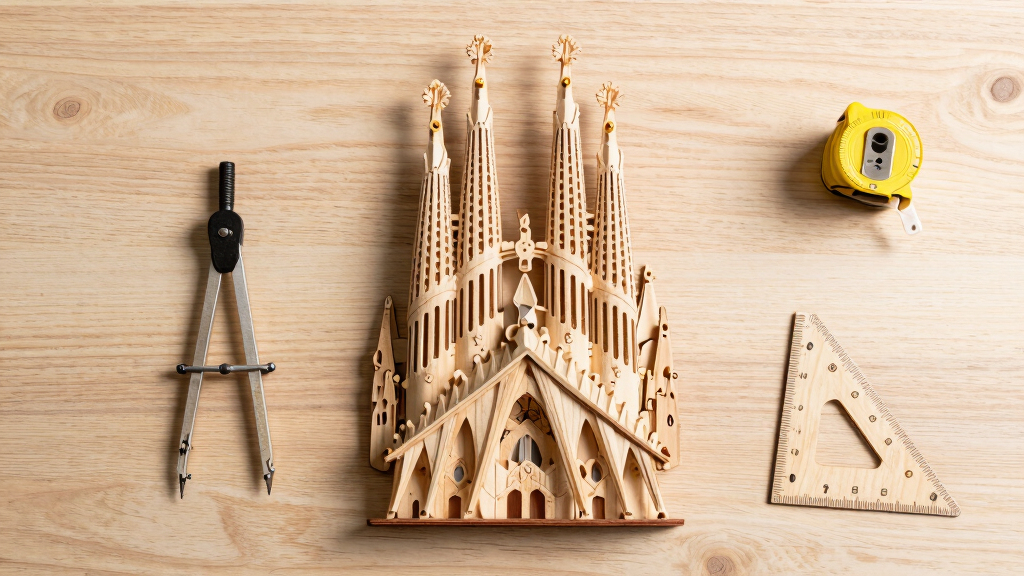
A team of architects and mathematicians has identified intricate mathematical patterns in the design of Barcelona’s Sagrada Familia, shedding light on Gaudí’s innovative approach. The discovery confirms the use of advanced geometry in the basilica’s architecture, with implications for understanding its ongoing construction.
Researchers have confirmed the presence of complex mathematical patterns in the architectural design of Barcelona’s Sagrada Familia, revealing that Antoni Gaudí employed advanced geometric principles in the basilica’s construction. This discovery offers new insights into Gaudí’s innovative approach and the basilica’s ongoing development.
A multidisciplinary team of architects, mathematicians, and historians announced in March 2024 that they have identified specific geometric and mathematical structures within the basilica’s design. Using high-resolution imaging and computer modeling, the team found recurring patterns based on Fibonacci sequences, fractals, and hyperbolic geometry that Gaudí seemingly integrated into the structure.
According to Dr. Laura Sánchez, lead researcher from the University of Barcelona, “Our analysis shows that Gaudí’s design was not only inspired by nature but also embedded with complex mathematical principles that guided the proportions and spatial arrangements of the basilica.” The team’s findings suggest that Gaudí’s work was more mathematically sophisticated than previously understood, blending natural forms with advanced geometry.
The discovery confirms that these mathematical principles are visible in both the basilica’s external facades and its interior structural elements. The ongoing construction, which began in 1882 and is expected to complete in the coming years, now has a new layer of understanding regarding the architect’s original intentions.
Implications for Architectural and Mathematical Scholarship
This discovery matters because it deepens understanding of Gaudí’s architectural genius and his use of mathematics, which could influence future architectural design and restoration efforts. Recognizing the mathematical underpinnings also elevates the basilica’s status as a masterpiece of integrative design, blending art, nature, and science.
Furthermore, the findings could inspire new approaches in architectural education and preservation, emphasizing the role of complex geometry in historic structures. It also highlights the potential for using modern technology to uncover hidden aspects of historical architecture that were previously unknown.
geometric design architecture books
As an affiliate, we earn on qualifying purchases.
As an affiliate, we earn on qualifying purchases.
Historical and Architectural Background of Gaudí’s Designs
Antoni Gaudí began working on the Sagrada Familia in 1882, envisioning a basilica that combined Gothic and Art Nouveau styles with natural forms and innovative engineering. Over decades, Gaudí incorporated geometric principles, such as hyperboloids and helicoids, into his design. Despite his death in 1926, construction has continued based on his plans and models, with modern techniques now aiding the process.
Previous studies have suggested that Gaudí used geometric ratios inspired by nature, but detailed mathematical analysis has been limited. The recent discovery builds on this by providing concrete evidence of complex mathematical structures embedded within the design, confirming the architect’s sophisticated understanding of geometry and mathematics.
“Our analysis shows that Gaudí’s design was not only inspired by nature but also embedded with complex mathematical principles that guided the proportions and spatial arrangements of the basilica.”
— Dr. Laura Sánchez
architectural modeling software for complex structures
As an affiliate, we earn on qualifying purchases.
As an affiliate, we earn on qualifying purchases.
Remaining Questions About the Mathematical Patterns
While the team has identified specific geometric patterns, it is still unclear how intentionally Gaudí embedded these mathematical principles into every aspect of the design. The extent to which these patterns influenced the overall architectural process remains a subject for further research. Additionally, it is not yet confirmed whether Gaudí himself fully understood the mathematical complexity or if it was an emergent property of his design process.
Fibonacci sequence architectural decor
As an affiliate, we earn on qualifying purchases.
As an affiliate, we earn on qualifying purchases.
Future Research and Application of Findings
Researchers plan to further analyze the basilica’s structural elements to understand how these mathematical patterns were applied during construction. The findings may also influence restoration efforts, ensuring that future work respects Gaudí’s original geometric concepts. Additionally, the team aims to publish detailed technical papers and collaborate with architects to explore how these patterns can inspire modern design.
hyperbolic geometry construction tools
As an affiliate, we earn on qualifying purchases.
As an affiliate, we earn on qualifying purchases.
Key Questions
How did researchers discover the mathematical patterns in Sagrada Familia?
The team used high-resolution imaging, computer modeling, and geometric analysis to identify recurring patterns based on Fibonacci sequences, fractals, and hyperbolic geometry within the basilica’s design.
What significance does this discovery have for Gaudí’s work?
It reveals that Gaudí employed advanced mathematical principles, showing a deeper level of sophistication in his architectural approach than previously understood.
Will this affect ongoing construction or restoration of the basilica?
Yes, the findings could influence restoration practices to better preserve Gaudí’s original geometric intentions and guide future construction efforts.
Are these mathematical patterns visible to visitors?
Some patterns are visible in the basilica’s facades and structural elements, but many are subtle and require detailed analysis to uncover.
Could this discovery change the way we understand architectural history?
Potentially, as it highlights the integration of complex mathematics into architectural design, which could reshape interpretations of historic structures.
Source: hn