The best woodworking joinery tools make accurate, repeatable joints without forcing you into a method that does not suit your projects. My best overall pick is the Kreg Jig R3 Pocket-Hole Jig Master System for its approachable setup and practical starter kit; the GOINGMAKE Dowel Jig Kit stands out for controlled dowel alignment, while the Adjustable Aluminum Spline Jig Set serves table-saw and router-table work. The main tradeoff is between speed and repeatability on one hand, and flexibility across joint types on the other. A dedicated jig can make a particular joint easier, but it will not replace careful layout or fit every project. Read on for the full breakdown and guidance on which tool matches your shop and the joints you make most.

Get business pricing on tools and workshop supplies
- Business-only prices and quantity discounts
- Tax-exempt purchasing
- Multiple users, one account, clear invoices
Complete the kit



Key Takeaways
- The Kreg R3 is the most balanced starting point: its pocket-hole approach prioritizes fast assembly, while dedicated dowel tools better suit concealed, aligned joints.
- The GOINGMAKE kit separates itself from basic handheld dowel options with a quick clamp and positive stop, features that can help repeat drilling positions across multiple parts.
- Three dowel jigs serve different buyers: ANPTGHT and Milescraft 1333 offer self-centering layouts with several bushing sizes, while Milescraft 1332 is the simpler choice for less demanding setups.
- Specialty tools pay off only when their joint is part of the plan: the Tordale set is aimed at kumiko angles, the spline jig at table-saw or router-table work, and Kreg‘s loose-tenon joiner at a more dedicated tenon workflow.
- Corner clamps and the chisel plane support the joinery process rather than replace a jig: WYQYQ and WETOLS help hold assemblies square, while the POWERTEC tool is for fitting and cleanup.


| woodworking joinery tool | Weight | Model | Material |
|---|---|---|---|
| Tordale 4-Piece Kumiko Joinery | — | — | — |
| ANPTGHT Self-Centering Dowel J | 1.76 pounds | — | — |
| Milescraft 1333 Dowel Jig Kit | 16 ounces | 1333 | — |
| WYQYQ 4-Piece 90-Degree Corner | — | — | Aluminum alloy |
| Kreg Jig R3 Pocket-Hole Jig Ma | — | R3 | Nylon |
| GOINGMAKE Dowel Jig Kit with Q | 4.13 lb | DF0506 | Metal |
| POWERTEC Chisel Plane with Fla | 5.92 oz | 72162 | — |
| WETOLS 4-Piece 90-Degree Corne | 13.44 oz | — | Polyamide |
| Adjustable Aluminum Spline Jig | 1.61 lb | — | Aluminum alloy |
| Kreg Edge 20V Ionic Drive Loos | 12.87 lb | KPTBEDGE100B | — |
| Milescraft 1332 JointMate Hand | — | 1332 | Plastic |
More Details on Our Top Picks
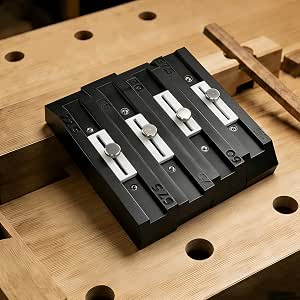
Tordale 4-Piece Kumiko Joinery Jig Set with Multi-Angle Guide Rails
For Kumiko patterns, the multi-angle guide rails make this set more specialized than the dowel jigs in this roundup: they support angled layouts and repeatable positioning rather than centered holes for dowel joints. Clear graduations help set up consistent cuts, while the non-slip base and steady clamping pressure are intended to keep small workpieces from shifting during assembly. That focus makes the Tordale a better fit for lattice work than the Kreg R3, which is designed around pocket-hole construction. The tradeoff is limited versatility: its design is aimed at Kumiko and related techniques, not general-purpose joinery. The listed included component names a woodworking angle clamp but does not explain every piece in the four-piece set, so buyers should check the package contents before relying on it for a particular setup.
Pros:- Multi-angle guide rails support varied joinery layouts.
- Non-slip base and steady clamping pressure help hold workpieces in place.
- Clear graduations aid repeatable positioning.
- Designed to resist wear and deformation with repeated use.
Cons:- Its Kumiko-focused design is less useful for common dowel or pocket-hole joints.
- The listed component information does not clarify every piece in the four-piece set.
Best for: Woodworkers making Kumiko panels or other projects that need repeatable angled positioning and clamping.
Not ideal for: Buyers who mainly need dowel-hole alignment or pocket-hole drilling, or anyone who needs a clearly itemized set of general-purpose jigs.
- Brand:Tordale
- Model number:MUGONG-2026-LIANGJIAO
- Set size:4 pieces
- Dimensions:9 x 2.3 x 1.77 inches
- Color:Black
- Style:Classic
- Listed included component:Woodworking angle clamp
Our verdict“Choose the Tordale when angled Kumiko layouts are the priority, but pick a dowel or pocket-hole jig for more common shop joinery.”
ANPTGHT Self-Centering Dowel Jig with 1/4, 5/16, and 3/8-Inch Guides
The ANPTGHT stands out for workflows that call for a series of evenly spaced dowel holes: its positioning feature helps repeat the layout, and the self-centering action is meant to align holes across a board. It also accepts stock from 5/8 to 2.4 inches thick, a wider upper limit than the Milescraft 1333, which is specified for boards up to 1.5 inches. Aluminum guide construction and steel bushings provide the drilling interface, while the included pins and sleeves cover three common dowel diameters. The tradeoff is that it starts at 5/8 inch, so it does not suit thinner stock as well as the Milescraft. Its size options are also limited to 1/4, 5/16, and 3/8 inch, making it less adaptable when a project calls for another dowel diameter.
Pros:- Self-centering design helps align holes between mating boards.
- Positioning feature supports evenly spaced hole sequences.
- Clamps to boards from 5/8 to 2.4 inches thick.
- Includes pins and drill sleeves for three common dowel sizes.
Cons:- The 5/8-inch minimum board thickness excludes thinner stock.
- Only supports 1/4-, 5/16-, and 3/8-inch dowel sizes.
- Its 1.76-pound weight is less suited to a very light, minimal kit.
Best for: Woodworkers joining medium-to-thick boards who need to drill repeated, evenly spaced holes in one of three common dowel sizes.
Not ideal for: Builders working with stock thinner than 5/8 inch or projects that require dowels outside the three included diameters.
- Manufacturer:ANPTGHT
- Guide material:Aluminum
- Bushing material:Steel
- Compatible dowel sizes:1/4, 5/16, and 3/8 inch
- Board thickness range:5/8–2.4 inches
- Weight:1.76 pounds
- Color:Red
- Included:Self-centering jig, dowel pins, and three drill sleeves for each listed size
Our verdict“Pick the ANPTGHT for repeated dowel layouts on thicker boards; choose the Milescraft 1333 if you need to work with thinner stock.”
Milescraft 1333 Dowel Jig Kit – Self-Centering Handheld Dowel Jig with 3 Metal Bushing Sizes (1/4 in, 5/16 in, 3/8 in)
The Milescraft 1333 is the most ready-to-use dowel package here: alongside three hardened steel bushing sizes, it includes brad-point bits, drill stops, dowel centers, and glue. Its 1/2- to 1 1/2-inch board range covers thinner stock than the ANPTGHT, making it a stronger match for smaller furniture parts and lighter projects. The self-centering handheld format also avoids needing a larger dedicated setup for basic corner, edge, and surface joints. Compared with the ANPTGHT, it gives up capacity for thick boards and does not list a positioning pin for evenly spaced hole sequences. Its main limitation is shared by both dowel kits: only three diameters are covered. This is a practical all-in-one starting point, not a solution for every dowel size or high-volume drilling setup.
Pros:- Self-centering handheld design supports corner, edge, and surface joints.
- Hardened steel bushings guide the three included bit sizes.
- Individual depth stops help keep drilling depth consistent.
- Includes brad-point bits, dowel centers, and glue for a broad starter setup.
Cons:- Board thickness range tops out at 1.5 inches, below the ANPTGHT’s upper limit.
- Only three bushing sizes are included.
- No positioning pin for repeated, evenly spaced hole sequences is listed.
Best for: Newer woodworkers who want a handheld doweling setup with bits, depth stops, centers, and glue for common furniture joints.
Not ideal for: Woodworkers joining boards thicker than 1.5 inches, needing a repeated-hole positioning feature, or using dowels outside the three included sizes.
- Brand:Milescraft
- Model:1333
- Weight:16 ounces
- Bushing material:Hardened steel
- Bushing sizes:1/4, 5/16, and 3/8 inch
- Board thickness range:1/2–1 1/2 inches (12–38 mm)
- Included accessories:Three brad-point bits, drill stops, dowel/tenon centers, and wood glue
- Number of pieces:1
Our verdict“Choose the Milescraft 1333 for a well-equipped dowel starter kit and thinner stock, but opt for the ANPTGHT when working with thicker boards.”
WYQYQ 4-Piece 90-Degree Corner Clamp Set
Where the dowel jigs in this roundup guide hole placement, the WYQYQ set holds parts together at 90 degrees during assembly. Four clamps let a builder secure several corners at once, which can be more useful for squaring a cabinet or frame than relying on a single clamp. Adjustable jaws accommodate different workpiece thicknesses up to 2.75 inches, and the oblong holes allow attachment to a workbench. That makes this a different kind of joinery aid from the Kreg R3: it helps keep an assembly aligned but does not create or guide the joint itself. The limits are its maximum clamping range and listed 2.72 kg weight, which may make the set less convenient for small work or frequent repositioning. It is best treated as an assembly aid, not a joint-making jig.
Pros:- Four clamps can secure multiple corners in one assembly.
- Adjustable jaws and rotating nuts handle varied workpiece thicknesses.
- Oblong holes allow clamps to be attached to a workbench.
- Non-slip rubber handles support a secure grip.
Cons:- Maximum clamping range is limited to about 2.75 inches.
- Listed set weight of 2.72 kg may make repeated repositioning less convenient.
- Holds assemblies at right angles but does not guide joint cutting or drilling.
Best for: Cabinet and frame builders who want to hold several right-angle corners steady during glue-up or fastening.
Not ideal for: Woodworkers seeking a tool that drills or cuts the joint, or those assembling pieces thicker than 2.75 inches.
- Brand:WYQYQ
- Quantity:4 clamps
- Material:Aluminum alloy
- Maximum clamping range:2.75 inches (70 mm)
- Jaw width:3.74 inches (95 mm)
- Jaw depth:1.38 inches (35 mm)
- Item weight:2.72 kg
- Item dimensions:16.93 × 11.42 × 4.72 inches
Our verdict“Choose the WYQYQ set to hold multiple right-angle assemblies during glue-up, not as a substitute for a jig that makes the joint.”
Kreg Jig R3 Pocket-Hole Jig Master System with Starter Screw Kit and 2-Inch Face Clamp
The Kreg R3 is the portable choice for builders who want to make pocket-hole joints for shelves, bookcases, and built-ins without committing to a larger shop setup. Its guides adjust for stock from 1/2 to 1 1/2 inches, with nine depth settings in 1/8-inch increments to match common material thicknesses. The bundle also includes a face clamp, adapter, assorted screws, and carrying case, so it covers more of the basic setup than the Tordale Kumiko jig, which serves a much narrower technique. Compared with the Milescraft 1333, the Kreg is built around pocket screws rather than dowels, making joint choice the key distinction. Its thickness range still excludes stock outside 1/2 to 1 1/2 inches, and each guide has only one listed chip-relief hole.
Pros:- Portable jig suits home projects and repairs.
- Nine depth settings and 1/8-inch increments help match common stock thicknesses.
- Clamp pad adapter works with standard bar clamps, C-clamps, and Kreg face clamps.
- Bundle includes assorted screws, a carrying case, and a 2-inch face clamp.
Cons:- Material thickness range is limited to 1/2–1 1/2 inches.
- Only one wood-chip relief hole is listed per drill guide hole.
- Pocket-hole construction may not suit projects calling for dowel or angled lattice joinery.
Best for: DIY builders and repair-focused woodworkers who want a portable system for pocket-hole assembly in common board thicknesses.
Not ideal for: Woodworkers who prefer dowel or Kumiko joinery, or who need to join material thinner than 1/2 inch or thicker than 1 1/2 inches.
- Brand:Kreg
- Model:R3
- Material:Nylon
- Material thickness range:1/2–1 1/2 inches (12–38 mm)
- Adjustment increments:1/8 inch (3 mm)
- Depth settings:9
- Included components:Pocket-hole jig, 100 assorted screws, carrying case, clamp pad adapter, and 2-inch face clamp
- Unit count:1 set
Our verdict“Pick the Kreg R3 for portable pocket-hole work on common board sizes; choose the Milescraft 1333 when you want dowel joints instead.”
GOINGMAKE Dowel Jig Kit with Quick Clamp and Positive Stop
For dowel joinery that needs repeatable spacing, this kit offers more setup guidance than the compact handheld Milescraft 1333. Its hardened bushings cover 1/4-, 3/8-, and 1/2-inch dowels, while positive edge stops and laser scales help place holes consistently across boards and multi-row layouts. The included quick clamp speeds up positioning, and the jig can also work with separate woodworking clamps when a setup calls for a different hold.
That range suits butt, miter, edge, T, and center joints, but the extra adjustments mean more parts to set than a simple self-centering jig. It also requires a separate hand drill, and its drill sizes do not include 5/16 inch, unlike the Milescraft 1333 and ANPTGHT options in this roundup. Choose it for guided repeatability, not the broadest dowel-size selection.
Pros:- Includes hardened bushings and drill bits for three common dowel diameters.
- Positive stops and laser scales support repeatable hole positioning.
- Quick clamp speeds setup and can be removed for use with other clamps.
- Supports several joint layouts, including edge, T, miter, and multi-row joints.
Cons:- Requires a separate hand drill.
- Does not include a 5/16-inch bushing or drill bit.
- The multiple stops and scales add setup steps compared with simpler handheld jigs.
Best for: Woodworkers making repeated dowel joints across several joint types who want stops, scales, and a quick clamp in one kit.
Not ideal for: Buyers who need 5/16-inch dowels, want a powered joiner, or prefer a minimal jig with fewer setup adjustments.
- Manufacturer:GOINGMAKE
- Model:DF0506
- Material:Metal
- Weight:4.13 lb
- Drill bushing sizes:1/4, 3/8, and 1/2 in
- Adjustments:Positive stops in 1/8-in increments; laser scales in 1/16-in increments
- Clamping:Quick clamp; compatible with separate woodworking clamps
- Compatible joints:Butt, miter, edge, T/cross, multi-row, and center joints
Our verdict“Choose this kit for versatile, repeatable dowel layouts; skip it if you need 5/16-inch holes or a simpler setup.”
POWERTEC Chisel Plane with Flat Blade, 72162
This compact chisel plane is a focused finishing tool for the small corrections that follow a joint cut: trimming plugs, paring a proud edge, or lifting dried glue from a flat surface. Its flat SKD11 steel blade is rated at 58–62 HRC, and the machined aluminum body gives the short tool a stable base for controlled detail work. Compared with the Kreg Edge 20V Loose Tenon Joiner, which cuts mortises, the POWERTEC handles refinement after assembly rather than creating the joint itself.
The replaceable blade and alignment pin support straightforward blade changes, but this is no substitute for a plane used to true wide surfaces. Its small footprint is the advantage in tight spots and the limitation on broader work. Replacement blades are sold separately, so buyers who need a complete trimming system should account for that separate purchase.
Pros:- Compact form suits tight spaces and controlled detail work.
- SKD11 steel blade is rated 58–62 HRC for wear resistance.
- Machined aluminum body provides a stable base.
- Blade is replaceable and secured with a screw and alignment pin.
Cons:- Designed for small trimming tasks, not leveling wide surfaces.
- Replacement blades are sold separately.
Best for: Woodworkers who routinely pare joinery, trim plugs, or clean glue from small flat areas after assembly.
Not ideal for: Buyers seeking a tool to cut mortises or flatten wide boards, or those who want spare blades included.
- Model:72162
- Blade type:Flat
- Blade material:High-carbon SKD11 tool steel
- Blade hardness:58–62 HRC
- Body material:Machined aluminum
- Handle material:Resin-infused maple
- Blade setup:Secured with a screw and alignment pin
- Weight:5.92 oz
Our verdict“Pick this chisel plane for precise cleanup around completed joints, not for cutting or flattening larger areas.”
WETOLS 4-Piece 90-Degree Corner Clamp Set
When the task is holding small boards square during glue-up or assembly, these four spring-loaded clamps offer a simpler approach than the adjustable aluminum spline jig in this lineup. They hold 90-degree corners or T-joints, and one-handed operation leaves the other hand free to position a workpiece. The polyamide bodies are lightweight, while the stated 3/16- to 3/4-inch thickness range covers many thinner frame and box parts.
These clamps help hold alignment; they do not cut a spline slot or make a joint by themselves. That makes them useful as assembly aids, but less specialized than the spline jig for reinforced miter corners. The 3/4-inch maximum also rules them out for thicker stock, and spring pressure may not suit every demanding glue-up. Choose them for quick positioning on small projects, not heavy-duty clamping.
Pros:- Four clamps provide multiple holding points for assembly.
- Accommodates board thicknesses from 3/16 to 3/4 inch.
- One-handed spring operation helps keep workpieces positioned.
- Supports both 90-degree corners and T-joints.
Cons:- Limited to boards no thicker than 3/4 inch.
- Holds workpieces for assembly but does not guide or cut a joinery feature.
- Spring-loaded pressure may not replace stronger clamping for demanding glue-ups.
Best for: Woodworkers assembling thin frames, boxes, or T-joints who want several lightweight clamps that can be operated with one hand.
Not ideal for: Builders working with boards thicker than 3/4 inch or needing a jig to cut reinforced spline joinery.
- Set size:4 clamps
- Material:Polyamide
- Board thickness:3/16–3/4 in
- Supported joints:90-degree corners and T-joints
- Operation:One-handed, spring-loaded
- Dimensions:3.3 × 2.8 × 1.5 in
- Weight:13.44 oz
- Color:Orange
Our verdict“Choose this set for quick, light-duty alignment of thin frame parts, but use another solution for thick stock or spline cutting.”
Adjustable Aluminum Spline Jig Set for Table Saw and Router Table, 2 Pieces
For mitered frames and boxes that need spline reinforcement, this two-piece jig has a more specific job than the WETOLS corner clamps: it holds the corner at a right angle while a table saw or router table cuts the spline slot. Its adjustable clamping range of 5–42 mm accommodates different frame thicknesses, and the low-clearance profile keeps the work close to the table for controlled cutting. Anodized aluminum construction suits a jig that needs to hold its setup through repeated shop use.
The tradeoff is tool dependence. Unlike the WETOLS clamps, this set cannot help with general assembly alone; it requires a compatible table saw or router table and a careful setup. The recommended frame-depth range is 15–500 mm, which also puts a boundary on the work it is intended to handle. Choose it when spline slots are the goal, not as an all-purpose corner clamp.
Pros:- Adjustable clamping range accommodates stock from 5 to 42 mm thick.
- Supports mitered corners from both sides to hold a right angle for slot cutting.
- Low-clearance design keeps workpieces close to the table.
- Anodized aluminum alloy construction.
Cons:- Requires a compatible table saw or router table.
- Its intended use is narrower than a general-purpose corner clamp.
- Recommended frame-depth range is 15–500 mm.
Best for: Woodworkers with a table saw or router table who regularly reinforce mitered frames, boxes, or similar corners with splines.
Not ideal for: Buyers without a compatible saw or router table, or those seeking general-purpose clamps for assembly.
- Set size:2 pieces
- Material:Aluminum alloy
- Finish:Anodized
- Clamping range:5–42 mm (0.2–1.65 in)
- Recommended frame depth:15–500 mm (0.59–19.7 in)
- Compatible tools:Table saw or router table
- Weight:1.61 lb
- Power source:Hand powered
Our verdict“Choose this jig set for controlled spline-slot cutting on mitered corners; skip it if you need a standalone assembly clamp.”
Kreg Edge 20V Ionic Drive Loose Tenon Joiner Kit
This cordless joiner is the most purpose-built powered option in this group: its brushless motor and carbide cutter machine mortises for loose-tenon joints, while the GOINGMAKE dowel jig guides a hand drill to make dowel holes. That difference matters if you want a dedicated mortising workflow rather than a manually drilled connection. An auto-centering guide, adjustable fence, stops, and mortise-width adjustment help align cuts across stock sizes, and the included 20V battery and charger make the kit ready for cordless operation.
It is a more involved choice than the handheld jigs and needs room for a larger tool, at 12.87 pounds. Chip relief slots help clear debris, though dedicated dust extraction may still be needed for some work. The listed setup is built around the included 4.0 Ah battery for recommended results. Choose it for powered loose-tenon production, not occasional simple dowel joints.
Pros:- Brushless 20V motor and carbide cutter machine loose-tenon mortises.
- Auto-centering guide helps align cuts on narrow stock.
- Adjustable fence, stops, and mortise width support varied setups.
- Includes a 4.0 Ah lithium-ion battery and charger.
Cons:- At 12.87 lb, it is substantially heavier than handheld dowel jigs.
- Dedicated dust extraction may still be needed for some work.
- Recommended results rely on the included 4.0 Ah battery.
Best for: Woodworkers who regularly make loose-tenon mortises and want a dedicated cordless joiner with alignment adjustments.
Not ideal for: Occasional hobbyists who only need basic dowel holes or buyers who prefer a compact, hand-powered jig.
- Manufacturer:Kreg
- Model:KPTBEDGE100B
- Weight:12.87 lb
- Dimensions:10.31 × 8.88 × 16.38 in
- Power:20V cordless
- Motor:Brushless
- Cutter:High-speed carbide
- Battery and charger:4.0 Ah lithium-ion battery and charger included
Our verdict“Choose this kit for frequent, powered loose-tenon joinery; for simpler dowel work, the GOINGMAKE jig is a less specialized alternative.”
Milescraft 1332 JointMate Handheld Dowel Jig
The Milescraft JointMate earns its place for woodworkers who want one handheld jig for corner, edge, and surface joints. Its self-centering pins and adjustable, removable fence help align boards without laying out drilling marks, while metal bushings guide bits in three common sizes. That makes it more adaptable across everyday projects than a jig focused on a single joint style. Compared with the Milescraft 1333 Dowel Jig Kit, this model is a more stripped-down option: the listed package includes the JointMate rather than a broader kit. Its plastic body also gives up some durability compared with a metal-bodied tool, and the three bushing sizes limit bit choice. It suits general-purpose doweling, but buyers seeking a quick-clamp setup may prefer the GOINGMAKE jig.
Pros:- Supports corner, edge, and surface dowel joints with one tool
- Metal bushings guide drilling with the included 1/4-, 5/16-, and 3/8-inch sizes
- Self-centering pins and an adjustable, removable fence simplify alignment
- Accommodates lumber from 1/2 to 1-1/2 inches thick
Cons:- Plastic body may be less durable than an all-metal jig
- Limited to the three included bushing sizes
- Package lists the JointMate alone, rather than a larger accessory kit
Best for: Woodworkers who make a mix of corner, edge, and surface joints and want a handheld jig that works across common board thicknesses without marking each hole.
Not ideal for: Users who need an all-metal jig, additional bushing sizes, or a quick-clamp system for repetitive production work.
- Brand:Milescraft
- Model:1332
- Material:Plastic
- Bushing sizes:1/4, 5/16, and 3/8 inches
- Compatible lumber thickness:1/2 to 1-1/2 inches
- Fence:Adjustable and removable
- Pin type:Dowel
- Warranty:3 years
Our verdict“Choose the JointMate for flexible, mark-free doweling across common joint types, but pick a more durable or quick-clamp jig for heavy repetitive use.”

How We Picked
I compared these tools by the work they help a woodworker do: joinery method, setup demands, alignment support, repeatability, and usefulness across likely projects. I also weighed practical details such as included guides or clamps, whether a tool depends on a table saw or router table, and how much of a shop’s work it can support. A tool’s value here comes from matching a real need, not from having the most specialized design.
The ranking favors tools with a broad, approachable role near the top, then places more specialized or supporting tools where their narrower use makes sense. That puts the Kreg R3 ahead as a versatile entry into pocket-hole assembly, with dowel jigs close behind for buyers who prioritize concealed joints and accurate hole alignment. Specialty choices such as the kumiko set, spline jig, and loose-tenon joiner rank for the distinct work they enable, while corner clamps and the chisel plane fill supporting roles. Every option has a tradeoff: a narrow-purpose tool may deliver a more focused workflow, but it earns its place only if that method fits the buyer’s projects.
| woodworking joinery tool | Material |
|---|---|
| Tordale 4-Piece Kumiko Joinery | — |
| ANPTGHT Self-Centering Dowel J | — |
| Milescraft 1333 Dowel Jig Kit | — |
| WYQYQ 4-Piece 90-Degree Corner | Aluminum alloy |
| Kreg Jig R3 Pocket-Hole Jig Ma | Nylon |
| GOINGMAKE Dowel Jig Kit with Q | Metal |
| POWERTEC Chisel Plane with Fla | — |
| WETOLS 4-Piece 90-Degree Corne | Polyamide |
| Adjustable Aluminum Spline Jig | Aluminum alloy |
| Kreg Edge 20V Ionic Drive Loos | — |
| Milescraft 1332 JointMate Hand | Plastic |
Factors to Consider When Choosing Best Woodworking Joinery Tools
Choosing among joinery tools starts with the joints you need to make repeatedly, not with the longest feature list. These broader questions can help narrow the field before you commit to a method or add another jig to the shop.
Choose the joint before choosing the tool
Start by deciding what the joint must do: carry a load, stay hidden, allow quick assembly, or suit a decorative pattern. Pocket holes favor efficient assembly, while dowels and loose tenons can keep the exterior cleaner; splines and kumiko address more specialized construction. A common mistake is buying a jig because it looks versatile, then discovering that its joint style does not suit the visible surfaces or stresses in the project. Sketch the joint and the finished piece before comparing tools. For furniture that mixes joint types, a general-purpose option may earn more use than a highly specialized jig. If one method dominates your work, a dedicated tool can make setup more consistent.
Separate repeatability from first-time setup
A tool that centers on a board or uses a stop can reduce repeated measuring, but it cannot correct a poorly marked reference face or inconsistent stock thickness. Before buying, think about how often you will repeat the same joint and how many parts need matching holes. For a single repair, a basic jig may be enough; for a batch of chair rails or cabinet parts, clamping and positive stops can save setup time and limit accumulated errors. Do a dry layout and label reference faces so each part is registered the same way. Buyers sometimes focus on the number of guides included while overlooking how securely the workpiece is held. Repeatability depends on the whole setup, not just the jig.
Check compatibility with your shop
Some joinery tools work by hand, while spline systems may rely on a table saw or router table, and powered loose-tenon tools add another machine to the workflow. Consider the space needed to support long stock, access the work safely, and store the tool between projects. A jig that depends on a machine you do not own can turn into an expensive gap in the process, even if its joint is attractive. Check that the tool’s intended workpiece sizes and setup match your materials and shop layout. Do not assume a table-mounted jig will suit small pieces or awkward assemblies without added support. A compact handheld tool may be the more practical choice in a limited shop.
Budget for the whole joint-making process
The jig is only one part of a reliable joint: bits, screws, glue, clamps, layout tools, and suitable stock can all affect the result. A starter kit may reduce the number of separate purchases, but verify that its consumables and sizes suit the work you plan to do. Buyers can overspend on the joinery tool and leave too little for adequate clamping or sharp cutting tools. Conversely, the cheapest jig may demand more careful setup or extra accessories to control the work. Compare the complete workflow rather than the tool alone. Paying more makes sense when a feature removes a repeated source of error or supports a method you use often.
Match precision demands to the finished piece
Small decorative work and visible furniture joints can expose tiny alignment errors that a rough utility assembly may tolerate. Decide how much adjustment the joint allows and whether the tool’s guides give you control over the angle, spacing, and depth you need. Practice on offcuts from the same stock before drilling or cutting finished parts; wood thickness and grain can change how a setup behaves. A frequent mistake is treating a self-centering jig as a substitute for checking the workpiece edge and squareness. For repeatable results, keep reference edges consistent and test the joint fit before glue-up. Reserve specialized guides for work where their added control has a clear purpose.
Count supporting tools as part of the decision
Clamps, a chisel plane, and careful layout tools do not create every joint, but they can affect how cleanly parts meet and how square an assembly stays. A corner clamp can help hold a right-angle frame during fastening, yet it does not correct parts cut out of square. A chisel plane can assist with trimming or fitting, but it is not a substitute for choosing the right primary joinery method. Think about which stages cause trouble in your current workflow: alignment, cutting, assembly, or cleanup. Add a supporting tool only when it addresses that bottleneck. This keeps a collection of jigs from growing without making the finished joints more reliable.
Frequently Asked Questions
Should I start with a pocket-hole jig or a dowel jig?
Choose a pocket-hole jig if your priority is assembling cabinets, shop furniture, or other projects quickly with accessible fasteners. Choose a dowel jig if you want a concealed joint and are prepared to manage hole depth, alignment, and glue-up carefully. The Kreg R3 is the more direct starting point for pocket-hole work, while the self-centering dowel options in this roundup suit buyers focused on hole alignment. Neither method is right for every project, and neither removes the need for accurate stock preparation. If you are undecided, base the choice on the joints your next few projects actually require.
Are the three dowel jigs interchangeable?
They overlap in purpose, but their included clamping and positioning features make them different choices rather than automatic substitutes. The ANPTGHT and Milescraft 1333 both offer self-centering guides in several common dowel sizes, while the GOINGMAKE kit adds a quick clamp and positive stop for repeat setups. The Milescraft 1332 is a more basic handheld option for buyers who do not need the same level of setup support. Compare how each tool registers on your stock and how it holds the work, not just the bushing sizes. Test any candidate on scrap before using it on a finished piece.
When does a spline jig make more sense than a dowel jig?
A spline jig is a better fit when your project calls for splines at corners or along a seam and you already have access to a table saw or router table. A dowel jig is more appropriate when you want aligned round holes joining two pieces without relying on a machine-table setup. Splines can add a visible design detail or reinforce a corner, but the jig’s value depends on the cuts and stock your project allows. Account for safe workholding and support before choosing a table-mounted method. If splines are a rare feature in your work, a dowel tool may see more regular use.
Do corner clamps improve the strength of a joint?
Corner clamps mainly help position parts at a right angle during fastening or glue-up; they do not make a weak joint stronger by themselves. Strength comes from the joint design, sound cuts, suitable materials, and the right adhesive or fasteners for the project. A clamp can still help by limiting movement while parts are joined, but it cannot make out-of-square edges meet cleanly. Use a square to check the assembly rather than assuming the clamp guarantees accuracy. Choose WYQYQ or WETOLS based on fit and workflow, not as a substitute for the joinery method.
Is a powered loose-tenon joiner worth choosing over a handheld jig?
A powered loose-tenon joiner can suit a woodworker who makes many matching mortises and wants a dedicated workflow for that joint. It is a less direct choice for occasional projects or a small shop that already relies on simpler handheld jigs. Compare its role with dowel tools and pocket-hole systems: each method has different setup needs, appearance, and project fit. Factor in the space, compatible accessories, and practice needed to make consistent cuts. If loose-tenon joints are central to your work, the dedicated tool may justify its place; otherwise, a more flexible or simpler jig may be easier to use regularly.
Conclusion
For the broadest starting point, I recommend the Kreg Jig R3 as best overall: it gives many woodworkers a practical route into pocket-hole assembly. The GOINGMAKE Dowel Jig Kit is my best value-style pick for buyers who want clamping and a positive stop in a dowel-focused workflow, while the Kreg Edge 20V Ionic Drive Loose Tenon Joiner Kit is the best premium, dedicated choice for those committed to loose-tenon work. Beginners who want a clear, accessible assembly method can start with the Kreg R3; beginners set on dowels should compare the self-centering guides and choose by workholding needs. For specialized needs, pick the Tordale set for kumiko, the Adjustable Aluminum Spline Jig for table-saw or router-table splines, or a corner clamp set for assembly support. Choose the tool that matches your most common joint, then add specialty equipment when a real project calls for it.