To get smooth boards with your planer and jointer, make certain proper setup and alignment. Adjust blades for clean cuts, and set the fence square to the table. Always work with the grain to prevent tear-out, making light passes to avoid snipe. Maintain consistent pressure and feed direction. Paying attention to grain and surface response helps refine the finish. Keep your tools well-maintained; the right technique leads to perfect, smooth results. Keep going to discover more tips for flawless boards.
Key Takeaways
- Ensure the grain runs parallel to the cutter head or blades to prevent tear-out and achieve a smooth surface.
- Properly align and sharpen knives, and set machine heights for precise, consistent cuts.
- Adjust infeed and outfeed tables to be level and fence square to maintain straight, even edges.
- Feed wood with consistent pressure and direction, avoiding against-grain passes to minimize roughness.
- Perform regular maintenance and fine-tuning to keep machines operating optimally for smooth, clean results.
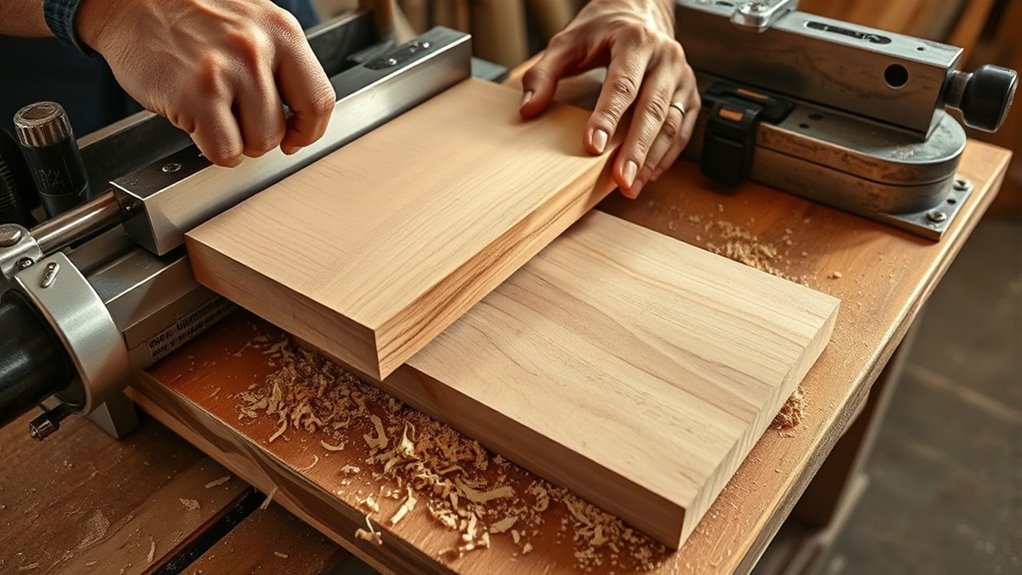
Achieving smooth, flat boards is vital for quality woodworking projects, and using a planer and jointer is the most effective way to do it. The key to success begins with understanding the importance of grain direction and proper machine setup. Grain direction influences how your wood responds during planing and jointing; working against the grain can cause tear-out and rough surfaces. Before you start, examine the wood’s grain pattern carefully. You want to plan your cuts so that the grain runs parallel to the cutter head or blades, which minimizes tear-out and produces cleaner surfaces.
Proper grain direction and machine setup are essential for smooth, high-quality woodworking results.
When setting up your jointer, align the knives precisely and ensure the infeed and outfeed tables are level. Proper machine setup is essential because even small misalignments can lead to uneven edges and surface inconsistencies. Check the cutter head height and adjust it to just slightly shave the surface — no more than a few thousandths of an inch at a time. This allows for a controlled, smooth cut that preserves the integrity of your wood. Also, ensure the fence is perfectly square to the table; this guarantees your edge joints are straight and true.
For the planer, the setup involves similar precision. Make sure the blades are sharp and correctly installed to avoid uneven thickness or tear-out. Adjust the planer’s height to remove only a small amount of material per pass, especially when working with rough lumber. This conservative approach helps you maintain control and prevents snipe, those unwanted dips at the ends of boards. When feeding your wood into the planer, keep the grain direction consistent and avoid feeding against the grain, which could cause chips or gouges.
Additionally, understanding the importance of proper setup and maintenance can significantly impact your results, ensuring your equipment functions optimally and produces the best finish possible. As you work, pay attention to how the wood responds to your machine setup. If you notice tear-out or roughness, stop and reassess your grain direction and setup. Sometimes, changing the feed direction or slightly adjusting the machine’s height can dramatically improve the finish. Consistent feed pressure also helps ensure even thickness and a smooth surface. Remember, patience is key: taking light, deliberate cuts with properly adjusted equipment produces the best results.
wood planer with adjustable blades
As an affiliate, we earn on qualifying purchases.
As an affiliate, we earn on qualifying purchases.
Frequently Asked Questions
How Do I Choose Between a Planer and Jointer?
You should choose a planer if you need to thin boards to a consistent thickness, paying attention to feed rate for smooth results. Opt for a jointer when you want to straighten edges or flatten surfaces, ensuring blade alignment is precise for clean cuts. Both tools complement each other, so consider your project’s needs; a jointer for edges and flattening, and a planer for thicknessing.
What Safety Precautions Are Essential When Using These Tools?
Think of your tools as fierce dragons—you must respect their power. Always wear personal protective equipment like goggles and ear protection to guard against flying debris and loud noise. Keep your machine well-maintained, regularly checking blades and belts, to prevent accidents. Never ignore safety guards or rush operation. Your vigilance guarantees a safe, smooth journey through woodworking, transforming potential hazards into mere legends of the past.
Can I Use a Planer or Jointer on Hardwoods?
Yes, you can definitely use a planer or jointer on hardwoods. Just pay attention to the grain direction to prevent tear-out and guarantee a smooth cut. Adjust your blades properly for the best finish quality, and take light passes if needed. Always inspect the board frequently to maintain accuracy. By doing so, you’ll achieve a polished, professional look on your hardwood projects with minimal effort.
How Often Should I Calibrate My Planer or Jointer?
You should calibrate your planer and jointer at least once a month or after changing blades, depending on how often you use them. Incorporate calibration into your maintenance schedule to guarantee peak performance and accuracy. Regular calibration helps maintain smooth cuts and prolongs the equipment’s lifespan. If you notice uneven surfaces or inconsistent thickness, it’s time to check and adjust your tools promptly.
What Are Common Troubleshooting Issues With These Machines?
You might face issues like uneven cuts or snipe, often caused by dull blades or improper feed rate adjustments. Check if your blades need sharpening, as dull blades can leave rough surfaces. Also, tweak the feed rate to make certain the operation runs smoothly; going too fast or slow can cause trouble. Regularly inspecting and maintaining these aspects helps keep your planer and jointer running smoothly and producing perfect, smooth boards.
jointer with square fence
As an affiliate, we earn on qualifying purchases.
As an affiliate, we earn on qualifying purchases.
Conclusion
Think of your woodworking tools as a team of skilled sculptors shaping raw marble into a masterpiece. The jointer and planer work together like a perfect dance, smoothing out rough edges and revealing the true form beneath. With each pass, they transform your boards from jagged blocks to sleek, polished surfaces. Mastering this duo turns your workshop into an artist’s studio, where your vision comes to life with precision and grace.
woodworking planer and jointer combo
As an affiliate, we earn on qualifying purchases.
As an affiliate, we earn on qualifying purchases.
sharp planer knives for smooth finish
As an affiliate, we earn on qualifying purchases.
As an affiliate, we earn on qualifying purchases.