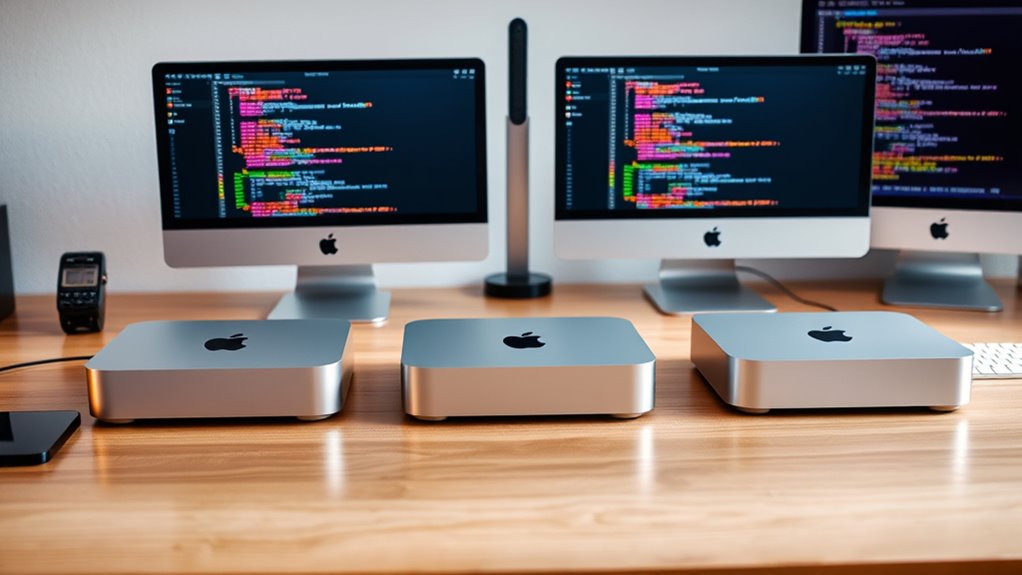

Choosing a Mac mini for software development means balancing compile performance, memory, storage, compatibility, and the risks of buying an older renewed desktop. My top pick is the 2026 M6 Mac mini for current macOS work and multi-display setups; the 2020 M1 Mac mini is the more practical low-cost entry to Apple silicon; and the 2018 Core i3 Mac mini is a better fit when you specifically need an Intel Mac with Thunderbolt 3. The tradeoff is clear: newer Apple silicon brings a more current platform, while older Intel options may suit legacy tools but carry greater age and support uncertainty.

Get business pricing on tools and workshop supplies
- Business-only prices and quantity discounts
- Tax-exempt purchasing
- Multiple users, one account, clear invoices
I ranked these models for the daily realities of coding: running an IDE alongside browsers and terminals, building projects, connecting development peripherals, and leaving room for future workloads. An 8GB configuration can run light projects, but it is a real ceiling for multitasking and memory-hungry tools. I also distinguish the 2014 Mac mini from newer choices rather than treating its large hard drive as a substitute for current performance.
Complete the kit



Key Takeaways
- The M6 model ranks first for current macOS development because it offers up to 32GB unified memory, three-display support, and current connectivity; choose a configuration with enough memory for your tools.
- The M1 Mac mini is my strongest older Apple silicon option here, but its listed 8GB unified memory and 256GB SSD constrain larger projects and simultaneous workloads.
- The 2018 Core i3 is the Intel pick for developers who need Thunderbolt 3 or legacy Intel software, though its renewed condition and limited memory deserve caution.
- The 2018 Core i5 offers more CPU cores and a 512GB SSD on its listing, but the product information conflicts on SSD capacity, so verify the exact unit before buying.
- I would avoid the 2014 dual-core model as a primary modern development machine; its 1TB hard drive and older platform do not offset its age and modest processing capability.
| Apple Mac mini Desktop Computer with M6 Chip (2026) |  | Best Overall | Processor: Apple M6 chip | Memory: Up to 32GB unified memory | Memory bandwidth: 170GB/s | VIEW ON AMAZON | See Our Full Breakdown |
| Apple Mac mini (2020) with M1 chip, 8-core CPU and GPU, 8GB RAM, 256GB SSD, Silver (Renewed) |  | Best Older Apple Silicon Option | Processor: Apple M1 chip | CPU: 8-core | GPU: 8-core | VIEW ON AMAZON | See Our Full Breakdown |
| Apple Mac mini Desktop, Intel Core i3, 8GB RAM, 256GB SSD (Renewed) |  | Best for Intel-Specific Development | Processor: Eighth-generation Intel Core i3, 3.6 GHz, quad-core | Graphics: Intel UHD Graphics 630 | Memory: 8GB DDR4, 2666MHz | VIEW ON AMAZON | See Our Full Breakdown |
| Apple Mac Mini (2018), 3.0 GHz 6-Core Intel Core i5, 8 GB RAM, 512 GB SSD, Renewed |  | Best Renewed Intel Option for More CPU Cores | Model: Mac mini (2018), MXNG2LL/A | Processor: 3.0 GHz 6-core Intel Core i5 | Memory: 8GB DDR4, 2666MHz | VIEW ON AMAZON | See Our Full Breakdown |
| Apple Mac mini Desktop, Intel Core i5 2.6 GHz, 8 GB RAM, 1 TB Hard Drive (Renewed) |  | Best for Legacy Tasks and Basic Desktop Use | Model year: 2014 | Processor: 2.6 GHz dual-core Intel Core i5 | Memory: 8GB DDR3 RAM | VIEW ON AMAZON | See Our Full Breakdown |
| mac mini for software development | Processor | Memory | Ports | Storage |
|---|---|---|---|---|
| Apple Mac mini Desktop Compute | Apple M6 chip | Up to 32GB unified memory | Three Thunderbolt 4, HDMI, two USB-C, headphone jack | — |
| Apple Mac mini | Apple M1 chip | 8GB unified memory | — | 256GB SSD |
| Apple Mac mini Desktop | Eighth-generation Intel Core i3, 3.6 GHz, quad-core | 8GB DDR4, 2666MHz | Four Thunderbolt 3, HDMI 2.0, two USB 3 | 256GB SSD |
| Apple Mac Mini | 3.0 GHz 6-core Intel Core i5 | 8GB DDR4, 2666MHz | Four Thunderbolt 3, HDMI 2.0, two USB 3 | 512GB SSD listed; capacity details conflict |
| Apple Mac mini Desktop | 2.6 GHz dual-core Intel Core i5 | 8GB DDR3 RAM | Thunderbolt, HDMI, four USB, FireWire 800, Gigabit Ethernet, SDXC | 1TB hard drive |
More Details on Our Top Picks
Apple Mac mini Desktop Computer with M6 Chip (2026)
The M6 Mac mini is the clearest choice for developers who want a current desktop platform rather than a refurbished system with older hardware. Its Apple silicon supports modern macOS workflows, and the option for up to 32GB of unified memory matters more to a busy developer than the compact case alone: additional memory can give an IDE, browser tabs, containers, and communication tools more room to run together. The listed 170GB/s memory bandwidth and on-device AI workflow support also position it for newer development tasks, though actual results depend on the software and selected configuration.
Compared with the M1 model below, this Mac mini offers a higher memory ceiling, newer wireless standards, and support for up to three external displays. It is also far more suitable than the Intel renewals for someone starting a new macOS development setup. Three Thunderbolt 4 ports, HDMI, two USB-C ports, 2.5Gb Ethernet, Wi-Fi 7, and Bluetooth 6 provide flexible connections for docks, fast accessories, and multiple screens. Its five-by-five-inch footprint leaves more desk space than the older Mac minis, whose supplied dimensions are larger.
The main drawback is that the description gives a memory maximum, not the memory amount in every available configuration. I would match the configuration to the workload rather than assume the base version will suit heavy builds or virtualized environments. This is also a poor fit for a buyer who needs native Intel compatibility or is seeking a renewed, older machine for a narrowly defined legacy setup. For general modern development, though, it is the lineup’s strongest blend of headroom, connections, and current platform features.
Pros:- Up to 32GB unified memory offers more headroom than the 8GB M1 listing.
- Supports up to three external displays for multi-window development setups.
- Thunderbolt 4, HDMI, USB-C, and 2.5Gb Ethernet cover a broad range of peripherals.
- Compact five-by-five-inch design with Wi-Fi 7 and Bluetooth 6.
Cons:- The supplied description does not identify the memory amount in each configuration.
- Not suited to workflows that require native Intel hardware or software compatibility.
Best for: Developers building a new macOS workstation who want current Apple silicon, several display options, modern connectivity, and the ability to select up to 32GB unified memory.
Not ideal for: Developers who specifically need an Intel Mac for legacy software, or buyers who will not check the selected memory configuration against their workload.
- Processor:Apple M6 chip
- Memory:Up to 32GB unified memory
- Memory bandwidth:170GB/s
- Ports:Three Thunderbolt 4, HDMI, two USB-C, headphone jack
- Networking:Wi-Fi 7, Bluetooth 6, 2.5Gb Ethernet
- Displays:Up to three external displays
- Operating system:macOS
- Dimensions:Five by five inches
Our verdict“I rank the M6 first for modern development because it has the strongest memory ceiling and connectivity in this group, provided the chosen configuration fits the workload.”
Apple Mac mini (2020) with M1 chip, 8-core CPU and GPU, 8GB RAM, 256GB SSD, Silver (Renewed)
This renewed M1 Mac mini is the sensible middle ground for buyers who want Apple silicon without moving down to the aging Intel models. Its eight-core CPU and GPU, alongside a 16-core Neural Engine, make it a more contemporary development platform than the 2018 and 2014 systems in this roundup. For everyday coding, smaller projects, and learning, that platform advantage can matter more than an Intel model’s higher listed core count. It is also a more attractive choice than the 2014 Mac mini’s dual-core processor and hard drive.
The limitation is hard to miss: this specific listing includes only 8GB of unified memory and a 256GB SSD. Unified memory is shared by the processor and graphics, so those 8GB must serve the entire system. That can become restrictive when an IDE, browser, local services, and other development tools are open together. The SSD is responsive storage, but 256GB leaves less space for toolchains, simulators, source trees, and build artifacts than the listed 512GB drive on the 2018 Core i5 listing. I would not treat the Neural Engine as a substitute for extra system memory.
Compared with the M6, this is an older, more constrained machine: its supplied description does not list newer connectivity, multiple-display capabilities, or a larger memory option. Still, for a learner or a developer with modest projects, it makes more sense than buying an old Intel desktop solely for its vintage compatibility. Choose it for an Apple silicon development environment with light demands; skip it if your daily work depends on large builds, memory-heavy containers, or substantial local data.
Pros:- Eight-core Apple M1 CPU and GPU provide a modern architecture compared with the older Intel picks.
- The 16-core Neural Engine supports machine-learning-oriented workflows.
- SSD storage is a better fit for development tools than the 2014 model’s hard drive.
Cons:- 8GB unified memory may constrain IDEs, browsers, and local services running together.
- 256GB SSD can fill quickly with toolchains, projects, and build files.
- Renewed condition means it is an older device rather than a new-system purchase.
Best for: Students, new developers, and users with light coding projects who want an Apple silicon Mac mini and can work within 8GB memory and 256GB storage.
Not ideal for: Developers running demanding builds, multiple virtualized services, or large project libraries that need more memory and storage headroom.
- Processor:Apple M1 chip
- CPU:8-core
- GPU:8-core
- Neural Engine:16-core
- Memory:8GB unified memory
- Storage:256GB SSD
- Condition:Renewed
- Color:Silver
Our verdict“I recommend this renewed M1 for lighter Apple silicon development, but its fixed 8GB memory makes it a poor choice for sustained multitasking.”
Apple Mac mini Desktop, Intel Core i3, 8GB RAM, 256GB SSD (Renewed)
The renewed 2018 quad-core Core i3 Mac mini is the lineup’s straightforward Intel option. Its eighth-generation processor, 8GB of DDR4 memory, and 256GB SSD make it a more balanced starting point than the 2014 dual-core Mac mini, while Thunderbolt 3 offers a useful connection for compatible docks and storage. I would place it ahead of the older 2014 unit for basic coding because its newer processor generation and SSD-based storage are a better match for everyday responsiveness.
Its role is narrower than the M1’s. Choose this model when Intel compatibility is a real requirement for a specific toolchain or testing environment, not merely because the processor is familiar. For general modern development, the M1’s Apple silicon architecture is the stronger forward-looking option, while the M6 brings a much higher memory ceiling and support for more displays. The i3 has only 8GB RAM and a 256GB SSD, so it offers little room for demanding builds or several local services. The product listing specifies a 90-day limited warranty, which is a modest coverage window for a renewed computer.
Its four Thunderbolt 3 ports, HDMI 2.0, USB 3, Gigabit Ethernet, and 802.11ac Wi-Fi provide practical desk connectivity. Those ports do not erase the age of the platform, and the given information does not promise a particular software-support lifetime. Developers should check that their required operating system and tools work with the exact machine before committing. For a focused Intel testing box or a basic existing-workflow machine, it has a purpose; for a new primary workstation, I would favor the M6 or M1.
Pros:- Eighth-generation quad-core Intel Core i3 is newer than the 2014 dual-core option.
- 256GB SSD supports quicker everyday file and application access than a hard drive.
- Four Thunderbolt 3 ports plus HDMI 2.0 and USB 3 support varied desk setups.
- Includes Gigabit Ethernet and a stated 90-day limited warranty.
Cons:- 8GB memory and 256GB storage limit heavier development workloads.
- Renewed condition and a 90-day warranty offer less assurance than a new system.
- Older Intel platform is less compelling for general use than either Apple silicon option.
Best for: Developers who need an Intel-based Mac for legacy applications, compatibility testing, or a basic coding workflow with Thunderbolt 3 accessories.
Not ideal for: Buyers seeking a long-term primary development machine for demanding builds, many simultaneous apps, or large local projects.
- Processor:Eighth-generation Intel Core i3, 3.6 GHz, quad-core
- Graphics:Intel UHD Graphics 630
- Memory:8GB DDR4, 2666MHz
- Storage:256GB SSD
- Ports:Four Thunderbolt 3, HDMI 2.0, two USB 3
- Networking:Gigabit Ethernet, 802.11ac Wi-Fi
- Operating system:macOS
- Warranty:90-day limited warranty
Our verdict“I would choose this 2018 i3 only when Intel compatibility matters; for ordinary new development, the M1 or M6 is a better platform fit.”
Apple Mac Mini (2018), 3.0 GHz 6-Core Intel Core i5, 8 GB RAM, 512 GB SSD, Renewed
This renewed 2018 six-core Core i5 Mac mini is the Intel model to examine when your workflow can use more CPU cores than the quad-core i3 provides. It also lists a 512GB SSD, double the capacity stated for the i3 model, which gives development tools and project files more breathing room. For a developer maintaining Intel-era software, those are meaningful advantages over the 2014 Mac mini and the i3 configuration.
There is an important listing issue: the product description identifies a 512GB SSD, while the supplied cons note conflicting capacities of 256GB and 512GB. I would confirm the exact storage in the offered unit rather than base a purchase on the title alone. Its 8GB of DDR4 memory remains modest for a development desktop, and the Intel UHD Graphics 630 is not aimed at graphics-heavy work. Compared with the M1, this model offers a clear Intel-specific use case, but the M1 is the more appealing choice if the software runs well on Apple silicon and the memory limit is acceptable.
Four Thunderbolt 3 ports, HDMI 2.0, and two USB 3 ports suit a developer with several peripherals or an external drive. As a renewed machine, it also brings the uncertainty of older hardware and does not have the M6’s listed modern wireless and display support. I rank it below the 2018 i3 overall because the conflicting storage details weaken confidence in its stated advantage, even though its six-core processor is appealing for parallel work. It makes sense only after confirming configuration and compatibility.
Pros:- Six-core Intel Core i5 offers more listed CPU cores than the 2018 quad-core i3.
- The stated 512GB SSD provides more room than the M1 and i3 listings.
- Four Thunderbolt 3 ports, HDMI 2.0, and USB 3 support common development peripherals.
Cons:- Product information conflicts on whether the SSD is 256GB or 512GB.
- 8GB DDR4 memory can constrain multitasking and larger development environments.
- Renewed Intel hardware is an older, narrower choice than the M6 or M1.
Best for: Developers who need an Intel Mac with a six-core processor and want a larger SSD than the 2018 i3 listing, after verifying the supplied unit’s capacity.
Not ideal for: Buyers who want clear, dependable configuration details, more than 8GB memory, or a current Apple silicon platform.
- Model:Mac mini (2018), MXNG2LL/A
- Processor:3.0 GHz 6-core Intel Core i5
- Memory:8GB DDR4, 2666MHz
- Storage:512GB SSD listed; capacity details conflict
- Graphics:Intel UHD Graphics 630
- Ports:Four Thunderbolt 3, HDMI 2.0, two USB 3
- Wireless:802.11ab
- Condition:Renewed
Our verdict“This is the stronger 2018 Intel pick on paper, but I would buy it only after confirming the SSD capacity and checking software compatibility.”
Apple Mac mini Desktop, Intel Core i5 2.6 GHz, 8 GB RAM, 1 TB Hard Drive (Renewed)
The renewed 2014 Mac mini is the least suitable option here for a primary software development machine, but it may still serve a narrowly defined legacy role. Its dual-core 2.6GHz Intel Core i5, 8GB DDR3 memory, and 1TB hard drive are a substantially older combination than the 2018 i3 and i5 systems. The large drive offers capacity for files, yet it is a mechanical hard drive rather than an SSD, so it should not be mistaken for faster project loading or build activity.
For basic scripting, a lightweight editor, or a secondary machine used to access older software, its older Intel platform may be relevant. But I would favor the 2018 i3 for a more general Intel development setup: it has a quad-core processor, DDR4 memory, an SSD, and Thunderbolt 3. The M1 is another stronger everyday option, with an eight-core Apple silicon CPU and SSD storage, although its 8GB memory still limits heavier multitasking. The 2014 model’s four USB ports, HDMI, Thunderbolt, Gigabit Ethernet, and SDXC slot can connect older peripherals, but they do not make up for its dated processing and storage.
Its maximum listed display resolution is 2560 × 1600, another reason not to select it for a modern multi-monitor workstation. Since it is renewed and runs an older Mac OS X environment as described, buyers should verify the installed operating system and whether their required developer tools remain compatible. I would skip it for current app development, large builds, or a main machine expected to handle several demanding services. Its place is as a low-demand or legacy-use desktop, not as a peer to the M6.
Pros:- 1TB hard drive provides substantial listed file capacity.
- Includes HDMI, Thunderbolt, four USB ports, Gigabit Ethernet, and an SDXC slot.
- Compact desktop enclosure suitable for a basic secondary setup.
Cons:- Dual-core processor and 8GB DDR3 memory are dated for current development workloads.
- Hard drive is less responsive for tools and projects than the SSDs in the other listings.
- Renewed 2014 hardware has greater age and software compatibility uncertainty.
Best for: A buyer who needs a renewed Intel Mac for lightweight legacy tasks, basic scripting, or a secondary desktop with older peripherals.
Not ideal for: Developers seeking a main 2027 workstation, fast project storage, contemporary display flexibility, or strong compile performance.
- Model year:2014
- Processor:2.6 GHz dual-core Intel Core i5
- Memory:8GB DDR3 RAM
- Storage:1TB hard drive
- Graphics:Integrated Intel Iris Graphics
- Maximum display resolution:2560 × 1600 pixels
- Ports:Thunderbolt, HDMI, four USB, FireWire 800, Gigabit Ethernet, SDXC
- Condition:Renewed
Our verdict“I would choose this 2014 model only for light legacy use; the 2018 Intel options and both Apple silicon choices are better primary development machines.”

How We Picked
I ranked these five Mac minis by how well each suits software development in 2027, not by brand familiarity or a single headline specification. My priorities were processor capability for builds and everyday responsiveness, memory headroom for an IDE plus supporting apps, SSD storage for project files and tools, and connectivity for displays, drives, and network access. I also weighed platform age, renewal status, and how clearly the supplied product details describe the configuration.
The M6 model leads because its current-generation Apple silicon platform, up-to-32GB memory option, and support for up to three displays make it the most adaptable choice in this lineup. The M1 follows as an older but still appealing Apple silicon alternative, with the significant caveat that this listing has only 8GB of unified memory. The 2018 Intel models serve narrower use cases: the quad-core i3 is a reasonable legacy Intel desktop, while the six-core i5 has stronger listed CPU and storage figures but a conflicting SSD-capacity description. The 2014 model ranks last because its dual-core processor, spinning hard drive, and old platform are poor matches for demanding contemporary workflows.
I have not treated renewed devices as equivalent to new systems. Their age, condition, included warranty, and configuration accuracy affect suitability, especially when a development environment depends on a particular operating system or toolchain. The provided product details do not specify every compatibility or upgrade path, so I avoid assuming them. I favor a machine that fits the buyer’s actual workload over a model that looks capable on one spec alone.
| mac mini for software development | Ports | Graphics |
|---|---|---|
| Apple Mac mini Desktop Compute | Three Thunderbolt 4, HDMI, two USB-C, headphone jack | — |
| Apple Mac mini | — | — |
| Apple Mac mini Desktop | Four Thunderbolt 3, HDMI 2.0, two USB 3 | Intel UHD Graphics 630 |
| Apple Mac Mini | Four Thunderbolt 3, HDMI 2.0, two USB 3 | Intel UHD Graphics 630 |
| Apple Mac mini Desktop | Thunderbolt, HDMI, four USB, FireWire 800, Gigabit Ethernet, SDXC | Integrated Intel Iris Graphics |
Factors to Consider When Choosing Mac Mini For Software Development
I would choose a Mac mini by matching its memory, processor generation, and storage to the tools I actually run. The newest chip is not automatically the right answer for every developer, but these five models differ sharply in headroom and age.
Memory is the first limit to check
Development rarely means running only an editor. A typical desktop can have an IDE, browser, terminal, local database, chat app, and build tools open at once. That is why the M6’s up-to-32GB option matters: it offers much more room than the fixed 8GB listings. The M1’s 8GB unified memory can work for modest projects, but it is shared across system and graphics tasks. Both 2018 Intel models also list 8GB, while the 2014 model uses 8GB DDR3. If your work involves large repositories, simulators, or several services, prioritize a configuration with more memory rather than focusing only on CPU cores.
Pick a processor platform for your toolchain
The M6 and M1 use Apple silicon, while the 2018 and 2014 models use Intel processors. For current general-purpose macOS development, the M6 is the most adaptable choice in this group, with the M1 a capable older option for light work. Intel still has a role if a required application, build environment, or compatibility test depends on Intel hardware. Among the Intel choices, the six-core 2018 i5 has more listed cores than the 2018 quad-core i3, but it also has conflicting storage information. The 2014 dual-core system is best reserved for older or very light workloads.
SSD capacity affects more than source files
Project repositories are only part of a development machine’s storage needs. Toolchains, SDKs, simulators, containers, build outputs, and caches can also occupy space. The 256GB SSDs in the M1 and 2018 i3 leave less room than the stated 512GB SSD on the 2018 i5, if that listing’s capacity is confirmed. The M6 description does not specify storage, so check the exact configuration. The 2014 model has a 1TB hard drive, but extra capacity does not equal SSD responsiveness; for software work, its older drive is a substantial tradeoff.
Treat renewed listings as a separate decision
Every model here except the M6 is listed as renewed. That may suit a buyer who wants an older configuration for a specific purpose, but condition and support details matter. Check the included warranty, exact storage and memory, operating-system compatibility, and return terms before choosing a renewed computer. The 2018 i3 listing specifies a 90-day limited warranty; the 2018 i5 listing has conflicting SSD details. I would not assume a renewed machine has the same remaining useful life or configuration certainty as a new system.
Plan the desk setup around ports and displays
A coding setup may need multiple displays, external backup storage, wired networking, and a dock. The M6 supports up to three displays and lists Thunderbolt 4, HDMI, USB-C, and 2.5Gb Ethernet. The 2018 Intel models include Thunderbolt 3 and HDMI 2.0, which can be useful for older peripherals and docks. The M1 listing does not supply its port or display details, so verify those against the exact model before purchase. The 2014 model’s stated maximum resolution of 2560 × 1600 makes it less flexible for a contemporary multi-display workspace.
Frequently Asked Questions
Which Mac mini in this roundup is best for software development?
I rank the 2026 M6 Mac mini first because it is the most current platform here and can be configured with up to 32GB unified memory. Its support for up to three external displays and broad port selection also suits a full development desk. I would still check the exact memory and storage configuration before buying, since the supplied description gives a memory ceiling but not every configuration detail.
Is 8GB of memory enough for coding on a Mac mini?
8GB can handle lighter coding, such as learning, small projects, or a limited set of open apps, but it can feel restrictive when an IDE, browser, local services, and build tools run together. That applies to the listed M1 and renewed Intel models. For larger builds, containers, or sustained multitasking, I would favor the M6 configuration with more memory rather than treating the 8GB models as equivalent.
Should I choose an M1 Mac mini or a 2018 Intel Mac mini?
For general development, I would lean toward the M1 Mac mini if your tools support Apple silicon and your workload fits its 8GB memory and 256GB SSD. A 2018 Intel model makes more sense when you have a specific Intel-only application or compatibility-testing need. Between the two 2018 choices, the i5 has more listed cores, but its storage capacity information conflicts; the i3 listing is clearer but has only a 256GB SSD.
Is the renewed 2014 Mac mini suitable as a primary development computer?
I would not select the 2014 Mac mini as a primary machine for contemporary development. Its dual-core processor, 8GB DDR3 memory, and hard drive are a weaker combination than the SSD-equipped 2018 systems and Apple silicon models. It may suit basic scripting or a legacy task, but buyers should verify that the required operating system and developer tools work on the exact unit.
What should I verify before buying a renewed Mac mini?
Check the exact memory and storage configuration, renewed condition details, warranty coverage, operating-system compatibility, and the ports and display support required by your setup. This is especially relevant to the 2018 Core i5 listing because its product information conflicts on SSD capacity. For any renewed model, confirm the seller’s terms and make sure your essential development tools support that Mac’s processor platform and software environment.
Conclusion
For a new primary workstation, I recommend the M6 Mac mini to developers who want the broadest memory headroom and current connectivity in this group. If your projects are modest and you want an older Apple silicon desktop, the renewed M1 is the better fit as long as 8GB memory and 256GB storage are sufficient. Choose the 2018 Core i3 for a basic Intel-specific setup, or consider the six-core 2018 Core i5 only after confirming its SSD capacity. I would reserve the 2014 Mac mini for lightweight legacy work, not as a main machine for modern software development.