To speed up tape measure use, focus on recognizing the main inch marks first. Memorize key fractions like 1/2, 1/4, 1/8, and 1/16 to avoid second-guessing. Look for larger, more prominent marks to quickly identify measurements, and skip mentally converting fractions during measurements. With practice, you’ll learn to identify marks instinctively. Keep exploring, and you’ll discover even more tips to make your measurements faster and more accurate.

Get business pricing on tools and workshop supplies
- Business-only prices and quantity discounts
- Tax-exempt purchasing
- Multiple users, one account, clear invoices
Key Takeaways
- Focus on quickly identifying whole inch marks before counting fractional lines.
- Memorize common fractions (1/2, 1/4, 1/8, 1/16) to recognize them instantly.
- Use visual cues like larger or highlighted marks to locate inches rapidly.
- Practice regularly to develop instinctive recognition of measurement marks.
- Understand the measurement system’s logic to anticipate mark placements and reduce hesitation.
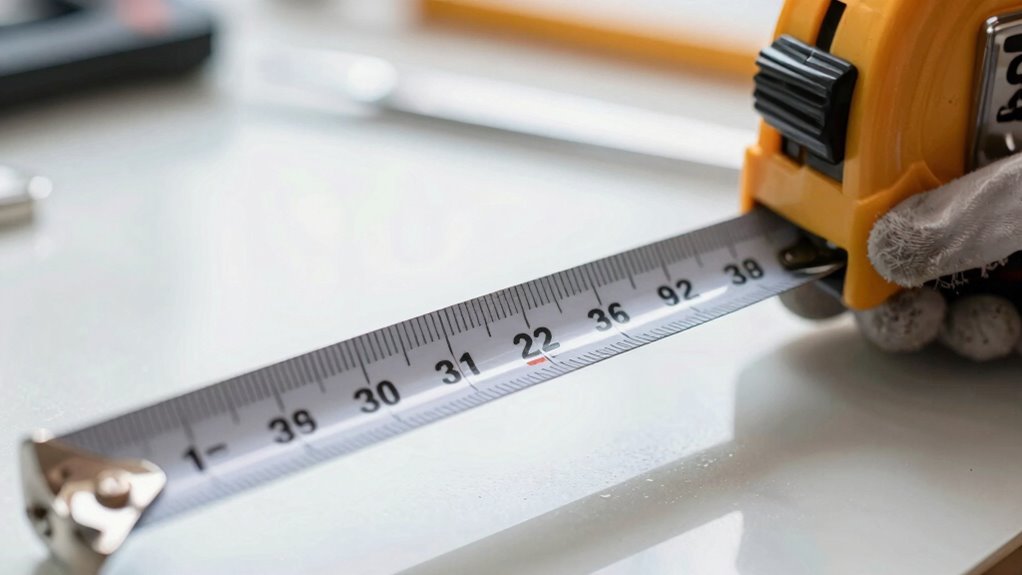
Reading a tape measure quickly can save you time on your projects, but it takes practice to develop this skill. To do that, you need to understand the roots of measurement systems and how they influence what you see on the tape. Historically, measurement systems like the imperial system and the metric system have shaped how rulers and tape measures are designed. The imperial system, with its fractions and inches, often causes confusion, especially when trying to read measurements fast. Knowing the history helps you grasp why certain markings are there and how they relate to each other, making it easier to interpret them quickly.
One of the most common measurement mistakes is misreading fractions or trying to convert them mentally on the fly. For example, many people mistake the 1/8th or 1/16th marks, which can lead to inaccurate cuts or fittings. Instead of second-guessing each fraction, focus on familiarizing yourself with the common measurement marks and their decimal equivalents. This way, you can memorize key fractions like 1/2, 1/4, 1/8, and 1/16, which are the most frequently used. By doing so, you’ll reduce hesitation and speed up your reading process.
To improve your speed, start by looking at the whole inch first, then focus on the fractional marks. Many tape measures have the inch number highlighted or larger, so you can quickly identify the main measurement. From there, count the smaller marks to determine the fractions. With practice, you’ll begin to recognize these marks instinctively, rather than needing to carefully count each one. This reduces the mental load and allows for faster, more confident readings. Developing this visual recognition can significantly boost your efficiency. Understanding the measurement origins can also help you understand why certain marks are placed where they are, aiding faster interpretation. Recognizing the measurement systems and their historical context enhances your ability to read measurements swiftly and accurately. Ultimately, mastering how to read a tape measure faster involves understanding its historical measurement origins and minimizing common measurement mistakes. By familiarizing yourself with common fractional marks, recognizing the main inch marks, and practicing regularly, you’ll become more efficient and accurate. With patience and consistent effort, your ability to read tape measurements swiftly will improve, saving you valuable time on every project.
Products Worth Considering

LG C2 Series 65-Inch OLED evo 4K Smart TV (OLED65C2PUA, 2022)

Philips Hue Large Smart Light Tube, Black – White and Color Ambiance LED Color-Changing Light – 1 Pack

Samsung 42-Inch S90H OLED 4K Smart TV Bundle
As an affiliate, we earn on qualifying purchases.
Frequently Asked Questions
What Is the Most Common Mistake When Reading Fractions on a Tape Measure?
The most common mistake when reading fractions on a tape measure is misjudging fraction precision, often confusing the smaller marks. You might overlook the difference between 1/8 and 1/16, leading to errors. Recognizing these common errors helps you read more accurately. Pay close attention to the fraction markings, and double-check your readings to avoid mistakes caused by misinterpreting the smaller fractions.
How Can I Memorize Fractional Conversions Quickly?
To memorize fractional conversions quickly, use simple fraction conversion tricks like recognizing common fractions and their decimal equivalents. Break complex conversions into smaller steps and practice with memorization techniques such as flashcards or quick quizzes. Repetition helps solidify these conversions, so regularly review them. With consistent practice, you’ll develop an intuitive grasp of fractions, enabling you to read tape measure fractions faster and more accurately without second-guessing.
Are Digital Tape Measures More Accurate Than Analog Ones?
Digital tape measures are generally more accurate than analog ones because digital accuracy minimizes human error and provides precise readings instantly. Analog limitations, like parallax or difficulty reading small fractions, can lead to inaccuracies. With digital models, you get clear, easy-to-read measurements, making your work more reliable and efficient. If you need precise measurements for detailed projects, opting for a digital tape measure is the smarter choice.
How Do I Read a Tape Measure in Metric Units?
To read a tape measure in metric units, look for the centimeter and millimeter markings. Each large number represents centimeters, while the smaller lines denote millimeters. For measurement precision, note that 10 millimeters equal 1 centimeter. To convert to other metric units, use simple metric conversion techniques. With practice, you’ll quickly interpret metric measurements, making your work more efficient and accurate.
What Tools Can Help Improve Tape Measure Reading Speed?
Did you know that using the right tools can cut your measuring time by up to 50%? To improve your tape measure reading speed, consider a digital measuring tool or a magnifying glass for better visibility. Practicing consistent measuring techniques and regularly calibrating your tools guarantees accuracy and efficiency. These tools help you read measurements faster, minimizing errors, and boosting your confidence on every project.
Conclusion
Mastering quick tape measure readings saves you time and boosts confidence on the job. Did you know that professionals who read tape measures accurately and swiftly can complete tasks up to 30% faster? With practice, you’ll avoid second-guessing fractions and work more efficiently. Keep practicing these tips, and you’ll become a tape measure pro in no time—saving both time and effort on every project.