The best Milwaukee circular saw blades depend on what you cut: for a versatile starting point, I’d choose the Milwaukee 7-1/4-Inch 24-Tooth Framing Blade, while the 60-tooth Ultra-Fine Finish blade suits cleaner crosscuts and the 5-3/8-inch metal-cutting blade serves a different material entirely. The main tradeoff is speed versus cut quality: lower tooth counts clear material quickly, while higher counts favor smoother finishes but may cut more slowly. Blade diameter, kerf, arbor fit, and saw compatibility matter just as much as brand. This roundup compares 14 options, including multi-packs and Diablo alternatives, so you can match a blade to your work without buying the wrong size or tooth pattern. Read on for the full breakdown and buyer guidance.

Get business pricing on tools and workshop supplies
- Business-only prices and quantity discounts
- Tax-exempt purchasing
- Multiple users, one account, clear invoices
Complete the kit


Key Takeaways
- The 7-1/4-inch 24-tooth Milwaukee framing blades form the strongest general-purpose group; pack size is the main distinction between the 2-, 3-, and 10-packs, not the basic cut style.
- Tooth count signals the job more clearly than the brand name: 24-tooth blades prioritize fast framing cuts, while the 40- and 60-tooth options are better suited to finish work.
- The 5-3/8-inch 30-tooth metal-cutting blade is the material-specific outlier; it is not a substitute for wood-cutting blades.
- Size and arbor fit narrow the field quickly: 6-1/2-, 7-1/4-, and 10-inch blades serve different saws, and a matching diameter alone does not confirm compatibility.
- Diablo alternatives broaden the lineup with framing and finish options, but buyers should compare kerf, tooth pattern, and intended material rather than assuming every blade is interchangeable with Milwaukee models.




| Milwaukee circular saw blade | Blade diameter | Model | Tooth count |
|---|---|---|---|
| Milwaukee Accessory 48-40-1232 | 12 inches | 48-40-1232 | — |
| Milwaukee 5-3/8-Inch 30-Tooth | 5-3/8 inches | 48-40-4205 | 30 |
| Milwaukee Circular Saw Framing | — | — | 24 |
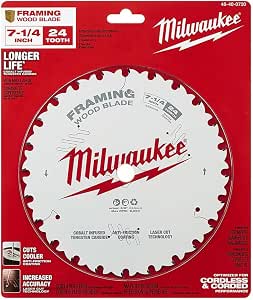
| Milwaukee 7-1/4-Inch 24-Tooth | 7-1/4 inches | 48-40-0740 | 24 |
| Diablo 7-1/4-Inch 24-Tooth Fra | 7-1/4 inches | — | 24 |
| Milwaukee 48-41-0726 7-1/4 in | 7-1/4 inches | 48-41-0726 | 40 |
| Milwaukee 7-1/4-Inch 24-Tooth | 7-1/4 inches | 48-40-0722 | 24 |
| 6-1/2-Inch Circular Saw Blades | 6-1/2 inches (165 mm) | — | — |
| Diablo Framing Saw Blade for W | 6-1/2 inches | D0624A | — |
| Milwaukee 7-1/4-Inch 60-Tooth | 7.25 inches | 48-41-0730 | 60 |
| Milwaukee 7-1/4-Inch 24-Tooth | 7-1/4 inches | 48-40-0720 | — |
| Diablo Framing Saw Blade for W | 6-1/2 inches | D0624X | — |
| Diablo Finish Trim Saw Blade | 6-1/2 inches | D0641X | — |
| Milwaukee 10-Inch Circular Saw | 10 inches | 48-40-1036 | — |
More Details on Our Top Picks
Milwaukee Accessory 48-40-1232 44-Tooth and 80-Tooth Circular Saw Blade
This two-blade set earns its place for buyers who need two tooth counts for different wood cuts and a 12-inch blade diameter. The 44-tooth blade suits faster general cutting, while the 80-tooth option is better matched to cleaner cuts in sheet goods and finished wood. Compared with the Milwaukee 7-1/4-Inch 24-Tooth Framing Blade, this set covers more finish-oriented work, but its larger format is only useful if your saw accepts 12-inch blades. A thin kerf can reduce cutting resistance, while the anti-friction coating helps limit gumming and corrosion. Laser-cut vibration slots are intended to steady the cut. The main limitation is clear: these blades are for wood, not metal or masonry, and they are not a general-purpose set for smaller saws.
Pros:- Includes 44-tooth and 80-tooth blades for different wood-cutting needs.
- Thin kerf is designed to reduce cutting resistance and support faster cuts.
- Laser-cut vibration slots are intended to improve cut control.
- Anti-friction coating resists gumming and corrosion.
Cons:- The 12-inch diameter limits compatibility to saws built for that size.
- Not intended for cutting metal or masonry.
Best for: Woodworkers and builders with a compatible 12-inch circular saw who switch between faster lumber cuts and cleaner plywood or finish cuts.
Not ideal for: Owners of standard 7-1/4-inch or compact saws, and anyone who needs a blade for metal or masonry.
- Model:48-40-1232
- Blade diameter:12 inches
- Tooth counts:44 and 80
- Pack quantity:2 blades
- Tooth material:Cobalt-infused tungsten carbide
- Coating:Anti-friction
- Compatible materials:Softwood, hardwood, wet and treated lumber, plywood, OSB, LVL, PSL, and LSL
Our verdict“Choose this set if your 12-inch saw needs both a faster wood blade and a finer-cut option; skip it if you use a smaller saw.”
Milwaukee 5-3/8-Inch 30-Tooth Carbide Metal-Cutting Circular Saw Blade
Among these picks, this is the one built for metal rather than wood, making it a distinct choice for buyers with a compatible 5-3/8-inch saw. Its 30 cobalt-infused tungsten carbide teeth are designed to retain sharpness, and the laser-cut slots aim to reduce vibration, heat, and noise. The product is also designed to leave clean, burr-free cuts that can be handled soon after cutting, which may reduce pauses during metalwork. Compared with the wood-focused Milwaukee 7-1/4-Inch 24-Tooth Framing Blade, it fills a different material need, not a faster framing role. Its tradeoff is fit: the listing specifies metal compatibility but does not name particular saw models, so buyers need to verify diameter and saw compatibility before ordering.
Pros:- Designed specifically for metal cutting rather than wood.
- Cobalt-infused tungsten carbide teeth are intended to maintain sharpness.
- Laser-cut slots help damp vibration and reduce heat and noise.
- Designed to produce clean, burr-free cuts that cool for handling.
Cons:- The 5-3/8-inch diameter limits use to compatible saws.
- The product data does not identify specific compatible saw models.
Best for: Metal fabricators or tradespeople who own a compatible 5-3/8-inch circular saw and want a blade designed for cleaner, cooler metal cuts.
Not ideal for: Wood framers, users with saws that take other blade diameters, or buyers who need clearly listed saw-model compatibility.
- Model:48-40-4205
- Blade diameter:5-3/8 inches
- Tooth count:30
- Compatible material:Metal
- Blade material:Alloy steel
- Tooth material:Cobalt-infused tungsten carbide
- Weight:6.72 ounces
Our verdict“Pick this blade for metal work only if your saw accepts a 5-3/8-inch blade and you have confirmed the fit.”
Milwaukee Circular Saw Framing Blades 7-1/4″ 24T – 10PK
This ten-blade set is aimed at crews that go through framing blades regularly and want replacement stock in the common 7-1/4-inch size. Its 24-tooth layout favors quick cuts in wood, while the thin kerf is designed to reduce waste and cutting resistance. Precision-ground carbide teeth target smoother cutting, and heat-expansion slots help manage blade stress during use. Compared with the single Milwaukee 7-1/4-Inch 24-Tooth Thick-Kerf Framing Blade, this pack emphasizes having spares on hand rather than a thicker kerf for added stability. That bulk quantity may suit repeated framing work, but it is less appealing for occasional projects, and the stated wood compatibility rules it out for metal or masonry. The product data also gives limited material detail beyond the listed shank material.
Pros:- Ten blades provide a ready supply for frequent framing work.
- 24-tooth design is suited to fast wood cuts.
- Thin kerf is intended to reduce material waste and cutting resistance.
- Heat-expansion slots help manage blade stress.
Cons:- Designed for wood, not metal or masonry.
- A ten-blade pack may be excessive for occasional users.
- The product data lists plastic as the shank material, offering limited detail about the blade body.
Best for: Framing crews, contractors, and frequent DIY builders who use 7-1/4-inch saws and want multiple wood-cutting replacement blades available.
Not ideal for: Occasional users who need only one blade, buyers seeking a metal-cutting option, or anyone who prioritizes a thick kerf.
- Blade size:7-1/4 inches
- Tooth count:24
- Pack quantity:10 blades
- Compatible material:Wood
- Tooth material:Tungsten carbide
- Kerf design:Thin kerf
- Weight:6.56 ounces
Our verdict“Choose this pack if you regularly frame with a 7-1/4-inch saw and value spare blades over a single thicker-kerf option.”
Milwaukee 7-1/4-Inch 24-Tooth Thick-Kerf Framing Circular Saw Blade
This blade is the stability-focused framing option in the group. Its 0.071-inch thick kerf is designed to support steady cuts through softwood, hardwood, and laminated wood, while cobalt-infused carbide teeth target demanding lumber work. Diamond venting helps move chips away and manage heat during high-speed use. Compared with Milwaukee’s 7-1/4-Inch 24-Tooth 10-Pack, this is a one-blade choice that puts the emphasis on a thicker cut rather than stocking several thin-kerf blades. That added kerf can suit buyers who prefer a more substantial blade, but it may ask more of the saw than a thinner alternative, particularly on cordless tools. It remains a wood blade, so the framing-focused design does not make it suitable for metal or masonry.
Pros:- Thick 0.071-inch kerf is designed to support stable cuts.
- Cobalt-infused carbide teeth suit softwood, hardwood, and laminated wood.
- Diamond venting helps eject chips and manage heat.
- Designed for high-RPM cordless saw use.
Cons:- The thicker kerf may demand more cutting power than a thin-kerf blade.
- Single-blade package offers no spare.
- Compatible materials are limited to wood.
Best for: Builders who make frequent cuts in framing and laminated lumber and prefer a thicker-kerf blade for a stable feel on a compatible saw.
Not ideal for: Cordless saw users prioritizing lower cutting resistance, buyers who want multiple blades in one pack, or anyone cutting metal or masonry.
- Model:48-40-0740
- Blade diameter:7-1/4 inches
- Tooth count:24
- Kerf thickness:0.071 inches
- Tooth material:Cobalt-infused carbide
- Package quantity:1 blade
- Compatible material:Wood
Our verdict“Choose this single blade if cut stability in wood matters more to you than the lower resistance of a thin-kerf framing option.”
Diablo 7-1/4-Inch 24-Tooth Framing Saw Blades, 10-Pack
This is the non-Milwaukee alternative for buyers who want a ten-pack of thin-kerf framing blades in the familiar 7-1/4-inch size. The 0.059-inch kerf is thinner than the Milwaukee thick-kerf blade’s 0.071 inches, which may reduce resistance when cutting framing lumber and engineered wood. Stabilizer vents and a non-stick coating are designed to limit vibration, heat, gumming, and corrosion; Tracking Point tooth design is intended to help keep cuts controlled. Compared with Milwaukee’s 7-1/4-Inch 24-Tooth Framing Blade 10-Pack, Diablo supplies a stated kerf measurement and named coating, while still serving a similar bulk wood-framing role. The tradeoff is that this is not a Milwaukee blade, and its wood-focused compatibility excludes metal and masonry. Buyers should confirm their saw accepts the blade.
Pros:- Ten blades suit frequent framing and replacement needs.
- 0.059-inch thin kerf is designed to reduce cutting resistance.
- Stabilizer vents help reduce vibration and blade warping.
- Non-stick coating resists heat, gumming, and corrosion.
Cons:- Not a Milwaukee-branded blade, unlike the other framing picks here.
- Designed for wood and wood composites, not metal or masonry.
- Requires a compatible circular saw.
Best for: Frequent framers who want a ten-pack of thin-kerf 7-1/4-inch blades for lumber, plywood, pressure-treated wood, and engineered wood.
Not ideal for: Buyers set on Milwaukee-branded blades, users needing a metal-cutting blade, or anyone whose saw does not accept a compatible 7-1/4-inch blade.
- Brand and model:Diablo D0724A
- Blade diameter:7-1/4 inches
- Tooth count:24
- Pack size:10 blades
- Kerf:0.059 inches
- Plate thickness:0.040 inches
- Coating:Perma-SHIELD non-stick coating
- Compatible materials:Wood, engineered wood, plywood, and pressure-treated wood
- Maximum speed:8,000 RPM
Our verdict“Choose this pack if you want a named thin-kerf alternative for repeated wood framing and do not require Milwaukee branding.”
Milwaukee 48-41-0726 7-1/4 in 40T Fine Finish Circular Saw Blades (10-pack)
I’d choose this 10-blade pack for shops that regularly need a finer cut than a framing blade provides. Its 40 high-speed steel teeth are specified for alloy steel, making it distinct from the Milwaukee 24-Tooth Framing Circular Saw Blades, which are aimed at fast wood cutting. The larger tooth count favors a smoother finish, but it is not the best match when speed through framing lumber is the priority. The pack also means fewer blade replacements to arrange for frequent work, though that advantage matters less to an occasional user. The product data lists a 7-1/4-inch diameter but does not state the arbor size, so I would verify saw fit before buying. It is a focused bulk choice, not a universal blade for every material or task.
Pros:- 40 teeth favor smoother, finer cuts than a 24-tooth framing blade.
- Ten-blade pack suits frequent replacement needs.
- Specified for alloy steel cutting.
- 7-1/4-inch diameter fits a common circular-saw blade size.
Cons:- The product data does not list the arbor size, so compatibility needs checking.
- The 40-tooth design is less suited to fast rough framing cuts.
- The single listed diameter limits use on saws requiring another blade size.
Best for: Woodworkers or metalworking shops that use compatible 7-1/4-inch saws frequently and want multiple fine-finish blades on hand.
Not ideal for: Occasional DIY users, buyers who need fast framing cuts, or anyone who cannot confirm the blade’s arbor fit.
- Model:48-41-0726
- Blade diameter:7-1/4 inches
- Tooth count:40
- Blade material:High-speed steel
- Compatible material:Alloy steel
- Pack count:10
- Weight:16 ounces
Our verdict“Choose this pack if you need repeated fine-finish cuts with a compatible 7-1/4-inch saw, but confirm the arbor before ordering.”
Milwaukee 7-1/4-Inch 24-Tooth Framing Circular Saw Blades, 2-Pack
For routine framing, I’d put this two-pack of 24-tooth blades ahead of Milwaukee’s 40-tooth fine-finish option: the lower tooth count and thin kerf are better aligned with quick cuts through lumber. Cobalt-infused carbide teeth are intended to retain sharpness, while the stated material range covers softwood, hardwood, treated and wet lumber, plywood, OSB, and structural engineered wood. That breadth makes this a practical jobsite choice for changing stock, though it remains a wood blade rather than a cross-material solution. The listing specifies a 5/8-inch arbor with a diamond knockout and compatibility with corded and cordless circular saws. Compared with the 6-1/2-inch Diablo D0624A, this Milwaukee blade is larger and more directly suited to 7-1/4-inch saws, but the two-blade pack offers less reserve for heavy ongoing use.
Pros:- 24-tooth layout and thin kerf support fast wood cutting.
- Cobalt-infused carbide teeth are designed for extended sharpness.
- Rated for wet, treated, and engineered lumber as well as common wood.
- 5/8-inch arbor with diamond knockout is specified.
Cons:- Limited to wood-cutting applications.
- Two blades provide less replacement capacity than a larger pack.
- The framing tooth count prioritizes speed over fine-finish cuts.
Best for: Framers and remodelers using 7-1/4-inch corded or cordless saws who cut a mix of solid and engineered wood.
Not ideal for: Buyers needing a finish blade, a blade for metal or other non-wood materials, or a larger multi-blade supply.
- Model:48-40-0722
- Blade diameter:7-1/4 inches
- Tooth count:24
- Arbor:5/8 inch with diamond knockout
- Blade material:Cobalt-infused carbide
- Pack count:2
- Compatible devices:Circular saws, corded and cordless
- Suitable materials:Softwood, hardwood, wet and treated lumber, plywood, OSB, LVL, PSL, LSL, and OSL
Our verdict“Pick this two-pack for versatile 7-1/4-inch framing work across common and engineered lumber, not for finish cutting or non-wood materials.”
6-1/2-Inch Circular Saw Blades, 24T and 60T, 5/8-Inch Arbor
This set is a useful alternative for buyers with a 6-1/2-inch saw who want both a 24-tooth and a 60-tooth blade in one purchase. The lower-count blade is positioned for faster cutting, while the higher-count option offers more teeth for cleaner cuts; however, the supplied description does not assign specific materials or tasks to each blade, so I would not assume a precise finish capability. Its tungsten carbide teeth, thin kerf, heat-dissipating grooves, and noise-reducing perforations provide a broader feature set than the simpler Milwaukee 7-1/4-inch 60-Tooth Ultra-Fine Finish blade. The tradeoff is brand and fit: this is Revvstark, not Milwaukee, and the 5/8-inch arbor and 6-1/2-inch diameter must match the saw. It covers wood, plastic, and composite materials, not unrestricted metal cutting.
Pros:- Includes both 24-tooth and 60-tooth blades for different cut priorities.
- Tungsten carbide teeth are designed to resist abrasion and heat.
- Thin kerf supports faster, cleaner cutting.
- Noise-reducing perforations and expansion grooves address vibration and heat.
Cons:- Not a Milwaukee-branded blade.
- Limited to saws with a 6-1/2-inch blade capacity and 5/8-inch arbor.
- The listing does not clearly assign materials or tasks to each tooth count.
Best for: Owners of compatible 6-1/2-inch saws who want separate lower- and higher-tooth-count blades for varied wood, plastic, or composite work.
Not ideal for: Milwaukee-only buyers, users with 7-1/4-inch saws, or anyone who needs clearly specified task guidance or a metal-cutting blade.
- Blade diameter:6-1/2 inches (165 mm)
- Arbor:5/8 inch (15.8 mm)
- Tooth counts:24T and 60T
- Maximum RPM:8,000
- Material:Alloy steel with tungsten carbide teeth
- Included quantity:2 blades
- Compatible saws:Electric circular saws, miter saws, and table saws
- Compatible materials:Wood, plastic, and composite materials
Our verdict“Buy this set if your 6-1/2-inch saw fits its 5/8-inch arbor and you want two tooth-count options for wood and compatible composites.”
Diablo Framing Saw Blade for Wood – 6-1/2″ Dia, 24 ATB Teeth, 5/8″ Arbor
I’d favor the Diablo D0624A over the Revvstark two-blade set when a buyer wants one clearly specified compact framing blade for regular wood work. Its 24 ATB teeth and thin kerf target efficient cuts in hardwood, softwood, treated lumber, plywood, and OSB, while the TiCo carbide and Perma-SHIELD coating are intended to resist wear and material buildup. Laser-cut stabilizer vents and expansion slots address vibration, heat, and blade movement—useful details for maintaining straighter cuts during repeated work. It also lists a maximum speed of 8,800 RPM and a 5/8-inch arbor. The cost of this more specialized construction is less flexibility than the Revvstark pair, which includes a 60-tooth option and covers plastic and composites. This is a focused wood blade, and its feature set may be more than occasional home projects require.
Pros:- 24 ATB teeth and thin kerf suit efficient framing cuts.
- TiCo high-density carbide and Perma-SHIELD coating are designed to resist wear and buildup.
- Stabilizer vents and expansion slots target vibration, heat, and warping.
- 5/8-inch arbor and 8,800 RPM maximum are specified.
Cons:- Designed for wood, so it is not a general-purpose metal-cutting blade.
- Single blade offers less tooth-count flexibility than the Revvstark two-pack.
- Its specialized features may be unnecessary for occasional light-duty cutting.
Best for: Frequent users of compatible 6-1/2-inch saws who prioritize controlled framing cuts in varied lumber and sheet goods.
Not ideal for: Occasional DIY users seeking a basic blade, or buyers who want a second tooth count or stated plastic and composite compatibility.
- Model:D0624A
- Blade diameter:6-1/2 inches
- Tooth configuration:24 ATB
- Arbor:5/8 inch
- Maximum RPM:8,800
- Blade material:TiCo high-density carbide with Perma-SHIELD coating
- Weight:5.44 ounces
- Warranty:Limited lifetime
Our verdict“Choose the Diablo for frequent, controlled framing cuts with a compatible 6-1/2-inch saw; choose a multi-blade set if tooth-count flexibility matters more.”
Milwaukee 7-1/4-Inch 60-Tooth Ultra-Fine Finish Circular Saw Blade
For finish work where a smoother cut matters more than speed, I’d choose this Milwaukee’s 60-tooth layout over the 24-tooth Milwaukee framing blade. The higher tooth count is intended for ultra-fine finish cuts, making it a better fit for careful trimming in listed materials such as wood and plastic. Its compatibility also includes soft metals, a useful distinction from the wood-only framing options, although the description does not identify specific metal types or cutting limits. At 7-1/4 inches, it suits a different saw size than the compact Diablo D0624A, which is 6-1/2 inches and focused on framing. High-speed steel construction keeps the listed material straightforward, but buyers seeking a framing blade for rapid lumber cuts should choose a lower-tooth-count option. The arbor size is not supplied, so fit needs confirmation.
Pros:- 60 teeth are intended for ultra-fine finish cuts.
- Listed for wood, plastic, and soft metals.
- 7-1/4-inch diameter suits compatible full-size circular saws.
- High-speed steel construction is specified.
Cons:- The higher tooth count is less suited to fast framing cuts than a 24-tooth blade.
- The arbor size is not listed and must be checked for saw fit.
- Soft-metal compatibility is stated without naming specific metals or cutting limits.
Best for: Finish carpenters and careful DIYers with compatible 7-1/4-inch saws who need fine cuts in wood, plastic, or suitable soft metals.
Not ideal for: Framers prioritizing fast rough cuts, buyers cutting materials outside those listed, or users who cannot verify arbor compatibility.
- Model:48-41-0730
- Blade diameter:7.25 inches
- Tooth count:60
- Blade material:High-speed steel
- Compatible materials:Wood, plastic, and soft metals
- Thickness:0.06 inches
- Weight:7.52 ounces
Our verdict“Pick this Milwaukee blade for fine-finish work on a compatible 7-1/4-inch saw, but verify the arbor and material limits first.”
Milwaukee 7-1/4-Inch 24-Tooth Framing Circular Saw Blades, 3-Pack
This set suits wood-framing work where a familiar 7-1/4-inch, 24-tooth format matters more than finish quality. Three blades in the pack give a contractor or frequent DIY builder replacements on hand, while the tooth count favors fast framing cuts through wood and engineered wood over fine, clean edges. Compared with the Milwaukee 7-1/4-Inch 24-Tooth Framing Circular Saw Blades, 2-Pack, this listing supplies one additional blade for a busier workload. The tradeoff is that the listed material is high-speed steel, not carbide, and the product data limits compatibility to wood and engineered wood. Buyers seeking smoother finish cuts should choose a higher-tooth blade, such as the Milwaukee 10-inch 60-tooth option, if their saw accepts that diameter.
Pros:- Three blades provide spares for recurring framing work.
- 24-tooth layout is suited to fast, rough cuts.
- Listed for both wood and engineered wood.
Cons:- High-speed steel construction is a less durable specification than carbide-tipped options in this roundup.
- The 24-tooth design prioritizes speed over a smooth finish.
- Compatibility is listed only for wood and engineered wood.
Best for: Framers and frequent DIY builders with a compatible 7-1/4-inch saw who want three wood-cutting blades for ongoing rough work.
Not ideal for: Finish carpenters, metal cutters, and buyers who need a blade for materials beyond wood and engineered wood.
- Brand:Milwaukee
- Model:48-40-0720
- Pack count:3
- Blade diameter:7-1/4 inches
- Teeth:24
- Material:High-speed steel
- Compatible materials:Wood and engineered wood
- Weight:10.4 ounces
Our verdict“Choose this three-pack for repeated rough framing with a compatible 7-1/4-inch saw, but look elsewhere for finish cuts or broader material use.”
Diablo Framing Saw Blade for Wood – 6-1/2″ Diameter, 24 Teeth, .059″ Kerf (Model D0624X)
For a compact saw that takes a 6-1/2-inch blade, this Diablo is the framing-oriented alternative to Milwaukee’s 7-1/4-inch 24-tooth three-pack. Its 24 TiCo carbide teeth and thin .059-inch kerf are designed to cut framing lumber and sheet goods with less resistance, a useful match for cordless saws where cutting drag can matter. Stabilizer vents are intended to limit vibration and heat, while the Perma-Shield coating helps resist buildup and corrosion. Those features give it a more detailed durability and cut-control proposition than the listed Milwaukee high-speed-steel framing blade. The tradeoff is fit: it is not a substitute for a 7-1/4-inch blade, and its stated use is wood only. Choose this for compact-saw framing, not for mixed-material jobs.
Pros:- TiCo Hi-Density carbide tips are designed for durable wood cutting.
- Thin .059-inch kerf reduces cutting resistance.
- Stabilizer vents are designed to reduce vibration and heat.
- Perma-Shield coating helps resist gumming, rust, and corrosion.
Cons:- Fits only saws designed for a 6-1/2-inch blade.
- Specified for wood rather than metal or other materials.
- Its 24-tooth framing profile is less suited to fine finish cuts than a higher-tooth blade.
Best for: Cordless-saw owners with a compatible 6-1/2-inch blade who cut framing lumber, plywood, OSB, or hardboard siding.
Not ideal for: Owners of 7-1/4-inch saws or anyone needing a blade for metal or other non-wood materials.
- Model:D0624X
- Blade diameter:6-1/2 inches
- Teeth:24
- Kerf:0.059 inch
- Carbide type:TiCo Hi-Density
- Coating:Perma-Shield
- Compatible materials:Wood, including framing lumber, plywood, OSB, and hardboard siding
Our verdict“Pick this Diablo for fast, rough wood cuts with a compatible compact saw; choose a 40- or 60-tooth blade when edge finish matters more.”
Diablo Finish Trim Saw Blade, 6-1/2-Inch, 40-Tooth, 5/8-Inch Arbor
When a compact saw needs cleaner edges than a framing blade can provide, this 40-tooth, 6-1/2-inch Diablo fills that role. Its TiCo carbide teeth and 0.059-inch thin kerf are intended to support smooth cuts in hardwood, softwood, and plywood without the heavier cutting feel of a thicker blade. Stabilizer vents and Perma-Shield coating add vibration, heat, and buildup control features that the basic Milwaukee 7-1/4-inch 24-tooth framing blade does not list. That makes this the better fit for trim work and visible edges, while the Milwaukee is more appropriate for rough framing. The tradeoff is reduced flexibility: it is for wood, and buyers must match both the 6-1/2-inch diameter and 5/8-inch arbor. It also sacrifices the fast, aggressive feel of a lower-tooth framing blade.
Pros:- 40 teeth are suited to smoother cuts than a 24-tooth framing blade.
- Thin kerf helps reduce cutting drag and material waste.
- TiCo carbide teeth and shock-resistant brazing are designed for durability.
- Stabilizer vents and Perma-Shield coating address vibration, noise, and buildup.
Cons:- Requires a compatible 6-1/2-inch saw with a 5/8-inch arbor.
- Wood-only use limits versatility across materials.
- A higher tooth count is less tailored to fast rough framing than the 24-tooth options.
Best for: Trim carpenters and careful DIYers using a compatible 6-1/2-inch saw who want smoother cuts in hardwood, softwood, or plywood.
Not ideal for: Framers prioritizing fast rough cuts, users with a different blade diameter or arbor, and anyone cutting non-wood materials.
- Brand:Diablo
- Model:D0641X
- Blade diameter:6-1/2 inches
- Teeth:40
- Arbor size:5/8 inch with diamond twist-out
- Kerf:0.059 inch
- Maximum speed:10,000 RPM
- Compatible devices and material:6-1/2-inch corded and cordless circular saws and trim saws with a 5/8-inch arbor; wood
- Warranty:Limited lifetime
Our verdict“Choose this Diablo for cleaner wood cuts from a compatible compact saw, not for fast framing or materials beyond wood.”
Milwaukee 10-Inch Circular Saw Wood Cutting Blades, 2-Pack, 60 Teeth
This two-pack is the wood-cutting choice here for buyers who already use a compatible 10-inch saw and want a finer tooth pattern. At 60 teeth per blade, it is aimed at smoother cuts than the 24-tooth Milwaukee framing options, making it a better match for work where a rough framing edge is not the goal. The tungsten carbide material also distinguishes it from the high-speed-steel 7-1/4-inch Milwaukee three-pack. However, the larger diameter means it cannot serve as a general replacement for the compact 6-1/2-inch Diablo blades or standard 7-1/4-inch framing blades. The product data gives little fit detail beyond its 10-inch size and wood use, so buyers should verify their saw’s requirements before purchase. Its stated scope is wood cutting only.
Pros:- 60-tooth pattern is better suited to smoother cuts than 24-tooth framing blades.
- Tungsten carbide construction is specified for the blades.
- Two blades are included.
- Designed for wood-cutting applications.
Cons:- The 10-inch diameter limits fit to compatible saws.
- Product data does not specify arbor size or additional compatibility details.
- Wood-only use rules it out for metal and other non-wood materials.
Best for: Woodworkers and contractors with a compatible 10-inch saw who want two higher-tooth-count blades for smoother wood cuts.
Not ideal for: Owners of 6-1/2-inch or 7-1/4-inch saws, rough framers seeking an aggressive 24-tooth blade, and users cutting non-wood materials.
- Brand:Milwaukee
- Model:48-40-1036
- Pack size:2
- Blade diameter:10 inches
- Teeth:60
- Material:Tungsten carbide
- Compatible material:Wood
Our verdict“Choose this pair when your 10-inch saw needs finer wood-cutting blades; skip it if you need a compact or framing-focused blade.”

How We Picked
I organized the lineup around the decisions that affect a cut: material, blade diameter, tooth count, kerf, and intended task. Framing blades rank highly for broad utility across common wood-cutting jobs, while finish blades earn their place for cleaner edges and metal-cutting blades are judged as focused tools rather than all-purpose picks. Pack quantity also matters for buyers who replace blades often, but a larger pack does not make a blade a better fit for a saw or job.
The ranking favors useful role clarity, compatibility information, and versatility over brand loyalty alone. I distinguish Milwaukee products from Diablo alternatives and avoid treating similar 24-tooth blades as meaningfully different when the provided specifications do not establish a performance difference. Where product details are limited, I keep the recommendation narrow and direct readers to verify the saw manual, arbor, and material rating before purchase.
Factors to Consider When Choosing Best Milwaukee Circular Saw Blades
Before choosing from the reviews, I’d narrow the field by matching the blade to the saw and the cut rather than choosing by pack size or tooth count alone. These broader checks can prevent poor cut quality, unnecessary wear, and compatibility mistakes.
Match Blade Diameter and Arbor to the Saw
Start with the saw’s manual or the blade currently fitted, then confirm both diameter and arbor size. A 6-1/2-inch blade and a 7-1/4-inch blade are not interchangeable just because both are intended for circular saws. Arbor fit matters too; never assume an adapter makes an otherwise unsuitable blade safe. Also check the blade’s maximum rated RPM against the saw. A mismatch can create unsafe operation or prevent the blade from seating correctly, so compatibility should be settled before comparing cut performance.
Choose Teeth for the Cut, Not for a Better-Sounding Number
Tooth count gives a useful starting point, but it does not tell the whole story. Lower counts generally favor faster, rougher cuts, making them common for framing, while more teeth tend to leave a smoother edge in finish work. The tradeoff is that a high-tooth blade can cut more slowly and may be less suited to rapid stock removal. Tooth geometry and material rating also affect results. Pick for the cut you make most often, and use a separate blade when a project demands a visibly cleaner edge.
Treat Kerf as a Fit and Performance Choice
Kerf is the width of the cut made by the blade, and it can affect both waste and how the blade works with a saw. Thin-kerf blades remove less material and may suit some lower-powered saws, but the saw’s manual remains the authority on compatible blade types. A thicker kerf can feel more substantial in some setups, yet it removes more stock and can place different demands on the saw. Do not choose by kerf in isolation: check the blade’s stated use and saw compatibility, especially when comparing products that list a specific kerf measurement with those that do not.
Separate Wood Blades from Metal-Cutting Blades
A blade designed for metal is not simply a finer version of a wood blade. Material rating is a safety and cut-quality boundary, so use a blade only on the materials specified by its manufacturer. The Milwaukee 5-3/8-inch metal-cutting option belongs in a separate decision from framing and finish blades. Check the workpiece type, saw instructions, and any required cutting setup before use. If your projects include both wood and metal, plan for separate blades rather than trying to make one blade cover both jobs.
Balance Pack Size Against How Often You Replace Blades
A multi-pack can make sense for crews or frequent cutters who want replacements ready, while a smaller pack reduces the chance of storing blades that may not suit future work. Pack quantity is a convenience factor, not a performance rating. Before buying a large quantity, confirm the blade matches your saw and the materials you routinely cut. Buyers who are still deciding between framing and finish work may be better served by trying a smaller quantity first. For established routines, larger packs can reduce repeat purchasing and keep a consistent blade type on hand.
Look Beyond Brand When Comparing Similar Blades
This roundup includes Milwaukee and Diablo options, and the brand alone does not determine which blade fits your job. Compare diameter, tooth pattern, kerf, material rating, and stated application across the exact model details. Several products share a 24-tooth framing role, so pack format or a clearly stated specification may be the practical differentiator. Avoid assuming two blades are equivalent because their tooth counts match. When a listing omits a key detail, check the manufacturer’s product information before buying.
Frequently Asked Questions
Can I use a Milwaukee 7-1/4-inch blade on any 7-1/4-inch circular saw?
Not automatically. Diameter is only one compatibility check; the arbor, maximum RPM, blade type, and saw manufacturer’s instructions matter too. Confirm the saw is designed for the blade’s kerf and intended material. Never force a blade onto an arbor or rely on an adapter unless the saw maker approves that setup. If any specification is unclear, check the manual or manufacturer’s product details before cutting.
Should I choose a 24-tooth framing blade or a 60-tooth finish blade for general home projects?
Choose based on the cuts that matter most in your projects. A 24-tooth blade favors quicker framing and rough construction cuts, while a 60-tooth blade is more appropriate when a cleaner edge is the priority. Neither is a universal winner: finish blades can be slower for bulk cutting, and framing blades may leave more splintering on visible edges. If you regularly do both kinds of work, keeping separate blades avoids asking one blade to handle conflicting jobs.
Are the 2-pack, 3-pack, and 10-pack Milwaukee framing blades different in cutting performance?
The product names identify different pack quantities, but the supplied details do not establish a performance advantage for one pack size. Choose the quantity around your replacement needs, after confirming the exact model and specifications. A smaller pack can suit occasional DIY work or someone trying a blade type for the first time. Frequent users may prefer having more replacements ready, but buying more does not make the blade more compatible or suitable for a different cut.
Can I use the 5-3/8-inch metal-cutting blade to cut wood or the wood blades to cut metal?
No—choose a blade for the material specified by its manufacturer. The metal-cutting blade and wood-cutting blades serve different applications, and tooth count alone does not make them interchangeable. Using the wrong blade can lead to poor results and unsafe operation. Check the blade label and saw manual for approved materials and setup. If your work includes both, use the correct dedicated blade for each material.
When is a Diablo blade a better choice than a Milwaukee blade in this lineup?
A Diablo option may suit you when its listed size, tooth pattern, kerf, and intended task align more closely with your saw and project. The lineup includes Diablo framing choices and a finish-trim option, so compare those specifications with the Milwaukee alternatives rather than choosing by logo alone. The available product names do not establish that one brand cuts better in every situation. Verify the complete model details and saw compatibility, especially where kerf or other specifications differ. Choose the blade whose documented fit and application match your actual work.
Conclusion
For a broad wood-cutting starting point, I’d make the Milwaukee 7-1/4-Inch 24-Tooth Framing Blade my best overall pick; it offers a clear framing role and appears in several pack formats. The best value depends on how often you cut: occasional users can favor a smaller pack, while frequent users may prefer the 10-pack. For smoother cuts, my best premium-style choice is the Milwaukee 7-1/4-inch 60-tooth Ultra-Fine Finish blade, while the 40-tooth finish options offer another route when a fine finish is needed. Beginners should start by matching a familiar 7-1/4-inch framing blade to their saw manual and avoid buying a large pack before confirming fit. For specific needs, choose the 5-3/8-inch metal-cutting blade only for approved metal work, and consider the 6-1/2-inch or 10-inch options only when your saw calls for that diameter. The best choice is the one that matches your saw, material, and typical cut—not simply the blade with the most teeth or the largest pack.