The best manual lawn aerators match the way your soil needs to be treated: hollow tines remove plugs, while spike tools make holes without extracting soil. My best overall pick is the Manual Lawn Core Aerator with 2 Hollow Tines and 2 Spike Tines, since it combines both approaches for varied lawn conditions. For repeated coverage across a larger area, the Hubiiett 24-Inch Rolling Lawn Aerator with 42 Spikes offers a broader rolling format; the Adjustable Stainless Steel Manual Lawn Aerator with 4 Hollow Tines is a focused choice for core aeration. The tradeoff is between deeper soil relief and faster coverage, with effort, clogging, and storage also affecting the fit. Read on for the full breakdown and guidance on choosing the right tool for your yard.

Get business pricing on tools and workshop supplies
- Business-only prices and quantity discounts
- Tax-exempt purchasing
- Multiple users, one account, clear invoices
Complete the kit


Key Takeaways
- Core aeration and spike aeration serve different jobs: the dual-tine core model pairs plug removal with spike penetration, while most other listed tools rely on spikes alone.
- Rolling designs favor repeated coverage: the Hubiiett’s 42-spike, 24-inch format and the Seeutek’s 23-inch roller offer a different workflow from step-on tools, but rollers still use spikes rather than removing soil plugs.
- Tine count is not a substitute for tine type: a tool with 17 spikes does not provide the same soil relief as a four-hollow-tine core aerator.
- Adjustability shows up in several spike models: RIFPOD, Seeutek, and WORKPRO offer adjustable handles, a useful fit feature that does not by itself make a tool suitable for every soil condition.
- The lineup spans distinct use cases rather than one universal winner: compact step-on tools, tall-handled spike tools, core aerators, and rollers trade off control, coverage, and storage needs.
| Manual Lawn Core Aerator with 2 Hollow Tines and 2 Spike Tines |  | Best for Mixed Core and Spike Aeration | Brand: FLMAQE | Model: 001 | Tine count: 4 (2 hollow, 2 spike) | VIEW LATEST PRICE | See Our Full Breakdown |
| RIFPOD Manual Lawn Aerator with 15 Iron Spikes, Adjustable Height |  | Best for Adjustable Handle Height | Brand: RIFPOD | Model: STQ-009 | Spike count: 15 | VIEW LATEST PRICE | See Our Full Breakdown |
| Leweio Heavy-Duty Manual Lawn Aerator with 4 Steel Spikes |  | Best for Targeted Compacted Spots | Manufacturer: Leweio | Model: LA4 | Spike count: 4 | VIEW LATEST PRICE | See Our Full Breakdown |
| Walensee 15-Spike Manual Lawn Aerator |  | Best for Leverage on Small Lawn Areas | Manufacturer: Walensee | Model: GTL-111 | Spike count: 15 | VIEW LATEST PRICE | See Our Full Breakdown |
| Manual Lawn Aerator with 17 Steel Spikes |  | Best for Broad Spike Coverage | Brand: YKTEEDENS | Model: Mla-001 | Spike count: 17 | VIEW LATEST PRICE | See Our Full Breakdown |
| Seeutek 23-Inch Rolling Lawn Aerator with Adjustable Handle |  | Best for Adjustable Handling | Brand: Seeutek | Model: BQJ-2000-0807 | Width: 23 inches | VIEW LATEST PRICE | See Our Full Breakdown |
| SENVERT Rolling Lawn Aerator, Manual Push Spike Tool |  | Best for Easy Setup and Transport | Type: Manual rolling lawn aerator | Model: JX-002 | Manufacturer: Senvert | VIEW LATEST PRICE | See Our Full Breakdown |
| Manual Lawn Core Aerator with Three Hollow Tines |  | Best for Targeted Core Aeration | Type: Manual core aerator | Tines: 3 hollow, replaceable tines | Construction: Sturdy metal with heat-treated tines | VIEW LATEST PRICE | See Our Full Breakdown |
| Hubiiett 24-Inch Rolling Lawn Aerator with 42 Spikes |  | Best for Heavier Rolling Aeration | Manufacturer: Hubiiett | Model: AF10393T | Width: 24 inches | VIEW LATEST PRICE | See Our Full Breakdown |
| Adjustable Stainless Steel Manual Lawn Aerator with 4 Hollow Tines |  | Best for Upright, Controlled Core Removal | Material: Stainless steel | Handle height: Adjustable from 43.3 to 48.5 inches | Tines: 4 hollow coring tines | VIEW LATEST PRICE | See Our Full Breakdown |
| Heavy-Duty Steel Hollow-Tine Lawn Aerator, Blue |  | Best for Core Aeration | Type: Manual hollow-tine lawn aerator | Material: Industrial-strength steel | Tine count: 3 | VIEW LATEST PRICE | See Our Full Breakdown |
| Manual Lawn Aerator with 11 Steel Spikes |  | Best for Beginners | Brand: Qsxou | Model: SPLA-01 | Material: Powder-coated steel | VIEW LATEST PRICE | See Our Full Breakdown |
| WORKPRO 38-Inch Manual Lawn Aerator with 17 Steel Spikes |  | Best for Broad Spike Coverage | Brand: WORKPRO | Model: W152020 | Length: 38 inches | VIEW LATEST PRICE | See Our Full Breakdown |
| Saker Manual Lawn Aerator with 15 Iron Spikes |  | Best for Adjustable Handle Fit | Spike count: 15 | Spike length: 2.3 inches | Adjustable height: 32.2–35.4 inches | VIEW LATEST PRICE | See Our Full Breakdown |
| SakerPlus Manual Lawn Aerator with 15 Spikes and Rebound Spring |  | Best for Soft, Loose Soil | Brand: SakerPlus | Model number: GJ70486 | Material: Thickened iron | VIEW LATEST PRICE | See Our Full Breakdown |
| manual lawn aerator | Model | Spike count |
|---|---|---|
| Manual Lawn Core Aerator with | 001 | — |
| RIFPOD Manual Lawn Aerator wit | STQ-009 | 15 |
| Leweio Heavy-Duty Manual Lawn | LA4 | 4 |
| Walensee 15-Spike Manual Lawn | GTL-111 | 15 |
| Manual Lawn Aerator with 17 St | Mla-001 | 17 |
| Seeutek 23-Inch Rolling Lawn A | BQJ-2000-0807 | — |
| SENVERT Rolling Lawn Aerator | JX-002 | — |
| Manual Lawn Core Aerator with | — | — |
| Hubiiett 24-Inch Rolling Lawn | AF10393T | 42 |
| Adjustable Stainless Steel Man | — | — |
| Heavy-Duty Steel Hollow-Tine L | — | — |
| Manual Lawn Aerator with 11 St | SPLA-01 | 11 |
| WORKPRO 38-Inch Manual Lawn Ae | W152020 | 17 |
| Saker Manual Lawn Aerator with | — | 15 |
| SakerPlus Manual Lawn Aerator | — | 15 |
More Details on Our Top Picks
Manual Lawn Core Aerator with 2 Hollow Tines and 2 Spike Tines
This is the most versatile tine setup in this group: two hollow tines pull small soil cores, while two spike tines puncture the surrounding ground. That gives buyers a way to remove some compacted soil, unlike the spike-only Walensee 15-Spike Manual Lawn Aerator, which makes channels without extracting plugs. Its 4.7-inch heat-treated metal tines and long comfort-grip handle suit focused work on compacted patches rather than fast coverage across a whole lawn. The tradeoff is pace: four tines treat a narrow strip with each press, and manual core extraction takes effort. The maker recommends pre-watering to help the tines enter the soil, so this is less convenient for anyone who wants to aerate dry ground on demand. Quick assembly is a plus, but it remains a hands-on tool.
Pros:- Combines two hollow tines for core removal with two spike tines for puncturing.
- Heat-treated metal tines are designed for durability.
- Long comfort-grip handle is intended to reduce hand and back strain.
- Semi-assembled design takes about five minutes to put together.
Cons:- Pre-watering is recommended to help the tines penetrate and extract soil plugs.
- Four tines mean slower coverage than the 15- and 17-spike tools in this lineup.
- Manual core aeration requires repeated physical effort.
Best for: Homeowners who want to core-aerate small compacted areas and also puncture nearby soil with one tool.
Not ideal for: People covering a large lawn or seeking quick, low-effort aeration; its four-tine head covers little ground per press.
- Brand:FLMAQE
- Model:001
- Tine count:4 (2 hollow, 2 spike)
- Tine length:4.7 inches
- Tine material:Heat-treated metal
- Handle:Long handle with comfort grip
- Assembly:Semi-assembled; approximately 5 minutes
- Color:Orange
Our verdict“Choose this for targeted lawn work when removing some soil plugs matters more than covering ground quickly.”
RIFPOD Manual Lawn Aerator with 15 Iron Spikes, Adjustable Height
The RIFPOD is the height-adjustable choice here, extending from 32 to 35 inches to better fit users of different heights. Its 15 iron spikes cover more ground with each press than the four-spike Leweio Heavy-Duty Manual Lawn Aerator, making it a more practical pick for routine work across a modest lawn. A dual-spring mechanism is designed to help clear dirt and dried leaves, which may reduce interruptions while working. The compromise is that these are 1.74-inch spikes, shorter than the Walensee’s roughly 2.8-inch spikes, and this tool punctures rather than extracts soil cores. Assembly also takes more involvement than the quick-setup FLMAQE model: screws, washers, and a small wrench are included. It suits buyers who value a customizable working height over core removal or a simple out-of-box setup.
Pros:- Adjustable 32–35-inch height accommodates different users.
- Fifteen spikes cover more ground per press than four-spike models.
- Dual-spring design is intended to help clear dirt and dried leaves.
- Reinforced, rust-resistant iron construction.
Cons:- The 1.74-inch spikes are shorter than the Walensee’s approximately 2.8-inch spikes.
- Spike-only design punctures soil without removing cores.
- Requires assembly with screws, washers, and the included small wrench.
Best for: Households with users of different heights who want a multi-spike tool for routine aeration on a modest lawn.
Not ideal for: Buyers seeking soil-plug removal, longer spikes, or a tool that needs minimal assembly.
- Brand:RIFPOD
- Model:STQ-009
- Spike count:15
- Spike length:1.74 inches
- Adjustable height:32–35 inches
- Material:Iron
- Operation:Manual
- Color:Black
Our verdict“Pick the RIFPOD if an adjustable handle matters more to you than core removal or longer spike penetration.”
Leweio Heavy-Duty Manual Lawn Aerator with 4 Steel Spikes
For a compacted patch that needs firm, deliberate pressure, the Leweio offers a focused alternative to broad multi-spike heads. Its four heat-treated steel spikes, foot bar, and cushioned T-handle let the user apply weight while staying upright. The 2.2-inch spike length is greater than the RIFPOD’s 1.74 inches, though the RIFPOD’s 15-spike head treats more ground with each press. Polished triangular blades are designed to resist clogging, a useful detail when repeatedly puncturing soil. At 3.78 pounds, it is relatively light to carry between areas, but it is still a manual tool and its narrow head makes whole-lawn work slow. The maker positions it for small and medium yards; buyers with expansive lawns or a need to remove soil plugs should look elsewhere, including the hollow-tine FLMAQE.
Pros:- Four heat-treated steel spikes are designed for compacted soil.
- Foot bar and cushioned T-handle support leverage and upright use.
- Polished triangular blades are designed to reduce clogging.
- Powder-coated iron frame is intended to resist wear and rust.
Cons:- Four spikes cover less ground per press than the RIFPOD or Walensee.
- Spike design punctures soil rather than removing cores.
- Manual operation still takes repeated effort across larger areas.
Best for: Homeowners with a small or medium yard who want a lightweight, leverage-assisted tool for isolated compacted areas.
Not ideal for: People aerating a large lawn or wanting broad coverage per press; its four-spike head works more slowly than 15-spike options.
- Manufacturer:Leweio
- Model:LA4
- Spike count:4
- Spike dimensions:2.2 inches long × 1.2 inches wide
- Spike material:Heat-treated steel
- Frame material:Powder-coated iron
- Height:37.4 inches
- Item weight:3.78 pounds
- Handle:Cushioned T-handle
Our verdict“Choose the Leweio for deliberate spot treatment where leverage and a lighter tool matter more than coverage speed.”
Walensee 15-Spike Manual Lawn Aerator
The Walensee pairs a 15-spike, three-row head with a foot pedal and cushioned T-handle, giving each press broader coverage than the four-spike Leweio while adding leverage for small-area work. Its spikes reach about 2.8 inches, longer than the RIFPOD’s 1.74-inch spikes, but that does not make it a good match for every soil type: the product guidance rules out heavy sticky clay and rocky ground, and hard or dry soil should be watered first. The detachable design also helps with carrying and storage, a practical advantage over tools with no stated break-down feature. This is still a spike aerator, not a core extractor like the FLMAQE. I’d choose it for spot aeration on workable soil, not for a large lawn or stubborn ground that calls for plug removal.
Pros:- Fifteen spikes in three rows cover more ground per press than four-spike tools.
- Foot pedal and cushioned T-handle provide leverage.
- Detachable design makes carrying and storage easier.
- Powder-coated iron construction.
Cons:- Not recommended for heavy sticky clay or rocky ground.
- Hard or dry soil should be watered before use.
- Best suited to small areas, not large-scale aeration or soil-core removal.
Best for: Owners of small lawns who want a detachable, foot-assisted spike tool for spot aeration in workable soil.
Not ideal for: People with heavy clay, rocky or persistently dry ground, or large lawns that need faster, broader coverage.
- Manufacturer:Walensee
- Model:GTL-111
- Spike count:15
- Spike length:About 2.8 inches
- Handle length:34.6 inches
- Material and finish:Iron with powder-coated finish
- Design:Three-row spike layout; detachable
- Item weight:4.49 pounds
Our verdict“Choose the Walensee for small-area spot aeration when your soil is workable and storage-friendly construction is a priority.”
Manual Lawn Aerator with 17 Steel Spikes
With 17 hardened-steel spikes in three rows, this model has the largest stated spike count in the group, making it the coverage-oriented pick among these manual tools. Its foot-press design suits targeted lawn care, while the cushioned upright T-handle helps steady each push. Compared with the Walensee’s 15-spike head, the extra two spikes may cover a little more ground per press, but neither tool removes soil plugs. That distinction matters: the FLMAQE’s hollow tines extract cores, while this one only creates openings and is not a substitute if core aeration is the goal. The spring-free design avoids a spring mechanism, and the included cleaning brush supports upkeep. Its limits are soil conditions: it works best on moist, non-waterlogged ground and should be kept away from rocks and very dry soil.
Pros:- Seventeen hardened-steel spikes in three rows create broad coverage per press.
- Spring-free foot-press design needs no batteries, cords, or fuel.
- Cushioned T-handle supports steady control.
- Bolted components can be removed for maintenance or replacement.
Cons:- Punctures soil without removing plugs.
- Works best on moist soil and should not be used on very dry or waterlogged ground.
- Rocks can interfere with use and may damage the spikes.
Best for: Homeowners who want a high-spike-count foot-press tool for targeted aeration on moist, stone-free lawn areas.
Not ideal for: Buyers who need soil plugs removed or who have rocky, very dry, or waterlogged ground.
- Brand:YKTEEDENS
- Model:Mla-001
- Spike count:17
- Spike length:2.44 inches
- Spike material:Hardened steel
- Spike arrangement:3 rows
- Frame material:Powder-coated steel
- Operation:Manual, foot-press
- Dimensions:6 × 12 × 40 inches (D × W × H)
Our verdict“Pick this for broad, targeted spike aeration on suitable soil, but choose a hollow-tine model if you need to remove cores.”
Seeutek 23-Inch Rolling Lawn Aerator with Adjustable Handle
The Seeutek is a practical fit for buyers who want a rolling aerator with some control over both working height and soil penetration. Its fillable roller can take water or sand to add weight, while the three-position padded T-bar gives more flexibility than the fixed-height handling on many basic push tools. Compared with the SENVERT Rolling Lawn Aerator, it is lighter at 24 pounds and has a wider 23-inch stated width, but SENVERT arrives with its main body assembled and includes auxiliary wheels for moving over hard surfaces.
The galvanized steel body and rust-resistant painted surface suit routine outdoor storage, though they do not remove the need for care. Assembly is required, and pushing any manual roller still takes effort; added weight may help the spikes enter compacted ground but makes the tool harder to move.
Pros:- Fillable roller lets users add water or sand to increase downward force.
- Three handle-height settings and a padded T-bar allow a more adaptable grip.
- Galvanized steel with a painted surface is intended to resist rust.
- Tripod handle connection is designed to provide stability.
Cons:- Requires assembly before use.
- Manual rolling takes physical effort, especially after adding weight.
- The 2-inch spikes may offer less reach than the Hubiiett’s 3-inch spikes.
Best for: Homeowners seeking a rolling aerator with adjustable handle height and the option to add weight for seasonal lawn care.
Not ideal for: Buyers who want a ready-to-use tool with minimal setup, or anyone unable to push a weighted manual roller across the lawn.
- Brand:Seeutek
- Model:BQJ-2000-0807
- Width:23 inches
- Spike length:2 inches
- Handle settings:3 height settings
- Material:Galvanized steel
- Weight:24 pounds
- Power source:Manual
Our verdict“Choose the Seeutek if adjustable handling and fillable weight matter more than quick setup or longer spikes.”
SENVERT Rolling Lawn Aerator, Manual Push Spike Tool
SENVERT makes sense for buyers who want a substantial rolling tool without assembling the roller body from scratch: the main body arrives assembled, leaving only the handle to attach. At 32 pounds, it starts heavier than the Seeutek, and its chamber can take sand or stones to reach up to 55 pounds. That added mass can help press the spiral-spiked tread into soil, but SENVERT specifically says not to add water, unlike the Seeutek’s fillable roller.
The auxiliary TPR wheels help keep the spikes off hard surfaces during transport, a useful distinction from a basic roller that must be dragged or lifted between lawn and pavement. Its stated small-to-medium-lawn scope is a limit, however, and loading sand or stones adds a step. Compared with the Hubiiett, it has a lower maximum loaded weight, but its setup and transport details make it a straightforward choice for routine home use.
Pros:- Main body arrives assembled, with only the handle left to attach.
- Can be loaded with sand or stones to reach a maximum weight of 55 pounds.
- Spiral-spiked tread is designed for smoother rolling and directional control.
- Auxiliary TPR wheels help move the tool over hard surfaces without dragging the spikes.
Cons:- Designed for small to medium-sized lawns rather than extensive areas.
- Sand or stones are needed to reach the maximum loaded weight.
- Water must not be used as filler.
Best for: Homeowners with small or medium lawns who want a heavier roller, quick handle-only setup, and wheels for moving it over paths.
Not ideal for: People with large lawns or buyers who need a tool that can be weighted with water rather than sourcing sand or stones.
- Type:Manual rolling lawn aerator
- Model:JX-002
- Manufacturer:Senvert
- Weight:32 pounds
- Maximum loaded weight:55 pounds
- Dimensions:20.5 × 14 × 49 inches
- Wheels:Auxiliary TPR wheels
- Setup:Attach the handle; main body comes assembled
Our verdict“Pick SENVERT for a weighty rolling aerator with simple setup and pavement-friendly transport on a modest-sized lawn.”
Manual Lawn Core Aerator with Three Hollow Tines
Unlike the rolling spike tools in this group, this three-tine aerator removes soil plugs rather than simply puncturing the surface. That makes it a more targeted choice for compacted patches where the goal is to open channels through the soil, instead of covering a broad area with repeated rolling passes. Its replaceable, heat-treated hollow tines also offer a maintenance path if the working parts wear, while the non-slip handle helps keep each step controlled.
That focused approach is slower across a whole lawn than using the 23-inch Seeutek roller, and it asks more of the user with repeated stepping. Soil preparation matters: dry ground should be watered first, and the tool should not be twisted or pried sideways while embedded. Buyers wanting a simple rolling pass or a tool for hard, dry ground should look elsewhere; this model is better suited to patient work on manageable areas.
Pros:- Three hollow tines remove soil plugs rather than only making narrow punctures.
- Replaceable tines support repair and continued use.
- Heat-treated tines and sturdy metal construction are suited to repeated use.
- Ergonomic non-slip handle supports grip and control.
Cons:- Dry soil should be watered before aeration.
- Must not be rocked, twisted, or pried sideways while in the ground.
- Repeated stepping covers ground more slowly than the rolling Seeutek.
Best for: Gardeners treating compacted lawn patches who want to extract soil cores and value replaceable tines.
Not ideal for: People aerating a large lawn quickly, or those unwilling to water dry soil and use a careful straight stepping motion.
- Type:Manual core aerator
- Tines:3 hollow, replaceable tines
- Construction:Sturdy metal with heat-treated tines
- Handle:Ergonomic, non-slip
- Assembly:Manual assembly with included tools
- Soil preparation:Water dry soil before use
Our verdict“Choose this tool for deliberate core removal on compacted patches, not for fast coverage of an entire lawn.”
Hubiiett 24-Inch Rolling Lawn Aerator with 42 Spikes
Hubiiett is the strongest fit here for buyers who want a rolling spike tool with room to add substantial weight. Its 42 heat-treated, 3-inch spikes are arranged in a spiral, and the sand chamber raises the stated weight to up to 70 pounds. That puts it ahead of the SENVERT’s 55-pound maximum for users working harder ground, though added weight also makes handling more demanding. The 24-inch stated width can cover a broad strip per pass, but the manufacturer recommends pulling rather than pushing when the tool is loaded.
An adjustable three-height T-grip, anti-slip pads, and auxiliary wheels address comfort and transport, while the anti-rust coating suits outdoor use. This is still described for small to medium lawns, so the extra mass does not make it a practical answer for every large property. Compared with the lighter Seeutek, it offers longer spikes and a higher sand-loaded limit at the cost of heft and a pull-oriented technique.
Pros:- Forty-two heat-treated spikes are designed to resist bending and deformation.
- Three-inch spikes and a sand chamber allow more reach and added downward force.
- Adjustable T-grip and anti-slip pads support control.
- Auxiliary wheels help with movement across hard surfaces.
Cons:- The manufacturer recommends pulling rather than pushing when extra weight is added.
- Its loaded weight can make operation physically demanding.
- Designed for small to medium-sized lawns.
Best for: Homeowners with compacted small or medium lawns who want longer spikes and the option to add sand for more penetration.
Not ideal for: Buyers who prefer pushing a lightweight roller, have a large lawn, or do not want to handle a tool loaded to substantial weight.
- Manufacturer:Hubiiett
- Model:AF10393T
- Width:24 inches
- Spike count:42
- Spike length:3 inches
- Weight:31 pounds listed in product information; 32 pounds in description
- Maximum weight with sand:70 pounds
- Material and finish:Alloy steel with anti-rust coating
- Handle:Three-height adjustable T-grip
Our verdict“Choose the Hubiiett if you want a sand-weighted roller with longer spikes and can manage its heavier, pull-oriented operation.”
Adjustable Stainless Steel Manual Lawn Aerator with 4 Hollow Tines
This four-tine core aerator suits buyers who prefer stepping into soil cores rather than pushing a roller. Its 43.3–48.5-inch adjustable handle supports an upright stance for users of different heights, and the dual-position foot platform helps spread pressure across all four tines. The angled side-release channels are designed to move soil out of the hollow tines and reduce buildup, a practical contrast with the three-tine model, which relies on inserts to help release plugs.
At 5.5 pounds, it is much lighter to carry than the SENVERT or Hubiiett, but each hole requires a separate step, so it is not a fast whole-lawn tool. It also needs moist soil: frozen, extremely dry, or fully saturated ground is outside its recommended conditions. I would favor it for edges, narrow strips, and compacted spots where controlled core removal matters more than rolling coverage.
Pros:- Adjustable handle helps users of different heights work in a more upright stance.
- Four hollow tines remove soil cores to create pathways into the ground.
- Dual-position foot platform spreads stepping pressure across the tines.
- Angled channels with side outlets are designed to reduce soil buildup.
Cons:- Repeated stepping is laborious across large lawn areas.
- Works best on moist soil and is not recommended for frozen, extremely dry, or fully saturated ground.
Best for: Homeowners who need upright, controlled core aeration for lawn edges, narrow strips, and localized compacted areas.
Not ideal for: People seeking rapid coverage across a large lawn or planning to aerate frozen, extremely dry, or saturated soil.
- Material:Stainless steel
- Handle height:Adjustable from 43.3 to 48.5 inches
- Tines:4 hollow coring tines
- Foot platform:Dual-position step
- Grip:Cushioned, non-slip
- Weight:5.5 pounds
- Soil ejection:Angled flow-through channels with side outlet
- Recommended soil:Moist soil
Our verdict“Pick this lightweight core aerator for upright, targeted work on moist soil rather than broad, fast lawn coverage.”
Heavy-Duty Steel Hollow-Tine Lawn Aerator, Blue
For buyers who want to remove soil rather than simply puncture it, this model’s three hollow tines give it a different job from the spike tools in this group. Pulling out cores can make room for air, water, and nutrients, which is useful on compacted turf. The wide foot plate gives you a stable place to apply pressure, while the long comfort-grip handle helps with control. Compared with the WORKPRO 17-spike aerator, this is a slower, more targeted choice: it removes plugs but covers less ground per step. Replaceable, anti-clogging tines support upkeep, though core aeration still takes repeated manual effort. Follow the instruction not to twist or pry while the tines are buried, and expect some setup before use.
Pros:- Three hollow tines extract soil cores to relieve compaction.
- Replaceable, anti-clogging tines support maintenance over time.
- Wide foot plate and long comfort-grip handle aid step-in operation.
- Tools are included for semi-assembly.
Cons:- Core removal across a whole lawn takes repeated manual effort.
- Tines should not be twisted or pried while underground.
- Covers less ground per step than multi-spike options such as the WORKPRO 17-spike aerator.
Best for: Lawn owners with compacted patches who specifically want to extract soil cores rather than make spike holes.
Not ideal for: People aerating a large lawn quickly, or anyone who prefers a spike tool that does not remove soil plugs.
- Type:Manual hollow-tine lawn aerator
- Material:Industrial-strength steel
- Tine count:3
- Tines:Tempered, replaceable, anti-clogging
- Dimensions:15.7 × 10 × 2.7 inches
- Weight:3.52 pounds
- Color:Blue
Our verdict“Choose this model for targeted core aeration and replaceable tines, not for fast coverage across a large lawn.”
Manual Lawn Aerator with 11 Steel Spikes
This 11-spike model is a straightforward starting point for someone learning to aerate by hand. Its foot bar and T-handle make the basic motion clear: step down, then pull the tool back out. The spike count sits below the 15-spike Saker models, so each step makes fewer holes, but that can mean less resistance when entering and extracting the tool. Powder-coated steel is intended for use across clay, sand, and loam, though dry ground should be watered first to help the spikes penetrate. Unlike the three-hollow-tine blue aerator, this tool loosens soil without removing cores; it is the simpler option for routine spike aeration, not a substitute for core removal on heavily compacted turf. Manual stepping and pulling still require effort.
Pros:- Eleven spikes offer a less crowded layout than the 15-spike Saker models.
- Foot bar and T-handle support step-on use with less bending.
- Powder-coated steel is specified for clay, sand, and loam soils.
- Can support routine aeration, overseeding, and drainage work.
Cons:- Dry soil may need watering before the spikes enter easily.
- The user must step the spikes into the soil and pull the tool out repeatedly.
- Spike holes do not remove soil cores like the Heavy-Duty Steel Hollow-Tine Lawn Aerator.
Best for: First-time manual aerator buyers with a small or medium lawn who want a simple step-on spike tool.
Not ideal for: Buyers seeking soil-core removal, or people who need to cover a large area with fewer repeated steps.
- Brand:Qsxou
- Model:SPLA-01
- Material:Powder-coated steel
- Spike count:11
- Handle:T-handle
- Foot bar:Sturdy step-on foot bar
- Suitable soil types:Clay, sand, and loam
Our verdict“Pick this for a simple introduction to step-on spike aeration, especially if you do not need core removal.”
WORKPRO 38-Inch Manual Lawn Aerator with 17 Steel Spikes
The WORKPRO’s 17 spikes make it the broad-coverage choice among these hand-stepped models: each press creates many holes, reducing the number of placements needed compared with the 11-spike Qsxou. Its stated 2.3-inch penetration depth suits routine loosening, while the self-cleaning spring helps release soil and debris between presses. At 38 inches long, the T-handle offers an upright grip, and reinforced, coated steel is intended to stand up to regular yard work. The tradeoff is that more spikes can mean more resistance when the ground is firm, and this remains a manual tool that requires stepping and pulling. It also needs assembly. Unlike the three-tine hollow-core model, it makes holes without extracting plugs, so it prioritizes coverage over core removal.
Pros:- Seventeen spikes create broad coverage with each step.
- Spike penetration is specified up to 2.3 inches.
- Self-cleaning spring helps release soil and debris.
- Reinforced steel, rust-resistant coating, and ergonomic T-handle suit recurring yard work.
Cons:- Manual stepping and extraction can take effort, especially in firm soil.
- Assembly is required before use.
- Does not extract cores like the Heavy-Duty Steel Hollow-Tine Lawn Aerator.
Best for: Homeowners with a small to medium lawn who want many spike holes per step and a self-cleaning mechanism.
Not ideal for: People with very firm, dry soil or buyers who want to remove soil cores instead of making spike holes.
- Brand:WORKPRO
- Model:W152020
- Length:38 inches
- Spike count:17
- Spike penetration depth:Up to 2.3 inches
- Construction:Reinforced steel with rust-resistant coating
- Handle:Ergonomic T-handle made of TPE and PP
- Included tools:M10 spanner and M10 combination wrench
Our verdict“Choose the WORKPRO for high hole count per step and debris release, provided spike aeration fits your lawn’s needs.”
Saker Manual Lawn Aerator with 15 Iron Spikes
The Saker pairs 15 spikes with an adjustable handle, making it a stronger fit for households where users differ in height. Its handle adjusts from 32.2 to 35.4 inches, so it offers more fit flexibility than the fixed-length 38-inch WORKPRO, though the WORKPRO has two more spikes and a stated penetration depth. A double-layer soil-ejecting spring is intended to clear debris and help the tool release after each press. The iron frame has a rust-resistant coating, and gloves are included. This is still a step-on aerator, and the product calls for soft, moist soil to make penetration easier. That limits its convenience on dry, hard ground; compared with the 11-spike Qsxou, it offers more holes per press but may ask more of the user at each step.
Pros:- Fifteen spikes create multiple holes with each press.
- Handle adjusts from 32.2 to 35.4 inches for different users.
- Double-layer spring helps eject soil and debris.
- Rust-resistant iron construction and included protective gloves.
Cons:- Soft, moist soil is recommended for easier spike penetration.
- Manual step-in and pull-out operation requires physical effort.
- Heavier than the 3.52-pound hollow-tine blue model at 6.53 pounds.
Best for: Households with users of different heights who want a 15-spike tool with adjustable handle length.
Not ideal for: People who need to aerate hard, dry ground or want a lighter, lower-resistance tool for frequent use.
- Spike count:15
- Spike length:2.3 inches
- Adjustable height:32.2–35.4 inches
- Material:Thickened iron with rust-resistant coating
- Spring system:Double-layer soil-ejecting spring
- Dimensions:15.7 × 12.6 × 4.7 inches
- Weight:6.53 pounds
- Included accessories:Protective gloves
Our verdict“Choose the Saker if adjustable handle height matters more than minimizing weight or working in dry, firm soil.”
SakerPlus Manual Lawn Aerator with 15 Spikes and Rebound Spring
The SakerPlus is designed around a rebound spring and reinforced foot pedal, a useful combination when the tool is used in the soft, loose soil specified for this model. Its 15 spikes match the Saker manual aerator’s count, and both offer three height settings spanning 32.2 to 35.4 inches. The Saker describes a double-layer soil-ejecting spring, while this version emphasizes rebound and debris clearing after a press; the product data does not state a separate spike length. A powder-coated iron frame and secured pedal add structure, but the stated soil fit is a real limitation: this is not the pick for dry, hard ground. Like the WORKPRO, it makes spike holes rather than removing cores, so choose it for repeated step-on aeration in suitable soil, not plug extraction.
Pros:- Fifteen sharp spikes loosen soil with multiple holes per press.
- Rebound spring helps release the tool and clear debris.
- Three handle settings adjust height from 32.2 to 35.4 inches.
- Thickened iron frame, powder-coated finish, and reinforced foot pedal.
Cons:- Product data specifies soft and loose soil, limiting its fit for hard, dry lawns.
- Manual stepping and extraction remain necessary.
- Does not remove soil plugs like the Heavy-Duty Steel Hollow-Tine Lawn Aerator.
Best for: Gardeners with soft, loose soil who want an adjustable 15-spike tool with a rebound-assisted release.
Not ideal for: People aerating dry or compacted hard ground, or buyers who need hollow-tine core removal.
- Brand:SakerPlus
- Model number:GJ70486
- Material:Thickened iron
- Finish:Rust-resistant powder coating
- Spike count:15
- Adjustable height:32.2–35.4 inches
- Height settings:3
- Spring:Rebound spring
Our verdict“Pick the SakerPlus for adjustable, spring-assisted spike aeration in soft, loose soil, not for tougher ground or core removal.”
How We Picked
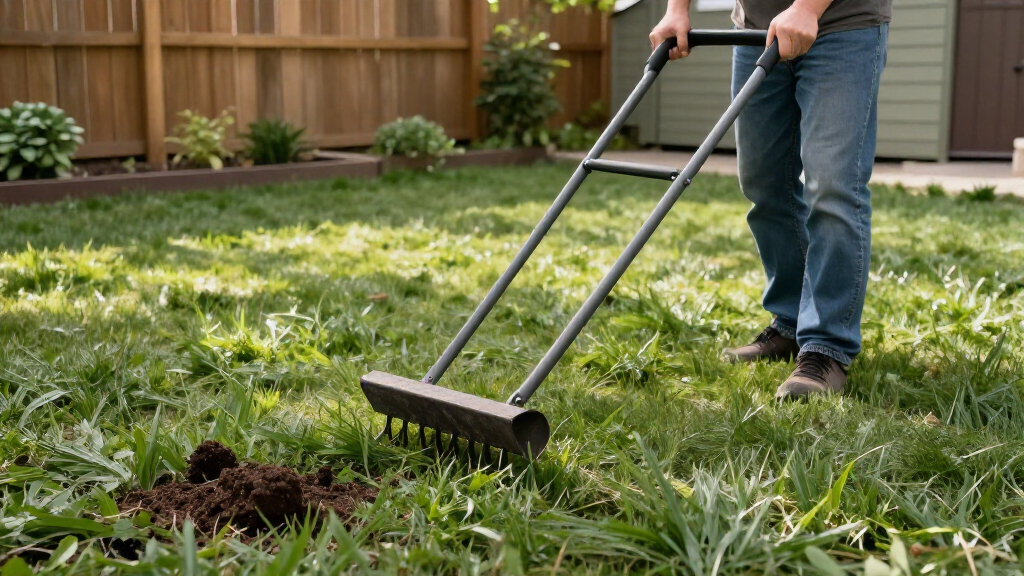
I compared the 15 listed tools by the work their designs can realistically do, rather than treating all aerators as interchangeable. The main criteria were tine type and soil action, coverage per pass, handle format and adjustability, stated construction materials, and practical details such as cleaning, storage, and the effort involved in repeated use. Core tools received credit for removing plugs; spike tools were judged as puncturing tools, not as substitutes for core aeration.
The ranking favors versatility and a clear match to common lawn needs, then weighs usability and build details against limitations. That puts the two-hollow, two-spike core tool first for its mixed approach, while dedicated hollow-tine options rank well for buyers who specifically need plug removal. Rollers earn consideration for coverage, but their spike-only action limits their suitability for heavily compacted soil. Where product names do not establish details such as tine depth or tool weight, I avoid assuming them; buyers should verify those specifications before purchase.
Factors to Consider When Choosing Best Manual Lawn Aerators
Choosing an aerator starts with the lawn problem, not the largest number printed in a product name. These broader checks can help you avoid buying a tool that covers ground quickly but treats the wrong soil issue.
Choose Plug Removal or Puncturing
A hollow-tine tool extracts small soil plugs, creating space for air, water, and roots; a spike tool pushes into the ground but leaves the soil in place. That difference matters most when the soil is compacted, because forcing spikes into dense ground can press soil sideways rather than remove it. For a lawn that needs meaningful relief, look for clearly identified hollow tines, not just a high spike count. Spike tools can suit lighter maintenance or narrow areas where plug removal is not the goal. A mixed tool can cover more than one task, but it may not match a dedicated core aerator for plug removal. Check whether the listing specifies hollow construction and plug dimensions instead of inferring performance from the product title.
Match the Tool to Your Lawn’s Size and Shape
Small lawns, narrow strips, and spaces around beds can be easier to manage with a step-on tool because you can place each puncture where it is needed. A roller makes repeated passes across open ground more natural, though turning around obstacles and edging can take extra effort. Do not assume a wider roller automatically saves time: its spikes still need to engage the soil, and the tool must be manageable when pushed and turned. For a large yard, manual aeration can become tiring regardless of format, so plan to work in sections rather than trying to finish everything at once. Compare the tool’s working width with the lawn’s open areas, not just its overall length. Storage space matters too, especially for long-handled or wide rolling models.
Treat Spike Count as One Part of Coverage
A larger number of spikes may create more punctures in a pass, but it does not tell you how deeply they penetrate or how much force is needed. Closely spaced spikes can be harder to push into firm ground, while a smaller set may be easier to control in tight spots. Look for the listed spike arrangement, spacing, and dimensions when available, then match those details to your soil and intended coverage. A 42-spike roller and a 15-spike step-on tool differ in how they cover ground, not simply in which one is more powerful. Avoid choosing by count alone if the product details do not explain the working width or penetration. The right layout is the one you can use consistently across the areas that need treatment.
Check Handle Fit and the Effort Each Design Requires
Manual aeration uses body weight, pushing force, or repeated steps, so handle shape and length affect comfort over a full session. Adjustable handles can help accommodate different users or working positions, but they do not remove the physical effort of penetrating soil. A step-on tool calls for controlled downward pressure; a roller shifts the work toward walking and pushing. If you have limited strength or balance, consider which motion feels more manageable and whether the tool’s listed weight is suitable. Rebound springs may help a tool return after a press, but they are not a substitute for checking stability and grip. Make sure any adjustable joints lock securely and the handle provides enough clearance for your stride.
Account for Soil Moisture, Cleaning, and Storage
Very dry ground can resist tine penetration, while excessively wet soil may smear or compress instead of forming clean holes or plugs. Moderate moisture generally makes manual aeration more workable, so check the soil itself rather than relying only on a calendar. Hollow tines can collect soil and need clearing during or after use; spike tools avoid plug removal but still require cleaning to keep dirt from building up. Steel construction can offer a sturdy feel, while stainless steel may appeal to buyers who want a material with greater resistance to corrosion, though care and storage still matter. Inspect joints, fasteners, and tine attachment points, since those areas take repeated force. A tool that fits in your storage space and can be cleaned easily is more likely to be ready when the lawn needs attention.
Frequently Asked Questions
Should I choose a hollow-tine aerator or a spike aerator?
Choose hollow tines when you want to remove soil plugs and relieve compaction rather than simply make punctures. Spike tools can suit lighter maintenance or areas where you want a straightforward manual tool, but they leave soil in place. For dense soil, the distinction is more important than the number of spikes or the handle style. The dual-tine core model in this roundup offers both types, while dedicated hollow-tine models focus on plug removal. Check the product details for confirmation that the tines are hollow before buying.
Can a manual aerator handle a large lawn?
It can, but the time and physical effort rise with lawn size, soil firmness, and how closely you space passes. A roller can make repeated movement across an open lawn more convenient than placing a step-on tool at each spot, but it still requires steady pushing and turning. Manual tools are easier to manage when you work in sections and focus on compacted or high-traffic areas first. For a large property, compare the aerator’s working width and your realistic pace before committing. If broad coverage is the main need, the Hubiiett and Seeutek roller formats are worth comparing, while neither replaces core aeration.
Will more spikes make an aerator work better?
Not on their own. Spike count affects the number of contact points, but penetration depth, spacing, tool weight, soil moisture, and the force needed also shape the result. A high-count tool may cover more points in one pass yet be harder to press or push into firm ground. More spikes also do not turn a spike tool into a core aerator, since they do not extract plugs. Compare the complete tine layout and intended soil action rather than picking the largest count.
When is an adjustable handle worth choosing?
An adjustable handle can make it easier to set a comfortable working position when users differ in height or when a fixed handle feels awkward. That fit can reduce unnecessary bending or reaching, but it cannot make a poorly matched tine design work better for your soil. Check that the adjustment mechanism locks firmly and does not add unwanted looseness under pressure. If only one person will use the tool and the fixed handle already suits them, adjustability may matter less than tine type or cleaning access. Treat it as a usability feature, not a performance guarantee.
Do I need to aerate when the lawn is dry or very wet?
Neither extreme is ideal for most manual aeration. Hard, dry soil can make tines difficult to insert and increase the effort required, while saturated ground can smear and compress around the holes. Check moisture by pressing into the soil: it should be workable without feeling waterlogged or rock-hard. If conditions are unsuitable, wait rather than forcing a tool through the lawn. This is especially helpful with manual tools, where the right soil condition can make a noticeable difference to effort and the quality of the openings.
Conclusion
For most buyers seeking one adaptable tool, I’d choose the Manual Lawn Core Aerator with 2 Hollow Tines and 2 Spike Tines as the best overall, because its design covers plug removal and puncturing. For a value-minded choice, the Manual Lawn Aerator with 11 Steel Spikes is a straightforward option if spike aeration fits the job; choose it for simplicity, not core aeration. My best premium pick is the Adjustable Stainless Steel Manual Lawn Aerator with 4 Hollow Tines for buyers who prioritize dedicated plug removal and stainless steel construction. Beginners who want a guided working position can start with an adjustable-handle spike model such as the RIFPOD, while buyers with open lawns should compare the Hubiiett and Seeutek rollers for coverage. For compact areas or a mix of soil needs, the dual-tine core tool is the most flexible fit; for dense, compacted ground, prioritize hollow tines over spike count.