Finding the best industrial dust collector depends on your specific workshop size, dust types, and budget. The top overall choice, JET Cyclone Dust Collector, offers a strong balance of power and filtration for most professional settings. For those prioritizing value, the WEN DC1300 delivers impressive capacity at an accessible price. If premium performance is your goal, the DEWALT Dust Separator provides high efficiency with minimal maintenance. However, tradeoffs exist—larger units can be costly and bulky, while smaller models may lack the power needed for demanding tasks. Continue reading for a detailed breakdown tailored to different workshop needs.
Key Takeaways
- Power output and airflow volume are primary factors influencing dust collection efficiency in larger workshops.
- Filtration quality, especially micron rating, significantly affects indoor air quality and worker health.
- Mobility and size matter—larger units often require dedicated space, while compact models suit smaller setups.
- Maintenance features like collection bag capacity and filter accessibility can save time and reduce downtime.
- Price correlates with features; investing more typically yields better durability and performance, but budget options still serve hobbyist needs well.




More Details on Our Top Picks
WEN DC1300 1,300 CFM 14-Amp 5-Micron Woodworking Dust Collector with 50-Gallon Collection Bag and Mobile Base
This WEN dust collector stands out for its impressive airflow capacity of 1,300 CFM, making it ideal for sizable workshops with multiple tools like routers and planers. Compared to the smaller WEN DC3401, which offers only 660 CFM, the DC1300 handles larger dust loads with ease, though it involves a bigger footprint and slightly higher noise levels. Its 50-gallon collection bag reduces downtime, and the mobile base with swivel casters simplifies movement around a large space. However, the unit’s power draw and size may be overwhelming for smaller setups or hobbyists with limited space. Still, for those needing high throughput and large capacity, this model offers reliable performance with straightforward maintenance. It’s best suited for professional or serious DIY shops that demand continuous, heavy dust collection.
Pros:- High airflow capacity of 1,300 CFM for demanding dust loads
- Large 50-gallon collection bag minimizes emptying frequency
- Mobile base with swivel casters allows easy repositioning
- Dual 4-inch inlets for connecting multiple tools simultaneously
Cons:- Relatively bulky and requires significant space for setup
- Higher noise levels may necessitate hearing protection
- Power consumption is higher compared to smaller units
Best for: Workshop owners with multiple woodworking machines and ample space.
Not ideal for: Small hobbyists or garages with limited space, due to its size and power requirements.
- CFM:1300
- Motor Power:14 amps
- Collection Capacity:50 gallons
- Impeller Size:10-inch steel
- Number of Inlets:2
- Mobility:Mobile base with four swivel casters
Bottom line: This pick makes the most sense for large, busy shops where high capacity and mobility are priorities.
VEVOR Dust Collector, 1550 CFM 2.5 Micron Vortex Cone Dust Collectors, 3.0HP Sawdust Collection System with Two 35-Gallon Dusts Collector Bags & Two 42-Gallon Filter Bags, 3400 RPM.(220V Plug)
This VEVOR model excels in handling large volumes of fine dust, with an airflow of 1550 CFM and 2.5-micron filtration, making it a solid choice for medium to large workshops focused on fine woodworking or finishing tasks. Unlike the WEN DC1300, which is more suited for general woodworking, this system’s vortex cone design optimizes separation efficiency, reducing filter clogging and extending bag life. Its dual 35-gallon dust bags and filter bags support longer continuous operation, minimizing interruptions. The 3.0HP motor provides steady suction at a manageable noise level of under 90dB. A potential tradeoff is its higher power draw and size, which might be unnecessary for smaller workshops. For those needing robust, high-capacity dust collection with excellent fine dust filtration, this model offers a professional-grade solution.
Pros:- Exceptional airflow of 1550 CFM for demanding dust loads
- Dual large 35-gallon dust bags enable extended operation
- Efficient 2.5-micron filtration captures fine dust particles
- Overload-resistant 3.0HP motor ensures durability
Cons:- Requires significant space and electrical capacity
- Higher energy consumption compared to smaller units
- Complex setup may be challenging for novices
Best for: Medium to large workshops requiring high airflow and fine dust filtration.
Not ideal for: Small hobby shops or budget-conscious DIYers, due to its size and power needs.
- CFM:1550
- Filtration Micron:2.5
- Bag Capacity:Two 35-gallon bags
- Motor Power:3.0 HP
- RPM:3400
- Voltage:220V
Bottom line: Ideal for high-volume, fine dust projects in professional or expansive workshop environments.
VEVOR Dust Collector, Wall Mount Dust Collector 1 HP, 560 CFM Woodworking Dusts Collectors with 2.5 Micron Collectors Bag, Dusts Collection System for Woodworking/Workshop, Industrial Factories
This wall-mounted VEVOR dust collector offers a compact, space-saving solution with 560 CFM airflow, making it suitable for small to medium workshops or factories where floor space is at a premium. Compared to larger floor units like the VEVOR vortex system, this model’s wall mounting and 1HP motor make it easier to install and manage in confined areas. Its 2.5-micron filtration efficiently captures fine dust, improving air quality, while the convenient bottom zipper on the 21-gallon bag simplifies maintenance. However, its lower airflow limits its effectiveness for heavy-duty or multiple-tool use, and it may require more frequent bag changes in busier environments. This makes it an excellent choice for smaller shops focused on maintaining a clean workspace without occupying floor space.
Pros:- Space-saving wall mount design
- Moderate airflow of 560 CFM suitable for small setups
- Efficient 2.5-micron filtration improves air quality
- Easy bag emptying with bottom zipper
Cons:- Limited airflow for multiple or heavy-duty tools
- Not suitable for large or commercial-scale workshops
- Lower motor power might reduce overall suction in demanding tasks
Best for: Small to medium workshops needing effective space-efficient dust collection.
Not ideal for: Large shops or high-demand environments where higher CFM is required.
- CFM:560
- Filtration Micron:2.5
- Bag Capacity:21 gallons
- Motor Power:1 HP
- Design:Wall mount
- Noise Level:≤ 90dB
Bottom line: Best suited for small shops or areas where space efficiency and moderate airflow are key priorities.
The Dustopper PRO, Low-Profile Dust Separator for Shop Wet/Dry Vacuums. Includes High-Flow 90 Degree Sweep Elbows and Connection Hose. Fits Standard 5 Gallon Buckets, Made in USA
The Dustopper PRO offers a low-profile, highly innovative cyclonic separator design that can be easily attached to standard 5-gallon buckets, making it ideal for budget-conscious DIYers and hobbyists. Its patented design maximizes separation efficiency without requiring high CFM, reducing strain on shop vacuums and extending their lifespan—something the larger, high-capacity units like the VEVOR vortex system cannot match in terms of simplicity. The inclusion of two high-flow sweep elbows and a connection hose simplifies setup and ensures minimal turbulence loss. While it’s not designed for continuous, heavy-duty use or large dust loads, it effectively captures debris before it reaches your vacuum, saving on filters and bags. Its USA-made quality and ease of use make it a popular choice for small-scale projects.
Pros:- Low-profile, easy to attach to standard buckets
- Maximizes separation with cyclonic design
- Includes two high-flow sweep elbows for performance
- Made in the USA with quality standards
Cons:- Limited capacity for continuous, heavy-duty dust loads
- Not suitable for high-volume industrial use
- Requires a shop vacuum or small dust extractor
Best for: DIY enthusiasts and hobbyists looking for an affordable, space-saving dust separator.
Not ideal for: Large professional workshops or environments with high dust demands.
- Material:Anti-static resin
- Bucket Compatibility:Standard 5 gallons
- Diameter:2.25 inches
- Length:7 inches
- Weight:1.63 kg
- Flow Capacity:Max 5 Bars pressure
Bottom line: This is the best choice for budget-friendly, easy-to-install dust separation in small workshops or DIY projects.
WEN Woodworking Dust Collector, 5.7-Amp Motor with 12-Gallon Bag, Mobile Base, and Optional Wall Mount (DC3401)
The WEN DC3401 offers a compact, portable dust collection option with a 5.7-amp motor and 660 CFM airflow, making it ideal for small to medium workshops that need effective dust control without taking up much space. Its 12-gallon bag and onboard handle facilitate easy transportation and quick disposal, similar to the larger WEN DC1300 but on a smaller scale. Compared to the DC1300, which handles larger volumes, this model is more suitable for hobbyists or small shops with fewer tools. The optional wall mount adds flexibility, though it may not be as robust or high-capacity as larger systems. For those prioritizing mobility and space efficiency, this unit provides reliable dust collection at a friendly price point.
Pros:- Compact size with 12-gallon bag for easy mobility
- Includes a mobile base with lockable casters
- Optional wall mount for space-saving installation
- Good airflow of 660 CFM for small setups
Cons:- Lower capacity compared to larger units like the WEN DC1300
- Not suited for multiple tools running simultaneously
- Limited to small or hobbyist applications
Best for: Small workshops or hobbyists needing effective dust collection in limited space.
Not ideal for: Large production shops or environments with heavy or continuous dust loads.
- CFM:660
- Bag Capacity:12 gallons
- Motor Power:5.7 amps
- Impeller Size:6-inch
- Mobility:Mobile base with lockable casters
- Optional Mounting:Wall mount
Bottom line: Ideal for small, space-constrained shops or hobbyists seeking reliable dust control with portability.
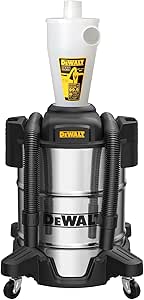
DEWALT Dust Separator with 10 Gallon Stainless Steel Tank, 99.5% Efficiency Cyclone Dust Collector, High-Performance Cycle Powder Collector Filter, DXVCS003, White
This DEWALT dust separator stands out for its high efficiency, capturing 99.5% of dust and debris before it reaches your shop vac, which helps prolong the vac’s lifespan and maintains strong suction. Compared to the Mullet Cyclone, it offers a larger stainless steel tank and more durable construction, making it better suited for heavy-duty, continuous use. The included 10-gallon container is easy to empty, and its anti-clogging, heat-resistant materials help sustain performance over time. However, its size and weight may limit portability if you need to move it frequently around a large shop. It also requires some setup to connect with various vacuum hoses, which could be a minor inconvenience. This pick makes the most sense for contractors or serious hobbyists who need reliable, long-term dust management without frequent emptying or filter replacements.
Pros:- Captures 99.5% of dust and debris, greatly reducing filter clogging
- Heavy-duty stainless steel tank resists corrosion and damage
- Compatible with most vacuum cleaners via 1-7/8″ or 2-1/2″ ports
- Large 10-gallon capacity minimizes frequent emptying
Cons:- Relatively heavy and bulky, limiting portability
- Requires some assembly and setup to connect hoses
Best for: Professional woodshops and serious DIYers needing high-capacity, durable dust separation.
Not ideal for: Small hobbyists or those with limited space, as the unit is bulky and requires setup.
- Capacity:10 gallons
- Material:Stainless steel
- Efficiency:99.5%
- Power Source:Manual (vacuum connection)
- Dimensions:Not specified
- Weight:Not specified
Bottom line: Ideal for professionals or heavy users who value durability and high efficiency over portability.
WEN Woodworking Dust Collector, 7.4-Amp Induction Motor with 15-Gallon Bag, Mobile Base, and Optional Wall Mount (DC3474)
This WEN dust collector offers a powerful 7.4-amp motor and a spacious 15-gallon collection bag, making it suitable for extensive woodworking projects. It moves up to 600 CFM, comparable to smaller professional units like the DEWALT but at a more affordable price point. The unit’s portability is enhanced with swivel casters and a built-in handle, and it can be wall-mounted for space-saving storage. Compared to the Mullet cyclone, it is less specialized for separating fine dust but provides excellent overall suction and capacity for the price. Its noise level at 72 decibels is reasonable for a machine of this size. A minor tradeoff is that it may require more frequent emptying due to its less sophisticated dust separation system. This makes it a great choice for hobbyists or small shops prioritizing capacity and cost-efficiency without sacrificing performance.
Pros:- Powerful 7.4-amp motor with 600 CFM airflow
- Large 15-gallon bag reduces emptying frequency
- Portability with swivel casters and optional wall mount
- Affordable price for capacity and features
Cons:- Less effective at filtering fine dust compared to cyclone units
- Requires regular emptying of the large bag
Best for: Home woodshops and hobbyists seeking a large-capacity, budget-friendly dust collector.
Not ideal for: Professional shops needing maximum fine dust filtration or compact setups.
- Motor Power:7.4 amps
- Capacity:15 gallons
- Airflow:600 CFM
- Noise Level:72 decibels
- Wheels:Swivel casters
- Mounting:Optional wall mount
Bottom line: Perfect for hobbyists who need high-capacity dust collection on a budget without complex setup.
JET Cyclone Dust Collector, 2-Micron Filter, 1-1/2 HP, 115V 1Ph (JCDC-1.5)
The JET Cyclone Dust Collector excels in filtering fine dust down to 1 micron, making it ideal for capturing very small particles that traditional systems might miss. Its cyclone separation system pulls larger debris into a 20-gallon steel drum, reducing strain on the filter and maintaining suction. Compared to the DEWALT model, it offers better fine dust filtration and a more robust cyclone separation feature. The unit’s 1-1/2 HP motor provides strong airflow, and its mobility is facilitated by swivel casters and quick-release levers. The remote control adds convenience for operation from a distance. A drawback could be its higher cost and the need for a dedicated 115V power supply. This model suits professional shops or serious hobbyists prioritizing superior dust filtration and debris separation.
Pros:- Filters particles down to 1 micron for superior dust capture
- Two-stage cyclone separation extends filter life
- Heavy debris is directed into a 20-gallon steel drum
- Remote control for easy operation
Cons:- Higher cost and larger footprint
- Requires dedicated 115V power supply
Best for: Professionals or hobbyists needing excellent fine dust capture and large debris separation.
Not ideal for: Small or portable setups where compact size and simplicity are preferred.
- Filtration:2-micron
- Capacity:20 gallons
- Motor:1-1/2 HP
- Voltage:115V
- Mobility:Swivel casters
- Control:Remote
Bottom line: Best suited for users who need high-precision dust filtration and debris separation in a stationary setup.
Mullet High-Speed Cyclone Dust Collector for Shop Vacuum – Sawdust Separator, Dust Collectors for Woodworking, Garage, Hobbyist Debris Extraction
The Mullet High-Speed Cyclone Dust Collector is a compact, highly efficient separator that pre-collects over 99% of debris, significantly reducing filter clogging in your shop vac or dust extractor. Its parabolic design and seamless construction create a faster airflow and better dust capture than typical straight-wall cyclones, making it ideal for hobbyists and small workshops. Unlike the larger cyclone units like the DEWALT or JET, it is lightweight and easily portable, fitting standard shop vac hoses with included adapters. Users report it maintains strong suction even after extensive use, such as removing popcorn ceiling debris. A potential downside is that its capacity is limited to 5 gallons, requiring more frequent emptying during large projects. This makes it perfect for small-scale woodworking or DIY projects where space and portability are key.
Pros:- Pre-separates over 99% of debris, maintaining suction
- Faster airflow due to parabolic design
- Universal hose adapters for compatibility with most shop vacuums
- Lightweight and portable for easy use
Cons:- Limited capacity at 5 gallons, needing frequent emptying
- Less effective at capturing very fine dust without additional filtration
Best for: Hobbyists and small shop owners needing a portable, efficient debris separator compatible with shop vacuums.
Not ideal for: Commercial or large-scale shops that require high-capacity or fine dust filtration.
- Capacity:5 gallons
- Design:Parabolic cyclone
- Material:Seamless plastic
- Compatibility:Universal shop vac hoses
- Filtration:Over 99%” debris separation
- Portability:Lightweight, compact
Bottom line: Excellent for hobbyists or small workshops seeking a portable cyclone separator that enhances shop vac performance.

How We Picked
The products included in this roundup were evaluated based on performance, build quality, filtration efficiency, ease of use, and overall value. We prioritized units with proven airflow capabilities suitable for demanding industrial environments, ensuring they can handle continuous use. Ease of maintenance, filter longevity, and portability also played key roles in our ranking. Our goal was to identify options that balance power and practicality, catering to a broad spectrum of workshop sizes and budgets. The final order reflects a combination of these factors, highlighting models that excel in real-world industrial applications while considering cost-effectiveness and user convenience.Factors to Consider When Choosing Best Industrial Dust Collector
Choosing the right industrial dust collector involves understanding several key factors that impact performance and usability. Beyond basic specs, it’s important to consider how the unit fits your workspace, the types of dust you generate, and your long-term maintenance needs. Making an informed decision can prevent costly mistakes like underpowered units or excessive downtime. Here are the essential considerations to guide your selection:Airflow Capacity and Power
Airflow capacity, measured in CFM (cubic feet per minute), determines how effectively a dust collector can handle large volumes of debris. For heavy-duty industrial use, units with higher CFM ratings ensure faster dust removal and better overall performance. However, more powerful units tend to be larger and more energy-consuming, so balancing power with your workspace size and electrical capacity is key. Smaller workshops may benefit from moderate CFM units that still provide effective dust control without excessive power draw.
Filtration Efficiency
Filtration ratings, often expressed in microns, reveal how fine a dust particle a unit can trap. For industrial environments, 1-2 micron filters are preferable because they prevent fine dust from recirculating into the air, protecting health and equipment. Cheaper units may lack this level of filtration, leading to poorer air quality. Additionally, filter durability and ease of replacement are important for long-term maintenance and cost savings.
Size, Portability, and Space Requirements
Industrial dust collectors vary widely in size, from compact wall-mounted models to large, stationary units. Consider your available space and whether mobility is necessary—if you need to move the unit between different stations, look for models with wheels or handles. Larger units can process more dust but require dedicated space and may be difficult to install in confined areas. Conversely, smaller or wall-mounted models save space but might not meet the demands of heavy-duty tasks.
Ease of Maintenance and Longevity
Regular maintenance is essential to keep dust collectors functioning optimally. Features like large collection bags or bins reduce frequency of emptying, while easily accessible filters simplify replacement. Consider units with durable construction and high-quality filters that withstand continuous use. Investing in models with straightforward maintenance routines can extend lifespan and reduce operational downtime, making them more cost-effective over time.
Price and Overall Value
While budget models are appealing, they often sacrifice power, filtration, or durability. Conversely, premium units tend to offer advanced features, better filtration, and longer-lasting components, but at a higher cost. Assess your workshop’s specific needs—if you generate large amounts of dust regularly, spending more on a high-capacity, industrial-grade collector makes sense. For hobbyist or light-duty use, more affordable options can still provide effective dust control without overpaying.
Frequently Asked Questions
How do I know if a dust collector is powerful enough for my workshop?
The key is matching the unit’s CFM rating to the size of your workspace and the volume of dust generated. Larger workshops with multiple machines require higher CFM ratings—ideally above 1,500 CFM for industrial settings. For smaller or occasional use, units with 500-1,000 CFM can suffice. Always consider the ducting length and the number of branches, as these can reduce effective airflow, so choose a slightly higher capacity if your setup is complex.
Is filtration quality more important than airflow for air quality?
Both are critical, but filtration quality significantly impacts indoor air health. High-efficiency filters trap fine particles that can cause respiratory issues or equipment damage. Even a powerful unit with low-quality filters won’t provide clean air if the dust slips through. Ideally, select a dust collector with a micron rating of 1-2 microns and check for features like HEPA filtration if needed for sensitive environments.
Can I use a small dust collector for industrial applications?
Small units are generally not suitable for continuous, heavy-duty industrial use due to limited airflow and capacity. They may work for light tasks or hobbyist projects but can quickly become overwhelmed in a factory setting. For consistent industrial performance, investing in larger, high-capacity models with robust filtration is advisable. Using undersized units can lead to clogged filters and poor dust removal, reducing safety and efficiency.
What maintenance should I expect with an industrial dust collector?
Maintenance typically involves regular emptying of collection bags or bins, replacing or cleaning filters, and inspecting ductwork for clogs. High-quality units offer easy access to filters and collection chambers, reducing downtime. Keeping filters clean and replacing them as recommended ensures optimal airflow and filtration. Proper maintenance not only extends the unit’s lifespan but also maintains safe air quality standards in your workshop.
Is it better to buy a stationary or portable dust collector?
The choice depends on your workspace layout and workflow. Stationary units are suitable for large, dedicated workshops where the dust source remains fixed, offering higher capacity and efficiency. Portable models are more flexible, allowing movement between different stations or jobs, but often have lower CFM ratings. Consider your space, the frequency of use, and whether mobility outweighs the need for higher power when making your decision.
Conclusion
For most professional workshops, the JET Cyclone Dust Collector stands out as the best overall choice, combining power, filtration, and durability. Budget-conscious hobbyists or small workshops will find the WEN DC1300 provides excellent value without sacrificing performance. Those seeking premium features and maximum efficiency should consider the DEWALT Dust Separator. Beginners or DIYers might prefer compact, easy-to-maintain models like the Mullet High-Speed Cyclone. Ultimately, matching the dust collector’s specs to your specific needs ensures a safer, cleaner workspace that supports your workload and budget.