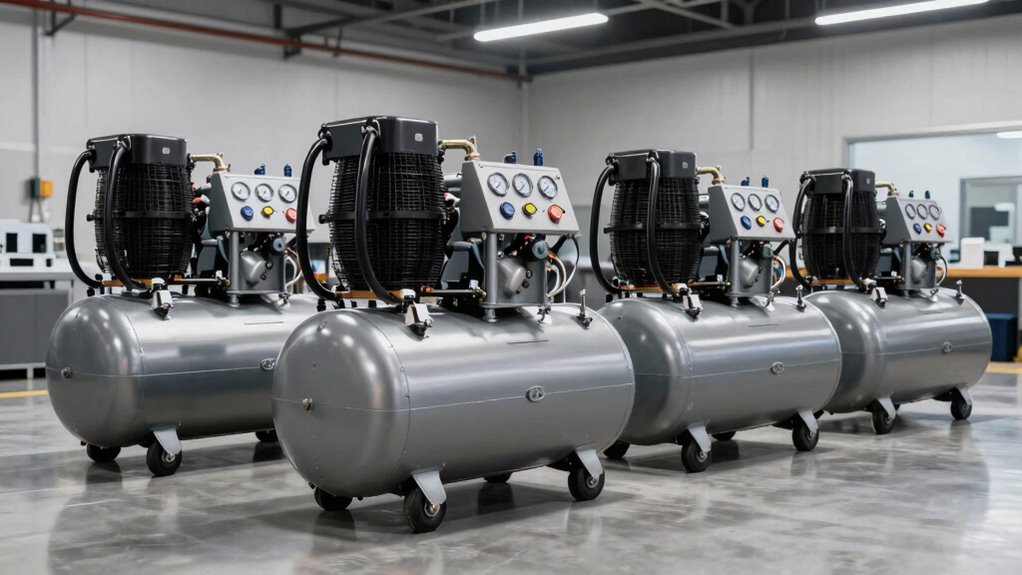
Choosing a 60-gallon air compressor is less about tank size—all five options share it—and more about how much usable air the pump supplies, what electrical service your shop has, and how demanding your tools are. I rank the DEWALT 5 HP first for its lineup-leading 14.6 CFM at 90 PSI, while the Ingersoll Rand SS3L3 is a strong match for buyers who value continuous-duty operation and a long-life cast-iron pump. The DEWALT 3.7 HP offers another high-output path, reaching 11.5 CFM at 90 PSI with a 175 PSI ceiling.

Get tools and workshop supplies delivered free — and shop member deals
- Fast, free delivery on millions of items
- Access to Prime Big Deal Days deals on October 6–7
- Prime Video, Amazon Music and more included
The tradeoffs are real: the strongest models call for dedicated 208–240V power, and a 60-gallon vertical tank is a heavy, stationary commitment. The JEGS is the only listed 110V option, but its 6.3 CFM at 90 PSI is a different capacity class from the leading shop units. My ranking favors useful airflow and clearly stated operating fit, while factoring in power requirements, pump design, noise, and spec reliability.
Complete the kit

Key Takeaways
- The DEWALT 5 HP supplies the most stated airflow: 14.6 CFM at 90 PSI, but requires a 240V supply and 20A service.
- The DEWALT 3.7 HP and Ingersoll Rand SS3L3 both exceed 11 CFM at 90 PSI; the DEWALT reaches 175 PSI, while the Ingersoll Rand emphasizes continuous-duty use and pump longevity.
- Campbell Hausfeld combines a two-stage cast-iron pump and 175 PSI maximum with lower stated airflow of 7.6 SCFM at 90 PSI.
- JEGS is the lineup’s 110V choice, but its 6.3 CFM at 90 PSI makes it better suited to lighter-demand tool use than sustained high-airflow work.
- Before choosing any stationary 60-gallon unit, check voltage, circuit capacity, floor space, delivery access, and installation requirements.
| DEWALT 60-Gallon Vertical Air Compressor |  | Best Overall for High Airflow | Tank capacity: 60 gallons | Motor: 5 HP | Airflow: 17 CFM at 40 PSI; 14.6 CFM at 90 PSI | VIEW ON AMAZON | See Our Full Breakdown |
| DEWALT 60-Gallon Vertical Electric Stationary Air Compressor |  | Best for High Pressure and Strong Airflow | Tank capacity: 60 gallons | Motor: 3.7 HP, oil-lubricated | Airflow: 11.5 CFM at 90 PSI | VIEW ON AMAZON | See Our Full Breakdown |
| Ingersoll Rand SS3L3 Single-Stage Air Compressor, 3 HP, 60-Gallon Vertical |  | Best for Continuous-Duty Shop Use | Tank capacity: 60 gallons | Motor: 3 HP | Airflow: 11.3 CFM at 90 PSI | VIEW ON AMAZON | See Our Full Breakdown |
| Campbell Hausfeld 60-Gallon Two-Stage Air Compressor, 175 PSI, 230V |  | Best Two-Stage and Quieter Shop Option | Tank capacity: 60 gallons | Pump: Oil-lubricated, two-stage cast iron | Motor: 3.7 HP induction motor | VIEW ON AMAZON | See Our Full Breakdown |
| JEGS 3 HP Vertical Air Compressor with 60-Gallon Tank |  | Best for 110V Availability | Tank capacity: 60 gallons | Motor: 3 HP, 110V, single phase | Compressor: Single-stage, V-twin cylinder | VIEW ON AMAZON | See Our Full Breakdown |
| air compressor 60 gallon | Tank capacity | Motor | Airflow | Maximum pressure |
|---|---|---|---|---|
| DEWALT 60-Gallon Vertical Air | 60 gallons | 5 HP | 17 CFM at 40 PSI; 14.6 CFM at 90 PSI | 175 PSI |
| DEWALT 60-Gallon Vertical Elec | 60 gallons | 3.7 HP, oil-lubricated | 11.5 CFM at 90 PSI | 175 PSI |
| Ingersoll Rand SS3L3 Single-St | 60 gallons | 3 HP | 11.3 CFM at 90 PSI | 135 PSI |
| Campbell Hausfeld 60-Gallon Tw | 60 gallons | 3.7 HP induction motor | 7.6 SCFM at 90 PSI; 6.9 SCFM at 175 PSI | 175 PSI |
| JEGS 3 HP Vertical Air Compres | 60 gallons | 3 HP, 110V, single phase | 8.6 CFM at 40 PSI; 6.3 CFM at 90 PSI | 115 PSI |
More Details on Our Top Picks
DEWALT 60-Gallon Vertical Air Compressor
I put this DEWALT first because it pairs the shared 60-gallon tank with the lineup’s strongest stated output: 14.6 CFM at 90 PSI. That gives it a stronger case for multiple pneumatic tools or air-hungry work than the JEGS at 6.3 CFM and the Campbell Hausfeld at 7.6 SCFM at the same pressure. Its 17 CFM at 40 PSI also points to substantial delivery for lower-pressure tasks.
The compromise is its electrical demand. This model specifies a 240V supply and 20A maximum current, so it is not a plug-in replacement for a standard household compressor. The single-stage, oil-lubricated belt-drive design and ASME tank suit a dedicated shop, but buyers should verify the exact motor and circuit requirements before installation. Compared with the DEWALT 3.7 HP, it has more stated airflow; compared with the Ingersoll Rand, it does not carry the same listed continuous-duty and pump-life details.
I rank it as the broadest-fit choice for buyers who need the most airflow in this group and already have suitable electrical service. Its stationary form is a poor match for anyone who needs to move a compressor around a jobsite, and the provided specs do not give a pump-life figure or detailed duty-cycle rating. Treat it as a high-capacity shop machine, not a portable or low-power option.
Pros:- Highest listed airflow in this group: 14.6 CFM at 90 PSI
- 175 PSI maximum pressure
- ASME-certified 60-gallon tank
- Vertical belt-drive layout uses floor space efficiently
Cons:- Requires the specified 240V supply and up to 20A
- Stationary design is not suited to frequent relocation
- Provided specifications do not state pump life or duty cycle
Best for: Workshop owners who need the highest listed airflow here and have a suitable 240V, 20A supply.
Not ideal for: Buyers without compatible electrical service, those who need portability, or shoppers seeking a stated pump-life or duty-cycle rating.
- Tank capacity:60 gallons
- Motor:5 HP
- Airflow:17 CFM at 40 PSI; 14.6 CFM at 90 PSI
- Maximum pressure:175 PSI
- Voltage:208–230V motor; 240V supply specified
- Maximum current:20A
- Pump and drive:Single-stage, oil-lubricated belt drive
- Tank certification:ASME
- Noise level:70 dB
Our verdict“I rank this DEWALT first for buyers who can support its electrical needs and want the strongest stated airflow from a 60-gallon option here.”
DEWALT 60-Gallon Vertical Electric Stationary Air Compressor
This DEWALT earns its place near the top with a useful combination of 11.5 CFM at 90 PSI and a 175 PSI maximum. It delivers less stated airflow than the 5 HP DEWALT, but more than the Ingersoll Rand’s 11.3 CFM and substantially more than the JEGS or Campbell Hausfeld at 90 PSI. The extra pressure headroom may suit shop tasks that call for a higher pressure range, though buyers should still match airflow to each tool’s demand.
Its 3.7 HP oil-lubricated motor and ASME-certified tank make it a serious stationary-shop pick. Unlike the JEGS, it needs 208V or 230V power; unlike the 5 HP DEWALT, its listed maximum current is 15A rather than 20A. That difference can matter when checking an existing circuit, but it does not remove the need to confirm the manufacturer’s installation requirements. The stated 87 dB noise level is also higher than the other models with supplied figures.
I see it as the better fit for a buyer who wants a high-pressure unit and strong output without stepping up to the 5 HP model’s stated airflow and current demand. Compared with the quieter Ingersoll Rand listing at 78 dB, this DEWALT is specified as louder. Its 200-pound weight and fixed vertical layout also make delivery and placement a planned installation, not a casual move.
Pros:- 11.5 CFM at 90 PSI
- Maximum pressure of 175 PSI
- Compatible with 208V or 230V power
- ASME-certified 60-gallon tank
Cons:- Requires higher-voltage electrical service
- Listed noise level is 87 dB
- Heavy, stationary installation at 200 pounds
Best for: Dedicated garage or workshop users who need 175 PSI capability and strong airflow with a 208V or 230V supply.
Not ideal for: Buyers limited to standard 110V power, noise-sensitive workspaces, or anyone needing a portable compressor.
- Tank capacity:60 gallons
- Motor:3.7 HP, oil-lubricated
- Airflow:11.5 CFM at 90 PSI
- Maximum pressure:175 PSI
- Voltage:208V or 230V
- Maximum current:15A
- Tank certification:ASME
- Noise level:87 dB
- Weight:200 pounds
Our verdict“I recommend this DEWALT when 175 PSI and 11.5 CFM at 90 PSI matter more than minimizing noise or using a lower-voltage circuit.”
Ingersoll Rand SS3L3 Single-Stage Air Compressor, 3 HP, 60-Gallon Vertical
The SS3L3 is a compelling alternative to the DEWALT 3.7 HP because it lists 11.3 CFM at 90 PSI, only slightly below that DEWALT’s 11.5 CFM, while adding explicit 100% continuous-duty operation. Its cast-iron pump is designed for over 5,000 hours of use, and automatic start/stop plus thermal overload protection support routine shop operation. For buyers who expect long, regular work sessions, those operating details are more informative than tank size alone.
It tops out at 135 PSI, well below the 175 PSI available from both DEWALT models and the Campbell Hausfeld. That ceiling is not a drawback for every shop, but it rules this compressor out for jobs that require more pressure. The model calls for 230V power, so it shares the higher-voltage installation hurdle of the other substantial shop units. Its listed 78 dB noise figure is lower than the DEWALT 3.7 HP’s 87 dB and higher than the Campbell Hausfeld’s 65 dB.
I would choose it over the DEWALT 3.7 HP when continuous-duty information and pump construction carry more weight than a 175 PSI maximum. The listing’s reported weight of 0.27 g is plainly suspect, so I would not use that figure for delivery planning; confirm actual shipping and installation dimensions with the seller. The one-year warranty is also shorter than some buyers may expect from a stationary shop investment.
Pros:- 11.3 CFM at 90 PSI
- Listed for 100% continuous-duty operation
- Cast-iron pump designed for over 5,000 hours of use
- Automatic start/stop and thermal overload protection
Cons:- Maximum pressure is 135 PSI, below several competing models
- Requires 230V power
- Listed weight of 0.27 g appears inaccurate
Best for: Workshop users who value stated continuous-duty operation, a cast-iron pump, and 11.3 CFM at 90 PSI.
Not ideal for: Buyers who need 175 PSI, standard 110V compatibility, or a reliable listed weight for planning transport.
- Tank capacity:60 gallons
- Motor:3 HP
- Airflow:11.3 CFM at 90 PSI
- Maximum pressure:135 PSI
- Voltage:230V
- Pump:Cast iron; designed for over 5,000 hours of use
- Noise level:78 dB
- Warranty:1 year
Our verdict“I favor the SS3L3 for regular-duty workshop use where its continuous-duty and pump-life claims matter more than a 175 PSI ceiling.”
Campbell Hausfeld 60-Gallon Two-Stage Air Compressor, 175 PSI, 230V
Campbell Hausfeld takes a different route from the single-stage DEWALT and Ingersoll Rand models: its two-stage, oil-lubricated cast-iron pump is paired with a 175 PSI maximum. It also has the lowest stated noise figure among the products that provide one, at 65 dB. For a workshop where compressor noise is a concern and the higher pressure ceiling is useful, that combination gives it a distinct role.
The main compromise is airflow. At 7.6 SCFM at 90 PSI, it falls well short of the DEWALT 5 HP at 14.6 CFM and the two models around 11 CFM. Its 6.9 SCFM at 175 PSI also shows that airflow drops at the maximum pressure rating. I would compare the compressor’s output with the actual consumption of each tool rather than assuming the 175 PSI rating makes it a high-volume choice. It can be a better match than the JEGS for buyers seeking a two-stage pump and higher pressure, but the JEGS has 110V power compatibility.
The unit requires a dedicated 230/240V supply and weighs 255 pounds, so setup and relocation take planning. Its vertical tank saves floor space relative to a horizontal layout, while the stationary design still limits mobility. The stated pump life of up to 10,000 hours based on a B-10 bearing rating is a useful durability detail, but it does not offset the lower airflow if a buyer’s tools need more air than the compressor can provide.
Pros:- Two-stage, oil-lubricated cast-iron pump
- 175 PSI maximum pressure
- Lowest listed noise level in this roundup at 65 dB
- Pump life stated up to 10,000 hours based on B-10 bearing rating
Cons:- 7.6 SCFM at 90 PSI trails the strongest airflow options
- Requires a dedicated 230/240V supply
- 255-pound stationary unit is difficult to relocate
Best for: Shop owners who want a two-stage cast-iron pump, 175 PSI capability, and a comparatively low stated noise level.
Not ideal for: Users running air-hungry tools that need more than 7.6 SCFM at 90 PSI or buyers without dedicated 230/240V service.
- Tank capacity:60 gallons
- Pump:Oil-lubricated, two-stage cast iron
- Motor:3.7 HP induction motor
- Airflow:7.6 SCFM at 90 PSI; 6.9 SCFM at 175 PSI
- Maximum pressure:175 PSI
- Voltage:230V; dedicated 230/240V supply required
- Tank type:Vertical ASME
- Noise level:65 dB
- Weight:255 pounds
Our verdict“I would shortlist this model for quieter, higher-pressure shop work, but not for tools that demand the airflow supplied by the leading DEWALT.”
JEGS 3 HP Vertical Air Compressor with 60-Gallon Tank
The JEGS has the clearest practical advantage for buyers who cannot run a higher-voltage compressor: its 3 HP motor operates on 110V single-phase power. That sets it apart from every other model here, all of which require 208–240V service. It includes two brass quick-disconnect couplings, thermal overload protection, and an oil drain valve, so the listed features address basic connection and maintenance needs.
Its airflow is the main limit. The compressor delivers 6.3 CFM at 90 PSI, less than the Campbell Hausfeld’s 7.6 SCFM and far below the Ingersoll Rand or DEWALT models above 11 CFM. It reaches 8.6 CFM at 40 PSI, but buyers should use the 90 PSI figure when comparing tools that operate around that pressure. The 115 PSI maximum is also the lowest in the group, so this is not the right pick for work that needs a higher pressure ceiling.
I rank it as a power-access choice, not as a substitute for the higher-output shop compressors. The vertical 60-gallon tank suits a fixed garage installation, but hoses and fittings are not included. The listing gives conflicting weight figures—200 pounds and 310 pounds—so I would verify the actual shipping weight before arranging delivery or placement. Choose it when 110V compatibility outweighs the lower airflow; skip it if sustained use of demanding air tools is the priority.
Pros:- Uses 110V single-phase power
- 60-gallon vertical tank for fixed garage or shop use
- Thermal overload protection
- Two brass quick-disconnect couplings and an oil drain valve
Cons:- 6.3 CFM at 90 PSI is the lowest listed 90 PSI airflow here
- Maximum pressure is limited to 115 PSI
- Conflicting listed weight figures of 200 and 310 pounds
Best for: Garage owners who need a stationary 60-gallon tank but only have 110V single-phase power available.
Not ideal for: Users running high-demand tools, jobs requiring more than 115 PSI, or buyers who need dependable weight information before delivery.
- Tank capacity:60 gallons
- Motor:3 HP, 110V, single phase
- Compressor:Single-stage, V-twin cylinder
- Airflow:8.6 CFM at 40 PSI; 6.3 CFM at 90 PSI
- Maximum pressure:115 PSI
- Dimensions:28 × 22.5 × 73 inches
- Included connections:Two brass quick-disconnect couplings
- Protection:Thermal overload protection
- Listed weight:Conflicting figures: 200 and 310 pounds
Our verdict“I recommend the JEGS only when 110V compatibility is the deciding factor and its lower airflow and 115 PSI ceiling fit the intended tools.”
How We Picked
I compared these five models as 60-gallon stationary compressors, not as interchangeable tanks. Since tank capacity is identical across the lineup, I gave greater weight to the airflow figures at 90 PSI, which help distinguish how well a compressor may support air tools at a common working pressure. Maximum pressure also matters for specific applications, but a high PSI ceiling does not by itself mean a compressor can sustain a high-demand tool.
I then weighed each model’s motor and power requirements, pump construction, operating features, and stated duty characteristics. A 110V unit can be a practical fit where higher-voltage service is unavailable, while 208–240V models may better serve a dedicated workshop—but only if the electrical installation supports them. I also compared noise figures where supplied and considered the practical consequences of a heavy, stationary vertical machine.
Finally, I accounted for spec clarity and tradeoffs. The JEGS listing gives conflicting weight figures, and the Ingersoll Rand listing reports a weight of 0.27 g, which appears unreliable. I flag these rather than treating them as dependable measurements. Product roles reflect the differences buyers can use: airflow, electrical compatibility, pump style, pressure capability, and stated durability. I do not treat brand claims or a large tank as proof that every compressor will suit every shop.
Factors to Consider When Choosing Air Compressor 60 Gallon
All five choices have a 60-gallon vertical tank, so the right one depends on the pump’s output and the realities of your installation. I would match the compressor to your tools first, then confirm the electrical supply, pressure needs, and available space.
Compare airflow at your working pressure
Airflow, shown as CFM or SCFM, helps determine whether a compressor can keep up with a pneumatic tool while it runs. For a practical comparison, look at the figure at the pressure your tool uses: four entries list output at 90 PSI, ranging from 6.3 CFM for JEGS to 14.6 CFM for the 5 HP DEWALT. The Ingersoll Rand and 3.7 HP DEWALT sit close together at 11.3 and 11.5 CFM, while Campbell Hausfeld lists 7.6 SCFM. Check the tool maker’s air-consumption requirement and allow suitable headroom; a large tank can buffer short demand, but it cannot make a lower-output pump deliver high airflow continuously.
Treat maximum PSI and CFM as separate measures
Maximum pressure tells you the highest pressure the compressor is rated to reach; it does not describe how quickly it can supply air at that pressure. The two DEWALT models and Campbell Hausfeld list 175 PSI maximum, while the Ingersoll Rand reaches 135 PSI and JEGS 115 PSI. The Campbell Hausfeld’s output drops from 7.6 SCFM at 90 PSI to 6.9 SCFM at 175 PSI, illustrating why both figures matter. If your tools operate around 90 PSI, compare their airflow at 90 PSI instead of choosing by the highest pressure number alone.
Check voltage and circuit capacity before ordering
Electrical compatibility can eliminate a model before airflow comparisons matter. JEGS is the only listed 110V single-phase option. The Ingersoll Rand needs 230V, Campbell Hausfeld calls for a dedicated 230/240V supply, and the DEWALT choices specify 208–230V motor compatibility with a 240V supply for the 5 HP version. The 3.7 HP DEWALT lists 208V or 230V and a 15A maximum; the 5 HP DEWALT specifies 20A. Have a qualified electrician check the circuit, wiring, protection, and installation requirements rather than assuming an existing outlet is suitable.
Choose pump design for your work pattern
The Ingersoll Rand stands out for its listed 100% continuous-duty operation and cast-iron pump designed for over 5,000 hours of use. Campbell Hausfeld uses a two-stage cast-iron pump and lists a pump-life figure of up to 10,000 hours based on a B-10 bearing rating. The DEWALT 5 HP and JEGS are single-stage designs, while the 3.7 HP DEWALT is oil-lubricated. These details help frame intended use and maintenance, but they are not a substitute for checking service intervals, warranty terms, and the expected duty cycle for your tools.
Plan for noise, placement, and delivery
These compressors are stationary machines, and their size and weight affect installation well before first use. The listings show weights of 200 pounds for the 3.7 HP DEWALT and 255 pounds for Campbell Hausfeld; the JEGS listing conflicts between 200 and 310 pounds. Ingersoll Rand reports an implausible 0.27 g, so verify the real weight rather than relying on that figure. Noise figures also vary: Campbell Hausfeld lists 65 dB, the 5 HP DEWALT 70 dB, Ingersoll Rand 78 dB, and the 3.7 HP DEWALT 87 dB. Confirm placement, ventilation, access for maintenance, and noise-control needs before choosing a spot.
Remember that the tank is only part of the air system
A 60-gallon tank stores compressed air, but a working installation also needs suitable piping or hose, fittings, drainage, and often air treatment appropriate to the task. JEGS states that the air hose and fittings are not included; package contents for the other models should also be checked rather than assumed. For painting or other moisture-sensitive work, plan for filtration and moisture management. Include a way to drain condensate and follow the compressor maker’s instructions for oil, placement, startup, and electrical connection.
Frequently Asked Questions
Is a 60-gallon air compressor enough for a home workshop?
It can be, but tank size alone does not settle the question. I would compare each tool’s air consumption with the compressor’s CFM at the tool’s operating pressure. In this group, the 5 HP DEWALT’s 14.6 CFM at 90 PSI suits more demanding airflow needs than the JEGS at 6.3 CFM at 90 PSI. A compressor that falls short of a tool’s sustained demand may need recovery time even with a 60-gallon tank.
Which of these 60-gallon compressors works on 110V?
The JEGS is the listed 110V single-phase model. The other four require higher-voltage service: 230V for the Ingersoll Rand, dedicated 230/240V for Campbell Hausfeld, and 208V or 230V for the 3.7 HP DEWALT, while the 5 HP DEWALT specifies a 240V supply. Confirm the actual circuit requirements before purchase and installation.
Does a 175 PSI compressor always deliver more air?
No. Pressure and airflow are different specifications. A compressor’s maximum PSI shows its stated pressure ceiling, while CFM or SCFM indicates air delivery at a particular pressure. Campbell Hausfeld reaches 175 PSI but lists 7.6 SCFM at 90 PSI; the Ingersoll Rand reaches 135 PSI yet lists 11.3 CFM at 90 PSI. Match both pressure and airflow to the tool requirements.
Which model is best for tools used for long periods?
The Ingersoll Rand SS3L3 is the clearest candidate based on the supplied details because it is listed for 100% continuous-duty operation and uses a cast-iron pump designed for over 5,000 hours of use. Still, I would check the tool’s required CFM, maintenance schedule, and operating conditions before treating any compressor as suitable for a particular workload. Continuous-duty claims do not mean every tool demand is automatically supported.
Should I choose a two-stage compressor over a single-stage model?
Not by default. Campbell Hausfeld’s two-stage pump is paired with a 175 PSI ceiling, but its stated 7.6 SCFM at 90 PSI is lower than the airflow figures for the leading DEWALT and Ingersoll Rand models. I would favor its pump style when its pressure capability, stated noise level, and airflow fit the job. If a tool consumes substantial air, compare the actual CFM figures before prioritizing stage count.
Conclusion
For the broadest shop capability, I would choose the DEWALT 5 HP if my electrical service supports its 240V, 20A requirement; it leads this group in stated 90 PSI airflow. I would pick the Ingersoll Rand SS3L3 for listed continuous-duty operation and its cast-iron pump details, provided 135 PSI is enough. The 3.7 HP DEWALT is a strong fit for buyers who need 175 PSI and 11.5 CFM at 90 PSI, while the Campbell Hausfeld makes more sense when a two-stage pump and lower stated noise are priorities than maximum airflow. Choose the JEGS when 110V access is the deciding factor and your tools fit its lower output. Before settling on any of them, confirm tool demand, circuit compatibility, delivery weight, and installation space.
Halloween Picks
halloween
As an affiliate, we earn on qualifying purchases.