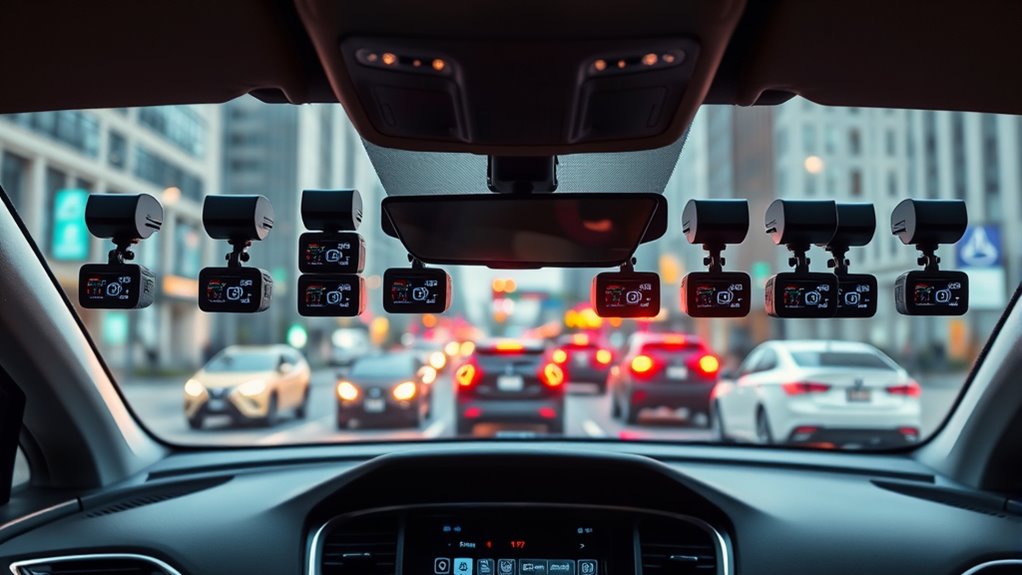

For most drivers, I’d start with the ROVE R2-4K Dual Dash Cam: its front and rear setup and included 128GB card make it a balanced choice for everyday coverage. The Garmin Dash Cam Mini 3 suits drivers who want a discreet camera, while the REDTIGER F17 adds a cabin view for rideshare and family use. The main tradeoff is between simple two-camera coverage, extra cabin or side views, and the installation and storage demands that come with more cameras. Image quality, especially at night, also depends on more than a 4K label. I’ll compare all 15 options by their strengths, compromises, and best-fit buyers below.

Get business pricing on tools and workshop supplies
- Business-only prices and quantity discounts
- Tax-exempt purchasing
- Multiple users, one account, clear invoices
Complete the kit


Key Takeaways
- Two-camera coverage is the most practical starting point. Several models pair front and rear views with a 128GB card, offering broader incident coverage without the added wiring of cabin cameras.
- More cameras bring more installation work. The four and five-channel options can capture cabin and side views, but buyers should plan for more careful positioning and larger storage needs.
- Resolution labels do not settle night performance. The REDTIGER F17 and other STARVIS 2 models call out sensor and HDR features, while buyers should still check sample footage and exposure details.
- Included cards vary widely. Bundled storage ranges from 32GB to 128GB across these listings, so a lower-capacity card may need replacing sooner, especially with multiple channels.
- Compactness and coverage pull in different directions. The Garmin Mini 3 favors a small, unobtrusive front camera, while multi-view models prioritize recording more of the vehicle’s surroundings.
| Affver 4K+2.5K Dual Dash Cam with WiFi 6 and GPS |  | Best for High-Detail Two-Way Recording | Resolution: 4K UHD front, 2.5K rear | WiFi: WiFi 6, 5GHz | GPS: Built-in | VIEW ON AMAZON | See Our Full Breakdown |
| 360° 5-Channel Dash Cam for Cars with Front, Rear, and Cabin Cameras |  | Best for Multi-Angle Vehicle Monitoring | Camera count: 5 | Resolution: 1080p front, 480p on other cameras | Display: 2.0-inch IPS | VIEW ON AMAZON | See Our Full Breakdown |
| Garmin Dash Cam Mini 3, Ultracompact 1080p HD Dash Camera |  | Best Compact Dash Cam | Resolution: 1080p HD | Field of view: 140 degrees | Polarizer: Garmin Clarity polarizer | VIEW ON AMAZON | See Our Full Breakdown |
| ICESKY 4K Dash Cam Front and Rear with GPS, WiFi 6, 128GB SD Card, Night Vision |  | Best for Four-Side Coverage | Video resolution: 2160p | Camera coverage: Front, rear, left, and right | Display: 0.3 inches | VIEW ON AMAZON | See Our Full Breakdown |
| 4K+4K+1080P 3 Channel Dash Cam with 128GB Card and Night Vision |  | Best for Front, Rear, and Cabin Recording | Video resolution: 4K front, 4K rear, 1080p cabin | Camera angles: 170° front, 150° rear, 150° cabin | Night recording: HD night vision with IR lights | VIEW ON AMAZON | See Our Full Breakdown |
| 4K+4K Dual Dash Cam Front and Rear with 128GB Card and Night Vision |  | Best for Matching Front and Rear Detail | Resolution: 4K front and rear (3840 × 2160) | Field of view: 170° front, 150° rear | Aperture: f/1.5 | VIEW ON AMAZON | See Our Full Breakdown |
| REDTIGER F17 4K 3-Channel Dash Cam with STARVIS 2 Sensor, HDR, 64GB Card, 5.8GHz WiFi |  | Best for Three-Way Coverage | Resolution: 4K front, 1080P cabin and rear | Sensor: STARVIS 2 IMX675 | Field of view: 150° front, 160° cabin, 155° rear | VIEW ON AMAZON | See Our Full Breakdown |
| Galphi 4K Dash Cam Front, 5GHz WiFi, 32GB Included, Mini Dashcam |  | Best Compact, Screen-Free Pick | Resolution: 4K UHD (2160P) | Lens angle: 160° | Wi-Fi: 5GHz | VIEW ON AMAZON | See Our Full Breakdown |
| 4 Channel 360° Dash Cam Front and Rear, 4K+1080P*3 FHD Car Camera |  | Best for Broad Multi-Angle Coverage | Channels and resolution: 4K front and 1080P on three other channels | Field of view: 360° | Display: 3-inch LCD | VIEW ON AMAZON | See Our Full Breakdown |
| ROVE R2-4K Dual Dash Cam Front and Rear with 128GB Card |  | Best for GPS and Storage Flexibility | Video resolution: Upscaled 4K front, 1080P rear | Sensor: Sony STARVIS 2 IMX675 | Field of view: 150° front, 140° rear | VIEW ON AMAZON | See Our Full Breakdown |
| REDTIGER F7NP 4K Dash Cam Front Rear, STARVIS 2 Sensor, Free Card Included |  | Best for Wide Road Coverage | Video resolution: 4K front, 1080p rear | Field of view: 170° | Sensor: STARVIS 2 CMOS | VIEW ON AMAZON | See Our Full Breakdown |
| REDTIGER 4K STARVIS 2 Dashcam Front and Rear with 128GB Card |  | Best for Feature-Rich Two-Camera Recording | Resolution: 4K UHD front, 1080p rear | Sensor: STARVIS 2 | Camera angles: 170° front, 140° rear | VIEW ON AMAZON | See Our Full Breakdown |
| 4K+4K Dash Cam with 128GB Card, WiFi6, Night Vision, GPS, Parking Monitoring |  | Best for Dual 4K Detail | Resolution: 4K front and 4K rear | Viewing angle: 170° | Night-vision apertures: F1.5/F1.8 | VIEW ON AMAZON | See Our Full Breakdown |
| 360 View 4 Channel Dash Cam with GPS, WiFi, Night Vision, and 128GB Card |  | Best for Cabin and Side Coverage | Resolution: 1080p | Number of cameras: 4 | Viewing angle: 160° | VIEW ON AMAZON | See Our Full Breakdown |
| 4 Channel Dash Cam 360° View 4K+1080P Car Camera with Night Vision, WiFi & APP Control, Includes 64GB SD Card |  | Best for High-Resolution Front and Multi-Angle Coverage | Resolution: 4K front, 1080p side cameras | Number of channels: 4 | Front viewing angle: 170° | VIEW ON AMAZON | See Our Full Breakdown |
| dash cam | Resolution | Wi-Fi |
|---|---|---|
| Affver 4K+2.5K Dual Dash Cam w | 4K UHD front, 2.5K rear | — |
| 360° 5-Channel Dash Cam for Ca | 1080p front, 480p on other cameras | — |
| Garmin Dash Cam Mini 3 | 1080p HD | — |
| ICESKY 4K Dash Cam Front and R | — | — |
| 4K+4K+1080P 3 Channel Dash Cam | — | — |
| 4K+4K Dual Dash Cam Front and | 4K front and rear (3840 × 2160) | Dual-band 5GHz and 2.4GHz |
| REDTIGER F17 4K 3-Channel Dash | 4K front, 1080P cabin and rear | 5GHz and 2.4GHz |
| Galphi 4K Dash Cam Front | 4K UHD (2160P) | 5GHz |
| 4 Channel 360° Dash Cam Front | — | — |
| ROVE R2-4K Dual Dash Cam Front | — | Dual-band 5.8GHz and 2.4GHz |
| REDTIGER F7NP 4K Dash Cam Fron | — | — |
| REDTIGER 4K STARVIS 2 Dashcam | 4K UHD front, 1080p rear | 5GHz |
| 4K+4K Dash Cam with 128GB Card | 4K front and 4K rear | Wi-Fi 6, dual-band 5.8GHz/2.4GHz |
| 360 View 4 Channel Dash Cam wi | 1080p | 5GHz |
| 4 Channel Dash Cam 360° View 4 | 4K front, 1080p side cameras | Dual-band 5GHz |
More Details on Our Top Picks
Affver 4K+2.5K Dual Dash Cam with WiFi 6 and GPS
The Affver A4 suits drivers who want sharper evidence from both ends of the car without adding cabin cameras. Its 4K front and 2.5K rear recording give it a resolution advantage over the Garmin Dash Cam Mini 3, which records only 1080p from a single forward-facing camera. The 160-degree front and 155-degree rear views also cover more of the roadway around the vehicle. WiFi 6 and built-in GPS make clips easier to transfer and pair with route and speed information. The tradeoff is a more involved dual-camera installation, and the included 64GB card may fill quickly when recording two high-resolution feeds. Choose it for detail and front-rear coverage; skip it if you want the smallest, simplest setup.
Pros:- Records 4K UHD in front and 2.5K in the rear
- Wide 160-degree front and 155-degree rear views
- WiFi 6 supports quick video transfers
- Built-in GPS records route and speed information
Cons:- Dual-camera installation can take more technical effort
- The included 64GB card may be limiting for two high-resolution feeds
Best for: Drivers who want high-resolution footage from both the front and rear and can manage a two-camera installation
Not ideal for: Drivers seeking a tiny, single-camera setup or ample included storage for long trips
- Resolution:4K UHD front, 2.5K rear
- WiFi:WiFi 6, 5GHz
- GPS:Built-in
- Screen:3.59 inches
- Field of view:160° front, 155° rear
- Night recording:F1.5 aperture with WDR
- Included memory card:64GB
- Warranty:24 months
Our verdict“Choose the Affver A4 for detailed front and rear footage with GPS; choose the Garmin Mini 3 for a more discreet, simpler single-camera setup.”
360° 5-Channel Dash Cam for Cars with Front, Rear, and Cabin Cameras
This five-camera system is aimed at drivers who need to see more than the road ahead, including activity inside and around the vehicle. Its front, rear, and cabin coverage offers a broader view of a vehicle than the Affver A4, which concentrates on higher-resolution front and rear footage. That makes this model a better fit for rideshare drivers or anyone who wants multiple angles available after an incident. The compromise is image detail: only the front camera records at 1080p, while the other views are 480p. Those secondary feeds can show what happened, but they offer less detail for identifying distant objects. A small 2.0-inch display also makes on-device review less comfortable. Choose coverage breadth over crispness here.
Pros:- Five cameras cover multiple areas inside and around the vehicle
- 1080p front recording captures more detail than its secondary feeds
- Loop recording supports ongoing capture
- Impact lock can preserve footage tied to a collision
Cons:- Rear and other secondary cameras record at 480p
- The 2.0-inch display is small for reviewing footage
- Multiple camera views can make installation and positioning more involved
Best for: Rideshare and commercial drivers who want front, rear, and cabin views recorded together
Not ideal for: Drivers who need clear fine detail from rear or cabin footage, or prefer a larger built-in display
- Camera count:5
- Resolution:1080p front, 480p on other cameras
- Display:2.0-inch IPS
- Included memory card:64GB
- Coverage:Front, rear, and interior views
- Compatibility:Cars, trucks, and SUVs
- Recording features:Loop recording and impact lock
- Reversing assistance:Smart reversing assistance
Our verdict“Choose this system when broad interior and exterior coverage matters more than high resolution across every camera.”
Garmin Dash Cam Mini 3, Ultracompact 1080p HD Dash Camera
The Garmin Dash Cam Mini 3 is the lineup’s discreet choice for drivers who want a forward-facing witness camera without a prominent screen or bulky housing. Its 140-degree view, HDR optics, and polarizer are designed to capture useful 1080p footage while reducing glare. Compared with the Affver A4, it gives up 4K detail, rear coverage, and built-in GPS, but takes less space on the windshield and keeps the setup focused on one camera. Voice control can make basic operation easier without reaching for the device. Some connected features rely on Wi-Fi, constant power, or Garmin’s paid Vault service, so it is less self-contained than a camera with local multi-camera recording. Pick it for a low-profile installation; look elsewhere for broader evidence coverage.
Pros:- Ultracompact design takes little windshield space
- HDR optics and a polarizer help manage challenging light and glare
- Voice control supports hands-free operation
- Designed for harsh vehicle environments
Cons:- Records only 1080p from a single forward-facing camera
- Online storage and some features require a paid Vault subscription
- Some functions depend on Wi-Fi and constant power
Best for: Drivers who want a discreet forward-facing camera with hands-free controls and a simple windshield footprint
Not ideal for: Drivers who need rear-camera footage, 4K detail, or local GPS route tracking in the camera
- Resolution:1080p HD
- Field of view:140 degrees
- Polarizer:Garmin Clarity polarizer
- HDR:Yes
- Voice control:Yes
- Connectivity:Wi-Fi
- App:Garmin Drive
- Vehicle durability:Designed for harsh vehicle environments
Our verdict“Choose the Garmin Mini 3 for discreet single-camera coverage and voice control, but pick the Affver A4 for front-rear detail and GPS.”
ICESKY 4K Dash Cam Front and Rear with GPS, WiFi 6, 128GB SD Card, Night Vision
The ICESKY S03 puts coverage around the vehicle ahead of a large, easy-to-use display: its cameras face front, rear, left, and right, and it includes a 128GB card. That makes it a stronger fit for drivers concerned about side incidents than the Affver A4, whose higher-resolution pair records only front and rear. The S03 also offers WiFi 6, built-in GPS, and eight IR lights for app-based clip handling, route information, and low-light capture. Its stated 2160p resolution is an advantage, though the provided specs do not break out resolution by camera. The 0.3-inch display is extremely small, so app control will matter more than on a model with a larger screen. Parking mode also needs a separately sold hardwire kit.
Pros:- Front, rear, left, and right cameras provide four-direction coverage
- Includes a 128GB memory card and supports cards up to 512GB
- Built-in GPS and WiFi 6 support route details and app-based transfers
- Eight IR lights support low-light recording
Cons:- The 0.3-inch display offers little room for viewing or adjusting settings
- Parking mode requires a separately sold hardwire kit
- Installation may need camera positioning adjustments
Best for: Drivers who want front, rear, and side camera views, such as rideshare operators or owners parking in busy areas
Not ideal for: Drivers who want a large on-device screen or a parking setup that works without separately buying a hardwire kit
- Video resolution:2160p
- Camera coverage:Front, rear, left, and right
- Display:0.3 inches
- Night recording:Eight IR lights
- GPS:Built-in
- WiFi:WiFi 6
- Memory card:128GB included; supports up to 512GB
- Power:Lithium Polymer battery
Our verdict“Choose the ICESKY S03 for four-direction coverage and included storage, provided app control and a separate hardwire kit suit your setup.”
4K+4K+1080P 3 Channel Dash Cam with 128GB Card and Night Vision
Drivers who carry passengers or want cabin footage alongside road evidence will get the most from this three-channel setup. It records 4K from both front and rear, plus 1080p inside the cabin, so it balances detail and interior coverage more effectively than the 360° 5-Channel Dash Cam, whose secondary cameras are listed at 480p. A 3.18-inch screen is also more practical for setup than the ICESKY S03’s 0.3-inch display. GPS, dual-band WiFi 6, and a 128GB card round out the package, while time-lapse parking monitoring adds a security option when hardwired. The tradeoffs are a more involved three-camera installation and the extra hardwire kit needed for parking monitoring. Choose it when cabin capture matters; skip it if you only need a small front camera.
Pros:- Records 4K front and rear with a separate 1080p cabin channel
- Wide 170-degree front and 150-degree rear and cabin angles
- Includes a 128GB card and supports up to 512GB
- Built-in GPS, dual-band WiFi 6, and time-lapse parking monitoring
Cons:- Parking monitoring requires a separately purchased hardwire kit
- Three cameras can make installation and positioning more complex
- The provided data gives limited detail about audio recording
Best for: Rideshare drivers, family drivers, and owners who want high-resolution front and rear footage plus a cabin recording
Not ideal for: Drivers who want a discreet one-camera installation or parking monitoring without a hardwire kit
- Video resolution:4K front, 4K rear, 1080p cabin
- Camera angles:170° front, 150° rear, 150° cabin
- Night recording:HD night vision with IR lights
- WiFi:Dual-band WiFi 6
- Memory card:128GB included; supports up to 512GB
- GPS:Built-in speed and location tracking
- Display:3.18-inch full-laminated screen
- Parking monitoring:Time-lapse recording; hardwire kit required
- Warranty:3 years
Our verdict“Choose this three-channel camera for detailed road footage with cabin coverage, and choose the Garmin Mini 3 if you want a simpler, smaller setup.”
4K+4K Dual Dash Cam Front and Rear with 128GB Card and Night Vision
For drivers who want comparable detail at both ends of the car, this model records 4K from both front and rear cameras, unlike the ROVE R2-4K Dual Dash Cam, which records 1080P at the rear. Its 170° front and 150° rear views also cover broad areas around the vehicle, while WDR and an f/1.5 aperture are aimed at keeping low-light footage usable. The included 128GB card gives you a starting point for recording, though high-resolution dual-channel video can fill it quickly. The 3-inch screen offers on-device control, and dual-band Wi-Fi adds phone access. Parking mode needs a separate hardwire kit, and managing clips or settings through the app may take some setup. This is the stronger fit for matching front-and-rear resolution; skip it if you want a simpler, lower-storage setup.
Pros:- Records 4K at both the front and rear, unlike the ROVE R2-4K’s 1080P rear camera
- Wide 170° front and 150° rear fields of view
- f/1.5 aperture, WDR, and night vision support low-light recording
- Includes a 128GB card and offers dual-band Wi-Fi
Cons:- Parking mode requires a separate hardwiring kit
- 4K recording from both cameras can consume storage quickly
- App-based setup and management may take some learning
Best for: Drivers who want similarly detailed 4K footage from both the front and rear cameras
Not ideal for: Drivers who want parking monitoring without installing a separate hardwire kit or who prefer lower-storage video
- Resolution:4K front and rear (3840 × 2160)
- Field of view:170° front, 150° rear
- Aperture:f/1.5
- Included memory card:128GB
- Maximum listed storage:1TB external storage; supported memory listed up to 512GB
- Display:3 inches
- Wi-Fi:Dual-band 5GHz and 2.4GHz
- Frame rate:25fps
Our verdict“Choose this model if matching 4K detail front and rear matters more than storage efficiency or a simple parking-mode installation.”
REDTIGER F17 4K 3-Channel Dash Cam with STARVIS 2 Sensor, HDR, 64GB Card, 5.8GHz WiFi
The REDTIGER F17 is the pick here for drivers who need to record the cabin as well as the road ahead and behind. Its three-channel layout pairs 4K front footage with 1080P cabin and rear views, a broader evidence picture than the two-camera ROVE R2-4K. A STARVIS 2 sensor and HDR support detail in changing light, while the cabin camera is useful for rideshare drivers or families who want interior footage. The tradeoff is that front resolution is only one part of the recording system: the inside and rear cameras are 1080P, and a 64GB card gives less headroom than the 128GB cards supplied with the ROVE and the 4K+4K Dual Dash Cam. Parking features require a hardwire kit, and configuring three cameras can take more effort than a basic front-and-rear setup.
Pros:- Records the front, cabin, and rear at the same time
- STARVIS 2 IMX675 sensor and HDR support challenging light
- 5GHz and 2.4GHz Wi-Fi provide wireless access
- Super capacitor is designed to handle temperature extremes
Cons:- Cabin and rear cameras record at 1080P rather than 4K
- Included 64GB card offers less capacity than the 128GB cards in some alternatives
- Parking modes require a separate hardwire kit and setup can be involved
Best for: Rideshare drivers and families who want simultaneous road, cabin, and rear recording
Not ideal for: Drivers who only need front-and-rear coverage or want high resolution from every camera
- Resolution:4K front, 1080P cabin and rear
- Sensor:STARVIS 2 IMX675
- Field of view:150° front, 160° cabin, 155° rear
- Wi-Fi:5GHz and 2.4GHz
- Included memory card:64GB
- Parking modes:Time lapse and collision detection
- Power supply:Super capacitor
- Guarantee:18 months
Our verdict“Pick the F17 if cabin footage is as important as front and rear coverage, and accept lower resolution on two channels.”
Galphi 4K Dash Cam Front, 5GHz WiFi, 32GB Included, Mini Dashcam
The Galphi favors a discreet, uncomplicated front-camera setup: its compact screen-free design keeps the windshield less cluttered than the 3-inch displays on the ROVE R2-4K and the 4K+4K Dual Dash Cam. It records 4K UHD through a 160° lens, with 5GHz Wi-Fi for transferring clips and a 32GB card already installed. That makes it a tidy choice for drivers who mainly want forward-facing evidence and phone access. The tradeoff is limited coverage: unlike the REDTIGER F17, it has no cabin or rear camera, and its included card is smaller than the 128GB cards bundled with some dual-camera options. Night vision, loop recording, and a G-sensor are listed, but parking mode requires a separate hardwire kit. Drivers who want on-camera controls or broader vehicle coverage should look elsewhere.
Pros:- Compact, screen-free design reduces windshield clutter
- 4K UHD recording with a 160° lens
- 5GHz Wi-Fi supports wireless clip transfer
- Includes a pre-installed 32GB card
Cons:- Front-only coverage misses rear and cabin incidents
- Included 32GB card has less capacity than the 64GB or 128GB cards supplied with alternatives
- Parking mode requires a separate hardwire kit
Best for: Drivers seeking a discreet front-only camera with phone-based clip access
Not ideal for: Drivers who need rear or cabin footage, an onboard screen, or parking monitoring without hardwiring
- Resolution:4K UHD (2160P)
- Lens angle:160°
- Wi-Fi:5GHz
- Included memory card:32GB
- Supported memory cards:Up to 256GB
- Design:Compact and screen-free
- Night vision:Yes
- Recording features:Loop recording and G-sensor
Our verdict“Choose the Galphi for a discreet front-only setup; choose the REDTIGER F17 if recording the cabin and rear matters.”
4 Channel 360° Dash Cam Front and Rear, 4K+1080P*3 FHD Car Camera
For drivers who want a view around the vehicle rather than just forward and rear recording, this four-channel system combines 4K front video with three 1080P views and a stated 360° field of view. That gives it broader directional coverage than the REDTIGER F17’s three-camera layout, which covers the cabin, front, and rear. The 3-inch LCD lets you check the device directly, while GPS, Wi-Fi, night vision, and a G-sensor add trip and incident-recording functions. The compromise is uneven resolution: only the front camera records 4K, so the other views provide less detail than the dual 4K feeds on the 4K+4K Dual Dash Cam. It includes a 64GB card and supports up to 256GB. Parking mode needs a separate hardwire kit, and four channels can make setup and clip review more involved.
Pros:- Four-channel configuration provides broad 360° coverage
- 4K front recording with three additional 1080P views
- Includes a 3-inch LCD, GPS, Wi-Fi, and night vision
- Includes 64GB storage and supports cards up to 256GB
Cons:- Only the front channel records in 4K
- Parking mode requires a separate hardwire kit
- Multiple cameras and features can make setup and footage review more complex
Best for: Drivers who want multiple directional views to capture activity around the car
Not ideal for: Drivers who prioritize high detail from every camera or want a simple two-camera installation
- Channels and resolution:4K front and 1080P on three other channels
- Field of view:360°
- Display:3-inch LCD
- Included memory card:64GB
- Maximum supported card:256GB
- Connectivity:Wi-Fi
- Maximum aperture:f/1.6
- Control method:App and push button
Our verdict“Choose this model for wide multi-angle coverage, while accepting lower resolution on three of its four channels.”
ROVE R2-4K Dual Dash Cam Front and Rear with 128GB Card
The ROVE R2-4K brings a strong mix of trip records and flexible storage in a conventional front-and-rear setup. Its built-in GPS logs speed and route, while dual-band Wi-Fi helps with wireless access to footage; the included 128GB card and support for cards up to 1TB suit drivers who want room to keep recordings. The key tradeoff is in the resolution description: front footage is upscaled 4K, and the rear camera records 1080P. That makes this a less even choice than the 4K+4K Dual Dash Cam, which records 4K at both ends, but it avoids that model’s demanding dual-4K storage load. A 3-inch IPS screen and supercapacitor round out the setup. Parking mode needs a separate hardwire kit, and app setup may take some adjustment.
Pros:- Built-in GPS records speed and route
- Includes a 128GB card and supports microSD cards up to 1TB
- Dual-band Wi-Fi and a 3-inch IPS screen provide flexible access
- STARVIS 2 sensor, HDR night vision, and supercapacitor are included
Cons:- Front resolution is described as upscaled 4K rather than native 4K
- Rear camera records at 1080P, below the 4K rear channel on the 4K+4K Dual Dash Cam
- Parking mode requires a separate hardwire kit
Best for: Drivers who value GPS route records and expandable storage in a front-and-rear camera
Not ideal for: Drivers who require native 4K footage or matching high resolution from both cameras
- Video resolution:Upscaled 4K front, 1080P rear
- Sensor:Sony STARVIS 2 IMX675
- Field of view:150° front, 140° rear
- Included microSD card:128GB
- Maximum microSD support:1TB
- Wi-Fi:Dual-band 5.8GHz and 2.4GHz
- Display:3-inch IPS
- Additional features:GPS, HDR night vision, motion detection, G-sensor, loop recording, voice guidance, thermal protection, supercapacitor
Our verdict“Choose the ROVE for GPS and generous storage expansion if upscaled 4K front and 1080P rear footage meet your needs.”
REDTIGER F7NP 4K Dash Cam Front Rear, STARVIS 2 Sensor, Free Card Included
The REDTIGER F7NP pairs 4K front footage with a 1080p rear camera and a 170° field of view, making it a sensible fit for drivers who want broad road context from a familiar two-camera setup. Compared with the REDTIGER F7N TOUCH, it also offers a wide front view and an included 128GB card, while its stated specs give less detail about features such as GPS and voice control. The STARVIS 2 sensor and f/1.5 aperture are aimed at improving low-light capture, and the supercapacitor is designed to tolerate heat better than a battery. Wi-Fi supports app-based footage handling, though setup may take patience. Parking recording needs a separate hardwire kit, so buyers seeking out-of-box parked-car monitoring should look elsewhere.
Pros:- Records 4K front and 1080p rear footage
- 170° front field of view captures a broad stretch of road
- Includes a 128GB memory card
- Supercapacitor is designed for better heat tolerance than a battery
Cons:- Parking mode requires a separately purchased hardwire kit
- Setup and app use may be complex for some drivers
- The listed specifications do not identify built-in GPS
Best for: Commuters and rideshare drivers who want broad front coverage, a rear camera, and an included memory card
Not ideal for: Drivers who want GPS listed as a built-in feature or parking monitoring without buying and installing a hardwire kit
- Video resolution:4K front, 1080p rear
- Field of view:170°
- Sensor:STARVIS 2 CMOS
- Aperture:f/1.5
- Connectivity:Wi-Fi
- Included storage:128GB card
- Maximum supported storage:512GB
- Display:3.16 inches
- Warranty:18 months
Our verdict“Choose the F7NP if broad front coverage and included storage matter more than built-in GPS or simple parking-mode installation.”
REDTIGER 4K STARVIS 2 Dashcam Front and Rear with 128GB Card
The REDTIGER F7N TOUCH combines 4K front and 1080p rear recording with built-in GPS, voice control, and 5GHz Wi-Fi. That mix gives it a broader feature set than the F7NP, whose listed specifications focus on core recording and app connectivity. GPS can attach location data to driving footage, while faster-band Wi-Fi and the stated 20MB/s download speed support phone transfers. Its 170° front and 140° rear angles offer substantial coverage, though the product details provide less emphasis on heat-resistant hardware than the F7NP’s supercapacitor description. Parking monitoring is available only with an additional hardwire kit, and installation may be involved. Pick this model if you value GPS and hands-free controls; skip it if you want a simpler setup for basic incident recording.
Pros:- Records 4K UHD front and 1080p rear footage
- Built-in GPS can associate location data with recordings
- Voice control supports hands-free operation
- Includes a 128GB card and supports 5GHz Wi-Fi
Cons:- Parking monitoring requires a separately purchased hardwire kit
- Installation may be complex for some owners
- The listed specifications do not state a supercapacitor or warranty term
Best for: Drivers who want GPS-tagged front and rear footage, voice control, and app access in one dash cam
Not ideal for: Drivers who prefer a simple plug-in setup or need parking monitoring without a separate hardwire installation
- Resolution:4K UHD front, 1080p rear
- Sensor:STARVIS 2
- Camera angles:170° front, 140° rear
- Wi-Fi:5GHz
- Download speed:20MB/s
- Included storage:128GB SD card
- Night recording:WDR and HDR
- GPS:Built-in
- Parking monitoring:Supported with hardwire kit
Our verdict“Choose the F7N TOUCH if built-in GPS and voice controls are worth a more involved installation.”
4K+4K Dash Cam with 128GB Card, WiFi6, Night Vision, GPS, Parking Monitoring
For drivers who want the same stated resolution at both ends of the car, this model records 4K front and rear, unlike the REDTIGER F7NP and F7N TOUCH, which pair 4K front footage with 1080p rear video. That extra rear detail may help when reviewing events behind the vehicle, while Wi-Fi 6 and GPS add wireless transfer and trip context. The listing specifies a 170° viewing angle and F1.5/F1.8 apertures for its night-vision system, but it does not clarify which angle or aperture applies to each camera. A 128GB card is included and storage can reach 512GB. The three-year warranty is longer than the 18-month term listed for the F7NP. Parking monitoring still requires hardwiring, and limited compatibility detail may complicate installation.
Pros:- Records 4K footage from both front and rear cameras
- Includes a 128GB card and supports storage up to 512GB
- Wi-Fi 6 and GPS support wireless transfers and trip data
- Three-year warranty is longer than the F7NP’s listed 18 months
Cons:- Parking monitoring requires a hardwire kit
- The listing does not clarify the viewing angle or aperture for each camera
- Hardwire compatibility details are limited
Best for: Drivers who prioritize high-resolution front and rear footage and want GPS plus a longer stated warranty
Not ideal for: Drivers who want clearly documented camera-by-camera specifications or parking monitoring without hardwiring
- Resolution:4K front and 4K rear
- Viewing angle:170°
- Night-vision apertures:F1.5/F1.8
- Wi-Fi:Wi-Fi 6, dual-band 5.8GHz/2.4GHz
- Included card:128GB
- Maximum supported storage:512GB
- GPS:Yes
- Parking monitoring:Time-lapse and collision detection supported
- Warranty:3 years
Our verdict“Choose this model if 4K rear footage and a three-year warranty matter more than detailed installation guidance.”
360 View 4 Channel Dash Cam with GPS, WiFi, Night Vision, and 128GB Card
Unlike the two-camera REDTIGER F7NP, this four-channel system records the front, rear, and sides, with interior coverage included. That layout is more useful for rideshare drivers or owners who want footage of activity inside and around the vehicle, though its cameras record at 1080p rather than the F7NP’s 4K front resolution. Eight infrared lights and WDR target clearer cabin and low-light footage; they do not change the resolution tradeoff. The included 128GB card and 5GHz Wi-Fi add convenient storage and phone access. GPS is optional and sold separately, while parking mode may call for extra hardware. Four camera views also mean installation can take more effort than fitting a front-and-rear pair. Choose it for coverage angles, not maximum image detail.
Pros:- Four cameras cover front, rear, side, and interior views
- Eight infrared lights and WDR support low-light recording
- Includes a 128GB SD card and 5GHz Wi-Fi
- Supercapacitor power is specified
Cons:- 1080p resolution offers less detail than the 4K front recording on the REDTIGER F7NP
- GPS requires a separate optional logger
- Four-camera installation may require additional accessories and effort
Best for: Rideshare drivers and owners who want to document cabin activity alongside front, rear, and side views
Not ideal for: Drivers who prioritize 4K road detail, built-in GPS, or a straightforward two-camera installation
- Resolution:1080p
- Number of cameras:4
- Viewing angle:160°
- Night recording:Night vision, WDR, and 8 infrared lights
- Wi-Fi:5GHz
- Included storage:128GB SD card
- GPS:Optional, sold separately
- Power:Supercapacitor
- Parking mode:Supported; additional hardware may be required
Our verdict“Choose this system if cabin and side coverage matter more to you than 4K detail or built-in GPS.”
4 Channel Dash Cam 360° View 4K+1080P Car Camera with Night Vision, WiFi & APP Control, Includes 64GB SD Card
This four-channel camera combines 4K front recording with 1080p side cameras and coverage that includes the rear, giving it a useful middle ground between a conventional dual-camera setup and the 1080p-only four-channel model above. Compared with the 360 View 4 Channel Dash Cam, this option specifies a higher-resolution front lens and a 170° front view, while including a 64GB card for initial recording. Dual-band 5GHz Wi-Fi and app control make footage access more convenient, and eight IR LEDs support night vision. The card is smaller than the 128GB card bundled with that competitor, and storage tops out at 256GB. Parking mode needs a separate hardwire kit, while the larger four-camera arrangement can occupy more windshield space and take more effort to install.
Pros:- Combines 4K front recording with 1080p side cameras across four channels
- 170° front lens covers a broad area ahead
- Includes a pre-installed 64GB card
- Dual-band 5GHz Wi-Fi and app control support footage access
Cons:- Parking mode requires a separately purchased hardwire kit
- Included 64GB storage is smaller than the 128GB card with the other four-channel option
- Large size and multi-camera installation can take up space and effort
Best for: Drivers who want 4K front footage plus side and rear coverage, including rideshare owners documenting multiple angles
Not ideal for: Drivers who need high-resolution footage from every camera, larger included storage, or a compact windshield setup
- Resolution:4K front, 1080p side cameras
- Number of channels:4
- Front viewing angle:170°
- Aperture:F1.6
- Night vision:8 IR LEDs
- Wi-Fi:Dual-band 5GHz
- Included storage:64GB SD card
- Maximum supported storage:256GB
- Operating temperature:-4°F to 158°F
Our verdict“Choose this model if you want a 4K front view with multi-angle coverage and can accept a smaller card and more involved fitment.”

How We Picked
I ranked these dash cams by how well their stated features serve common driving needs: readable footage, useful camera coverage, straightforward controls, installation demands, and included storage. I gave greater weight to balanced front-and-rear systems for general use, since they cover the road and traffic behind without the complexity of several cameras. I also considered whether listings identify useful image features such as GPS, HDR, or a named sensor, while treating resolution claims as one part of image quality rather than proof of it.
That logic puts adaptable dual-camera models ahead for most drivers, with specialized picks placed according to their audience. Multi-channel systems rank well for rideshare, family, and parked-vehicle coverage, but their extra views come with more setup and storage demands. The Mini 3 earns a compactness role rather than a broad-coverage one. Since product listings alone cannot establish real-world image quality or app reliability, I treat those as points buyers should verify through sample footage and current product details.
Factors to Consider When Choosing Dash Cams
I’d choose a dash cam by working backward from the incident you want recorded. The camera count and resolution matter, but so do installation, storage, phone access, and how the system behaves when parked. These broader checks can prevent buying a setup that captures more views than you can conveniently maintain.
Decide Which Directions Matter
A front camera records the road ahead, but it cannot document what happens behind your car or inside it. A rear camera is a sensible addition for everyday traffic incidents, while a cabin view serves rideshare drivers and families who need an interior record. Four or five channels may add side or wider cabin coverage, though each lens needs a useful position and clear view. Count the actual viewpoints rather than relying on a channel number in a product title. More angles help only when they capture distinct areas without being blocked by headrests, tint, or trim. If you rarely carry passengers and mainly want road evidence, a well-positioned front-and-rear pair is often easier to live with.
Treat Resolution as One Part of Image Quality
A 4K label describes pixel count, not whether a plate will be readable in a fast, dark, or rain-soaked scene. Lens quality, sensor performance, exposure handling, HDR, and glare control all shape the resulting footage. A dual 4K listing sounds impressive, but it may create larger files and does not automatically outperform a system with better low-light handling. Look for sample clips recorded in conditions like your own commute before deciding. Check whether the camera keeps detail in both bright skies and shadowed roads. If you cannot find reliable examples, regard claims such as night vision as a feature description rather than a guarantee.
Plan for Storage and Loop Recording
Dash cams typically record in repeating segments, so storage capacity affects how much footage remains available before older files are overwritten. Multi-camera systems and high-resolution recording fill a card faster than a single 1080p view. A 32GB or 64GB included card can get you started, but frequent driving or several active channels may call for more capacity. Confirm the supported card type and maximum capacity in the product documentation before buying a replacement. Check how the model protects locked incident clips, since those files should not be lost in routine looping. Format cards in the camera at the interval the manufacturer recommends to reduce recording problems.
Check Installation Before Choosing Extra Cameras
A front camera may take minutes to mount, while rear and cabin cameras can require routing cables around trim and across the vehicle. Multiple views add wiring and positioning decisions, and a rear camera mounted too high or behind heavy tint may produce poor footage. Before choosing a multi-channel kit, check whether the rear camera is intended for the cabin or the outside of the car. Consider whether you are comfortable tucking cables yourself or would rather pay an installer. A tidy installation matters because loose cables can distract the driver or interfere with vehicle controls. The easiest system to maintain may be more useful than a complex setup left partly installed.
Separate Driving Recording From Parking Coverage
GPS can attach location and speed data to recordings, but it does not keep a camera powered when the vehicle is off. Parking monitoring usually depends on a compatible hardwire kit or another power arrangement, which may be sold separately. Check what parking modes the specific model supports and whether they record continuously, after an impact, or after motion is detected. Continuous recording uses more storage and power, while event-triggered modes can miss activity outside their detection window. Confirm the installation requirements and vehicle battery protections before relying on parking coverage. If you park in a garage or private lot, a simpler driving-only setup may meet your needs with less wiring.
Weigh App Convenience Against On-Camera Controls
Wi-Fi can make it easier to view or transfer clips on a phone, but the label alone does not tell you whether the app is quick or dependable. Video transfer can take time, especially for long, high-resolution recordings. If you expect to retrieve footage at the roadside, check whether the camera has usable buttons and a screen or relies heavily on a phone connection. Voice control can help keep hands on the wheel, though it should not replace simple physical access to important functions. Review how clips are exported and whether GPS details remain attached when you share them. Pick the control method you are most likely to use under pressure.
Frequently Asked Questions
Is a front-and-rear dash cam enough for most drivers?
For everyday driving, a front-and-rear system covers the two directions involved in many traffic disputes without adding cabin wiring. It will not show what happens inside the vehicle or capture every side angle, which can matter for rideshare work or incidents in parking lots. I’d add a cabin view if passenger interactions are part of your work or if you specifically need an interior record. Before choosing a three-channel system, check that its cabin camera can be positioned without obstructing the driver’s view. For general commuting, a reliable dual setup is often the easier balance.
Should I choose 4K or a dash cam with a better low-light sensor?
I would not choose by resolution alone. 4K can preserve more detail in favorable conditions, but sensor quality, lens clarity, exposure, and glare control determine how useful that detail is at night or in difficult weather. A model that names a STARVIS 2 sensor or HDR feature gives you more information to investigate, though those labels are not a substitute for sample footage. Compare clips at night and during daytime glare if available. Also consider whether the extra resolution is worth the larger files and storage use for your driving pattern.
Do I need a hardwire kit for parking mode?
Many parking modes require the camera to receive power while the engine is off, which commonly means a hardwire kit or a compatible external power source. A GPS feature by itself does not provide power or guarantee parked recording. Check whether the kit is included and what type of parking recording the camera supports before counting it as a benefit. Hardwiring can provide a cleaner installation, but it adds setup work and should include suitable battery protection. If you only need footage while driving, you can skip this extra expense and installation step.
Will the included memory card be enough?
It depends on how often you drive, the recording resolution, and how many cameras are active. The 32GB and 64GB bundles in this roundup provide less room than the 128GB packages, and multi-channel recording can use capacity quickly. Loop recording recycles older files, but a protected incident clip may occupy space until you manage it. Confirm the supported card capacity and type for the exact model before upgrading. If you take frequent long trips, more supported storage can reduce how often you need to review and clear recordings.
Are four or five camera channels worth the added complexity?
Extra channels can help drivers who need cabin or side coverage, especially for passenger transport or vehicles with specific blind-spot concerns. They also mean more cameras to position, more cable routing, and larger demands on storage and power. Check what each channel actually sees, since a camera count does not guarantee a useful view of every side. For ordinary commuting, a front-and-rear pair may record the most relevant angles with less installation effort. Choose a multi-channel system when you can name the extra view you need and have a plan to install it well.
Conclusion
For a balanced everyday setup, I’d choose the ROVE R2-4K Dual Dash Cam as my best overall pick because it pairs front and rear recording with a 128GB card. The Galphi 4K Mini Dashcam is my best value direction for drivers seeking a compact front camera and a modest included card, while the REDTIGER F17 is my premium-style choice for buyers who want three-channel coverage and named imaging features. Beginners may find the Garmin Dash Cam Mini 3 easier to place discreetly, provided a front-only view is enough. For rideshare, family, or broad cabin coverage, I’d look at the multi-channel options, accepting more involved installation. Match the camera count to the views you truly need, then confirm card support and parking-power requirements before settling on a model.