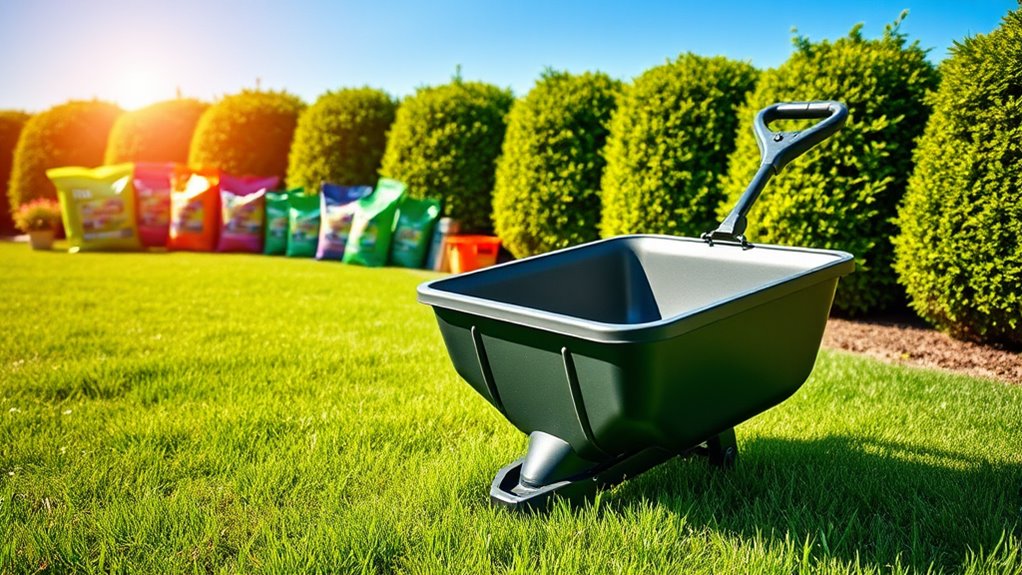
A drop spreader places seed, fertilizer, or ice melt in a controlled band, making it useful near beds, paths, and property edges where broadcast spread can drift. My best overall pick is the VEVOR 50 lb spreader, which pairs a manageable walk-behind format with 30 settings and all-terrain tires. For large lawns, the Agri-Fab 175 lb tow-behind offers a much wider 42-inch path, while the Spyker P70-12010 is the commercial-style option in this lineup. The main tradeoff is maneuverability versus coverage: push models suit tighter spaces, while tow-behind spreaders reduce walking and cover more ground per pass. Read on for the full breakdown and help matching capacity and spread style to your property.

Get business pricing on tools and workshop supplies
- Business-only prices and quantity discounts
- Tax-exempt purchasing
- Multiple users, one account, clear invoices
Complete the kit

Key Takeaways
- VEVOR is the strongest all-around fit: its 50 lb capacity, 18-inch width, 30 settings, and 10-inch all-terrain tires combine useful control with a walk-behind footprint.
- Agri-Fab’s 175 lb tow-behind is built for coverage: its 42-inch spread width and high capacity favor large properties, but the buyer needs a compatible towing setup and room to maneuver.
- The lineup splits sharply by working style: VEVOR, At Home, and Yard Commander are push options; the Agri-Fab models are tow-behind machines, with the 100 lb version adding spiking and seeding functionality.
- Capacity alone does not determine convenience: a bigger hopper means fewer refills, but a full spreader can be harder to handle or store, especially for a buyer without a towing vehicle.
- Material and task compatibility matter: the Agri-Fab spiker seeder is explicitly listed for seed, fertilizer, salt, and ice melt, while buyers should verify suitable materials and cleanup needs for other models.
| VEVOR Broadcast Drop Spreader – 50 lb Capacity, 18‑in Width, 30 Settings, 10‑in All‑Terrain Tires |  | Best for Adjustable Application | Capacity: 50 lb | Spread width: 18 in | Adjustable settings: 30 | VIEW ON AMAZON | See Our Full Breakdown |
| Spyker P70-12010 Commercial Drop Spreader, Black |  | Best for Commercial-Scale Manual Spreading | Hopper capacity: 120 lb | Spread width: Selectable 18 in or 36 in | Rate control: Variable and fixed rate bottoms | VIEW ON AMAZON | See Our Full Breakdown |
| Agri-Fab Tow-Behind Spiker Seeder Drop Spreader for Seed, Fertilizer, Salt and Ice Melt, 100 lb Capacity with 32 in Working Width |  | Best for Seeding and Soil Contact | Capacity: 100 lb | Working width: 32 in | Type: Tow-behind spiker seeder drop spreader | VIEW ON AMAZON | See Our Full Breakdown |
| At Home 75 lb Drop Spreader |  | Best for Low-Maintenance Walk-Behind Use | Capacity: 75 lb | Listed coverage: Up to 10,000 sq ft | Item weight: 24.6 lb | VIEW ON AMAZON | See Our Full Breakdown |
| Agri-Fab 45-0288 Tow-Behind Drop Spreader, 175 lb Capacity, 42-Inch Spread Width |  | Best for Large Properties | Capacity: 175 lb | Hopper volume: 17 gal | Spread width: 42 in | VIEW ON AMAZON | See Our Full Breakdown |
| Yard Commander 60 lb Walk-Behind Push Drop Spreader |  | Best Walk-Behind Capacity | Capacity: 60 lb | Coverage area: Up to 15,000 sq ft | Spread pattern: 22 inches | VIEW ON AMAZON | See Our Full Breakdown |
| drop spreader | Capacity | Spread width | Warranty |
|---|---|---|---|
| VEVOR Broadcast Drop Spreader | 50 lb | 18 in | — |
| Spyker P70-12010 Commercial Dr | — | Selectable 18 in or 36 in | — |
| Agri-Fab Tow-Behind Spiker See | 100 lb | — | Three-year limited |
| At Home 75 lb Drop Spreader | 75 lb | — | — |
| Agri-Fab 45-0288 Tow-Behind Dr | 175 lb | 42 in | Three-year limited consumer |
| Yard Commander 60 lb Walk-Behi | 60 lb | — | 1-year limited |
More Details on Our Top Picks
VEVOR Broadcast Drop Spreader – 50 lb Capacity, 18‑in Width, 30 Settings, 10‑in All‑Terrain Tires
For a walk-behind spreader that can handle several materials, the VEVOR’s 30 settings give it an adjustment range the At Home 75 lb Drop Spreader does not specify. Its 18-inch width also offers a narrower path than the Agri-Fab 45-0288’s 42-inch tow-behind, which can help when working around lawn edges or tighter areas. The 50 lb hopper means fewer stops than a small-capacity spreader, though it holds less than the At Home and far less than the tow-behind options. The steel frame and all-terrain wheels suit varied surfaces, but a full hopper adds pushing effort. The description lists pneumatic tires, which can be vulnerable to punctures on rough ground, so this is not my first choice for consistently rocky routes.
Pros:- 30 adjustable settings offer fine control across different materials
- 50 lb hopper reduces refill stops compared with smaller-capacity options
- 18-inch width is more manageable around tighter lawn areas than the 42-inch Agri-Fab 45-0288
- Powder-coated steel frame and all-terrain wheels support use on varied surfaces
Cons:- A full 50 lb load can make the unit harder to push, particularly on firm ground
- Pneumatic tires can be punctured on rough terrain
- Smaller hopper than the At Home 75 lb and larger tow-behind models
Best for: Homeowners who want adjustable application rates and an 18-inch walk-behind spreader for lawns, gravel, or seasonal ice melt
Not ideal for: Buyers covering large properties who want fewer refills, or anyone who needs a tow-behind model for low-effort coverage
- Capacity:50 lb
- Spread width:18 in
- Adjustable settings:30
- Wheel size:10 in
- Wheel type:Explosion-proof plastic, all-terrain; pneumatic tires listed
- Frame material:Powder-coated steel
Our verdict“Choose the VEVOR if adjustable settings and walk-behind control matter more than maximum capacity or effortless tow-behind coverage.”
Spyker P70-12010 Commercial Drop Spreader, Black
The Spyker P70-12010 is the strongest fit here for buyers who want a large manual drop spreader with selectable width. Its two sections let you choose 18 or 36 inches, offering more flexibility than the fixed 32-inch Agri-Fab tow-behind spiker seeder. Variable and fixed rate bottoms also give operators control over application, a useful distinction when changing materials or working across different areas. The 120 lb hopper cuts refill interruptions, but it comes with a substantial 65 lb unit weight before loading. Unlike the Agri-Fab 45-0288, this Spyker does not require a tractor; the tradeoff is that the operator must push it. I’d skip it for small, awkward lawns where its size and loaded weight are more burden than benefit.
Pros:- Selectable 18-inch or 36-inch spreading width adapts to different areas
- 120 lb hopper reduces refill frequency on larger jobs
- Variable and fixed rate bottoms support controlled application
- Pneumatic tires are designed to spread weight and help limit ruts
Cons:- 65 lb unit weight makes it demanding to maneuver even before loading
- Large dimensions may be cumbersome in confined storage areas
- Manual operation can be tiring over extensive or sloped ground
Best for: Groundskeepers and owners of sizable properties who want a high-capacity manual spreader with selectable working width and rate control
Not ideal for: People with small or steep lawns, or buyers seeking a lightweight push spreader that is easy to maneuver when full
- Hopper capacity:120 lb
- Spread width:Selectable 18 in or 36 in
- Rate control:Variable and fixed rate bottoms
- Item weight:65 lb
- Tires:13 x 5 in pneumatic
- Frame material:Alloy steel
- Dimensions:45 x 46 x 27 in
Our verdict“Pick the Spyker for adjustable, high-capacity manual spreading, but choose a tow-behind model if pushing a heavy load is impractical.”
Agri-Fab Tow-Behind Spiker Seeder Drop Spreader for Seed, Fertilizer, Salt and Ice Melt, 100 lb Capacity with 32 in Working Width
This Agri-Fab combines a drop spreader with a spiker seeder, making it the specialized pick for buyers who want to apply seed while working the ground. Its 32-inch working width covers more per pass than the VEVOR’s 18-inch width, while its 100 lb capacity means fewer refills than that walk-behind model. The added spiker function is the key difference from the straightforward Agri-Fab 45-0288, which offers a wider 42-inch path and a larger hopper for broad property maintenance. This model instead targets seeding tasks where ground contact matters. It requires a tow vehicle, so it is unsuitable for operators without compatible equipment or for small spaces that need hand-guided precision. A three-year limited warranty is included.
Pros:- Spiker-seeder design adds ground-contact seeding capability
- 100 lb capacity reduces refill breaks
- 32-inch working width covers more per pass than the VEVOR’s 18-inch width
- Three-year limited warranty is specified
Cons:- Requires a tow vehicle and cannot be used as a portable walk-behind spreader
- Narrower working width and lower capacity than the Agri-Fab 45-0288
- Combination spiker-seeder function may be unnecessary for buyers who only need basic spreading
Best for: Lawn owners with a compatible tow vehicle who want to spread seed while using a spiker seeder for ground-contact seeding work
Not ideal for: Buyers without a lawn tractor or other tow vehicle, or those who need a compact manual spreader for small lawns
- Capacity:100 lb
- Working width:32 in
- Type:Tow-behind spiker seeder drop spreader
- Listed materials:Seed, fertilizer, salt, and ice melt
- Power method:Tow-behind; requires a tow vehicle
- Warranty:Three-year limited
Our verdict“Choose this Agri-Fab when tow-behind seeding with ground contact is the priority, not maximum capacity or the widest coverage.”
At Home 75 lb Drop Spreader
The At Home 75 lb Drop Spreader makes a practical middle ground between the VEVOR’s 50 lb hopper and the heavy-capacity Spyker P70-12010. Its 75 lb capacity suits larger manual jobs without moving up to a 120 lb load, while 10-inch never-flat tires avoid the puncture concern associated with the VEVOR’s pneumatic tires. A poly tray, galvanized steel agitators, and maintenance-free steel flow control emphasize straightforward upkeep. Its stated coverage is up to 10,000 square feet, which makes it more relevant to residential lawns than the Agri-Fab 45-0288’s approximate 40,000-square-foot coverage. Still, this is a manual unit weighing 24.6 lb before material is added; steep ground or long pushing sessions can be tiring. Buyers who need a tow-behind setup should choose one of the Agri-Fab models instead.
Pros:- 75 lb capacity suits larger residential jobs with fewer refills than the VEVOR
- Never-flat 10-inch rubber tires avoid pneumatic tire inflation and puncture concerns
- Galvanized steel agitators and maintenance-free steel flow control support routine use
- Foam-padded handles add comfort during manual operation
Cons:- Manual pushing can be labor-intensive on slopes or across long distances
- 24.6 lb listed weight increases once the hopper is loaded
- 32-inch overall width may be awkward in narrow storage spaces or tight passages
Best for: Homeowners maintaining up to about 10,000 square feet who want a manual spreader with a larger hopper and tires that do not require inflation
Not ideal for: Owners of acreage who want tractor-powered coverage, or anyone who needs an especially light spreader for steep terrain
- Capacity:75 lb
- Listed coverage:Up to 10,000 sq ft
- Item weight:24.6 lb
- Tray material:Poly
- Wheel type:No-flat rubber
- Wheel diameter:10 in
- Overall dimensions:32 in W x 42.5 in D x 31.5 in H
Our verdict“Choose the At Home for low-maintenance, walk-behind spreading on a residential property, but move to a tow-behind model for much larger areas.”
Agri-Fab 45-0288 Tow-Behind Drop Spreader, 175 lb Capacity, 42-Inch Spread Width
For a large lawn or property, the Agri-Fab 45-0288 leads this group on hopper capacity and working width: it holds 175 lb and spreads across 42 inches. That combination can reduce both refills and passes compared with the 100 lb, 32-inch Agri-Fab spiker seeder. Its rustproof poly hopper is built for weather exposure and year-round materials such as seed, fertilizer, salt, and ice melt. The tradeoff is dependence on a lawn or garden tractor, plus the need to calibrate a drop pattern carefully for even coverage. Unlike the walk-behind At Home model, it is not suited to small lawns or hand-guided work around tight borders. The stated approximate coverage of 40,000 square feet makes this a better match for acreage than routine compact-yard maintenance.
Pros:- 175 lb capacity limits refill stops on extensive jobs
- 42-inch spread width covers more ground per pass than the other listed models
- Rustproof poly hopper is suited to weather exposure and year-round use
- Approximate 40,000-square-foot coverage is a fit for large properties
Cons:- Requires a lawn or garden tractor for operation
- Drop-spreader pattern calls for careful calibration to avoid uneven application
- Large capacity and width are excessive for many small residential lawns
Best for: Owners of large lawns or properties with a lawn or garden tractor who want high-capacity coverage across broad, open areas
Not ideal for: Small-yard owners without a tow vehicle, or buyers who need a portable spreader for tight areas and precise hand-guided passes
- Capacity:175 lb
- Hopper volume:17 gal
- Spread width:42 in
- Approximate coverage:40,000 sq ft
- Hopper material:Rustproof poly
- Warranty:Three-year limited consumer
- Origin:Made in USA
Our verdict“Choose the Agri-Fab 45-0288 for broad, tractor-towed coverage on a large property; skip it if you need compact or manual control.”
Yard Commander 60 lb Walk-Behind Push Drop Spreader
The Yard Commander pairs a 60 lb hopper with a 22-inch drop pattern, making it a practical choice for covering a substantial lawn without stepping up to a tow-behind unit. Its stated coverage reaches 15,000 sq ft, while the adjustable flow handle gives you control over how quickly seed or fertilizer leaves the hopper. Compared with the VEVOR Broadcast Drop Spreader, this model offers a larger capacity and wider stated pattern, but it is a drop spreader rather than a broadcast design, so its application path is more confined and calls for straighter passes.
The composite hopper resists corrosion and is easier to clean than a metal bin, and the 12-inch never-flat tires avoid punctures on uneven ground. The tradeoff is a 13.4 lb unit and a one-year limited warranty; buyers who need much greater capacity may prefer a tow-behind option such as the Agri-Fab 45-0288.
Pros:- 60 lb capacity reduces refill stops during lawn applications.
- 22-inch spread pattern and adjustable flow support controlled, straight-line coverage.
- Composite hopper resists corrosion and is easy to clean.
- 12-inch never-flat tires avoid punctures on varied terrain.
Cons:- At 13.4 lb, it may feel cumbersome for users seeking a lighter walk-behind model.
- One-year limited warranty offers a relatively short coverage period.
- Drop-style application requires straighter, carefully planned passes than a broadcast spreader.
Best for: Homeowners with medium-to-large lawns who want a walk-behind drop spreader, fewer hopper refills, and tires that can handle varied yard terrain.
Not ideal for: Owners of very large properties who want to cover ground from a riding mower, or buyers seeking a long warranty and a lighter-feeling push spreader.
- Capacity:60 lb
- Coverage area:Up to 15,000 sq ft
- Spread pattern:22 inches
- Dimensions:27.7 x 26.8 x 32.6 in
- Weight:13.4 lb
- Tires:12-inch never-flat
- Frame:Powder-coated steel
- Hopper:Composite
- Warranty:1-year limited
Our verdict“Choose the Yard Commander for high-capacity walk-behind spreading on a sizable lawn, but consider a tow-behind model if your property calls for faster coverage from a mower.”

How We Picked
I compared these six spreaders by the factors that change day-to-day use: push versus tow operation, hopper capacity, working width, adjustment range, terrain handling, and stated material uses. I also weighed how much control a model appears to offer around lawn edges against how quickly it can cover open ground. Since specifications alone do not establish durability, calibration accuracy, or performance with every material, I avoid treating unlisted details as proven advantages.
The ranking favors versatility for the widest range of homeowners first, then gives dedicated roles to large-area towing, commercial-style use, and simpler or specialized needs. The VEVOR leads for its mix of capacity, settings, width, and tire size. The Agri-Fab 175 lb ranks as the large-lawn specialist rather than the universal choice; the remaining models are differentiated by commercial positioning, spiking and seeding functions, or a simpler push-spreader format. Buyers should confirm tow compatibility, dimensions, and material guidance before choosing.
Factors to Consider When Choosing Drop Spreader
Choosing a drop spreader is less about finding the biggest hopper and more about matching the machine to your property, material, and working pattern. These broader checks can prevent a spreader that looks capable on paper from becoming awkward to use or difficult to store.
Match the drive style to your lawn and equipment
A walk-behind spreader gives you direct control over pace and turns, which helps around trees, narrow strips, and garden borders. A tow-behind model can cut down on walking across open lawns, but it depends on a compatible vehicle or tractor and enough turning space. Buyers sometimes choose towing for its apparent speed without checking whether their lawn has tight gates or obstacles. Also account for where the unit will be stored and whether it can be moved when loaded. If you do not already own suitable towing equipment, the total setup may favor a push model even when its hopper is smaller.
Choose capacity for refill frequency, not bragging rights
Capacity affects how often you stop to refill, but it also affects the load you push or tow. A large hopper can be helpful on an expansive property, yet a full load may be cumbersome to maneuver and harder to lift or empty. On a smaller lawn, a compact capacity can make storage and handling easier without adding much refill time. Estimate how much material your lawn requires per application before paying for extra capacity. Use the manufacturer’s loading and operating guidance, since maximum capacity does not tell you how heavy a particular seed, fertilizer, or ice melt will be.
Treat working width as a control tradeoff
A wider drop path can reduce the number of passes across a large, open area. That same width can make precise work beside beds, walkways, and property boundaries less convenient. A narrow spreader offers more control in confined areas but takes longer to cover broad lawns. Think about the shape of your lawn as well as its total area; long uninterrupted runs benefit more from width than irregular plots do. Plan to overlap passes consistently, because an advertised width does not by itself guarantee an even application.
Check material compatibility and cleanup demands
Seed, granular fertilizer, salt, and ice melt differ in size, shape, and handling needs, so one spreader may not suit every material equally well. Look for explicit manufacturer guidance for the products you plan to apply rather than assuming a hopper’s capacity means universal compatibility. Salt and ice melt can leave residue, making prompt cleaning and drying especially relevant to long-term upkeep. Fine or irregular materials may also behave differently through the gate, which can affect flow. If you intend to switch materials often, ask how the hopper and dispensing mechanism are cleaned and whether any parts need special care.
Prioritize calibration and repeatable settings
Even distribution depends on setting the flow rate for the specific material and application, not just choosing a number on a dial. A model with many settings may give finer adjustment, but it still needs calibration against the product label and the spreader’s instructions. A common mistake is to keep moving at the same speed while changing material; granule size and recommended application rates can call for a different setting. Keep notes on the material, setting, and walking pace that work for your lawn. For any model, begin conservatively and check the result before covering the entire area.
Consider whether a specialty function earns its upkeep
A spiker-seeder combines more than simple material distribution, which may appeal to someone who wants to seed while working the soil. That added function is useful only if it matches the lawn’s condition and the jobs you plan to perform. A dedicated drop spreader is simpler when controlled application is the main goal, while a combination unit can involve extra setup and maintenance. Check which functions can operate independently and what adjustments each task requires. Buyers should pay for added mechanisms only when they expect to use them, rather than treating extra features as automatic value.
Frequently Asked Questions
Is a drop spreader a better choice than a broadcast spreader for a small lawn?
It can be, particularly if your lawn has narrow edges, nearby planting beds, or paths where stray granules are unwelcome. A drop spreader releases material beneath its hopper rather than throwing it outward, which gives you a more defined application band. The tradeoff is that you need overlapping, consistent passes to cover the lawn evenly, and the work can take longer on large open areas. For a small, irregular lawn, control may matter more than speed. For broad, obstacle-free ground, a broadcast spreader may cover the area faster.
Should I choose a push model or a tow-behind drop spreader?
Choose based on the ground you need to cover and the equipment you already own. Push models make more sense for smaller or obstacle-filled lawns and do not require a towing vehicle, while tow-behind units suit larger open areas where walking every pass would be tiring. A tow-behind also needs space to turn and a compatible hitch or connection. Do not compare hopper capacity without factoring in the loaded weight and storage footprint. If you are unsure, the lawn’s layout and your available towing equipment are better guides than capacity alone.
Can I use one drop spreader for seed, fertilizer, salt, and ice melt?
Not automatically. Material compatibility depends on the spreader’s manufacturer guidance, the size and shape of the granules, and the unit’s dispensing mechanism. The Agri-Fab spiker seeder in this roundup is specifically listed for seed, fertilizer, salt, and ice melt, but that claim should not be applied to the other models. Salt and ice melt can also leave residue, so cleaning after use matters. Check the manual for approved materials and cleanup instructions before changing what you apply.
Does a wider drop spreader always finish the job faster?
A wider working path can reduce the number of passes on a large, open lawn, but it is not always faster in practice. A broad unit may be harder to guide close to edges or around obstacles, and irregular lawns can require frequent turns that erase some of the time saved. A narrower path can be easier to control in tight spaces, though it takes more passes over open ground. Think about usable straight-line runs, not only the lawn’s total area. Consistent overlap and a steady pace also affect how quickly you can finish without leaving missed strips.
How do I avoid applying too much or leaving stripes?
Start with the application rate on the material label and the spreader’s instructions, then calibrate for that particular product. Walk at a steady pace and overlap passes as directed; changing speed or spacing can create uneven bands. A high setting is not a shortcut to faster coverage if it delivers more material than the lawn needs. Try a small test area first and inspect the result before treating the whole lawn. Record the material, setting, and pace so you can repeat a successful application later.
Conclusion
For most homeowners, I recommend the VEVOR 50 lb spreader as the best overall because its walk-behind format, 30 settings, 18-inch width, and all-terrain tires balance control with practical capacity. The best choice for large lawns is the Agri-Fab 175 lb tow-behind, provided you have compatible towing equipment and room to turn. For a specialty job involving seeding and several listed materials, the Agri-Fab 100 lb spiker seeder is the specific-use pick; the Spyker suits buyers focused on a commercial-style model. Beginners or buyers seeking a straightforward push format can compare the At Home 75 lb and Yard Commander 60 lb, choosing by their desired capacity and stated features rather than assuming either has advanced adjustment. If you want the clearest all-around balance, choose VEVOR; if reducing passes over a large area matters most, choose the 42-inch Agri-Fab tow-behind.
Fall Picks

Arlo Essential Outdoor Pan-Tilt-Zoom Security Camera, 2K, Wired, 2-Camera Pack
As an affiliate, we earn on qualifying purchases.