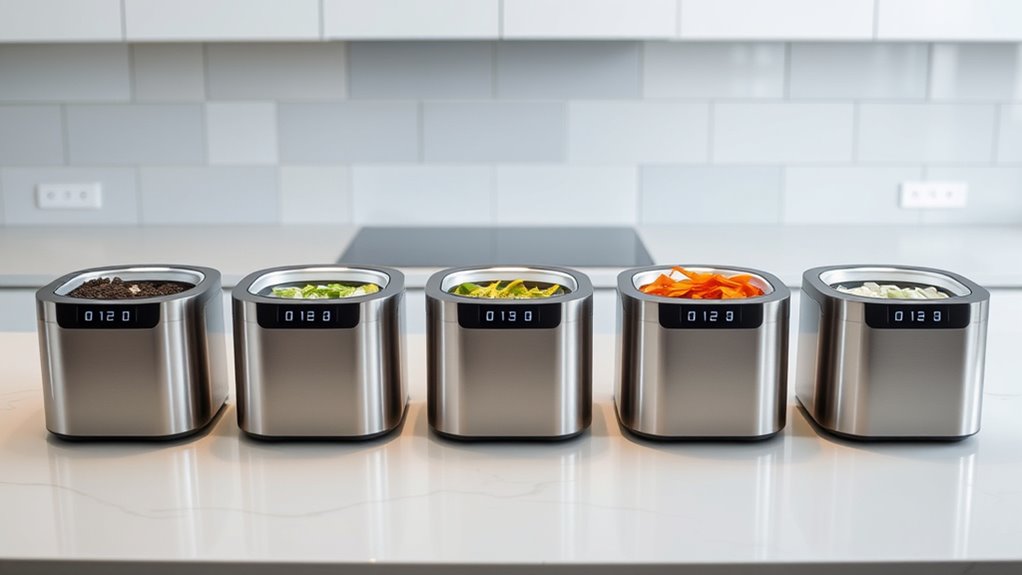

For most kitchens, I’d start with the Reencle Prime 14L: its larger capacity suits households that produce more scraps, while the compact Saluna 3L and Airthereal R500 are better fits when counter space is limited. The Growell 4L with brushless motor is another standout for shoppers who want a mid-size option with a motor-focused design. The main tradeoff is straightforward: larger bins mean fewer emptying cycles but take up more room, while smaller units are easier to place but fill sooner. Features such as filters, smart controls, and included accessories can also affect daily convenience and upkeep. Read on for how all 15 options compare and which electric compost bin for kitchen use best matches your routine.

Get business pricing on tools and workshop supplies
- Business-only prices and quantity discounts
- Tax-exempt purchasing
- Multiple users, one account, clear invoices
Complete the kit



Key Takeaways
- Capacity is the clearest dividing line: the two 14L Reencle Prime models are the largest listed options, while several compact picks hold around 2.5L to 3.2L.
- The Reencle Prime 14L is the household-size pick: its capacity gives it a different role from the countertop-focused 3L and 4L models, though it needs more room.
- Compact models trade fewer space demands for more frequent attention: Saluna, Assark, and Airthereal’s 2.5L R500 models suit tighter kitchens but have less capacity.
- Some products are near-duplicates in the lineup: Growell 4L listings and Ouaken 4L listings appear more than once, so buyers should check the exact variant and included features rather than relying on name alone.
- Controls and odor-management details help distinguish otherwise similar sizes: the Assark 5L is identified as smart, the KEEPEEZ has a touchscreen, and the Assark 3L lists a carbon filter.
| Growell 4L Electric Kitchen Composter with Brushless Motor, Black |  | Best for Flexible Processing Modes | Capacity: 4 L | Motor: Brushless | Processing modes: Auto (4–6 hours), Manual (1–6 hours), fermentation (10 hours) | VIEW ON AMAZON | See Our Full Breakdown |
| Reencle Prime 14L Electric Kitchen Composter |  | Best for High-Capacity Scrap Processing | Capacity: 14 L | Daily processing capacity: Up to 2.2 lbs of food scraps | Processing time: 2–24 hours | VIEW ON AMAZON | See Our Full Breakdown |
| Assark 5L Smart Electric Kitchen Composter |  | Best for Households Wanting a Clean Cycle | Capacity: Listed as both 5L and 6L | Model: HQD-450 | Modes: Compost, Quick, Clean | VIEW ON AMAZON | See Our Full Breakdown |
| Ouaken OK-255 5.5L Electric Kitchen Composter |  | Best for Mode Variety | Capacity: 5.5 L | Model: OK-255 | Modes: Standard, Quick, Crush, Clean, Store | VIEW ON AMAZON | See Our Full Breakdown |
| Ouaken 4L Electric Kitchen Composter |  | Best for Simple, Fast Cycles | Capacity: 4 L | Model: JF6001A | Waste reduction: Up to 90% in about 3 hours | VIEW ON AMAZON | See Our Full Breakdown |
| Reencle Prime Electric Composter, 14L, White |  | Best for High-Capacity Kitchen Composting | Capacity: 14 liters | Daily processing capacity: Up to 2.2 lbs | Processing time: 2–24 hours | VIEW ON AMAZON | See Our Full Breakdown |
| Saluna 3L Compact Electric Countertop Composter |  | Best for Beginners | Capacity: 3 liters | Modes: Quick and Standard | Composting time: 4 or 6 hours | VIEW ON AMAZON | See Our Full Breakdown |
| Assark 3L Electric Kitchen Composter with Carbon Filter |  | Best for Simple, Quiet Processing | Capacity: 3 L | Model: HQD-260C | Processing time: 4–6 hours | VIEW ON AMAZON | See Our Full Breakdown |
| Ouaken 4L Electric Kitchen Composter |  | Best for Easier Batch Cleanup | Capacity: 4 L | Model: J6001A | Noise level: Below 40 dBA | VIEW ON AMAZON | See Our Full Breakdown |
| Growell 3.2 L Electric Countertop Composter |  | Best for Adjustable Processing | Capacity: 3.2 L | Modes: Automatic and manual | Automatic processing time: Up to 8 hours | VIEW ON AMAZON | See Our Full Breakdown |
| Airthereal R500 Electric Kitchen Composter, 2.5 L, Gray |  | Best for Simple Operation | Capacity: 2.5 liters | Cycle time: 4 hours | Waste volume reduction: Up to 90% | VIEW ON AMAZON | See Our Full Breakdown |
| KEEPEEZ 1-Gallon Electric Composter with Touchscreen |  | Best for Quiet Kitchens | Model: FWD-301 | Capacity: 1 gallon | Composting time: 2–10 hours | VIEW ON AMAZON | See Our Full Breakdown |
| Growell 4L Electric Kitchen Composter with Brushless Motor |  | Best for Flexible Processing | Capacity: 4 L | Motor: Brushless | Processing modes: Auto (4–6 hours), Manual (1–6 hours), Fermentation (10 hours) | VIEW ON AMAZON | See Our Full Breakdown |
| GoveeLife Smart Electric Kitchen Composter |  | Best for App Control | Capacity: 3 L | Noise level: 40 dB | Waste reduction: Up to 90% | VIEW ON AMAZON | See Our Full Breakdown |
| Airthereal R500-V Electric Kitchen Composter, 2.5L, Gray |  | Best for Monitoring the Cycle | Model: Revive R500-V | Capacity: 2.5 liters | Dimensions: 12.5 × 10 × 12.5 inches | VIEW ON AMAZON | See Our Full Breakdown |
| electric compost bin for kitchen | Capacity | Noise level | Model | Modes |
|---|---|---|---|---|
| Growell 4L Electric Kitchen Co | 4 L | — | GWEC01BKD | — |
| Reencle Prime 14L Electric Kit | 14 L | As low as 28 dB | — | — |
| Assark 5L Smart Electric Kitch | Listed as both 5L and 6L | Below 40 dB | HQD-450 | Compost, Quick, Clean |
| Ouaken OK-255 5.5L Electric Ki | 5.5 L | Below 45 dBA | OK-255 | Standard, Quick, Crush, Clean, Store |
| Ouaken 4L Electric Kitchen Com | 4 L | Below 40 dBA | JF6001A | Crush, Ferment, Clean |
| Reencle Prime Electric Compost | 14 liters | As low as 28 dB | — | — |
| Saluna 3L Compact Electric Cou | 3 liters | ≤42 dB | — | Quick and Standard |
| Assark 3L Electric Kitchen Com | 3 L | Under 40 dB | HQD-260C | 3 |
| Ouaken 4L Electric Kitchen Com | 4 L | Below 40 dBA | J6001A | Crush, Ferment, Clean |
| Growell 3.2 L Electric Counter | 3.2 L | As low as 50 dB | — | Automatic and manual |
| Airthereal R500 Electric Kitch | 2.5 liters | — | — | — |
| KEEPEEZ 1-Gallon Electric Comp | 1 gallon | 28 dB | FWD-301 | Two composting modes and one auto-cleaning mode |
| Growell 4L Electric Kitchen Co | 4 L | — | — | — |
| GoveeLife Smart Electric Kitch | 3 L | 40 dB | H7184 | Composting, storage, and self-cleaning |
| Airthereal R500-V Electric Kit | 2.5 liters | — | Revive R500-V | — |
More Details on Our Top Picks
Growell 4L Electric Kitchen Composter with Brushless Motor, Black
The Growell 4L suits kitchens that want more control than a single automatic cycle provides. Its Auto mode runs for 4–6 hours, while Manual mode lets you choose a cycle length; a separate 10-hour fermentation mode adds another option. The brushless motor is designed for quieter, lower-maintenance operation, and a remaining-time display makes it easier to judge when the unit will be free. Compared with the Ouaken 4L JF6001A, Growell offers a wider range of processing controls, while Ouaken specifies a roughly three-hour cycle and a dishwasher-safe bucket. Dual carbon filters and a sealed design help contain kitchen odors, but filters need regular replacement. Its output is dried and reduced, not finished compost, so buyers should be ready to process it further before adding it to soil.
Pros:- Auto, Manual, and fermentation modes provide more cycle flexibility than a single-mode setup.
- Brushless motor is designed for quieter, lower-maintenance operation.
- Dual activated-carbon filters and a sealed design help manage odors.
- LED panel shows remaining cycle time.
Cons:- Dried output may need further processing before it is ready for soil.
- Carbon filters are recommended for replacement about every three months.
- Results can vary with food type, load, and filter condition.
Best for: Home cooks who want several cycle choices, a visible countdown, and a 4L countertop unit.
Not ideal for: People who want finished compost straight from the appliance or do not want to maintain replaceable carbon filters.
- Capacity:4 L
- Motor:Brushless
- Processing modes:Auto (4–6 hours), Manual (1–6 hours), fermentation (10 hours)
- Odor control:Dual activated-carbon filters
- Controls:LED touch panel with remaining-time display
- Model:GWEC01BKD
- Color:Black
- Warranty:3 years
Our verdict“Choose the Growell 4L if flexible cycle control matters more than a short, specified cycle or ready-to-use compost.”
Reencle Prime 14L Electric Kitchen Composter
The Reencle Prime 14L is the clear capacity pick here: its 14-liter chamber and stated daily capacity of up to 2.2 pounds of scraps suit households that generate more kitchen waste than a 4L or 5.5L unit can comfortably accommodate. Unlike the Growell 4L, which dries and reduces scraps through timed cycles, Reencle uses microbial processing and describes its output as compost. Its three-layer filter and low stated noise level of 28 dB also make it a stronger fit for a kitchen where the appliance may run near living areas. The tradeoff is a variable 2–24-hour processing window, so it is harder to plan around a fixed cycle time. It also needs a larger countertop footprint and ongoing access to electricity.
Pros:- 14L capacity and stated daily processing of up to 2.2 pounds suit higher-volume kitchens.
- Microbial processing is intended to produce compost rather than only dried, reduced scraps.
- Three-layer filter system helps manage odors.
- Stated noise level as low as 28 dB, with a starter pack and shovel included.
Cons:- Processing time varies widely from 2 to 24 hours.
- Larger capacity calls for more counter space than the 4L and 5.5L alternatives.
- Requires electricity to operate.
Best for: Families and frequent home cooks who produce substantial scraps and want a larger-capacity microbial composter.
Not ideal for: Apartment dwellers with limited counter space or buyers who need a predictable, short processing cycle.
- Capacity:14 L
- Daily processing capacity:Up to 2.2 lbs of food scraps
- Processing time:2–24 hours
- Processing technology:Microbial
- Noise level:As low as 28 dB
- Odor control:Three-layer filter system
- Color:Silver
- Included accessories:Carbon filter, compost starter pack, and shovel
Our verdict“Pick the Reencle Prime if your household needs far more capacity than the smaller grinders offer and can accommodate its size and variable cycle time.”
Assark 5L Smart Electric Kitchen Composter
The Assark 5L earns its place for households that want a dedicated cleaning mode alongside scrap processing. Its Compost, Quick, and Clean settings separate it from the Ouaken OK-255, whose five modes include Store and Crush but do not list a quick cycle. Double-layer blades are designed to handle tougher scraps, while the sealed, carbon-filtered bucket helps keep odors contained. The lid-open blade shutoff adds a useful safety measure in a busy kitchen. There is a significant information gap, though: the listing gives the capacity as both 5L and 6L, so buyers cannot confidently compare its usable volume with the Ouaken’s specified 5.5L. And the processed material still needs 1–3 weeks to cure and should be mixed with soil.
Pros:- Compost, Quick, and Clean modes cover different processing and maintenance needs.
- Double-layer blades are designed for tougher food scraps.
- Blades stop when the lid opens.
- Sealed bucket and carbon filter are designed to limit odors.
Cons:- Capacity is inconsistent in the product information, which states both 5L and 6L.
- Processed material needs 1–3 weeks to cure and should be mixed with soil before use.
- Listed noise level is below 40 dB, but no exact operating level is provided.
Best for: Households of three to five who value a clean mode, blade safety, and a mid-size countertop unit.
Not ideal for: Buyers who need a confirmed capacity or expect appliance output to be ready for soil immediately.
- Capacity:Listed as both 5L and 6L
- Model:HQD-450
- Modes:Compost, Quick, Clean
- Noise level:Below 40 dB
- Carbon filter life:Up to 6 months
- Scrap volume reduction:Up to 95%
- Recommended household size:3–5 people
- Curing time:1–3 weeks
- Safety feature:Blades stop when the lid opens
Our verdict“Choose the Assark if its clean mode and lid safety matter more to you than having a confirmed capacity or finished material straight away.”
Ouaken OK-255 5.5L Electric Kitchen Composter
The Ouaken OK-255 is a good match for buyers who want one countertop machine to handle different routines: its five modes include Standard, Quick, Crush, Clean, and Store. That breadth gives it an edge over the Growell 4L when dedicated crushing and storage settings matter, though Growell supplies clearer cycle durations and a remaining-time display. At 5.5L, the OK-255 also offers more stated room than either 4L option in this group without reaching the Reencle Prime’s much larger 14L scale. Drying, grinding, and cooling reduce waste volume by up to 90%, but the product information does not specify cycle length or energy use, making day-to-day planning harder. The filter needs periodic replacement, and its under-45-dBA noise figure is less specific than some alternatives.
Pros:- Five modes include Standard, Quick, Crush, Clean, and Store.
- 5.5L capacity is larger than the 4L models in this group.
- Reduces food-waste volume by up to 90%.
- Transparent flip-top lid and moisture collection tray add useful day-to-day features.
Cons:- Processing time and energy use are not specified.
- Activated-carbon filter replacement is listed at approximately every five months.
- Noise is specified only as below 45 dBA.
Best for: Home cooks who want several purpose-specific modes and more capacity than a 4L countertop composter.
Not ideal for: Buyers who need a stated processing time, energy-use information, or a very quiet appliance by a clearly defined noise figure.
- Capacity:5.5 L
- Model:OK-255
- Modes:Standard, Quick, Crush, Clean, Store
- Noise level:Below 45 dBA
- Food-waste volume reduction:Up to 90%
- Filter replacement interval:Approximately 5 months
- Non-stick coating hardness:9H
- Lid:Transparent flip-top
Our verdict“Choose the OK-255 if mode choice and a 5.5L chamber matter more than a clearly stated cycle time or energy figure.”
Ouaken 4L Electric Kitchen Composter
The Ouaken 4L JF6001A is the straightforward choice for buyers who prioritize a defined processing time and easy cleanup. It claims up to 90% volume reduction in about three hours, a clearer schedule than the Ouaken OK-255, whose listing gives no cycle duration. Its detachable, dishwasher-safe bucket also makes routine cleaning simpler than the Growell 4L, which emphasizes cycle flexibility and a brushless motor instead. Crush, Ferment, and Clean modes cover basic processing and maintenance, while the carbon filter is listed for up to five months of use. The capacity is still 4L, so households producing large amounts of scraps may fill it quickly. The product information also does not say which food materials it can process, leaving some uncertainty for buyers with varied kitchen waste.
Pros:- States up to 90% waste reduction in about three hours.
- Detachable bucket is dishwasher safe.
- Crush, Ferment, and Clean modes provide basic operating and cleaning options.
- Noise level is listed below 40 dBA.
Cons:- 4L capacity may be limiting for households that produce many scraps.
- Product information does not specify which food materials it can process.
- Carbon filter life is listed as up to five months, so replacement remains part of upkeep.
Best for: One- or two-person households that want a defined roughly three-hour cycle and a bucket that can go in the dishwasher.
Not ideal for: Large households, or buyers who need clear guidance on which food scraps are suitable for processing.
- Capacity:4 L
- Model:JF6001A
- Waste reduction:Up to 90% in about 3 hours
- Noise level:Below 40 dBA
- Modes:Crush, Ferment, Clean
- Carbon filter life:Up to 5 months
- Bucket:Detachable and dishwasher safe
- Color:Black
Our verdict“Pick this Ouaken 4L if a roughly three-hour cycle and dishwasher-safe bucket are more useful to you than larger capacity or detailed food-compatibility guidance.”
Reencle Prime Electric Composter, 14L, White
The 14-liter capacity makes the Reencle Prime the clearest choice here for households that produce more scraps than a small countertop unit can handle. It can process up to 2.2 pounds daily, while the Saluna and Assark each hold only 3 liters, so fewer batches may be needed. Its microbial process takes anywhere from 2 to 24 hours, a less predictable schedule than the Saluna’s fixed 4- or 6-hour modes. The three-layer filter and operation as quiet as 28 dB suit kitchens where odor and noise matter, and the included starter pack, carbon filter, and shovel help get it set up. The tradeoff is its 20.1-pound weight and larger 12 × 13 × 18.4-inch footprint; this is a substantial appliance, not a discreet small-kitchen pick.
Pros:- 14-liter capacity and daily processing of up to 2.2 pounds suit higher-volume households
- Three-layer filter is designed to minimize odors
- Quiet operation as low as 28 dB
- Includes a carbon filter, compost starter pack, and shovel
Cons:- At 20.1 pounds, it is heavy to move
- Processing time varies widely from 2 to 24 hours
- Its dimensions take up more space than the 3-liter Saluna and Assark
Best for: Households that generate a steady volume of food scraps and have counter or floor space for a larger indoor unit.
Not ideal for: People with limited kitchen space or anyone who wants a lightweight bin with a fixed, predictable cycle time.
- Capacity:14 liters
- Daily processing capacity:Up to 2.2 lbs
- Processing time:2–24 hours
- Noise level:As low as 28 dB
- Dimensions:12 × 13 × 18.4 in
- Weight:20.1 lbs
- Material and color:Polypropylene (PP), Star White
- Included accessories:Carbon filter, compost starter pack, shovel
Our verdict“Choose the Reencle Prime if household capacity matters more than a compact footprint or a tightly timed cycle.”
Saluna 3L Compact Electric Countertop Composter
The Saluna is a straightforward fit for someone trying an electric compost bin for the kitchen without committing to a large-capacity appliance. Its 3-liter bowl is smaller than the Ouaken’s 4-liter bucket and far below the Reencle Prime’s 14 liters, so it suits modest daily scraps rather than a busy household. Quick and Standard modes give a clear 4- or 6-hour cycle, making the expected wait easier to plan around than the Reencle’s variable 2–24 hours. Cleanup is another point in its favor: the detachable liner is dishwasher safe, and a self-cleaning cycle reduces routine scrubbing. The compromises are capacity and filter upkeep; replacement carbon filters may be needed, and the elongated 16.54-inch dimension means “compact” does not mean especially short on counter space.
Pros:- Two easy-to-understand modes finish in 4 or 6 hours
- Detachable liner is dishwasher safe
- Self-cleaning cycle can reduce manual cleanup
- Activated carbon filter is included for odor control
Cons:- 3-liter capacity requires more frequent emptying than the Ouaken 4L
- Replacement carbon filters may need to be swapped
- Its 16.54-inch length can take up noticeable counter space
Best for: First-time buyers in smaller households who want simple cycle choices and a removable liner they can wash in the dishwasher.
Not ideal for: Families or frequent cooks who need to process larger batches, or buyers seeking the smallest possible countertop footprint.
- Capacity:3 liters
- Modes:Quick and Standard
- Composting time:4 or 6 hours
- Noise level:≤42 dB
- Dimensions:16.54 × 8.27 × 13.39 in
- Material:Metal, stainless steel
- Cleaning:Self-cleaning; detachable liner is dishwasher safe
- Included:Replacement carbon filters
Our verdict“Pick the Saluna if you want a beginner-friendly, easy-to-clean unit for small batches and can work with its limited capacity.”
Assark 3L Electric Kitchen Composter with Carbon Filter
Assark’s strongest case is a quiet, compact drying-and-crushing routine with useful safeguards and cleanup features. It reduces food-scrap volume by up to 90% in 4–6 hours, and its noise level stays under 40 dB—quieter on paper than the Saluna’s stated ceiling of 42 dB. A lid-open pause adds a practical safety measure, while the removable non-stick bucket and auto-clean function help with maintenance. Like the Saluna, though, its 3-liter capacity is better matched to smaller batches than the Ouaken 4L. The carbon filter is rated for up to three months, so it may need attention sooner than the Ouaken’s stated filter life of up to five months. Its feature set is appealing, but it remains a small-batch appliance with ongoing filter replacement to plan for.
Pros:- Processes scraps in 4–6 hours and reduces volume by up to 90%
- Noise level is under 40 dB
- Removable non-stick bucket and auto-clean function simplify cleanup
- Pauses when the lid is opened
Cons:- 3-liter capacity is limited for larger households
- Carbon filter life is up to three months
- The listed processing range does not offer a faster fixed cycle than the Saluna’s Quick mode
Best for: Apartment dwellers or smaller households who value quieter operation, a lid safety pause, and a removable bucket.
Not ideal for: High-volume cooks who want fewer batches or buyers who prefer longer intervals between carbon-filter replacements.
- Capacity:3 L
- Model:HQD-260C
- Processing time:4–6 hours
- Waste volume reduction:Up to 90%
- Noise level:Under 40 dB
- Modes:3
- Carbon filter life:Up to 3 months
- Warranty:12-month limited warranty
Our verdict“Choose Assark for quiet, safety-conscious small-batch processing, but look to the Ouaken if you need more capacity and longer stated filter life.”
Ouaken 4L Electric Kitchen Composter
Compared with the 3-liter Saluna and Assark, the Ouaken gives you 4 liters of capacity without moving up to the much larger Reencle Prime. Its detachable bucket is dishwasher safe, which makes emptying and washing less of a chore after processing. The unit combines Crush, Ferment, and Clean modes with high-temperature drying, grinding, and cooling, and it is rated below 40 dBA. The carbon filter life is listed as up to five months, longer than Assark’s stated three months, though actual replacement needs can depend on use. There is a handling caveat: the bucket should be emptied before each cycle to prevent clumping and malfunctions. Reprocessing the same batch can also add time and power use, so this is a better fit for users who can run and empty batches routinely.
Pros:- 4-liter capacity exceeds the Saluna and Assark 3-liter bins
- Detachable bucket is dishwasher safe
- Three modes cover crushing, fermenting, and cleaning
- Noise level is below 40 dBA, with filter life listed up to five months
Cons:- Bucket should be emptied before each cycle to avoid clumping and possible malfunctions
- Running the same batch repeatedly can increase cycle time and power use
- No specific processing-time range is provided in the product data
Best for: Regular home cooks who want more capacity than a 3-liter bin and value a detachable, dishwasher-safe bucket.
Not ideal for: Anyone who wants to leave scraps in the machine across cycles or avoid managing batch size and emptying.
- Capacity:4 L
- Model:J6001A
- Noise level:Below 40 dBA
- Waste reduction:Up to 90%
- Modes:Crush, Ferment, Clean
- Carbon filter life:Up to 5 months
- Bucket:Detachable and dishwasher safe
- Color:White
Our verdict“The Ouaken suits buyers who want a mid-size kitchen composter and will keep up with emptying each processed batch.”
Growell 3.2 L Electric Countertop Composter
The Growell 3.2L is a more configurable choice than the Saluna, which offers only Quick and Standard cycles: here, buyers can select automatic or manual processing, with manual timing adjustable from 1 to 10 hours. That flexibility suits people who want more control over a batch, while the automatic cycle can take up to eight hours. Its grinding, high-temperature drying, and cooling reduce waste volume by up to 90%, and a built-in cleaning mode helps with routine care. The brushless motor and odor-filtering design are useful features, but the stated noise level can reach 50 dB—higher than the Assark and Ouaken, both listed below 40 dB. At 3.2 liters, it also offers only a modest capacity increase over the Saluna and Assark. The three-year warranty is a distinct advantage, though filter attention is prompted after 300 hours of use.
Pros:- Automatic and manual modes provide different levels of control
- Manual processing time is adjustable from 1 to 10 hours
- Built-in cleaning mode eases maintenance
- Three-year warranty and brushless motor are specified
Cons:- Automatic processing can take up to eight hours
- Noise level is listed as as low as 50 dB, higher than the Assark and Ouaken ratings
- Filter attention is required after 300 hours of use
Best for: Buyers who want to adjust processing time manually, with a built-in cleaning mode and a stated three-year warranty.
Not ideal for: Noise-sensitive households or anyone who wants a larger batch capacity and a consistently short cycle.
- Capacity:3.2 L
- Modes:Automatic and manual
- Automatic processing time:Up to 8 hours
- Manual processing time:1–10 hours
- Waste volume reduction:Up to 90%
- Noise level:As low as 50 dB
- Storage mode:12 or 24 hours
- Filter alert:After 300 hours of use
- Warranty:3 years
Our verdict“Choose the Growell if adjustable manual timing and warranty coverage matter more to you than quieter operation or a larger capacity.”
Airthereal R500 Electric Kitchen Composter, 2.5 L, Gray
The Airthereal R500 suits buyers who want a straightforward countertop routine: load scraps, press one button, and let its 4-hour drying-and-grinding cycle turn them into powder. Its 2.5-liter capacity is smaller than the Growell 4L, so households that produce a steady stream of scraps may need to run it more often. The cast-aluminum bucket is dishwasher safe, which makes cleanup less hands-on than with a unit that relies on manual scrubbing. Carbon filters help limit odors, but they do not change the fact that processing takes several hours. At 16.8 pounds, it is also not especially light to move around. I’d choose it for ease and low-fuss controls, not for speed or larger-batch capacity.
Pros:- One-button operation keeps the process simple.
- Reduces food-scrap volume by up to 90%.
- Cast-aluminum bucket is dishwasher safe.
- Carbon filters help control odors between cycles.
Cons:- The 4-hour cycle is a slow fit for frequent batches.
- At 16.8 pounds, it is relatively heavy for an appliance that may need to be moved.
- Its 2.5-liter capacity is smaller than the Growell 4L.
Best for: One- or two-person households that want simple controls, reduced scrap volume, and a dishwasher-safe bucket.
Not ideal for: Busy households that fill a 2.5-liter bin quickly, or buyers who want short cycles and an easy-to-move appliance.
- Capacity:2.5 liters
- Cycle time:4 hours
- Waste volume reduction:Up to 90%
- Blade design:SHARKSDEN tri-blade
- Bucket material and care:Cast aluminum; dishwasher safe
- Dimensions:12.5 × 10 × 12.5 inches
- Weight:16.8 pounds
- Warranty:1 year
Our verdict“Choose the R500 if you value easy one-button use and dishwasher cleanup more than fast processing or a larger capacity.”
KEEPEEZ 1-Gallon Electric Composter with Touchscreen
For an open-plan kitchen or a home where appliance noise is a concern, the KEEPEEZ FWD-301 has a clear advantage: its listed 28 dB noise level is quieter than the GoveeLife’s 40 dB rating. Sensors adjust processing to temperature and humidity, while two composting modes give it more flexibility than the one-button Airthereal R500. The tradeoff is capacity: at 1 gallon, it holds less than the Growell 4L, and the cycle can take anywhere from 2 to 10 hours. Its touchscreen, sealed lid, and self-cleaning mode reduce routine effort, though the self-cleaning feature does not make the limited batch size disappear. Energy use is listed at up to 0.5 kWh per cycle, a detail frequent users may want to factor into their choice.
Pros:- Listed 28 dB operation is quieter than the GoveeLife’s 40 dB rating.
- Sensors adjust the cycle based on temperature and humidity.
- Touchscreen offers two composting modes and a self-cleaning mode.
- Three-layer activated-carbon filter and sealed lid help manage odors.
Cons:- The 1-gallon capacity is smaller than the Growell 4L.
- Processing time varies from 2 to 10 hours.
- Uses up to 0.5 kWh per cycle.
Best for: Apartment dwellers and noise-sensitive households who process smaller batches and want touchscreen controls with a self-cleaning mode.
Not ideal for: Families or frequent cooks who need more than a 1-gallon capacity, or buyers who want a consistently short cycle.
- Model:FWD-301
- Capacity:1 gallon
- Composting time:2–10 hours
- Energy use:Up to 0.5 kWh per cycle
- Noise level:28 dB
- Filter:760 g, three-layer activated carbon
- Modes:Two composting modes and one auto-cleaning mode
- Warranty:3 years
Our verdict“Pick the KEEPEEZ for a quieter, feature-rich countertop setup if you can work with its small capacity and variable cycle time.”
Growell 4L Electric Kitchen Composter with Brushless Motor
The Growell 4L is the most adaptable choice in this group for buyers who want control over how scraps are processed. Auto mode runs for 4–6 hours, Manual mode lets users set a 1–6-hour cycle, and a separate 10-hour Fermentation mode adds an option the Airthereal R500 does not offer. Its 4-liter capacity also gives it more room than the 2.5-liter R500 and the 3-liter GoveeLife. A removable, top-rack-dishwasher-safe bucket and 30-minute cleaning cycle help with upkeep. The key caveat is that the dried output may need further processing before it is suitable for soil or gardens; this is a food-waste reducer, not a promise of finished garden compost. Dual carbon filters are recommended for replacement about every three months.
Pros:- 4-liter capacity is larger than the Airthereal R500 and GoveeLife models listed here.
- Auto, Manual, and Fermentation modes offer distinct processing options.
- Removable, top-rack-dishwasher-safe bucket simplifies cleanup.
- Dual activated-carbon filters and a dedicated cleaning cycle support routine maintenance.
Cons:- Dried output may need further processing before garden or soil use.
- Carbon filters are recommended for replacement about every three months.
- Auto processing takes 4–6 hours, so it is not a rapid batch option.
Best for: Home cooks who want a larger countertop capacity, adjustable processing, and a removable bucket for easier cleaning.
Not ideal for: Buyers who expect appliance output to be finished compost ready to add directly to garden soil, or who want to avoid recurring filter replacement.
- Capacity:4 L
- Motor:Brushless
- Processing modes:Auto (4–6 hours), Manual (1–6 hours), Fermentation (10 hours)
- Food-waste volume reduction:Up to 90%
- Odor control:Dual activated-carbon filters
- Cleaning cycle:30 minutes
- Inner bucket:Removable; top-rack dishwasher safe
- Warranty:3 years
Our verdict“Choose the Growell 4L if you want larger capacity and adjustable modes, and are comfortable treating its output as pre-processed scraps rather than finished compost.”
GoveeLife Smart Electric Kitchen Composter
The GoveeLife Smart Electric Kitchen Composter is the clear fit for buyers who want appliance controls and reminders on a phone. Its app supports phone or voice control, usage tracking, and filter reminders—features the KEEPEEZ’s touchscreen does not replicate. It also has composting, storage, and self-cleaning modes, so it can suit a kitchen routine that includes holding scraps between processing cycles. Capacity is 3 liters, below the Growell 4L, and its 29.6-pound weight plus nearly 20-inch listed height make counter placement a real space commitment. The 40 dB noise rating is quiet by the supplied specs, though the KEEPEEZ is rated quieter at 28 dB. A start-button issue may also arise if the tank is not positioned correctly or the unit needs to cool.
Pros:- App supports phone or voice control, usage tracking, and filter reminders.
- Composting, storage, and self-cleaning modes cover different kitchen routines.
- Dual carbon filters help control odors.
- Listed 40 dB operation is designed for relatively quiet use.
Cons:- Its 3-liter capacity is smaller than the Growell 4L.
- At 29.6 pounds and 19.88 inches tall, it takes substantial counter space and is heavy to move.
- The start button may require correct tank positioning or a cooling period.
Best for: Smart-home users who want phone or voice control, usage tracking, and filter reminders in a kitchen with room for a substantial appliance.
Not ideal for: Small kitchens, buyers seeking a lightweight appliance, or noise-sensitive users who prioritize a lower listed decibel level.
- Capacity:3 L
- Noise level:40 dB
- Waste reduction:Up to 90%
- Odor filters:Dual carbon filters
- Modes:Composting, storage, and self-cleaning
- Dimensions:15.59 × 13.66 × 19.88 inches
- Weight:29.6 pounds
- Model:H7184
Our verdict“Choose the GoveeLife if app-based control and reminders matter more than compact size, low weight, or the KEEPEEZ’s quieter listed operation.”
Airthereal R500-V Electric Kitchen Composter, 2.5L, Gray
The Airthereal R500-V shares the R500’s 2.5-liter format, tri-blade design, and dishwasher-safe cast-aluminum bucket, but its transparent glass cover gives buyers a way to view the process without opening the unit. Processing takes about 2–5 hours depending on the amount of scraps, making its timing less fixed than the standard R500’s listed 4-hour cycle. That flexibility can be useful when batch size changes, while the one-button operation keeps controls uncomplicated. It still has less capacity than the Growell 4L, and the product data notes that odors may occur during processing despite the biodegradable activated-carbon filters. The R500-V makes more sense than its sibling for people who value visibility and a longer warranty, but less sense for anyone expecting odor-free operation.
Pros:- Transparent glass cover lets users monitor processing without opening the unit.
- Reduces food-scrap volume by up to 90%.
- Cast-aluminum bucket is dishwasher safe.
- Three-year warranty is longer than the standard R500’s one-year warranty.
Cons:- The 2–5-hour processing time varies with the amount of scraps.
- Odors may still occur during processing despite the activated-carbon filter.
- Its 2.5-liter capacity is smaller than the Growell 4L.
Best for: Buyers who want a simple 2.5-liter appliance with a visible process, dishwasher-safe bucket, and a longer stated warranty.
Not ideal for: Households that need larger batches, predictable cycle timing, or the strongest available odor-control assurance.
- Model:Revive R500-V
- Capacity:2.5 liters
- Dimensions:12.5 × 10 × 12.5 inches
- Cover:Transparent visual glass
- Blades:SHARKSDEN tri-blade
- Waste volume reduction:Up to 90%
- Processing time:2–5 hours
- Bucket and care:Cast aluminum; dishwasher safe
- Warranty:3 years
Our verdict“Pick the R500-V over the standard R500 if viewing the cycle and a longer warranty matter to you, while accepting variable timing and possible odors.”

How We Picked
I ranked these electric compost bins around the factors that shape everyday kitchen use: capacity, counter footprint, controls, odor-management details, and likely upkeep. I gave larger models an advantage for households that generate more scraps, but not an automatic win; extra capacity only helps if the unit fits the kitchen and suits the owner’s routine. Compact models gained ground for limited counter space, while specified features such as a carbon filter, touchscreen, or smart controls mattered when they offered a clear use-case distinction.
The order reflects those tradeoffs rather than treating every listed feature as equally valuable. The Reencle Prime 14L leads for its capacity-led household fit; smaller Saluna and Airthereal models serve space-conscious buyers; and the mid-size Growell, Assark, and Ouaken options sit between those needs. Repeated or closely named variants are not assumed to be identical: I treat their listed specifications separately and recommend checking the exact model details before buying. No performance claims beyond the supplied product information are assumed.
Factors to Consider When Choosing Electric Compost Bin For Kitchen
Choosing an electric bin is less about picking the longest feature list and more about matching the machine to your kitchen and scrap habits. I’d settle the practical questions below before weighing smart controls or appearance.
Match Capacity to Your Scrap Routine
Capacity should reflect how often you cook, how much produce you prepare, and how many people contribute scraps. A large household may find a 2.5L or 3L bin fills too quickly, even if the smaller footprint looks appealing. A larger unit can reduce how often you manage the contents, but it also claims more counter or floor space. Avoid choosing by household size alone: meal-prep habits can matter more than the number of people at home. If you cannot estimate your daily scraps, track them for several days before deciding. That simple check can prevent both an undersized purchase and an unnecessarily bulky one.
Measure the Spot, Including Clearance
Measure the space where the bin will sit, then account for lid movement, access to the power outlet, and room to remove the bucket or filter. A model that fits on paper can still be awkward if it blocks a cabinet door or sits too close to a cooking surface. Countertop space is valuable, so think about whether the unit can live elsewhere without making it inconvenient to use. Larger-capacity designs such as the 14L options call for more deliberate placement than compact bins. Check product dimensions and any clearance guidance from the manufacturer before ordering. A good location should make adding scraps easy without turning the appliance into a daily obstruction.
Understand What the Output Is—and Is Not
Electric kitchen composters process food scraps, but the finished material should not automatically be treated as mature outdoor compost. Read the manufacturer’s instructions for how to use or dispose of the output, including whether it needs further curing or mixing with other material. Buyers can mistake reduced volume or a dry, soil-like appearance for a finished garden amendment. If your goal is direct garden use, check that the machine’s process and guidance suit that plan. If you mainly want to manage kitchen scraps more conveniently, focus on capacity and handling instead. The right choice depends on what you intend to do with the processed material after each cycle.
Look Beyond a Filter Label for Odor Management
A listed carbon filter is a useful detail, but it does not remove the need to follow operating and cleaning instructions. Odor can also depend on what goes in the bin, how long scraps sit, and whether parts are cleaned on schedule. Check whether replacement filters are available, how often the maker recommends changing them, and whether that ongoing maintenance suits you. A filter can add convenience, but it also creates a recurring task. Avoid assuming that every model without a prominently listed filter will behave the same way; compare each manufacturer’s odor-control guidance. For an open-plan kitchen, plan for both the appliance’s placement and its maintenance routine.
Choose Controls You Will Actually Use
Smart features and touchscreens can make operation more convenient, but they are not a substitute for a suitable capacity or easy cleaning. Ask whether you want remote or app-based interaction, or whether a simple control is enough for a machine used in a familiar spot. Extra controls may add setup steps that are unnecessary for someone who wants to load scraps and start a cycle. On the other hand, people who value monitoring or more direct interface options may prefer a model that specifies smart controls or a touchscreen. Check what the controls actually do rather than relying on labels alone. Prioritize functions that solve a real kitchen task, not features that merely sound advanced.
Compare Cleaning and Ongoing Ownership
Daily convenience depends on more than starting a cycle: the bucket, lid, filter, and any removable parts all need a workable cleaning routine. Before buying, look for clear instructions on which components come out and how they should be washed. A compact machine may save space but still feel inconvenient if emptying or cleaning is awkward. Also check replacement-part availability, especially for filters and other consumables, and confirm the warranty and support terms. These details are easy to overlook when comparing capacity and controls, yet they shape ownership over time. A simpler model with a manageable cleaning routine can be a better fit than a feature-rich unit that demands more attention than you want to give it.
Frequently Asked Questions
Is a 14L electric composter too large for a small household?
Not automatically, but capacity is only useful if you have space for the appliance and regularly generate enough scraps to make the size worthwhile. The Reencle Prime 14L models suit buyers who want more room between handling sessions, while a 2.5L to 4L option may be easier to place in a small kitchen. Check the actual dimensions and where the unit will sit before choosing. A larger bin can feel intrusive if it occupies a prime counter area. If your household produces modest scraps, favor a footprint that fits comfortably over capacity you may not use.
Are the two Reencle Prime 14L listings different enough to compare separately?
The listed distinction is color: one is identified as black and the other as white. The supplied product details do not establish a difference in capacity or core function, so I would not assume one performs better based on the listing name alone. Check the exact model number, included parts, warranty, and current manufacturer specifications before choosing between them. Color may matter if the unit will remain visible in your kitchen, but it should not replace a feature check. If the specifications match, choose the listing that best fits your kitchen and purchase preferences.
Should I choose a smart model or a simpler electric bin?
Choose smart controls only if the specific functions solve a task you expect to use, such as checking or managing operation through a connected interface. The Assark 5L is described as smart, and the GoveeLife listing also identifies a smart model, while the KEEPEEZ specifies a touchscreen. Those labels alone do not explain the available controls, so confirm the functions in the product documentation. A simpler model may be easier if you mainly want a straightforward countertop appliance. I’d prioritize capacity, placement, cleaning, and filter upkeep before paying extra attention to control features.
What should I check before buying a compact 2.5L or 3L model?
First, compare its capacity with the amount of scraps your household produces between emptying or processing sessions. Then measure the space carefully, including access to the lid and removable parts. Compact options such as the Airthereal R500 listings and Saluna 3L can suit kitchens where a larger machine would be hard to place, but their smaller capacity may mean more frequent handling. Check the manufacturer’s accepted-food guidance and cleaning instructions too. A small footprint is a real advantage only if the bin’s capacity and routine still fit your cooking habits.
Can I put the processed material straight into my garden?
Do not assume that processed output is finished compost ready for every garden use. Follow the specific manufacturer’s directions, since the output and recommended handling can differ between appliances. Some systems may call for further curing or mixing before garden application. If direct soil use is your main reason for buying, confirm that the instructions support your intended plants and growing setup before ordering. If that guidance is unclear, treat the appliance primarily as a kitchen-scrap processing tool until you can verify the appropriate use.
Conclusion
For most households that can accommodate the larger footprint, I’d choose the Reencle Prime 14L as the best overall option because its capacity separates it from the smaller countertop picks. For a best-value direction, compare the Ouaken 4L and Growell 4L listings against the exact features and included parts rather than treating repeated product names as identical. The best premium choice is the Reencle Prime if you want the lineup’s largest stated capacity; the best option for beginners is a straightforward compact model such as the Saluna 3L if limited counter space is your main concern. For specific needs, choose the Assark 3L if a listed carbon filter matters to you, or the KEEPEEZ if you prefer a touchscreen. Before ordering, verify dimensions, cleaning steps, filter replacement details, and the exact variant so the machine fits both your kitchen and your routine.