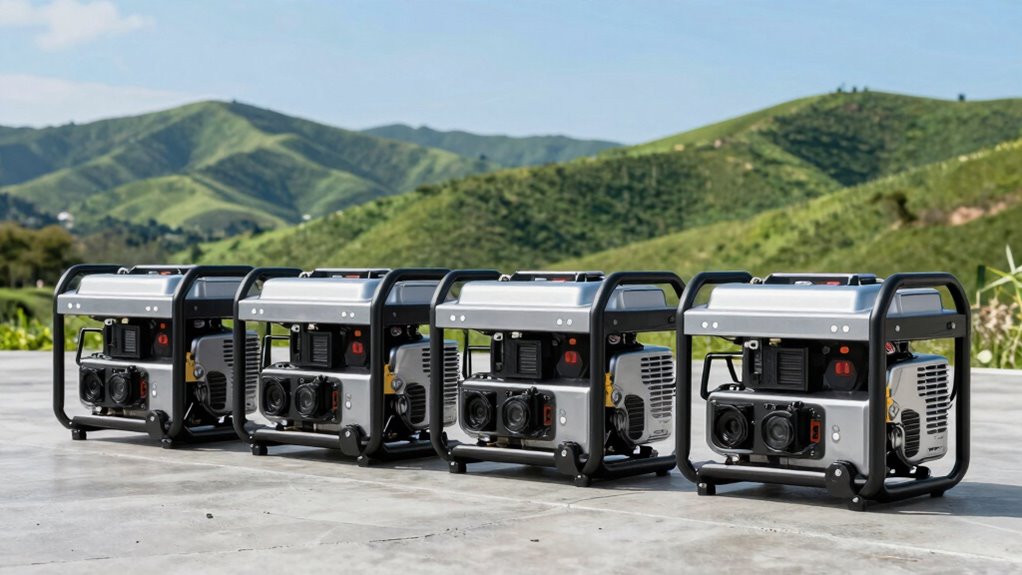
I compared these five inverter generators by how well their output, fuel options, outlets, runtime, and portability fit real buying needs. The Westinghouse iGen8200TFc is my most flexible choice for larger home backup because it runs on three fuels and includes a 50A outlet. For RV trips with a smaller power demand, the WEN 4800-Watt pairs an RV receptacle with wheels and a telescoping handle. The WEN DF680iX fills the middle ground with dual-fuel operation, 240V capability, and very low stated THD.

Get business pricing on tools and workshop supplies
- Business-only prices and quantity discounts
- Tax-exempt purchasing
- Multiple users, one account, clear invoices
The main tradeoff is straightforward: more output and fuel flexibility usually mean a larger, heavier machine and more setup complexity. A smaller gas-only generator can suit camping or basic backup, but it cannot match the WEN DF680iX or Westinghouse for household connections and fuel choice. I rank these picks by how clearly each serves a different buyer, not by assuming one generator is right for every job.
Complete the kit


Key Takeaways
- The Westinghouse iGen8200TFc is the only tri-fuel pick here, with gasoline, propane, and natural gas options plus a 50A outlet for compatible backup setups.
- The WEN DF680iX offers a strong middle ground: dual-fuel operation, 5,100 rated gasoline watts, a 240V receptacle, and stated THD below 1.2% at full load.
- The WEN 4800-Watt is aimed at RV and portable use, but its 72.7-pound weight makes its wheels more useful than lifting it into a vehicle.
- The BILT HARD 5500W has a 61.7-pound listed weight and dual-fuel capability, though its 1.14-gallon gasoline tank calls for more frequent refueling.
- The Oxseryn 4400 supplies 3,400 running watts and a 30A RV outlet in a 57-pound package, but it uses gasoline only and has a one-year warranty.
| Westinghouse iGen8200TFc Tri-Fuel Portable Inverter Generator |  | Best Overall for Flexible Home Backup | Gasoline output: 8,200 peak; 6,600 running watts | Propane output: 7,380 peak; 5,940 running watts | Natural gas output: 6,560 peak; 5,280 running watts | VIEW ON AMAZON | See Our Full Breakdown |
| BILT HARD 5500W Dual-Fuel Inverter Generator |  | Best for Portable Dual-Fuel Value | Gasoline output: 5,500 starting; 4,000 running watts | LPG output: 5,000 starting; 3,600 running watts | Fuel: Gasoline or LPG | VIEW ON AMAZON | See Our Full Breakdown |
| Oxseryn 4400-Watt Gas-Powered Inverter Generator |  | Best Compact, Straightforward RV Pick | Peak output: 4,400 watts | Running output: 3,400 watts | Fuel: Gasoline | VIEW ON AMAZON | See Our Full Breakdown |
| WEN DF680iX 6800-Watt Dual-Fuel Portable Inverter Generator |  | Best for 240V Loads and Low Distortion | Gasoline output: 6,800 surge; 5,100 rated watts | Propane output: 6,000 surge; 4,500 rated watts | Fuel types: Gasoline and propane | VIEW ON AMAZON | See Our Full Breakdown |
| WEN 4800-Watt RV-Ready Portable Inverter Generator with Fuel Shutoff |  | Best for RV Convenience and Easy Positioning | Surge output: 4,800 watts | Running output: 4,000 watts | Engine: 224 cc | VIEW ON AMAZON | See Our Full Breakdown |
| inverter generator | Outlets | Runtime | Gasoline output | Fuel |
|---|---|---|---|---|
| Westinghouse iGen8200TFc Tri-F | 14-50R 50A, TT-30R 30A, GFCI 5-20R duplex | Up to 17 hours at 25% load | 8,200 peak; 6,600 running watts | — |
| BILT HARD 5500W Dual-Fuel Inve | 120V 20A, TT-30R 30A, 12V DC, USB-C/USB-A adapter | — | 5,500 starting; 4,000 running watts | Gasoline or LPG |
| Oxseryn 4400-Watt Gas-Powered | Two 120V AC, one 30A RV, one 12V DC | Up to 14 hours at 25% load | — | Gasoline |
| WEN DF680iX 6800-Watt Dual-Fue | 120V/240V L14-30R, 120V receptacles, TT-30R, 12V DC, USB | Up to 6.1 hours at half load on gasoline; up to 9 hours at half load on a 20 lb propane tank | 6,800 surge; 5,100 rated watts | — |
| WEN 4800-Watt RV-Ready Portabl | Four 120V receptacles, TT-30R, 12V DC, two 5V USB ports | Up to 7 hours at half load | — | Gasoline |
More Details on Our Top Picks
Westinghouse iGen8200TFc Tri-Fuel Portable Inverter Generator
I put the Westinghouse first because it covers the widest range of backup plans in this lineup. Its tri-fuel system can use gasoline, propane, or natural gas, which gives an owner more ways to keep power available when one fuel is hard to obtain. On gasoline, it supplies 6,600 running watts; natural-gas output is lower at 5,280 running watts, so buyers should size their loads around the fuel they expect to use.
The 50A 14-50R outlet separates it from the RV-oriented WEN 4800 and the smaller Oxseryn. It can suit a compatible transfer-switch or interlock arrangement, while the TT-30R also supports an RV connection. Remote and electric start add convenience for a large portable unit, and the stated less-than-3% THD makes it a more clearly documented fit for sensitive electronics than models without a supplied THD figure. Its 3.9-gallon tank is listed for up to 17 hours at 25% load, but that light-load estimate should not be treated as expected runtime under heavy backup use.
The cost of this breadth is size and potential overcapacity. For basic camping loads, the BILT HARD or Oxseryn may be easier to justify, and a large generator can take more room and fuel than a modest setup needs. I would also verify the actual appliance starting and running requirements before choosing a fuel mode. Choose this Westinghouse for broad backup flexibility; skip it if a compact, simple, gasoline-only generator is the real goal.
Pros:- Runs on gasoline, propane, or natural gas.
- 6,600 gasoline running watts and a 50A outlet support larger compatible backup setups.
- Remote and electric start reduce the effort of starting the unit.
- Stated THD is below 3%, with up to 17 hours listed at 25% load.
Cons:- Its capacity may be unnecessary for modest camping or small backup needs.
- Output and runtime change with fuel type and load.
Best for: Households seeking higher-output backup, multiple fuel choices, and a 50A connection option.
Not ideal for: Campers or occasional users who need a light, compact generator for a few small loads.
- Gasoline output:8,200 peak; 6,600 running watts
- Propane output:7,380 peak; 5,940 running watts
- Natural gas output:6,560 peak; 5,280 running watts
- Fuel types:Gasoline, propane, natural gas
- Fuel tank:3.9 gallons
- Runtime:Up to 17 hours at 25% load
- THD:Less than 3%
- Outlets:14-50R 50A, TT-30R 30A, GFCI 5-20R duplex
Our verdict“I recommend the iGen8200TFc for buyers who value fuel choice and home-backup connections more than compact size.”
BILT HARD 5500W Dual-Fuel Inverter Generator
The BILT HARD is the pick I would examine first when dual-fuel flexibility matters but a 6,000-watt-class machine feels excessive. It produces 4,000 running watts on gasoline and 3,600 on LPG, enough to serve a more contained mix of appliances or RV loads than the Westinghouse iGen8200TFc. Its listed 61.7-pound weight is also lower than the WEN 4800’s 72.7 pounds, a meaningful difference for buyers who must move equipment by hand.
Convenience features are unusually practical for a smaller setup: an operating and fuel information display, economy mode, USB outputs, and carbon monoxide auto-shutoff are all included. It has a 30A RV outlet alongside a 20A receptacle, so it can connect to compatible RV equipment without needing the larger 50A arrangement found on the Westinghouse. Parallel connectors provide a route to more output, but that plan requires a second identical generator; it is not an instant capacity upgrade from this unit alone.
The sharpest limitation is its 1.14-gallon gasoline tank. The supplied information does not give a runtime figure, so I would not choose it on the assumption that it will run all day between refills. Propane adds fuel choice, but gasoline output is higher, and LPG still has its own tank and connection requirements. Compared with the Oxseryn, it trades a little simplicity for dual-fuel operation and a display. It suits buyers who value those extras and accept closer fuel management.
Pros:- Offers gasoline and LPG operation.
- Listed weight of 61.7 pounds is lower than the WEN 4800’s.
- Digital display, economy mode, and multiple charging outputs add everyday utility.
- Includes carbon monoxide auto-shutoff and low-oil protection.
Cons:- The 1.14-gallon gasoline tank is small, and no runtime figure is provided.
- Expanding output with parallel operation requires a second identical generator.
Best for: RV owners or backup users who want a manageable dual-fuel unit, a display, and a 30A outlet.
Not ideal for: Anyone needing long intervals between refueling, 240V output, or a larger household-backup connection.
- Gasoline output:5,500 starting; 4,000 running watts
- LPG output:5,000 starting; 3,600 running watts
- Fuel:Gasoline or LPG
- Engine:160 cc, 4-stroke OHV
- Tank capacity:1.14 gallons
- Weight:61.7 pounds
- Outlets:120V 20A, TT-30R 30A, 12V DC, USB-C/USB-A adapter
- Voltage:120 volts
Our verdict“I favor the BILT HARD for buyers who want dual-fuel and RV-ready features in a lighter listed package, not for extended unattended runtime.”
Oxseryn 4400-Watt Gas-Powered Inverter Generator
The Oxseryn earns its place as the simplest middle-output option here. With 3,400 running watts and a 30A RV outlet, it can fit a camping or backup plan that needs more than small electronics but does not call for the WEN DF680iX’s 5,100 gasoline running watts. At 57 pounds, it is the lightest listed model in this group, which can matter when one person has to move it around a campsite or storage area.
Its 2-gallon tank and up to 14-hour runtime at 25% load give it a more substantial stated light-load interval than the BILT HARD, whose runtime is not supplied and whose tank is smaller. The Oxseryn also includes ECO mode, overload protection, low-oil shutdown, and cold-start technology. Those features address practical operation, but its one-year warranty is shorter than the three-year warranties listed for both WEN models and the Westinghouse.
This is a gasoline-only choice, so it cannot fall back to propane or natural gas like the Westinghouse, BILT HARD, or WEN DF680iX. It also has an open-frame design, a drawback for buyers prioritizing a more enclosed form or quiet operation; the supplied specifications do not provide a noise figure. I would choose it for a relatively simple RV or portable-power role where its weight and 30A outlet matter more than multi-fuel flexibility or a longer warranty.
Pros:- 57-pound listed weight makes it the lightest option in this lineup.
- Provides 3,400 running watts and a 30A RV outlet.
- Up to 14 hours is listed at 25% load from its 2-gallon tank.
- Includes ECO mode, cold-start technology, and automatic protection features.
Cons:- Runs on gasoline only.
- Open-frame design may not suit buyers seeking an enclosed-style generator.
- The one-year warranty is shorter than the listed coverage on the WEN and Westinghouse models.
Best for: RV campers who want a 30A outlet, moderate running output, and the lightest listed generator in this comparison.
Not ideal for: Buyers who need dual-fuel operation, 240V household connections, or a longer stated warranty.
- Peak output:4,400 watts
- Running output:3,400 watts
- Fuel:Gasoline
- Tank capacity:2 gallons
- Runtime:Up to 14 hours at 25% load
- Weight:57 pounds
- Outlets:Two 120V AC, one 30A RV, one 12V DC
- Warranty:1 year
Our verdict“I would pick the Oxseryn for a lighter, uncomplicated RV-oriented setup, while accepting its gas-only design and shorter warranty.”
WEN DF680iX 6800-Watt Dual-Fuel Portable Inverter Generator
The WEN DF680iX is my specialist pick for buyers who need dual-fuel operation and 240V output without stepping up to the Westinghouse’s tri-fuel capacity. It supplies 5,100 rated watts on gasoline and 4,500 on propane, with a 120V/240V L14-30R receptacle. The bonded-neutral configuration is listed as supporting low-power Level 2 EV charging, but buyers should check their vehicle, charging equipment, and electrical setup for compatibility rather than assuming any 240V outlet will work for every charging need.
Its stated distortion figures are the strongest supplied in this comparison: under 1.2% THD at full load, compared with the Westinghouse’s less-than-3% figure. That distinction gives buyers a more specific power-quality reference, though real equipment compatibility still depends on the connected devices. Electric start, recoil backup, fuel shutoff, CO shutdown, and low-oil and low-fuel shutdown make the machine more feature-rich than the gas-only Oxseryn.
Portability is handled with wheels and a telescoping handle, but the product information does not list a weight, so I cannot call it easier to lift than the 57-pound Oxseryn or 61.7-pound BILT HARD. The runtime figures are also condition-specific: up to 6.1 hours at half load on gasoline and up to 9 hours at half load on a 20-pound propane tank. A propane tank is not included in the listed contents, and parallel connection hardware is sold separately. I rank it below the Westinghouse because it offers two fuels rather than three and less gasoline running output, but it is a sharper fit when 240V and low stated THD lead the checklist.
Pros:- Gasoline and propane operation provide fuel flexibility.
- Includes a 120V/240V outlet and a 30A RV receptacle.
- THD is stated as under 1.2% at full load.
- Wheels, telescoping handle, electric start, and multiple shutdown protections support operation and handling.
Cons:- Propane tank is not included in the listed contents.
- Parallel connection kit is sold separately.
- Runtime is shorter at the stated half-load conditions than the light-load figures cited for some competitors.
Best for: Buyers who need a 240V outlet, dual-fuel capability, and a clearly stated low-THD specification.
Not ideal for: Anyone who needs three fuel choices, a supplied propane tank, or a confirmed low-lift weight.
- Gasoline output:6,800 surge; 5,100 rated watts
- Propane output:6,000 surge; 4,500 rated watts
- Fuel types:Gasoline and propane
- Engine:224 cc dual-fuel
- THD:Under 0.3% at no load; under 1.2% at full load
- Runtime:Up to 6.1 hours at half load on gasoline; up to 9 hours at half load on a 20 lb propane tank
- Noise level:64 dB at quarter load
- Outlets:120V/240V L14-30R, 120V receptacles, TT-30R, 12V DC, USB
Our verdict“I recommend the DF680iX when 240V capability and low stated THD matter more than tri-fuel choice or maximum running output.”
WEN 4800-Watt RV-Ready Portable Inverter Generator with Fuel Shutoff
The WEN 4800 is built around a familiar use case: powering an RV or a collection of 120V loads with a 4,000-watt running output and a TT-30R receptacle. Compared with the Oxseryn, it adds listed wheels and a telescoping handle, plus four standard 120V receptacles and USB ports. Compared with the dual-fuel BILT HARD, however, it runs on gasoline alone, so the extra convenience is not matched by fuel flexibility.
Its 1.9-gallon tank is listed for up to 7 hours at half load, a more demanding condition than the 25%-load runtime figures supplied for the Westinghouse and Oxseryn. That makes the figures difficult to compare directly, but the stated test conditions at least give a useful reference point. Eco mode and fuel shutoff add practical ways to manage operation and storage, while the CO shutdown sensor and automatic low-oil shutdown add protection features.
The main portability caveat is that the unit weighs 72.7 pounds. Wheels help move it on suitable ground, but they do not make it a light lift into a vehicle or onto a raised surface. It also lacks the 240V outlet and fuel alternatives of the WEN DF680iX, and the parallel kit is sold separately. I see this as a stronger fit for users who can roll it into place and want a straightforward RV-ready outlet, rather than for campers who frequently carry equipment or households planning 240V backup.
Pros:- 4,000 running watts and a TT-30R outlet suit many RV-oriented setups.
- Wheels and a telescoping handle help reposition the unit.
- Includes CO shutdown, low-oil shutdown, fuel shutoff, and eco mode.
- Three-year limited warranty is listed.
Cons:- At 72.7 pounds, it may be cumbersome to lift despite its wheels.
- Gasoline-only operation offers less fuel flexibility than the BILT HARD, WEN DF680iX, and Westinghouse.
- Parallel connection kit is sold separately.
Best for: RV owners and home users who want a 30A outlet, wheels, a telescoping handle, and 120V power.
Not ideal for: Buyers who need propane or natural gas, 240V output, or a generator they can lift easily.
- Surge output:4,800 watts
- Running output:4,000 watts
- Engine:224 cc
- Fuel:Gasoline
- Tank capacity:1.9 gallons
- Runtime:Up to 7 hours at half load
- Weight:72.7 pounds
- Outlets:Four 120V receptacles, TT-30R, 12V DC, two 5V USB ports
Our verdict“I would choose the WEN 4800 for rollable RV and 120V use, not for frequent lifting or multi-fuel backup.”

How We Picked
I ranked these generators around the decisions that most affect a purchase: usable running output, fuel flexibility, outlet compatibility, runtime, portability, and safety features. Peak watts can help a motor start, but running watts are the better guide to what a generator can sustain. I gave more weight to clear, task-relevant differences than to a long feature list.
I also compared how each model fits the same broad category. An inverter generator is often chosen for cleaner power than a conventional generator, but the supplied specifications do not report THD for every model. I call out the Westinghouse and WEN DF680iX THD figures where provided rather than treating missing figures as equivalent. Similarly, runtime figures depend on fuel and load, so I identify the stated conditions instead of comparing unlike estimates as if they were direct tests.
My ranking gives the first position to the broadest-use option, then places the other models according to their strongest buyer fit. A generator designed around 240V backup needs should not automatically outrank a lighter RV-focused choice for a camper. I include drawbacks in every review so readers can see where a model’s advantages stop being useful.
| inverter generator | Runtime | Fuel |
|---|---|---|
| Westinghouse iGen8200TFc Tri-F | Up to 17 hours at 25% load | — |
| BILT HARD 5500W Dual-Fuel Inve | — | Gasoline or LPG |
| Oxseryn 4400-Watt Gas-Powered | Up to 14 hours at 25% load | Gasoline |
| WEN DF680iX 6800-Watt Dual-Fue | Up to 6.1 hours at half load on gasoline; up to 9 hours at half load on a 20 lb propane tank | — |
| WEN 4800-Watt RV-Ready Portabl | Up to 7 hours at half load | Gasoline |
Factors to Consider When Choosing Inverter Generator
I would start with the load and connection you actually need, then narrow the field by fuel and handling. A generator with more peak watts is not automatically a better fit if its running output, outlet type, or weight does not match the job.
Match Running Watts to Your Loads
Make a list of appliances you plan to run at the same time and check their running and starting requirements. Running watts describe sustained capacity; peak or surge watts provide temporary headroom for starting certain motors. The Westinghouse leads this group on gasoline running output at 6,600 watts, while the WEN DF680iX offers 5,100 and the WEN 4800 offers 4,000. The Oxseryn’s 3,400 running watts may suit a smaller set of loads, but it leaves less room to add equipment. Avoid treating the highest peak figure as the whole story: a generator must support the combined operating load after startup.
Choose Fuel for Availability, Not Just Flexibility
Gasoline is familiar and available in many places, while propane can be stored in suitable cylinders and natural gas may support a stationary home-backup arrangement when the generator and installation allow it. Tri-fuel flexibility belongs only to the Westinghouse; the BILT HARD and WEN DF680iX run on gasoline or LPG, and the Oxseryn and WEN 4800 are gasoline-only. Output changes by fuel, so size the unit using the figures for the fuel you expect to rely on. Check tank, hose, regulator, storage, and connection requirements before choosing a model around a secondary fuel.
Check the Outlet Before Buying
An RV-ready TT-30R outlet is not interchangeable with a 50A home connection or a 240V outlet. The Westinghouse provides a 50A 14-50R, while the WEN DF680iX supplies a 120V/240V L14-30R and is identified as supporting low-power Level 2 EV charging in its bonded-neutral configuration. The BILT HARD, Oxseryn, and WEN 4800 include 30A RV receptacles. Match the plug, voltage, amperage, and wiring arrangement to your equipment; for household backup, use a compatible transfer switch or interlock installed according to local requirements. Never connect a generator directly to a home’s wiring through an ordinary outlet.
Read Runtime Alongside Its Test Load
Runtime estimates only make sense when their load conditions are visible. The Westinghouse lists up to 17 hours at 25% load, and the Oxseryn lists up to 14 hours at that same percentage. The WEN 4800 lists up to 7 hours at half load, while the WEN DF680iX gives separate half-load figures for gasoline and propane. These are not direct head-to-head runtime tests, and your actual result will vary with connected demand, fuel, and operating mode. The BILT HARD specifications provided here do not include a runtime estimate, so I would not infer one from its tank size alone.
Balance Portability Against Capacity
Weight matters most when the generator must be lifted; wheels matter when it can be rolled across suitable ground. The Oxseryn is listed at 57 pounds and the BILT HARD at 61.7 pounds, while the WEN 4800 weighs 72.7 pounds. The Westinghouse has substantially greater listed output, and its role is better suited to a more substantial backup arrangement than casual carrying. Do not confuse wheels with easy lifting: consider where the generator will be stored, how it will get to the operating spot, and whether one person can safely handle it.
Use Safety and Power-Quality Details Carefully
CO shutoff, low-oil protection, overload protection, and fuel shutoff can help manage specific risks, but they do not replace safe placement or operating instructions. Run portable generators outdoors and away from doors, windows, and vents, following the manufacturer’s guidance. For electronics, look for a stated THD figure rather than assuming all inverter models have identical output quality: the Westinghouse lists less than 3%, and the WEN DF680iX lists under 1.2% at full load. Where a model’s THD is not provided here, I leave the comparison open instead of treating missing data as a guarantee.
Frequently Asked Questions
Which generator in this list has the most fuel flexibility?
The Westinghouse iGen8200TFc is the only tri-fuel model here, running on gasoline, propane, or natural gas. The BILT HARD and WEN DF680iX offer gasoline and LPG operation, while the Oxseryn and WEN 4800 use gasoline only. Compare output by fuel before buying because the Westinghouse and other dual-fuel models produce different wattage on each fuel.
Can these inverter generators power a home?
They can support selected household loads when the generator’s running capacity and outlets match the setup, but a generator is not automatically a whole-home solution. The Westinghouse includes a 50A outlet, and the WEN DF680iX includes a 120V/240V L14-30R. Have a qualified professional confirm compatibility and install an approved transfer switch or interlock where required; never feed a home’s wiring through a standard wall outlet.
Which models are best suited to RV use?
The BILT HARD, Oxseryn, and both WEN models list a TT-30R 30A RV outlet, while the Westinghouse includes both a TT-30R and a larger 50A receptacle. For lighter handling, the Oxseryn has the lowest listed weight at 57 pounds; the WEN 4800 adds wheels and a telescoping handle but weighs 72.7 pounds. Check your RV’s plug and power needs before selecting an outlet or adapter.
Are the listed runtime figures directly comparable?
No. Some estimates use 25% load and others use half load, and the WEN DF680iX provides different figures for gasoline and propane. The Westinghouse’s up-to-17-hour estimate and the Oxseryn’s up-to-14-hour estimate are both stated at 25% load, while the WEN 4800’s up-to-7-hour figure is at half load. Actual runtime changes with connected demand, fuel, and operating conditions.
What should I look for if I plan to power sensitive electronics?
Check the manufacturer’s power-quality specifications for a stated total harmonic distortion figure and compare it with the requirements of your equipment. The Westinghouse lists less than 3% THD, and the WEN DF680iX lists under 1.2% at full load. The supplied details for the other models do not state THD, so I would verify their specifications with the manufacturer rather than infer a figure from the word inverter alone.
Conclusion
For larger backup needs and fuel flexibility, I would start with the Westinghouse iGen8200TFc, provided its capacity and size suit the site. For 240V capability and the lowest stated full-load THD in this group, the WEN DF680iX is the more focused choice. RV users who can roll a heavier unit should look at the WEN 4800; buyers who prefer a lighter listed weight and a straightforward 30A outlet should compare the Oxseryn. The BILT HARD suits those who want dual-fuel operation in a lighter listed package and can live with a small gasoline tank. My final check would be the appliance load, required receptacle, fuel plan, and safe operating location—those details should decide between these five more than headline wattage alone.
Columbus Day / Indigenous Peoples' Day Picks
long weekend sales
As an affiliate, we earn on qualifying purchases.