A jobsite speaker radio can add Bluetooth audio, radio reception, or battery charging to a workday, but the right choice depends on the tools and power sources you already use. I rank the RIDGID R84089B as the best overall for its hybrid power approach, while the DEWALT DCR025 stands out for buyers who want a radio and charger in one, and the Milwaukee M18 Radio suits crews already using that battery platform. The main tradeoffs are battery compatibility, portability, charging features, and whether you want a straightforward work radio or a louder speaker with extra styling. Some options are tied to a specific tool brand, while others emphasize broad battery compatibility or Bluetooth playback. Read on for the full comparison and guidance on choosing a model that fits your worksite.

Get business pricing on tools and workshop supplies
- Business-only prices and quantity discounts
- Tax-exempt purchasing
- Multiple users, one account, clear invoices
Complete the kit


Key Takeaways
- Battery-platform fit separates the established tool-brand radios. RIDGID, Makita, DEWALT, and Milwaukee models make the most sense when their batteries are already part of your kit.
- Hybrid power can reduce battery interruptions. The RIDGID R84089B is the overall pick because its hybrid design gives buyers an alternative to relying solely on a cordless battery.
- Charging is a distinct reason to choose a radio. The DEWALT DCR025 and Milwaukee M12 Radio and Charger offer charging functions, while buyers focused on simple playback may not need that added role.
- The two Inwa MZ-100 listings appear to describe closely related speakers. Compare the exact listing and included accessories rather than treating the color difference as a major performance distinction.
- Battery-compatible third-party radios need extra checking. The DeWalt 20V MAX-compatible portable speaker may suit a battery owner seeking another option, but compatibility claims and included components deserve careful verification.
| RIDGID R84089B 18V Hybrid Jobsite Radio with Bluetooth |  | Best for AM/FM and Bluetooth Basics | Model: R84089B | Connectivity: Bluetooth, USB | Radio bands: AM, FM | VIEW ON AMAZON | See Our Full Breakdown |
| Inwa MZ-100 60W Jobsite Bluetooth Speaker with RGB Lights, Golden |  | Best for Big Bluetooth Sound and Extra Features | Model: MZ-100 | Power: 60W | Connectivity: Bluetooth 5.2, 3.5mm AUX | VIEW ON AMAZON | See Our Full Breakdown |
| Makita XRM06B 18V LXT Cordless Bluetooth Job Site Radio | 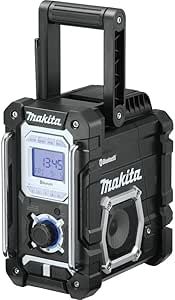 | Best Compact, Weather-Resistant Pick | Model: XRM06B | Connectivity: Bluetooth, auxiliary input | Radio band: FM | VIEW ON AMAZON | See Our Full Breakdown |
| DEWALT DCR025 20V MAX Bluetooth Jobsite Radio and Charger |  | Best for Charging and Worksite Power | Model: DCR025 | Power sources: DEWALT 20V MAX or FLEXVOLT 20V/60V MAX batteries; AC power | Battery charging: 3 A when connected to AC power | VIEW ON AMAZON | See Our Full Breakdown |
| Milwaukee M18 Bluetooth Jobsite Radio (Bare Tool) |  | Best for Rugged AM/FM and Long-Range Bluetooth | Model: 2952-20 | Connectivity: Bluetooth 5.0, up to 120-foot range | Radio: AM/FM, 18 presets | VIEW ON AMAZON | See Our Full Breakdown |
| Portable Jobsite Radio Speaker, Compatible with DeWalt 20V MAX Batteries |  | Best Feature Mix for DeWalt 20V MAX Owners | Power options: DeWalt 20V MAX battery or 18V/1.3A AC adapter | Battery included: No | Water resistance: IPX54 | VIEW ON AMAZON | See Our Full Breakdown |
| DEWALT DCR028B 12V/20V MAX Cordless Bluetooth Jobsite Radio |  | Best for DeWalt Platform Users | Power options: DeWalt 12V MAX, 20V MAX, or FLEXVOLT batteries; AC power | Bluetooth range: Up to 100 feet | Radio: AM/FM with six presets per band | VIEW ON AMAZON | See Our Full Breakdown |
| Inwa MZ-100 60W Jobsite Bluetooth Speaker with RGB Lights |  | Best for Multi-Brand Battery Flexibility | Maximum output power: 60 watts | Battery compatibility: Milwaukee M18, DeWalt 20V MAX, and DeWalt FLEXVOLT | Power options: Compatible batteries or included AC adapter | VIEW ON AMAZON | See Our Full Breakdown |
| Milwaukee M12 Cordless Radio and Charger (Tool Only) |  | Best Compact, Weather-Resistant Pick | Model: 2951-20 | Power source: M12 CP 2.0 battery or 12V DC | Battery runtime: Up to 10 hours | VIEW ON AMAZON | See Our Full Breakdown |
| jobsite speaker radio | Connectivity | Model |
|---|---|---|
| RIDGID R84089B 18V Hybrid Jobs | Bluetooth, USB | R84089B |
| Inwa MZ-100 60W Jobsite Blueto | Bluetooth 5.2, 3.5mm AUX | MZ-100 |
| Makita XRM06B 18V LXT Cordless | Bluetooth, auxiliary input | XRM06B |
| DEWALT DCR025 20V MAX Bluetoot | Bluetooth, auxiliary, USB | DCR025 |
| Milwaukee M18 Bluetooth Jobsit | Bluetooth 5.0, up to 120-foot range | 2952-20 |
| Portable Jobsite Radio Speaker | Bluetooth 5.0, AUX, TWS | — |
| DEWALT DCR028B 12V/20V MAX Cor | — | — |
| Inwa MZ-100 60W Jobsite Blueto | Bluetooth 5.2, 3.5 mm AUX | — |
| Milwaukee M12 Cordless Radio a | Bluetooth 4.2 | 2951-20 |
More Details on Our Top Picks
RIDGID R84089B 18V Hybrid Jobsite Radio with Bluetooth
The RIDGID R84089B suits buyers who want a straightforward radio that can play local AM/FM stations or stream audio over Bluetooth. Its 18V battery or hybrid power setup gives it flexibility around a work area, while the USB connection adds another useful option. Compared with the Makita XRM06B, the RIDGID receives AM as well as FM, but the Makita is described as water resistant and supports more battery platforms. The tradeoff here is a lack of weather protection: this model is not water resistant, so it needs a sheltered spot on dusty or damp jobs. The battery and charger are also sold separately, which matters if you are starting without compatible RIDGID gear. I’d choose it for basic station listening, not exposed-site durability.
Pros:- Plays both AM and FM stations alongside Bluetooth audio
- Runs on an 18V battery or hybrid power
- USB connectivity adds another connection option
Cons:- Not water resistant, limiting use in damp or exposed areas
- Battery and charger are sold separately
- 30-day limited warranty is shorter than the three-year coverage listed for the Makita XRM06B
Best for: RIDGID 18V tool owners who want both AM/FM reception and Bluetooth playback for sheltered work areas
Not ideal for: Crews working in wet or exposed conditions, or buyers who need a radio with a battery and charger included
- Model:R84089B
- Connectivity:Bluetooth, USB
- Radio bands:AM, FM
- Power:18V battery or hybrid power
- Maximum output:30 watts
- Water resistance:Not water resistant
- Dimensions:7.64 × 7.64 × 7.71 inches
- Weight:9.3 pounds
- Battery and charger:Sold separately
Our verdict“Choose the RIDGID if AM/FM, Bluetooth, and 18V flexibility matter more than weather protection or an included battery.”
Inwa MZ-100 60W Jobsite Bluetooth Speaker with RGB Lights, Golden
The Inwa MZ-100 is the lineup’s speaker-first pick: its stated 60W stereo output, dual woofers, dual tweeters, and passive radiators are aimed at fuller playback than a basic radio. It supports Bluetooth 5.2 and AUX, and its included AC adapter means it can run from a wall outlet without a tool battery. Unlike the RIDGID R84089B or Milwaukee M18 Bluetooth Jobsite Radio, the supplied details list no AM/FM tuner, so it is a poor match for buyers who rely on broadcast radio. The eight RGB modes and built-in power bank are useful extras, but they do not make up for the lack of waterproofing on exposed sites. Its battery compatibility spans Milwaukee M18 and DeWalt 20V MAX/FLEXVOLT, though batteries are separate. I’d pick it for flexible Bluetooth playback, not weather-ready radio duty.
Pros:- 60W stereo system uses dual woofers, tweeters, and passive radiators
- Runs from the included AC adapter or compatible Milwaukee and DeWalt batteries
- Bluetooth 5.2 and 3.5mm AUX offer two audio-input options
- Built-in power bank and customizable RGB lighting add utility beyond playback
Cons:- No AM/FM tuner is listed
- Not waterproof
- Compatible batteries are sold separately
Best for: Tradespeople who want a high-output Bluetooth speaker with AUX, an AC adapter, and compatibility with Milwaukee or DeWalt batteries
Not ideal for: Buyers who need AM/FM tuning or need a speaker that can handle wet jobsite conditions
- Model:MZ-100
- Power:60W
- Connectivity:Bluetooth 5.2, 3.5mm AUX
- Compatible batteries:Milwaukee M18, DeWalt 20V MAX, DeWalt FLEXVOLT
- Power adapter:Included
- Lighting:Eight customizable RGB modes
- Waterproofing:Not waterproof
- Dimensions:5.4 × 11.6 × 7.6 inches
- Warranty:1 year
Our verdict“Pick the Inwa for feature-rich Bluetooth sound and flexible power, but skip it if broadcast radio or water protection is a must.”
Makita XRM06B 18V LXT Cordless Bluetooth Job Site Radio
The Makita XRM06B earns its place for crews who value a smaller, more jobsite-conscious radio over extra charging features. Its two 3-inch speakers provide stereo sound, while dust- and water-resistant construction and protective bumpers make it a better fit for rougher conditions than the non-water-resistant RIDGID R84089B or DEWALT DCR025. It also accepts several Makita battery platforms, which can help owners use packs they already have; the listed runtime reaches up to 35 hours with an 18V 5.0Ah battery. The compromise is limited broadcast coverage: the supplied specs list FM, not AM, and Bluetooth and AUX handle other audio sources. It does not include a battery. I’d favor it for portable FM and streaming where some weather resistance matters more than a charger or AM reception.
Pros:- Dust- and water-resistant construction with protective bumpers
- Works with several Makita battery platforms from 7.2V to 18V
- Stereo playback through two 3-inch speakers
- Listed runtime reaches up to 35 hours with an 18V 5.0Ah battery
Cons:- FM is the only listed radio band; AM reception is not specified
- Battery is sold separately
- No USB charging feature is listed, unlike the DEWALT DCR025
Best for: Makita tool owners who want a portable Bluetooth/FM radio with weather-resistant construction and compatibility across several battery platforms
Not ideal for: Buyers who require AM reception, an included battery, or a larger speaker system with charging features
- Model:XRM06B
- Connectivity:Bluetooth, auxiliary input
- Radio band:FM
- Speakers:Two 3-inch side-firing speakers
- Compatible batteries:7.2V, 12V max, 12V max CXT, 14.4V, 18V LXT
- Runtime:Up to 35 hours with 18V 5.0Ah battery; up to 14 hours with 18V 2.0Ah battery
- Water resistance:Water resistant; dust-resistant construction
- Dimensions:11.5 × 7 × 12.9 inches
- Warranty:3-year limited warranty
Our verdict“Choose the Makita for weather-resistant FM and Bluetooth playback if you already own compatible batteries and do not need AM.”
DEWALT DCR025 20V MAX Bluetooth Jobsite Radio and Charger
The DEWALT DCR025 is more than a radio: when plugged into AC power, it can charge compatible batteries and supply power through two AC outlets, while USB charging and Bluetooth keep phones and audio sources in the mix. That makes it a stronger stationary work-area hub than the more portable Makita XRM06B, which focuses on battery-powered listening and weather resistance. The DCR025 can run from AC or DEWALT 20V MAX/FLEXVOLT batteries, and its stated Bluetooth range reaches up to 100 feet. Its compromises are size and exposure tolerance: at 15 pounds it is a substantial unit, and it is not water resistant. It also lists FM only, whereas the Milwaukee M18 Bluetooth Jobsite Radio adds AM and preset stations. I’d choose this DEWALT when charging and outlet access matter more than compactness.
Pros:- Runs on compatible batteries or AC power
- Charges compatible batteries when connected to AC
- Two AC outlets and a USB charging port support worksite devices
- Bluetooth range is listed at up to 100 feet
Cons:- Not water resistant
- At 15 pounds, it is less convenient to move than a compact radio
- FM is the only listed radio band
Best for: DEWALT 20V MAX or FLEXVOLT users setting up a sheltered work area who want battery charging, AC outlets, and USB charging in one unit
Not ideal for: Crews needing a compact radio for carrying between locations or a water-resistant model for exposed jobsites
- Model:DCR025
- Power sources:DEWALT 20V MAX or FLEXVOLT 20V/60V MAX batteries; AC power
- Battery charging:3 A when connected to AC power
- Bluetooth range:Up to 100 feet
- Audio output:20 watts per channel
- Connectivity:Bluetooth, auxiliary, USB
- Radio band:FM
- AC outlets:2
- Weight:15 pounds
Our verdict“Choose the DCR025 as a sheltered-workstation hub if battery charging and outlets matter more than low weight or weather resistance.”
Milwaukee M18 Bluetooth Jobsite Radio (Bare Tool)
The Milwaukee M18 Bluetooth Jobsite Radio is the strongest fit here for buyers who want a rugged, battery-or-AC radio with broad playback options. Its AM/FM tuner includes 18 presets, and Bluetooth 5.0 is listed with a range up to 120 feet—longer than the DEWALT DCR025’s stated 100 feet. Dual woofers and two tweeters give it a more developed speaker arrangement than the compact Makita XRM06B, while listed water, dust, and impact resistance suit tougher work areas. USB-C device charging is another practical addition. The tradeoff is that runtime varies with battery choice and volume; the stated maximum-volume figure is up to 13 hours with an M18 XC5.0 battery. This is a bare-tool listing, so check whether a battery is included before buying. I’d pick it for durable radio use, not a lightweight setup.
Pros:- AM/FM tuner includes 18 presets
- Bluetooth 5.0 range is listed at up to 120 feet
- Water, dust, and impact resistance suit demanding work areas
- Runs on an M18 battery or AC adapter and offers 3.0A USB-C charging
Cons:- Runtime depends on battery choice and listening volume
- Bare-tool listing means a battery may not be included
- At 10.8 pounds, it is heavier than its compact dimensions might suggest
Best for: Milwaukee M18 owners who want AM/FM presets, long-range Bluetooth, device charging, and a radio suited to rough jobsite conditions
Not ideal for: Buyers seeking a lightweight unit or a ready-to-run kit that includes a battery without needing to check the listing contents
- Model:2952-20
- Connectivity:Bluetooth 5.0, up to 120-foot range
- Radio:AM/FM, 18 presets
- Speakers:Dual 3.5-inch woofers and two high-range tweeters
- Power source:M18 battery or AC adapter
- Runtime:Up to 13 hours at maximum volume with M18 XC5.0 battery
- Device charging:USB-C, 3.0A
- Construction:Metal enclosure; water, dust, and impact resistance
- Dimensions and weight:12 × 5 × 6 inches; 10.8 pounds
Our verdict“Choose the Milwaukee for rugged AM/FM listening and extended Bluetooth range if you have, or plan to supply, an M18 battery.”
Portable Jobsite Radio Speaker, Compatible with DeWalt 20V MAX Batteries
This model makes sense for buyers who want more playback choices than a basic jobsite radio without committing to an established tool-brand unit. It combines AM/FM, Bluetooth, AUX, and TWS stereo pairing, while a 20V MAX battery or included AC adapter provides power flexibility. Compared with the DEWALT DCR028B, it offers 30 station presets rather than six per band and adds TWS pairing, but it is not a DeWalt-branded product, and the battery is separate. Its IPX54 rating and USB charging port suit everyday site use, though 15 watts of output is less suited to filling a large, noisy work area than the Inwa MZ-100’s stated 60 watts. The five-year warranty is a useful differentiator, but buyers should check battery fit and brand expectations before choosing it.
Pros:- Runs from a compatible DeWalt 20V MAX battery or the included AC adapter.
- Combines AM/FM, Bluetooth 5.0, AUX, and TWS pairing.
- IPX54-rated design and USB device charging support jobsite utility.
- Offers 30 station presets and a five-year warranty.
Cons:- Battery is not included, adding a separate power requirement.
- It is not affiliated with DeWalt despite battery compatibility.
- 15-watt maximum output is modest beside the Inwa MZ-100’s stated 60 watts.
Best for: DeWalt 20V MAX battery owners who want AM/FM, Bluetooth, AUX, and USB charging in one radio with an AC power option.
Not ideal for: Buyers who require a DeWalt-branded product, need a battery in the box, or want higher stated output for a large worksite.
- Power options:DeWalt 20V MAX battery or 18V/1.3A AC adapter
- Battery included:No
- Water resistance:IPX54
- Connectivity:Bluetooth 5.0, AUX, TWS
- Radio and presets:AM/FM; 30 station presets
- Maximum output:15 watts
- USB output:5V/2.1A
- Dimensions:8.6 x 7.2 x 12.2 inches
Our verdict“Choose it if you already own compatible DeWalt batteries and value broad playback options and presets more than brand affiliation or high output.”
DEWALT DCR028B 12V/20V MAX Cordless Bluetooth Jobsite Radio
The DCR028B is the straightforward pick for buyers who want a branded radio that fits several DeWalt battery families. It accepts 12V MAX, 20V MAX, and FLEXVOLT batteries, or can run from the included AC cord, so it is easier to adapt to an existing DeWalt setup than the Milwaukee M12 radio. Bluetooth reaches up to 100 feet, and AM/FM plus AUX gives crews alternatives when streaming is inconvenient. Compared with the less-established compatible-battery model in this roundup, this DeWalt brings a protective roll cage and stereo output, but has only six presets per band and no stated water resistance. The USB port is handy for charging a device, yet the radio is not waterproof and batteries are sold separately. It suits a typical worksite better than exposed wet conditions.
Pros:- Accepts DeWalt 12V MAX, 20V MAX, and FLEXVOLT batteries, plus AC power.
- Bluetooth range is specified up to 100 feet.
- Roll-cage design helps protect the radio on a busy site.
- Provides stereo audio, AM/FM, AUX input, and USB charging.
Cons:- Compatible batteries are sold separately.
- Not waterproof, limiting use in wet or exposed conditions.
- Six presets per band are fewer than the 30 presets on the other DeWalt-compatible radio in this batch.
Best for: DeWalt users with 12V MAX, 20V MAX, or FLEXVOLT batteries who want a brand-matched radio for indoor or sheltered work areas.
Not ideal for: Crews working in rain or frequent splashes, and buyers who need a battery included or extensive station presets.
- Power options:DeWalt 12V MAX, 20V MAX, or FLEXVOLT batteries; AC power
- Bluetooth range:Up to 100 feet
- Radio:AM/FM with six presets per band
- Connections:Bluetooth, 3.5 mm AUX, USB charging
- Speakers:Dual 3.5-inch woofers and 1-inch tweeters
- Audio output:Stereo
- Waterproofing:Not waterproof
- Warranty:3-year limited warranty
Our verdict“Pick the DCR028B for DeWalt battery flexibility and a protective frame, but skip it if your worksite regularly gets wet.”
Inwa MZ-100 60W Jobsite Bluetooth Speaker with RGB Lights
The MZ-100 stands apart by supporting Milwaukee M18, DeWalt 20V MAX, and DeWalt FLEXVOLT batteries, as well as the included AC adapter. That cross-platform compatibility is more useful to mixed-brand crews than the DEWALT DCR028B, which stays within DeWalt’s battery families. Its stated 60-watt output, stereo speaker layout, and bass technology make it the output-focused choice here; the customizable lights and power-bank function add convenience, though neither replaces core jobsite durability. Unlike the IP54-rated Milwaukee M12 radio or IPX54-rated DeWalt-compatible option, the MZ-100 is not waterproof, so I would keep it sheltered from rain and splashes. Batteries are also sold separately. It suits buyers who prioritize adaptable power and strong stated output over weather protection and a subdued, work-first design.
Pros:- Compatible with Milwaukee M18, DeWalt 20V MAX, and DeWalt FLEXVOLT batteries.
- Included AC adapter offers a power option when batteries are unavailable.
- Stated 60-watt output and stereo speaker configuration suit buyers seeking stronger sound.
- Adds a power-bank function and eight customizable light modes.
Cons:- Batteries are sold separately.
- Not waterproof, unlike the IP-rated options in this batch.
- No AM/FM radio is listed in the supplied product data.
Best for: Mixed-brand crews with Milwaukee M18 or DeWalt 20V MAX/FLEXVOLT batteries who want a higher-output speaker with AC backup.
Not ideal for: Workers who need water resistance, a battery included, or a compact radio with AM/FM tuning.
- Maximum output power:60 watts
- Battery compatibility:Milwaukee M18, DeWalt 20V MAX, and DeWalt FLEXVOLT
- Power options:Compatible batteries or included AC adapter
- Battery included:No
- Connectivity:Bluetooth 5.2, 3.5 mm AUX
- Audio output:Stereo
- Lighting:Multi-color LED with eight customizable modes
- Waterproofing:Not waterproof
Our verdict“Choose the MZ-100 for multi-brand battery compatibility and higher stated output, provided it can stay out of wet conditions.”
Milwaukee M12 Cordless Radio and Charger (Tool Only)
The Milwaukee 2951-20 is the compact, weather-resistant choice in this group, with an IP54 rating for protection against water and debris and a built-in handle and keyhole for hanging. Its M12 battery system makes it a natural fit for buyers already carrying Milwaukee compact tools; unlike the DEWALT DCR028B, it is not designed around a broad set of battery platforms. AM/FM and Bluetooth 4.2 cover basic listening, while the listed runtime reaches up to 10 hours with an M12 CP 2.0 battery. The major tradeoff is 3-watt speaker output: this is better suited to a nearby workstation than filling a large, noisy area. It is also a tool-only listing, so the battery is separate. Choose it for portability and protection, not volume.
Pros:- IP54 rating helps protect against water and debris.
- Supports Bluetooth and AM/FM listening.
- Can run from an M12 CP 2.0 battery or 12V DC power.
- Keyhole and hollow handle provide practical hanging and carrying options.
Cons:- Listed speaker output is only 3 watts, limiting coverage in noisy areas.
- Tool-only listing means the battery is not included.
- Bluetooth 4.2 is an older version than the Bluetooth 5.0 and 5.2 options in this batch.
Best for: Milwaukee M12 owners who need a compact radio for a small work area and value IP54 protection and hanging options.
Not ideal for: Crews who need loud sound across a large site, want a battery included, or need broader battery-platform compatibility.
- Model:2951-20
- Power source:M12 CP 2.0 battery or 12V DC
- Battery runtime:Up to 10 hours
- Connectivity:Bluetooth 4.2
- Radio bands:AM, FM
- Ingress protection:IP54
- Speaker output:3 watts
- Weight:2.29 kg
Our verdict“Choose this Milwaukee for a protected, easy-to-place radio near your workstation, but pick a higher-output model for larger crews or louder sites.”

How We Picked
I ranked these options around the jobsite decisions that affect daily use: how a radio gets power, whether it works with batteries a buyer may already own, and whether it adds useful functions such as charging. I also weighed portability, the practicality of Bluetooth and radio playback, and the likely fit for a shared work area. A feature only counted as an advantage when it offered a clear worksite benefit rather than adding complexity.
The ordering favors versatile, recognizable worksite options first, then models with more specific strengths or narrower appeal. The RIDGID R84089B leads for its hybrid power approach; the DEWALT DCR025 and Milwaukee charging models earn attention for combining audio with charging. Brand-platform fit matters, so no single radio is the right pick for every crew. I treat the two Inwa MZ-100 entries as near-duplicates and the third-party DeWalt-compatible model with added caution because buyers should confirm fit, included items, and operating details on the exact listing.
Factors to Consider When Choosing Jobsite Speaker Radio
Before choosing a jobsite radio, match its power and role to the way your crew works. A radio that shares batteries with your tools can be convenient, but that does not automatically make it the best option for long shifts or a mixed-brand team. These factors help separate useful extras from features that may go unused.
Match the battery platform to the crew, not just one tool
Start by listing the battery systems actually available on the job, including voltage and whether the radio requires a particular battery family. A model that accepts your existing packs can save you from maintaining a separate power setup. The tradeoff is that a radio may tie up a battery needed for a drill or saw, especially when the crew shares packs. For mixed-brand teams, check whether the radio can run from another power source or whether a separate battery would be necessary. Do not assume that similar voltage labels mean batteries are interchangeable. Confirm compatibility with the exact model and battery generation before buying.
Decide whether hybrid or cordless power suits the shift
Cordless operation keeps the setup portable, but it makes runtime part of the workday plan. Hybrid power can be useful where an outlet is available and saves a battery for tools, though it may not help at remote sites. Think about how long the radio will play, how often the site has power, and whether workers can recharge batteries during breaks. A common mistake is choosing based only on the battery platform while overlooking how many spare packs the crew has. If the radio will run for extended periods, a practical power plan can matter more than a long feature list. Check which power sources are supported and whether any required cable or battery is included.
Pay for charging only when it solves a real bottleneck
A radio with a charger can reduce the number of devices and cords around a work area. It may be especially useful when a crew already relies on the matching battery system and has a predictable place to power up. Charging functions can also add bulk and make the unit less suited to workers who move it frequently. Check what batteries the charger supports and whether charging is available in every power mode. Do not assume a USB port or charging label means the radio can recharge every tool battery. If tool charging is already handled elsewhere, a simpler radio may be the more practical choice.
Choose sound and controls for the work environment
On a busy site, clear audio and controls that are easy to operate matter more than a feature list built around maximum volume. Consider whether the radio will sit near one worker or serve a larger area, and whether you need Bluetooth playback, broadcast radio, or both. Bluetooth is handy for personal playlists, but reception and physical controls still matter when a phone is out of reach or unavailable. Extra lighting or visual effects may appeal to some buyers, yet they should not outweigh dependable playback and simple operation. If possible, check the exact specifications for radio bands, input options, and control layout. Also follow site rules about volume and personal audio, since louder is not always better for communication or safety.
Treat durability and portability as a pair
A jobsite radio needs to fit the way it will be carried, stored, and exposed to dust or incidental knocks. A larger unit may be easier to hear across a work area but can be inconvenient to move between floors or vehicles. A compact model is simpler to transport, though buyers should verify that it still suits the intended listening area. Look for clearly stated protection details rather than assuming that a rugged appearance means weather resistance. Consider where the radio will sit during work and how it will be stored at the end of a shift. The best balance depends on whether it stays at one station or travels with the crew.
Check what the listing includes and what it leaves out
Tool-only and bare-tool labels often mean the battery and charger are not included, so check the package contents before comparing options. This matters particularly for buyers entering a new tool platform, where the added battery and charging needs can change the overall value. Third-party compatibility claims deserve a closer read: verify the supported battery type, any limitations, and whether the radio has independent power options. Similar product names can also hide differences in color, package contents, or revisions. For the two Inwa MZ-100 listings, confirm which finish and accessories the specific listing provides. A careful listing check can prevent a mismatch that no headline feature can fix.
Frequently Asked Questions
Should I choose a radio that uses the same batteries as my tools?
Usually, a shared battery platform is convenient if you already own compatible packs and can spare one for the radio. The tradeoff is that audio playback may compete with tools for the same batteries, so a single-pack setup can become inconvenient during a long shift. Check the exact battery family rather than relying on brand name or voltage alone. If your crew uses several brands, a hybrid-powered option or a dedicated radio battery may be easier to manage. Match the radio to the crew’s actual battery supply, not just the tool you use most often.
Is a jobsite radio with a charger worth choosing over a simpler model?
It can be worthwhile when charging the same battery platform is already part of your routine and the radio will stay near a power source. Combining functions may reduce separate equipment, but it can also add size and limit portability. Check which battery packs the charger supports and whether charging works from the power source you plan to use. If your crew already has a dedicated charging station, the radio’s charger may add little practical value. Choose the combined model to solve a real charging need, not just because it has more features.
What should I verify before buying a third-party radio listed as battery compatible?
Confirm the exact battery model or family supported and look for stated limits on compatibility. Check whether the battery is included, whether the unit has another power option, and what accessories arrive in the package. A compatibility claim does not by itself tell you how securely the battery fits or how the radio behaves with different pack versions. Compare the listing details with the battery you already own, and contact the seller or manufacturer if the information is unclear. This extra check is especially useful when the radio is not made by the tool brand named in the listing.
Are the two Inwa MZ-100 listings different enough to compare as separate choices?
The supplied product names describe the same MZ-100 speaker, with one listing specifying a golden finish. That suggests the main distinction may be appearance or package details rather than a different radio design, but the exact listings should be checked. Compare included accessories, stated specifications, and model identifiers before choosing between them. Do not assume the color variation changes sound, battery support, or durability. If those details match, choose based on the finish and package that suit your needs.
Do I need a radio that supports both broadcasts and Bluetooth?
It depends on how you get audio at work. Broadcast radio can be useful when workers want live programming without pairing a phone, while Bluetooth offers more control over personal playlists and audio sources. Having both gives flexibility, but buyers should check which broadcast bands and Bluetooth functions the specific model supports. A Bluetooth-only speaker may be a better fit for a crew that always uses phones, while a radio function helps when phone use is limited. Also check site rules about audio devices and keep playback low enough for workers to hear instructions and warnings.
Conclusion
For the broadest mix of worksite flexibility, I recommend the RIDGID R84089B as best overall, particularly for buyers who value hybrid power. The DEWALT DCR025 is the best fit for someone who wants a radio that also charges compatible batteries, while the Milwaukee M18 Radio is a straightforward choice for crews already invested in Milwaukee’s M18 platform. For a beginner, I would start with the radio that matches batteries already on hand and avoid paying for charging features that will go unused. The Inwa MZ-100 listings are worth comparing for buyers drawn to a speaker-forward design and RGB lighting, but I would verify the exact package and specifications before choosing. If you need a compact charging option, look closely at the Milwaukee M12 Cordless Radio and Charger; if you want a compatible alternative to a DeWalt-branded model, verify the third-party battery fit and listing contents first. The best pick is the one that matches your power supply, crew setup, and site rules—not the one with the longest feature list.