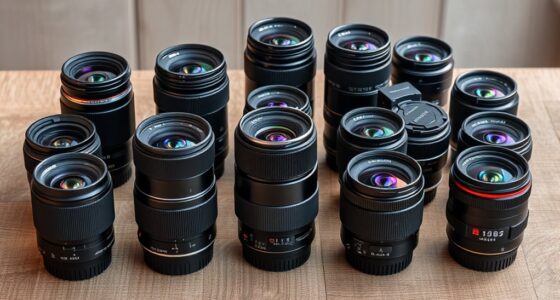
For photographers seeking premium professional DSLR lenses, I rank the Canon EF 24-70mm f/2.8L II USM as the best overall choice for its fast aperture and adaptable everyday range. The Nikon AF-S NIKKOR 70-200mm f/2.8E FL ED VR is a standout for event and portrait work, while the Canon EF 100-400mm f/4.5-5.6L IS USM suits wildlife and distant subjects. The main tradeoffs are zoom flexibility versus a prime’s wide aperture, and professional build and performance versus a lighter, less expensive lens. Mount compatibility matters too: Canon EF and Nikon F lenses are not interchangeable, and DSLR-to-mirrorless adaptation may affect handling. Read on for the full breakdown, including where the less expensive primes make more sense than an L-series zoom.

Get business pricing on tools and workshop supplies
- Business-only prices and quantity discounts
- Tax-exempt purchasing
- Multiple users, one account, clear invoices
Complete the kit



Key Takeaways
- The Canon EF 24-70mm f/2.8L II USM ranks first for its useful working range and constant f/2.8 aperture; the renewed listing has the same lens model, but its condition and included accessories need separate scrutiny.
- The Nikon 70-200mm f/2.8E FL ED VR is the strongest specialist pick here for photographers already using Nikon F cameras who need a fast telephoto zoom.
- The Canon 100-400mm L zoom fills a different job from the 70-200mm: it reaches farther for wildlife and field sports, while giving up a constant f/2.8 aperture.
- The Canon 50mm f/1.2L offers the widest aperture among the Canon 50mm options, but the 50mm f/1.8 STM is a lighter, simpler way to get a standard prime.
- The Rokinon 135mm f/2 and Canon 85mm f/1.8 provide portrait-focused prime options, but neither replaces a zoom when subject distance or framing changes quickly.
| Nikon AF-S NIKKOR 70-200mm f/2.8E FL ED VR Lens |  | Best Overall for Nikon Telephoto Work | Focal length: 70–200 mm | Maximum aperture: f/2.8 | Minimum aperture: f/22 | VIEW ON AMAZON | See Our Full Breakdown |
| Rokinon 135mm F2.0 ED UMC Telephoto Lens for Canon EF Mount |  | Best Manual-Focus Portrait Prime | Focal length: 135 mm | Maximum aperture: f/2.0 | Minimum aperture: f/22 | VIEW ON AMAZON | See Our Full Breakdown |
| Canon EF 50mm f/1.2L USM Lens |  | Best Premium Low-Light Standard Prime | Focal length: 50 mm | Maximum aperture: f/1.2 | Minimum aperture: f/16 | VIEW ON AMAZON | See Our Full Breakdown |
| Canon EF 24-70mm f/2.8L II USM Standard Zoom Lens (Renewed) |  | Best Professional Standard Zoom | Focal length: 24–70 mm | Maximum aperture: f/2.8 | Minimum aperture: f/22 | VIEW ON AMAZON | See Our Full Breakdown |
| Canon EF 50mm f/1.8 STM Lens – Black |  | Best Compact Everyday Prime | Focal length: 50 mm full frame; 80 mm equivalent on APS-C | Maximum aperture: f/1.8 | Autofocus motor: STM stepping motor | VIEW ON AMAZON | See Our Full Breakdown |
| Canon EF 24-70mm f/2.8L II USM Standard Zoom Lens |  | Best Overall Standard Zoom | Focal length: 24–70mm | Maximum aperture: f/2.8 | Minimum aperture: f/22 | VIEW ON AMAZON | See Our Full Breakdown |
| Canon EF 100-400mm f/4.5-5.6L IS USM Telephoto Zoom Lens with 77mm Filter Kit |  | Best for Wildlife and Distant Action | Focal length: 100–400mm | Maximum aperture: f/4.5–5.6 | Mount: Canon EF | VIEW ON AMAZON | See Our Full Breakdown |
| Canon EF 85mm f/1.8 USM Medium Telephoto Lens for Canon SLR Cameras |  | Best Lightweight Portrait Prime | Focal length: 85mm | Maximum aperture: f/1.8 | Minimum aperture: f/22 | VIEW ON AMAZON | See Our Full Breakdown |
| premium professional dslr lense | Focal length | Maximum aperture | Minimum aperture | Filter size |
|---|---|---|---|---|
| Nikon AF-S NIKKOR 70-200mm f/2 | 70–200 mm | f/2.8 | f/22 | 77 mm |
| Rokinon 135mm F2.0 ED UMC Tele | 135 mm | f/2.0 | f/22 | — |
| Canon EF 50mm f/1.2L USM Lens | 50 mm | f/1.2 | f/16 | 72 mm |
| Canon EF 24-70mm f/2.8L II USM | 24–70 mm | f/2.8 | f/22 | 82 mm |
| Canon EF 50mm f/1.8 STM Lens | 50 mm full frame; 80 mm equivalent on APS-C | f/1.8 | — | — |
| Canon EF 24-70mm f/2.8L II USM | 24–70mm | f/2.8 | f/22 | 82mm |
| Canon EF 100-400mm f/4.5-5.6L | 100–400mm | f/4.5–5.6 | — | 77mm |
| Canon EF 85mm f/1.8 USM Medium | 85mm | f/1.8 | f/22 | 58mm |
More Details on Our Top Picks
Nikon AF-S NIKKOR 70-200mm f/2.8E FL ED VR Lens
For Nikon F-mount photographers who need one professional lens for portraits, events, and action, the 70–200mm range and constant f/2.8 aperture make this the most flexible telephoto choice here. Optical stabilization helps when camera movement threatens sharpness, while the bright aperture supports faster shutter speeds and background separation. Compared with the Canon EF 24-70mm f/2.8L II USM, it reaches much farther but gives up the wider framing that makes a standard zoom useful indoors. Its 3.2-pound weight is the main cost of that reach and speed, especially during long handheld sessions. This is a strong professional tool, but it is specifically a Nikon F-mount option; Canon DSLR owners should look to the Canon lenses in this roundup.
Pros:- 70–200mm zoom covers portraits, events, and distant subjects without changing lenses
- Constant f/2.8 aperture supports low-light shooting and subject separation throughout the zoom range
- Optical image stabilization helps reduce blur from camera movement
- Nano Crystal Coating is included in the optical design
Cons:- At 3.2 pounds, it adds substantial weight to a camera kit
- Nikon F mount limits its fit for photographers using Canon DSLR bodies
Best for: Nikon F-mount event, wedding, and sports photographers who need a stabilized f/2.8 telephoto zoom for changing subject distances.
Not ideal for: Canon DSLR owners, or photographers prioritizing a light kit for long handheld days; this lens weighs 3.2 pounds.
- Focal length:70–200 mm
- Maximum aperture:f/2.8
- Minimum aperture:f/22
- Lens mount:Nikon F
- Format:FX/35 mm
- Image stabilization:Optical
- Minimum focus distance:3.6 ft (1.1 m)
- Filter size:77 mm
- Weight:3.2 lbs
Our verdict“Choose it if you shoot Nikon and want a stabilized, constant-f/2.8 telephoto zoom; skip it if weight or mount compatibility is a concern.”
Rokinon 135mm F2.0 ED UMC Telephoto Lens for Canon EF Mount
The Rokinon 135mm is for Canon EF shooters who prefer deliberate focus control to autofocus convenience. Its f/2.0 aperture gives portrait and night-sky photographers room to work in lower light, and the 135mm focal length offers a tighter view than the Canon EF 50mm f/1.2L USM. The long, damped manual-focus throw supports fine adjustments, which can suit carefully composed portraits or tripod-based astrophotography. That control comes with a clear compromise: moving subjects are harder to track than with the autofocus Nikon 70–200mm f/2.8E FL ED VR. The ED element and UMC coating are designed to reduce color fringing and flare, but this lens lacks water resistance. Choose it for considered, stationary shooting rather than fast-paced assignments.
Pros:- f/2.0 maximum aperture supports low-light shooting and shallow depth of field
- 135mm focal length provides a tighter portrait view than the Canon 50mm primes
- ED element and UMC coating are designed to limit chromatic aberration and flare
- Long, well-damped focus throw enables precise manual adjustments
Cons:- Manual focus can slow work with moving or unpredictable subjects
- Not water resistant
- Fixed focal length offers less framing flexibility than the Nikon 70–200mm zoom
Best for: Canon EF portrait and astrophotography shooters who work methodically and want a bright 135mm prime with precise manual focusing.
Not ideal for: Sports, event, or wildlife photographers who rely on autofocus to follow moving subjects, and outdoor shooters who need a water-resistant lens.
- Focal length:135 mm
- Maximum aperture:f/2.0
- Minimum aperture:f/22
- Lens mount:Canon EF
- Focus type:Manual
- Minimum focusing distance:2.6 ft
- Diaphragm blades:9
- Angle of view:18.8° full frame; 12.4° APS-C
- Coating:Ultra Multi-Coated (UMC)
Our verdict“Pick this lens for carefully focused Canon EF portraits or astrophotography, but choose an autofocus lens for fast-moving subjects.”
Canon EF 50mm f/1.2L USM Lens
When a Canon EF photographer values a very bright standard prime over zoom flexibility, the f/1.2 maximum aperture sets this L-series 50mm apart. Ring-type ultrasonic autofocus and full-time manual focus give it a more practical workflow for moving subjects than the manual-focus Rokinon 135mm, while the weather-resistant design adds reassurance for work outside controlled settings. Its 50mm view is more general-purpose than the Rokinon’s tighter portrait framing, though neither replaces a zoom when framing must change quickly. The tradeoffs are substantial: the focal length is fixed, there is no optical image stabilization listed, and the lens weighs 1.8 pounds. It makes the most sense for photographers who specifically want f/1.2 rendering and can work around a single angle of view.
Pros:- f/1.2 maximum aperture offers strong low-light capability and shallow depth of field
- Ultrasonic autofocus includes full-time manual focus adjustment
- Weather-resistant design suits work beyond sheltered indoor settings
- 50mm focal length provides a more general view than the Rokinon 135mm prime
Cons:- Fixed focal length cannot match the framing flexibility of the Canon 24–70mm zoom
- No optical image stabilization is listed
- Weighs 1.8 pounds for a standard prime
Best for: Canon EF portrait and documentary photographers who want a very bright 50mm prime, autofocus, and a weather-resistant design.
Not ideal for: Photographers who need zoom flexibility, built-in optical stabilization, or a lighter everyday lens.
- Focal length:50 mm
- Maximum aperture:f/1.2
- Minimum aperture:f/16
- Lens type:Prime
- Camera mount:Canon EF
- Focus type:Ring-type ultrasonic autofocus with full-time manual focus
- Closest focusing distance:1.48 ft (0.45 m)
- Filter size:72 mm
- Weight:1.8 pounds
Our verdict“Choose it for Canon EF shooting where f/1.2 and autofocus matter more than zoom range, stabilization, or low carry weight.”
Canon EF 24-70mm f/2.8L II USM Standard Zoom Lens (Renewed)
The Canon EF 24–70mm f/2.8L II is the most adaptable everyday option in this group for Canon EF shooters who need wide-to-short-telephoto framing without swapping lenses. Its constant f/2.8 aperture keeps exposure options consistent as you zoom, and ring-type USM autofocus with full-time manual control supports quick changes during a job. Compared with the Nikon 70–200mm f/2.8E FL ED VR, it trades telephoto reach and stabilization for a wider field of view and a more useful general-purpose range. The key drawback is no image stabilization, which matters when photographing still subjects at slower shutter speeds. This listing is also renewed and includes a 90-day limited warranty, a shorter stated warranty than the Canon 50mm f/1.2L’s one year.
Pros:- 24–70mm range handles wide scenes, portraits, and general event coverage
- Constant f/2.8 aperture maintains exposure flexibility across the zoom range
- Ring-type USM autofocus offers full-time manual focusing
- Super UD and UD elements are designed to reduce chromatic aberration
Cons:- No image stabilization
- Renewed condition comes with a 90-day limited warranty
- At 1.7 pounds, it is not a lightweight standard zoom
Best for: Canon EF wedding, event, and editorial photographers who need a fast standard zoom for varied scenes and changing compositions.
Not ideal for: Photographers who need optical stabilization, long telephoto reach, or a longer warranty than the stated 90-day limited coverage.
- Focal length:24–70 mm
- Maximum aperture:f/2.8
- Minimum aperture:f/22
- Lens mount:Canon EF
- Autofocus motor:Ring-type USM
- Minimum focusing distance:0.38 m (1.25 ft)
- Image stabilization:None
- Filter size:82 mm
- Condition and warranty:Renewed; 90-day limited warranty
Our verdict“Choose this renewed zoom for broad Canon EF event coverage and constant f/2.8 performance, provided you can work without stabilization.”
Canon EF 50mm f/1.8 STM Lens – Black
The Canon EF 50mm f/1.8 STM is the compact, straightforward prime in this lineup: it gives Canon DSLR owners a bright f/1.8 aperture and quiet autofocus without the heft or specialized character of the EF 50mm f/1.2L USM. Its STM motor is useful for smooth, quiet focusing during video, and on APS-C bodies the field of view is equivalent to about 80mm, a practical portrait perspective. The premium f/1.2L is the stronger match for photographers who specifically want a wider aperture and weather resistance; this model prioritizes lower carry weight and simple everyday use. The tradeoffs are its fixed focal length, no image stabilization, and no weather sealing. Its 0.21× maximum magnification also makes it a poor substitute for a dedicated close-up lens.
Pros:- f/1.8 aperture supports low-light shooting and background separation
- STM autofocus is designed for smooth, quiet operation during video
- Compact, lightweight design suits everyday carry
- Provides an approximately 80mm-equivalent view on APS-C bodies
Cons:- Fixed 50mm focal length limits framing flexibility compared with the Canon 24–70mm zoom
- No image stabilization
- Not weather-sealed
Best for: Canon DSLR beginners, travel photographers, and video creators who want a compact 50mm prime with quiet autofocus.
Not ideal for: Photographers who need weather sealing, stabilization, zoom framing, or high close-up magnification.
- Focal length:50 mm full frame; 80 mm equivalent on APS-C
- Maximum aperture:f/1.8
- Autofocus motor:STM stepping motor
- Minimum focusing distance:0.35 m (1.15 ft)
- Maximum magnification:0.21×
- Lens construction:6 elements in 5 groups
- Horizontal angle of view:40°
- Vertical angle of view:27°
- Diagonal angle of view:46°
Our verdict“Choose this compact prime for everyday Canon DSLR stills and video, but step up to the 50mm f/1.2L if you need weather resistance and a wider aperture.”
Canon EF 24-70mm f/2.8L II USM Standard Zoom Lens
The 24–70mm f/2.8L II is the most adaptable everyday work lens in this group: its standard zoom range covers environmental portraits, events, and general assignments without a lens change, while the constant f/2.8 aperture keeps exposure consistent as you zoom. Ring-type USM autofocus and aspherical elements support quick focusing and crisp results. Compared with the Canon EF 85mm f/1.8 USM, it gives up the wider aperture and compactness of a dedicated portrait prime, but gains framing flexibility for fast-moving shoots. That versatility comes with real costs: at 805 g, it is heavier than the 85mm, and it has no image stabilization. The large 82mm filter size also adds bulk to a filter kit, while the supplied data does not list weather resistance.
Pros:- Constant f/2.8 aperture supports low-light shooting and background separation throughout the zoom range.
- 24–70mm range handles wide-to-short-telephoto framing without frequent lens changes.
- Ring-type USM autofocus is fast and quiet, with full-time manual focus available.
- Aspherical elements support strong optical sharpness.
Cons:- No image stabilization, so handheld camera shake needs to be managed with shutter speed or support.
- At 805 g, it is a substantial lens for extended handheld use.
- 82mm filters are comparatively bulky, and weather resistance is not listed in the supplied data.
Best for: Canon EF DSLR photographers covering weddings, events, or varied assignments who want one fast standard zoom for changing compositions.
Not ideal for: Photographers who rely on stabilization for handheld low-light work, want a lightweight walk-around lens, or need a long telephoto reach.
- Focal length:24–70mm
- Maximum aperture:f/2.8
- Minimum aperture:f/22
- Mount:Canon EF
- Filter size:82mm
- Closest focusing distance:0.38m (1.25 ft)
- Weight:805 g
- Image stabilization:No
- Autofocus:Ring-type USM with full-time manual focus
Our verdict“Choose this as a versatile professional standard zoom if you value a constant f/2.8 aperture and flexible framing more than low weight or stabilization.”
Canon EF 100-400mm f/4.5-5.6L IS USM Telephoto Zoom Lens with 77mm Filter Kit
When your subject is well beyond the reach of a standard zoom, the 100–400mm focal range makes this L-series lens the specialist choice here. It suits wildlife, field sports, and other situations where moving closer is not practical; on APS-C bodies, the listed equivalent field of view is 160–640mm. Optical stabilization rated up to two shutter-speed stops can help reduce camera shake when shooting handheld, though it cannot freeze a moving subject. Compared with the Canon EF 24-70mm f/2.8L II USM, this lens reaches much farther but gives up a constant, bright aperture: its maximum shifts from f/4.5 to f/5.6 as you zoom. That makes bright conditions or higher ISO settings more relevant for action. The supplied data also does not list weather resistance, a limitation for photographers working in rain or dust.
Pros:- 100–400mm range reaches distant subjects while allowing framing adjustments without changing lenses.
- Optical stabilization helps reduce camera shake during handheld shooting.
- Ring-type USM autofocus offers full-time manual override.
- 77mm filter kit and lens cap keeper are included in the bundle.
Cons:- Maximum aperture narrows from f/4.5 to f/5.6, limiting light as you zoom in.
- Stabilization does not stop subject motion, so fast action may still demand high shutter speeds.
- Weather resistance is not listed in the supplied product data.
Best for: Canon EF DSLR wildlife and field-sports photographers who need long reach, handheld stabilization, and the flexibility to follow subjects at varying distances.
Not ideal for: Indoor action shooters who need a brighter constant aperture, or outdoor photographers who require stated weather resistance for rough conditions.
- Focal length:100–400mm
- Maximum aperture:f/4.5–5.6
- Mount:Canon EF
- Lens type:Telephoto zoom
- Image stabilization:Optical; up to two shutter-speed stops
- Filter size:77mm
- Minimum focus distance:5.9 ft
- Zoom ratio:4x
- Included bundle items:77mm filter kit, lens cap keeper
Our verdict“Pick this lens for distant wildlife and sports when reach and stabilization matter more than a bright, constant aperture.”
Canon EF 85mm f/1.8 USM Medium Telephoto Lens for Canon SLR Cameras
The 85mm f/1.8 USM is the portrait-focused pick for Canon DSLR owners who prefer a bright prime over zoom convenience. Its f/1.8 maximum aperture helps separate a subject from the background and allows more light than the f/2.8 Canon EF 24-70mm zoom, a useful difference for available-light portraits. At 425 g, it is also much lighter than that zoom, making it easier to carry through a long portrait session. The tradeoff is fixed framing: unlike the 24–70mm, this lens cannot quickly widen for a group or reframe when working in a tight space. It also lacks image stabilization, and its listed 2.8 ft minimum focusing distance limits close-up compositions. Choose it for portraits rather than as a single lens for varied professional assignments.
Pros:- f/1.8 maximum aperture supports low-light work and shallow depth of field.
- At 425 g, it is lighter and more compact than the Canon EF 24-70mm f/2.8L II USM.
- USM autofocus is quick and quiet, and the front element does not rotate during focusing.
- 85mm focal length is well suited to portrait framing.
Cons:- Fixed focal length requires moving position or changing lenses to alter framing.
- No image stabilization is listed.
- Minimum focusing distance of 2.8 ft can limit tight detail shots.
Best for: Canon DSLR portrait photographers who want a lightweight short-telephoto prime, shallow depth of field, and a bright aperture for available-light shooting.
Not ideal for: Photographers who need flexible framing, close-up capability, or stabilization for handheld shooting in dim conditions.
- Focal length:85mm
- Maximum aperture:f/1.8
- Minimum aperture:f/22
- Mount:Canon EF
- Weight:425 g
- Filter size:58mm
- Diaphragm blades:8
- Image stabilization:No
- Warranty:1 year
Our verdict“Choose this compact 85mm prime for portraits and available-light shooting if you can work within its fixed framing and lack of stabilization.”

How We Picked
I compared these lenses by how well they fit real professional DSLR assignments: working range, maximum aperture, stabilization where specified, focus and handling considerations, and the level of versatility each brings to a kit. I also weighed the cost of carrying a specialist lens against the benefit it offers for portraits, events, wildlife, or general-purpose work. Compatibility is part of the evaluation, since these are mount-specific DSLR lenses and adapting them to mirrorless bodies can change the practical experience.
The ranking favors lenses that cover demanding assignments without forcing a narrow use case. That puts the Canon EF 24-70mm f/2.8L II first as the most adaptable option, followed by tools with clear professional roles, such as Nikon’s 70-200mm and Canon’s 100-400mm. The remaining primes rank by the value of their specific strengths and how easily their limitations can be managed. The renewed 24-70mm is treated as a purchase-condition alternative to the standard version, not as a different optical design.
| premium professional dslr lense | Maximum aperture | Minimum aperture | Image stabilization |
|---|---|---|---|
| Nikon AF-S NIKKOR 70-200mm f/2 | f/2.8 | f/22 | Optical |
| Rokinon 135mm F2.0 ED UMC Tele | f/2.0 | f/22 | — |
| Canon EF 50mm f/1.2L USM Lens | f/1.2 | f/16 | — |
| Canon EF 24-70mm f/2.8L II USM | f/2.8 | f/22 | None |
| Canon EF 50mm f/1.8 STM Lens | f/1.8 | — | — |
| Canon EF 24-70mm f/2.8L II USM | f/2.8 | f/22 | No |
| Canon EF 100-400mm f/4.5-5.6L | f/4.5–5.6 | — | Optical; up to two shutter-speed stops |
| Canon EF 85mm f/1.8 USM Medium | f/1.8 | f/22 | No |
Factors to Consider When Choosing Premium Professional Dslr Lenses
Choosing among premium DSLR lenses is less about collecting the highest-end label and more about matching focal length, camera mount, and working style. I’d start with the assignments that recur in your calendar, then check whether a specialist lens solves a problem your current kit cannot.
Match Focal Length to How You Work
A lens’s focal length determines more than how close a subject appears; it shapes how much room you need and how you relate to your subject. A 24-70mm zoom can cover changing scenes quickly, while an 85mm or 135mm prime asks you to work within a narrower framing range. For wildlife or field sports, long reach can matter more than a wide aperture because you may not be able to move closer. A common mistake is buying a long telephoto for occasional distant subjects without accounting for its size, weight, and storage needs. I’d identify the distance and space constraints of your regular work before choosing a focal length.
Decide How Much Aperture You Actually Need
A wider maximum aperture can help in dim conditions and create shallower depth of field, but it is not automatically the better choice for every assignment. At a wedding or indoor event, f/2.8 can offer more flexibility than a slower zoom, especially when light changes quickly. For posed portraits, a fast prime may be valuable, though precise focus becomes more demanding as depth of field gets shallower. In bright outdoor work, reach, framing flexibility, or stabilization may matter more than the widest aperture available. I’d pay for speed when it solves a recurring lighting or subject-isolation problem rather than treating it as a prestige feature.
Check Mount Compatibility Before Comparing Features
Canon EF and Nikon F lenses fit different DSLR systems, so a lens that leads this list may not be an option for your camera body. If you use a mirrorless camera with an adapter, confirm that the specific body, adapter, and lens combination supports the autofocus and aperture functions you need. Adaptation can keep older glass useful, but it may add bulk and change balance, and performance depends on the equipment pairing. Also check whether your camera has a full-frame or APS-C sensor, since the field of view changes with sensor size. I’d settle compatibility first; comparing sharpness or aperture across lenses you cannot sensibly mount wastes effort.
Weigh Zoom Convenience Against Prime Specialization
A zoom can reduce lens changes and keep a photographer ready for rapidly changing subjects, while a prime may offer a larger aperture or a more manageable kit. Neither format is inherently more professional: the right choice depends on whether flexibility or a particular focal length improves the work. Several primes in this lineup occupy portrait-friendly focal lengths, so buying more than one can leave overlapping roles without adding much range. Conversely, relying on a single zoom may mean giving up the low-light advantage of a fast prime. Before adding a lens, map its focal range against what you already own and name the gap it will fill.
Treat Renewed Condition as a Separate Buying Decision
A renewed lens can share the model name and optical design of a standard listing without having the same history, condition, or included items. Ask what inspection or refurbishment was performed, what return window applies, and whether the hood, caps, case, or other listed accessories are included. For professional use, check the mount, zoom and focus rings, aperture operation, and front and rear elements as soon as the lens arrives. Dust or cosmetic marks do not always affect images, but mechanical faults and decentering can. I’d choose a renewed option only when the seller’s condition terms and return process make the tradeoff acceptable for your work.
Budget for the Whole Working Kit
The lens is only part of the practical cost of using a professional setup. Long or heavy optics may call for a stronger camera strap, tripod support, a suitable bag, or filters that match the lens’s thread size. A large front element can also make filters and protective accessories more expensive, while carrying several lenses adds weight and increases the chance of missed moments during changes. Avoid assuming that one high-end lens will replace every focal length you need. I’d compare the complete kit’s weight and accessory needs against the assignments it supports, then pay for premium construction where it affects daily reliability or image-making options.
Frequently Asked Questions
Is the Canon EF 24-70mm f/2.8L II worth choosing over the renewed listing?
Optically, both listings identify the same Canon EF 24-70mm f/2.8L II model, so the key difference is the item’s condition and what comes with it, not a separate lens design. I’d compare the seller’s refurbishment details, included accessories, warranty terms, and return policy before deciding. A standard listing may suit a buyer who prefers a clearer condition history, while a renewed listing may suit someone comfortable checking a used or refurbished item promptly. Inspect focus and zoom operation, the mount, and image sharpness across the frame after delivery. The right choice depends on how much uncertainty you can accept for a lens intended for regular professional work.
Can I use these Canon EF and Nikon F lenses on a mirrorless camera?
Often, DSLR lenses can be adapted to a mirrorless body, but the answer depends on the camera mount and the adapter. Canon EF lenses need an adapter compatible with the target camera system, while Nikon F lenses require a different pairing. Autofocus, aperture control, stabilization, and subject tracking support can vary by body, adapter, and lens combination. I’d check the camera maker’s compatibility guidance and test the exact combination before relying on it for paid work. An adapted lens may remain useful, but the added adapter can affect balance and handling.
Should I choose a 70-200mm f/2.8 zoom or a 100-400mm zoom for events and sports?
For indoor events, close action, and portraits in changing light, a 70-200mm f/2.8 zoom is generally the more flexible fit because its wider aperture can help when shutter speeds must stay high. A 100-400mm zoom is better suited to distant outdoor subjects where extra reach matters more than maintaining f/2.8. Field sports can call for either, depending on how close you can get to the action and whether lighting is controlled. Consider whether you need background separation and low-light flexibility or framing from a fixed position at greater distance. Some photographers need both roles, but many should start with the assignment they shoot most often.
Is a fast 50mm prime a better first professional lens than a 24-70mm zoom?
A 50mm prime can be a smart choice when you want a simple standard view, low-light flexibility, or a compact way to learn deliberate composition. A 24-70mm zoom covers more framing options without requiring a lens change, which is helpful at events or on busy assignments. The Canon 50mm f/1.2L and f/1.8 STM also differ in size, aperture, and intended level of investment, so the faster option is not automatically the right starting point. If missed moments from changing lenses are a concern, the zoom may serve you better. If you mainly shoot portraits or controlled scenes, a prime may fit your workflow more closely.
What should I check before buying a secondhand or renewed DSLR lens for paid work?
Start with the seller’s condition description, warranty or return terms, and the exact accessories included; do not assume a renewed listing matches a new one in those details. Check the mount for damage and test the focus and zoom rings for smooth, consistent movement. Photograph a detailed subject at different apertures and focal lengths to check focus accuracy and image consistency across the frame. Confirm that autofocus, aperture control, and stabilization work with your camera body, especially if you plan to adapt the lens. I’d avoid making a renewed or secondhand lens your only working option until you have tested it thoroughly.
Conclusion
For most Canon DSLR owners who need one high-end lens for varied assignments, I’d choose the Canon EF 24-70mm f/2.8L II USM as the best overall pick. The Nikon 70-200mm f/2.8E FL ED VR is my best premium specialist recommendation for Nikon F users covering events, sports, or portraits, while the Canon EF 50mm f/1.8 STM is the best value and beginner-friendly way into a standard prime. Choose the Canon EF 100-400mm for distant wildlife or field action, and look at the Rokinon 135mm f/2 or Canon 85mm f/1.8 when portrait-focused framing matters more than zoom flexibility. If you’re considering the renewed 24-70mm, make the decision on condition terms and included items, not on the model name alone.