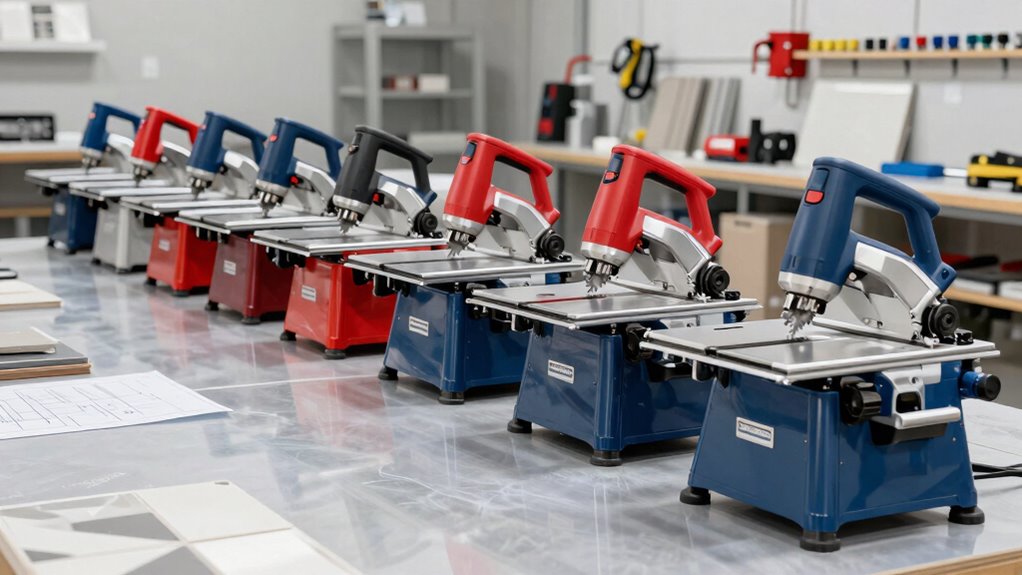

For a versatile wet tile saw, I’d start with the DEWALT D36000S, a full-size option suited to demanding work, while the SKIL 3550-02 stands out for water containment and the PORTER-CABLE PCE980 for a bench-style setup. The lineup ranges from handheld saws for localized cuts to 7-inch tabletop models and 10-inch machines built for larger tile and repeated cuts. The main tradeoff is between portability and cutting capacity, with water management, setup space, and the type of cuts you need also shaping the choice. A larger saw may handle more demanding projects, but it takes up more room and is less convenient to move. Read on for the full comparison and a recommendation matched to your work.

Get business pricing on tools and workshop supplies
- Business-only prices and quantity discounts
- Tax-exempt purchasing
- Multiple users, one account, clear invoices
Complete the kit


Key Takeaways
- The two DEWALT 10-inch saws are the capacity-focused choices: the D36000S and D24000S suit buyers who need a full-size cutting platform and can accommodate a heavier, larger setup.
- The SKIL 3550-02 puts water control near the center of the decision: its HydroLock system may appeal to indoor DIYers who want to limit spray around the saw.
- Seven-inch tabletop saws offer a practical middle ground: the VEVOR 3500 RPM, SKIL 3540-02, PORTER-CABLE PCE980, and VEVOR 3600 RPM models avoid the footprint of the 10-inch saws while offering a more supported work surface than handheld tools.
- Handheld options serve a different job, not a smaller version of the same job: the POWERTEC, DEWALT DWC860W, and Ryobi TC401 prioritize maneuverability for localized cuts over the support and repeatability of a table saw.
- Choosing by motor speed alone misses the bigger picture: blade size, work support, water handling, portability, and the tile dimensions you expect to cut matter more to fit than a single RPM figure.
| VEVOR 7-Inch Wet Tile Saw with 3500 RPM Induction Motor |  | Best for Quieter Bench-Top Cutting | Blade: 7-inch 65Mn steel | Motor: 750 W induction motor | Motor speed: 3500 rpm | VIEW ON AMAZON | See Our Full Breakdown |
| SKIL 3540-02 7-Inch Wet Tile Saw |  | Best for Beginners | Blade diameter: 7 inches | Power: 1325 W, 120 V corded | No-load speed: 3600 rpm | VIEW ON AMAZON | See Our Full Breakdown |
| PORTER-CABLE PCE980 7-Inch Wet Tile Saw |  | Best for Longer Cuts | Motor: 1.0 HP / 1300 W | Voltage: 120 V | Speed: 2850 rpm | VIEW ON AMAZON | See Our Full Breakdown |
| POWERTEC 4.5-Inch Handheld Wet/Dry Tile Saw | 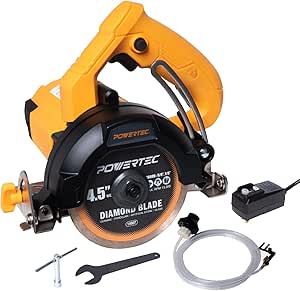 | Best Handheld Pick | Motor: 12 A / 1400 W | Speed: Up to 12,000 rpm | Blade: 4.5-inch continuous-rim diamond | VIEW ON AMAZON | See Our Full Breakdown |
| SKIL 3550-02 7-Inch Wet Tile Saw with HydroLock Water Containment System |  | Best for Larger Tiles and Indoor Cutting | Power: 600 W, 120 V corded | Speed: 3600 rpm | Blade: 7-inch continuous-rim diamond | VIEW ON AMAZON | See Our Full Breakdown |
| DEWALT DWC860W 4-3/8-Inch Wet/Dry Handheld Tile Saw |  | Best Handheld for Mixed Materials | Model: DWC860W | Power source: Corded electric | Motor: 10.8 A, 1,300 W | VIEW ON AMAZON | See Our Full Breakdown |
| VEVOR Wet Tile Saw – 7″ 65Mn Steel Blade, 3600 RPM |  | Best for Compact Bench Bevel Cuts | Power source: Corded electric | Dimensions: 17.3 × 15.2 × 9.4 in. | Weight: 22.5 lb | VIEW ON AMAZON | See Our Full Breakdown |
| Ryobi TC401 4-Inch Corded Wet Tile Saw, 12 Amp |  | Best for Simple Ceramic and Porcelain Cuts | Model: TC401 | Power: 12 amps | Power source: Corded | VIEW ON AMAZON | See Our Full Breakdown |
| DEWALT 10-Inch Wet Tile Saw with Stand, 15-Amp, Corded (D36000S) |  | Best for Large-Format and Long Cuts | Model: D36000S | Blade diameter: 10 in. | Motor: 15 amp, 1,800 W | VIEW ON AMAZON | See Our Full Breakdown |
| DEWALT 10-Inch Corded Wet Tile Saw with Stand (D24000S) |  | Best Mid-Size Saw with Folding Stand | Model: D24000S | Power source: Corded electric | Voltage: 120 V | VIEW ON AMAZON | See Our Full Breakdown |
| wet tile saw | Weight | Motor | Blade diameter |
|---|---|---|---|
| VEVOR 7-Inch Wet Tile Saw with | 20.2 pounds | 750 W induction motor | — |
| SKIL 3540-02 7-Inch Wet Tile S | 18 pounds | — | 7 inches |
| PORTER-CABLE PCE980 7-Inch Wet | 32 pounds | 1.0 HP / 1300 W | 7 inches |
| POWERTEC 4.5-Inch Handheld Wet | 9.5 pounds | 12 A / 1400 W | — |
| SKIL 3550-02 7-Inch Wet Tile S | 22.1 pounds | — | — |
| DEWALT DWC860W 4-3/8-Inch Wet/ | 6.6 lb | 10.8 A, 1,300 W | — |
| VEVOR Wet Tile Saw | 22.5 lb | — | — |
| Ryobi TC401 4-Inch Corded Wet | 9.3 lb | — | 4 in. |
| DEWALT 10-Inch Wet Tile Saw wi | 91 lb | 15 amp, 1,800 W | 10 in. |
| DEWALT 10-Inch Corded Wet Tile | — | — | 10 in. |
More Details on Our Top Picks
VEVOR 7-Inch Wet Tile Saw with 3500 RPM Induction Motor
The VEVOR TC180Ⅱ suits small tile jobs where a compact benchtop setup and a water reservoir matter more than long cuts. Its induction motor is designed for lower vibration and noise than a more basic motor, while the removable reservoir helps manage dust without a hose connection. Compared with the PORTER-CABLE PCE980, it is much lighter at 20.2 pounds, but its 1.25-inch maximum cutting depth and lack of a sliding-cart capacity figure make it less suited to larger or thicker tile. The saw handles 0–45-degree miter cuts and has a zinc-coated work surface, though buyers still need a corded outlet and should plan around its modest cutting depth.
Pros:- Induction motor is designed to reduce vibration and operating noise.
- Removable reservoir helps control dust and debris without a hose feed.
- Supports miter cuts from 0 to 45 degrees.
- Zinc-coated work surface resists rust and scratches.
Cons:- Maximum cutting depth of 1.25 inches limits work with thicker tile.
- Corded power requires access to an electrical outlet.
- No cutting-capacity measurement is listed for longer tile.
Best for: DIYers cutting standard-size ceramic or porcelain tile who want a compact benchtop saw with a removable water reservoir and angled-cut capability.
Not ideal for: Installers handling thick tile or long-format pieces; its maximum depth is 1.25 inches and the listed data does not specify a long cutting capacity.
- Blade:7-inch 65Mn steel
- Motor:750 W induction motor
- Motor speed:3500 rpm
- Maximum cutting depth:1.25 inches / 31 mm
- Maximum cutting angle:45 degrees
- Work surface:Zinc-coated
- Water reservoir:Removable
- Weight:20.2 pounds
Our verdict“Choose the VEVOR TC180Ⅱ for compact, moderate-depth tile work where lower-vibration operation and a removable reservoir matter more than capacity.”
SKIL 3540-02 7-Inch Wet Tile Saw
The SKIL 3540-02 is a straightforward choice for first-time tile projects: its adjustable rip fence and miter gauge give beginners clear reference points for repeatable straight and angled cuts. The stainless steel tabletop resists corrosion, and the built-in reservoir cools the blade while limiting dust. Compared with the SKIL 3550-02, this model has a smaller stated tile support limit, topping out at 12 × 12 inches, but it offers a listed 1-3/8-inch cut depth at 90 degrees. Its 18-pound weight is also lighter than the 3550-02. The tradeoff is capacity: shoppers working with larger formats may prefer the sliding extension on the 3550-02, and this saw still needs a nearby outlet.
Pros:- Adjustable rip fence and miter gauge help guide repeatable cuts.
- Corrosion-resistant stainless steel tabletop is suited to wet cutting.
- Reservoir cools the blade and helps reduce dust and debris.
- Supports bevel cuts from 0 to 45 degrees.
Cons:- Tile capacity is limited to pieces up to 12 × 12 inches.
- Corded operation requires access to a power outlet.
- Cut depth at 45 degrees is limited to 1 inch.
Best for: New DIY tilers working on bathroom backsplashes or other projects with tiles up to 12 × 12 inches who want a fence and miter gauge to guide cuts.
Not ideal for: Buyers cutting large-format tile or needing a larger support surface; its stated capacity is limited to tiles up to 12 × 12 inches.
- Blade diameter:7 inches
- Power:1325 W, 120 V corded
- No-load speed:3600 rpm
- Cross-cut capacity:7.75 inches
- Diagonal-cut capacity:7.25 inches
- Depth at 90 degrees:1-3/8 inches
- Depth at 45 degrees:1 inch
- Weight:18 pounds
Our verdict“Pick the SKIL 3540-02 for guided, smaller-tile projects, but step up to the SKIL 3550-02 if your work regularly involves larger formats.”
PORTER-CABLE PCE980 7-Inch Wet Tile Saw
For projects that outgrow compact tabletop saws, the PORTER-CABLE PCE980 offers a 17-inch cutting capacity and a cast-metal cutting cart. That reach gives it an advantage over the SKIL 3540-02, whose stated tile support is limited to pieces up to 12 × 12 inches. The 1.0 HP motor and included porcelain blade make this a more substantial option for porcelain, ceramic, and stone, while the miter square helps keep repeated cuts aligned. The difference comes with added bulk: at 32 pounds, it is much heavier than the SKIL and less convenient to move between rooms. Its listed cutting angle is 90 degrees, so buyers seeking the 0–45-degree bevel range available on several other saws should look elsewhere.
Pros:- 17-inch cutting capacity accommodates longer tile cuts than the compact SKIL 3540-02.
- 1.0 HP motor is paired with a cast-metal cutting cart.
- Includes a porcelain tile blade and miter square.
- Designed to cut porcelain, ceramic, and stone tile.
Cons:- At 32 pounds, it is heavier to carry and reposition than smaller saws.
- Requires a water supply for wet cutting.
- Listed cutting angle is 90 degrees, without a stated bevel range.
Best for: DIY renovators and tile setters who need to make longer cuts in porcelain, ceramic, or stone and can keep a heavier saw set up near a water supply.
Not ideal for: Buyers who prioritize portability or need bevel cuts; it weighs 32 pounds and the listed cutting angle is 90 degrees.
- Motor:1.0 HP / 1300 W
- Voltage:120 V
- Speed:2850 rpm
- Blade diameter:7 inches
- Cutting capacity:17 inches
- Cutting angle:90 degrees
- Weight:32 pounds
- Included components:7-inch porcelain tile blade, blade wrench, and miter square
Our verdict“Choose the PCE980 when longer cuts and a sturdier cart take priority over portability and bevel-cut flexibility.”
POWERTEC 4.5-Inch Handheld Wet/Dry Tile Saw
The POWERTEC HTS1045 is the flexible choice for cuts that a stationary tabletop saw cannot easily reach, such as trimming installed tile or shaping pieces on site. Its 9.5-pound handheld design, adjustable depth, and bevel setting make it more maneuverable than the bench-style VEVOR TC180Ⅱ. The water feed supports wet cutting and helps cool the blade, while an in-line GFCI plug adds electrical protection around water. Its 4.5-inch blade cuts to 1-7/16 inches straight, but that small format does not replace the broader work surface and repeatable support of a 7-inch saw. Wet operation also depends on a hose connection, so it is less convenient for a quick cut where water access is limited.
Pros:- Handheld 9.5-pound design is easier to maneuver on site than a benchtop saw.
- Adjustable depth and 0–45-degree bevel settings support varied cuts.
- Water feed helps cool the blade and reduce dust and chipping.
- In-line GFCI plug provides electrical protection.
Cons:- A 4.5-inch blade offers less supported cutting capacity than the 7-inch tabletop saws.
- Wet cutting requires a water hose connection.
- At 45 degrees, maximum cutting depth is 7/8 inch.
Best for: Tile installers and DIYers who need a portable saw for on-site trimming, bevel work, or cuts on tile that is already installed.
Not ideal for: Buyers who want a stable table for repeated, long straight cuts or do not have a hose connection available for wet cutting.
- Motor:12 A / 1400 W
- Speed:Up to 12,000 rpm
- Blade:4.5-inch continuous-rim diamond
- Arbor:7/8 inch
- Bevel range:0–45 degrees
- Maximum straight cutting depth:1-7/16 inches / 35.8 mm
- Maximum depth at 45 degrees:7/8 inch
- Weight:9.5 pounds
- Water feed:Adjustable, with 3/4-inch brass garden hose fitting
Our verdict“Choose the POWERTEC for portable trimming and bevel work, not as a substitute for a supported tabletop saw on long runs.”
SKIL 3550-02 7-Inch Wet Tile Saw with HydroLock Water Containment System
The SKIL 3550-02 stands out for buyers balancing larger tile support with indoor cleanup. Its HydroLock water containment system keeps water close to the blade to limit splashing, while a sliding extension supports tiles up to 18 × 18 inches. That gives it a clear capacity advantage over the SKIL 3540-02, which is limited to tiles up to 12 × 12 inches. The adjustable fence and settings for 0, 22.5, and 45 degrees cover common straight, miter, and angled cuts. The tradeoff is a 600-watt motor and a 7-inch blade, so this remains a compact-format saw rather than a heavy-duty alternative to the PORTER-CABLE PCE980 and its 17-inch cutting capacity. At 22.1 pounds, it is also less portable than the smaller SKIL model.
Pros:- HydroLock system helps contain water around the blade during indoor work.
- Sliding extension supports tiles up to 18 × 18 inches.
- Aluminum tabletop resists rust.
- Supports straight, miter, and bevel cuts at 0, 22.5, and 45 degrees.
Cons:- The 7-inch blade and listed support limit make it less suited to oversized or thick tile.
- At 22.1 pounds, it is heavier to move than the SKIL 3540-02.
- Its 600-watt rating is lower than the 1300-watt PORTER-CABLE PCE980.
Best for: Home renovators cutting tiles up to 18 × 18 inches indoors who want a sliding support extension and a system designed to limit water splash.
Not ideal for: Professionals cutting thick or unusually long tile who need a larger cutting capacity or a more substantial saw platform.
- Power:600 W, 120 V corded
- Speed:3600 rpm
- Blade:7-inch continuous-rim diamond
- Maximum tile support:18 × 18 inches
- Cutting angles:0, 22.5, and 45 degrees
- Table material:Aluminum
- Water containment:HydroLock system
- Weight:22.1 pounds
Our verdict“Choose the SKIL 3550-02 for larger indoor tile projects where water containment matters more than heavy-duty capacity.”
DEWALT DWC860W 4-3/8-Inch Wet/Dry Handheld Tile Saw
The DEWALT DWC860W suits jobs where carrying a tabletop saw is impractical: its 6.6-pound handheld body can cut ceramic, porcelain, granite, and concrete, and the water feed supports wet cutting to limit dust and blade wear. Adjustable depth and a 45-degree bevel give it more flexibility than the simpler, ceramic-and-porcelain-focused Ryobi TC401. It can also make dry cuts, though that choice brings more dust, so wet operation is the better fit for indoor work. Unlike the larger DEWALT D36000S, this is not a guide-rail setup for long, repeatable tile cuts; it is a portable tool for on-site shaping and shorter cuts. It needs a corded outlet, and the supplied specifications conflict on some details, so I would verify blade and operating information before purchase.
Pros:- Handles ceramic, porcelain, granite, concrete, and other stone materials
- Water feed can reduce airborne dust during wet cutting
- Adjustable cutting depth and 45-degree bevel expand cut options
- Lightweight handheld design is easier to carry between work areas than a tabletop saw
Cons:- Handheld format offers less support for long, repeatable cuts than the DEWALT D36000S
- Requires a corded power source
- Source specifications conflict on motor amperage, blade size, and speed
Best for: Tile setters and renovators who need a portable saw for short cuts across ceramic, porcelain, and stone materials.
Not ideal for: Buyers cutting many long, identical tiles or working where a corded outlet and water supply are unavailable.
- Model:DWC860W
- Power source:Corded electric
- Motor:10.8 A, 1,300 W
- Blade size:4-3/8 in.
- Maximum cutting depth:1-3/8 in.
- Bevel capacity:45 degrees
- Maximum no-load speed:13,000 rpm
- Weight:6.6 lb
Our verdict“Choose this DEWALT for portable, varied-material cutting; pick a tabletop model if your work depends on long, guided cuts.”
VEVOR Wet Tile Saw – 7″ 65Mn Steel Blade, 3600 RPM
This VEVOR is a small benchtop wet saw for DIYers who want angle cuts without stepping up to a jobsite-sized machine. Its table tilts from 0 to 45 degrees, while the detachable reservoir and galvanized work surface make cleanup more contained than with a handheld cutter such as the DEWALT DWC860W. The tradeoff is capacity: maximum depth is listed as 1.2 inches at 90 degrees and 0.8 inches at 45 degrees, well short of the deeper cuts available on the DEWALT D24000S. At 22.5 pounds, it is lighter than those full-size saws but still not especially convenient to carry repeatedly, and its cord restricts placement. I would favor it for modest tile projects with bevels, not large-format tile or frequent transport between sites.
Pros:- Adjustable 0-to-45-degree cutting angle supports bevel work
- Detachable water reservoir helps control dust and simplify cleanup
- Galvanized worktable is described as scratch-resistant
- More table-supported than the handheld DEWALT DWC860W
Cons:- Cut depth is limited to 1.2 inches at 90 degrees and 0.8 inches at 45 degrees
- At 22.5 pounds, it is less portable than a handheld saw
- Corded operation and a 17.3-by-15.2-inch footprint constrain placement
Best for: DIY renovators making occasional bevel cuts on smaller ceramic, marble, or stone pieces at a fixed workbench.
Not ideal for: Installers handling large-format tile, deep cuts, or frequent jobsite moves who need greater capacity and easier transport.
- Power source:Corded electric
- Dimensions:17.3 × 15.2 × 9.4 in.
- Weight:22.5 lb
- Blade material:65Mn steel
- Motor speed:3,600 RPM
- Cutting angle:0°–45°
- Maximum cut depth at 90°:1.2 in. (30 mm)
- Maximum cut depth at 45°:0.8 in. (20 mm)
- Water reservoir:Detachable PP reservoir
Our verdict“Choose this VEVOR for occasional, shallow bevel cuts on a compact bench, not for large tile or demanding site work.”
Ryobi TC401 4-Inch Corded Wet Tile Saw, 12 Amp
The Ryobi TC401 is a straightforward pick for buyers whose work is limited to ceramic and porcelain and who prefer a light, handheld format. At 9.3 pounds, it is easier to carry than the VEVOR 7-inch benchtop saw, but its 4-inch blade and sparse feature information make it a narrower choice than the DEWALT DWC860W, which is specified for a wider range of materials and includes depth adjustment and bevel capability. The TC401’s listed 12-amp motor and 24-tooth blade establish the basics, yet the supplied details do not describe cutting depth, bevel options, or water-management features. That uncertainty makes it harder to match to a particular installation. The listed 30-day warranty is also limited, so I would reserve this model for simple cuts rather than a tool investment for broad, repeated use.
Pros:- Designed for ceramic and porcelain cutting
- At 9.3 pounds, lighter to carry than the VEVOR benchtop saw
- Corded power avoids reliance on a battery
- Listed 12-amp motor and 4-inch blade provide basic cutting specifications
Cons:- Product information does not specify cutting depth, bevel capacity, or water-management details
- Listed 30-day warranty is limited
- Narrower stated material range than the DEWALT DWC860W
Best for: DIYers making basic cuts in ceramic or porcelain who want a lightweight corded handheld saw and do not need documented bevel features.
Not ideal for: Stone cutters or buyers needing specified cut depth, bevel capacity, detailed water control, or longer warranty coverage.
- Model:TC401
- Power:12 amps
- Power source:Corded
- Blade diameter:4 in.
- Number of teeth:24
- Weight:9.3 lb
- Compatible materials:Ceramic, porcelain
- Material:ABS plastic
- Warranty:30 days
Our verdict“Pick the Ryobi for simple ceramic or porcelain work when low weight matters more than broad material capability or detailed specifications.”
DEWALT 10-Inch Wet Tile Saw with Stand, 15-Amp, Corded (D36000S)
For demanding layouts, the DEWALT D36000S stands apart through its 37-inch rip capacity, extendable to 41 inches with a plunge cut, and its stated accuracy within 1/32 inch over 30-inch cuts. Those capacities make it a stronger fit for large-format tile than the DEWALT D24000S, whose listed rip capacity is 24 inches. A 10-inch blade, 15-amp motor, included stand, and water-tray system make this a jobsite-oriented package rather than a compact home-project tool. The cost of that reach is bulk: at 91 pounds, moving it takes more effort than moving the 69-pound D24000S, even though both include stands and water-management components. I would choose it when long, accurate cuts are central to the job; for smaller rooms and shorter pieces, its capacity may be more machine than needed.
Pros:- 37-inch rip capacity extends to 41 inches with a plunge cut
- Specified cutting accuracy is within 1/32 inch over 30-inch cuts
- Stand, porcelain tile blade, pump, trays, and guides are included
- Water tray system helps manage overspray around the cutting area
Cons:- At 91 pounds, it is heavy to move between jobsites
- Large capacity and included setup may be excessive for short, occasional cuts
- Corded operation requires access to a suitable power source
Best for: Professional tile installers and serious renovators cutting large-format tile or making long, repeatable rip and plunge cuts.
Not ideal for: DIYers with limited storage or frequent solo transport who do not need cuts longer than the D24000S can handle.
- Model:D36000S
- Blade diameter:10 in.
- Motor:15 amp, 1,800 W
- Voltage:120 V
- Speed:4,200 rpm
- Rip cut capacity:37 in. (41 in. with plunge)
- Crosscut capacity:8.5 in.
- Cutting accuracy:Within 1/32 in. over 30-in. cuts
- Weight:91 lb
Our verdict“Choose the D36000S when long, precise cuts justify a heavy setup; choose the D24000S for lower weight and a shorter rip capacity.”
DEWALT 10-Inch Corded Wet Tile Saw with Stand (D24000S)
The DEWALT D24000S balances a substantial 10-inch cutting platform with a lighter listed weight than the D36000S. Its 69-pound body and folding stand make it the more manageable option for crews that need a full-size saw but do not need the other DEWALT’s 37-inch rip capacity. The stainless steel rail system is designed to guide accurate cuts, while adjustable water nozzles and the included trays help contain overspray. A 24-inch rip capacity, 18 × 18-inch diagonal capacity, and 3 1/8-inch maximum depth cover a broad range of common tile work. Still, this is not a light portable cutter like the DEWALT DWC860W; moving and storing it takes room and effort. It also ships in two boxes, which can complicate delivery and setup.
Pros:- Folding stand supports setup and storage
- Stainless steel rail system is designed to guide accurate cuts
- Includes porcelain blade, pump, water pan, trays, and cutting guides
- Water trays and adjustable nozzles help control overspray
Cons:- At 69 pounds, it remains heavy to transport for one person
- 24-inch rip capacity is substantially shorter than the D36000S
- Ships in two boxes, adding a delivery and setup complication
Best for: Tile installers and serious DIY renovators who need a full-size 10-inch saw, a folding stand, and capacity for common floor and wall tile cuts.
Not ideal for: Buyers who need very long rip cuts beyond 24 inches, a lightweight handheld tool, or a compact storage footprint.
- Model:D24000S
- Power source:Corded electric
- Voltage:120 V
- Motor power:1.5 HP
- Blade diameter:10 in.
- Arbor size:5/8 in.
- Diagonal cut capacity:18 × 18 in.
- Rip capacity:24 in.
- Maximum cut depth:3 1/8 in.
Our verdict“Choose the D24000S for a capable full-size saw with a folding stand when its 24-inch rip capacity is enough.”

How We Picked
I ranked these saws by how well their format and stated features match common tile-cutting jobs: occasional home repairs, room-scale DIY installations, and repeated work with larger tiles. I weighed blade size and cutting-platform support alongside water delivery or containment, portability, setup needs, and the practical effect of each design on repeat cuts. A handheld saw can be the right choice for an installed tile or a cut that calls for maneuverability, but it does not replace a stable tabletop saw for a run of matching pieces.
The ranking favors a capable, versatile setup first, then separates the middle of the list by value-minded features and job fit rather than treating similar 7-inch saws as interchangeable. The 10-inch DEWALT models place high for buyers whose projects justify their larger format; compact handheld saws rank lower for general-purpose use because their strengths are narrower. I also considered ownership tradeoffs such as worksite footprint, water mess, and the likelihood that a buyer will need more cutting capacity later. Specifications alone cannot settle fit, so I frame each pick around the kind of work it suits and the compromises a buyer should expect.
Factors to Consider When Choosing Wet Tile Saw
Before choosing a wet tile saw, match the machine to the cuts you will actually make, your workspace, and how often you will move it. These broader factors can prevent a mismatch that blade speed or a long feature list may not reveal.
Match the Saw Format to the Work
A tabletop saw supports tile on a work surface, which makes it a natural fit for repeated straight cuts and consistent positioning. A handheld model is easier to bring to a tile that cannot be carried to a bench, but guiding the tool accurately can demand more attention and support from the operator. A common mistake is buying a handheld saw because it looks easier to store, then expecting it to handle a full room of uniform cuts as comfortably as a table saw. Think about where the tile will be cut: at a central station, near the installation, or in a tight repair area. If your project mixes both situations, prioritize the type of cut you will make most often and plan for the other task to take longer.
Check Tile Size and Cut Geometry
Blade diameter is only part of cutting capacity; the saw’s layout and supported travel also affect whether a tile can sit securely and pass through the blade. Before buying, compare the largest tile you expect to cut with the manufacturer’s stated cutting capacity, including diagonal or plunge-cut limits when those cuts matter. Do not assume a larger blade automatically makes every oversized tile easy to handle. Large-format tile can flex or shift if it is poorly supported, so a stable surface and room to guide the material matter alongside raw capacity. For small mosaics or trim pieces, a large saw may add bulk without improving the cuts you need most.
Plan for Water, Slurry, and Cleanup
Wet cutting helps control airborne dust, but it creates water spray and tile slurry that need a place to go. Containment features can make indoor or garage work easier to manage, though no system removes the need to protect nearby surfaces and clean the saw after use. Buyers sometimes focus on the promise of reduced mess and overlook where the machine will drain, how often the water needs attention, and whether cleanup is practical in their workspace. If you have no outdoor cutting area, give splash control and floor protection more weight than a small difference in motor speed. Also check the maker’s directions for water use and care rather than improvising a setup.
Balance Portability Against Stability
A compact saw is easier to carry and store, but lighter equipment can offer less support for large or heavy tile. A stand or substantial table can improve working height and material handling, yet it adds setup time and takes up storage space. Before choosing, consider the entire working arrangement: saw, stand, tile support, water supply, and a safe route for carrying materials. A common buying error is comparing the saw alone while ignoring the footprint it needs during a cut. For a fixed workshop or long installation, stability may be worth the added bulk; for scattered repairs, quick setup and transport can matter more.
Look Beyond RPM at the Cutting System
Motor speed figures are easy to compare, but they do not describe the whole cutting experience. Blade type and condition, water delivery, material support, and how securely the tile is guided all affect cut quality and pace. Check that the saw accepts an appropriate blade for the tile materials you plan to use, and confirm the blade size and arbor requirements before ordering replacements. A faster listed speed is not a substitute for a suitable blade or steady support. If you expect frequent work, include replacement blades and routine cleaning in your ownership plan; for occasional jobs, straightforward setup may be more useful than a feature aimed at high-volume use.
Choose Capacity for Your Likely Projects, Not Every Possibility
Paying for a larger saw makes sense when your projects regularly call for bigger tile, long cuts, or sustained use. It can be unnecessary if your work is limited to a backsplash, a few replacements, or cuts around an existing installation. Estimate the tile formats and number of cuts in your next few projects instead of buying for a hypothetical job you may never take on. Also leave room for project changes: moving from small ceramic tile to larger, denser material may shift the value toward a more capable platform. The right choice is the smallest, easiest-to-manage saw that still fits your real cutting requirements.
Frequently Asked Questions
Should I choose a 10-inch saw or a 7-inch wet tile saw?
Choose by the tile dimensions and cut types you need, not blade size alone. The 10-inch DEWALT models are the lineup’s full-size options for buyers whose work calls for a larger platform and who can manage the setup footprint. A 7-inch saw is a more compact middle ground for many home projects, but its actual capacity depends on the specific model’s stated limits. Check straight-cut and diagonal-cut capacity against your largest planned tile before deciding. If most of your work involves small or medium pieces, the larger machine may take up space without solving a problem you have.
Can a handheld wet tile saw replace a tabletop saw for a bathroom renovation?
It can handle localized cuts and situations where carrying tile to a saw is inconvenient, but it is not an equal substitute for a tabletop saw across every bathroom project. A supported table generally makes repeated straight cuts easier to position consistently, while handheld cutting calls for more control and suitable support beneath the tile. The POWERTEC, DEWALT DWC860W, and Ryobi TC401 are best viewed as maneuverable tools for specific tasks rather than direct matches for the larger saws. Count how many cuts your project needs and how many must match before choosing. For a high volume of repeat cuts, a tabletop format is usually the more practical starting point.
Is a water-containment feature enough to use a wet tile saw indoors?
A containment feature can help manage spray, but it does not make indoor cutting mess-free. Water and slurry can still escape, and the work area needs protection suited to its floors, walls, and nearby equipment. The SKIL 3550-02’s HydroLock system is a standout for buyers who place a premium on water control, but you should still plan for cleanup and follow the saw’s operating instructions. If indoor space is limited, test your setup in a protected area before beginning a large run of cuts. When you cannot control water safely, an outdoor or otherwise suitable work area may be the better choice.
What should I check before using a wet tile saw with porcelain or other dense tile?
Confirm that the saw and blade are appropriate for the specific tile material, thickness, and cut you need. A saw’s blade diameter or motor-speed figure by itself does not confirm that it will handle every dense tile cleanly. Review the manufacturer’s capacity and blade guidance, and use a sound, material-appropriate blade rather than assuming the included blade suits every job. Support the tile securely and avoid forcing it through the cut; poor support can cause chipping or an unsafe shift. If the tile is unusually thick or large, verify the saw’s limits before committing to the tool.
When is it worth choosing a larger saw with a stand?
A larger saw with a stand is easier to justify when you expect frequent cutting, need the capacity of a full-size platform, or want a dedicated station for a substantial installation. The DEWALT D36000S and D24000S fit buyers who can make use of that format and have room to set it up. For occasional repairs, the extra footprint and handling may outweigh the capacity you gain. Consider transport and storage as well as cutting needs: a saw that is difficult to move can complicate a job even if its capacity is generous. If your tile sizes and project volume do not call for a larger platform, a 7-inch model may be the more manageable fit.
Conclusion
For the broadest range of demanding work, I’d make the DEWALT D36000S my best overall pick, especially when a full-size platform and stand fit the project and workspace. The VEVOR 7-Inch Wet Tile Saw with 3500 RPM Induction Motor is my best value-oriented choice for buyers who want a tabletop format without moving to a 10-inch saw. For water-conscious DIYers and beginners setting up a home work area, the SKIL 3550-02 is the clearest place to start because its HydroLock system addresses a common source of mess. The DEWALT D24000S is my best premium-style alternative for buyers who want a full-size DEWALT setup, while the DEWALT DWC860W or POWERTEC handheld saw makes more sense for localized cuts and restricted spaces. Choose the 7-inch class for a compact general-purpose station, a handheld model for maneuverability, or a 10-inch saw when your tile size and workload justify the added footprint.