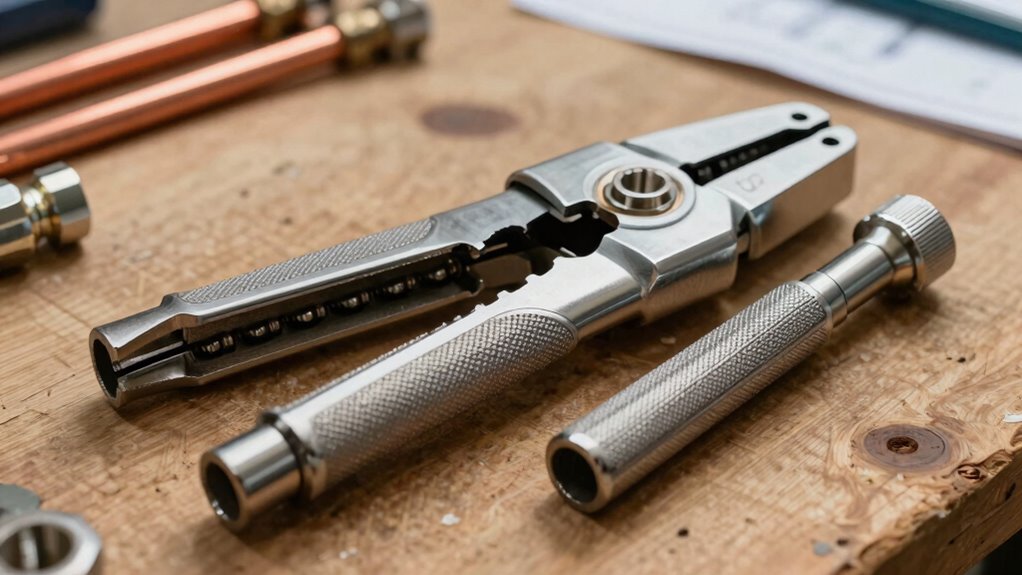

Press tools for plumbing let you join copper and PEX pipe without soldering, open flames, or drain-down time, and the right one depends mostly on how often you press, what pipe sizes you tackle, and how much you want to spend. The Milwaukee M12 Force Logic 2473-22 earns my best overall pick for its one-handed operation, reliable full-cycle pressing, and jaws that cover the most common 1/2″–1″ residential sizes. The RIDGID RP 115 is the strongest challenger for tight mechanical rooms thanks to its compact mini-press design, while the VEVOR 32KN kit with six jaws stands out as the value play for occasional users who want size coverage without the pro-tool price. The main tradeoff in this category is battery-powered convenience and speed versus cheaper hydraulic kits that cost less but demand more effort and slower cycles. Keep reading for the full breakdown of all ten tools.

Get business pricing on tools and workshop supplies
- Business-only prices and quantity discounts
- Tax-exempt purchasing
- Multiple users, one account, clear invoices
Complete the kit


Key Takeaways
- The Milwaukee 2473-22 and RIDGID RP 115 separate themselves from the field with full-cycle press mechanisms that physically prevent removing the tool before the press completes — a safety feature none of the budget hydraulic models offer.
- Budget hydraulic kits (VEVOR, CHANHYD, IBOSAD, KELIN) consistently bundle more jaws and accessories than the pro cordless tools, but they trade away speed, one-handed use, and repeatability across a full day of pressing.
- Pipe size range is the biggest spec to check: several kits stop at 1″, while the VEVOR 32KN six-jaw kit and the 11-die hydraulic model reach 2″, which matters for commercial and mixed-size work.
- Copper-only versus copper-and-PEX capability split the lineup almost in half — buyers doing repipes or PEX repairs should confirm the tool presses PEX fittings, not just VUS-profile copper jaws.
- Battery count and jaw compatibility matter more than headline price: kits shipping with two batteries and standard jaw mounts avoid the hidden costs that single-battery or proprietary-jaw tools create.


| press tool for plumbing | Brand | Voltage |
|---|---|---|
| VEVOR 18V Electric Pipe Crimpi | VEVOR | 18V |
| AMZCNC 18V Cordless Pro Press | AMZCNC | 18V |
| RIDGID RP 115 Mini Press Tool | — | 12V |
| VEVOR 18V Electric Pipe Crimpi | VEVOR | 18V |
| CHANHYD Hydraulic Copper Pipe | CHANHYD | — |
| Hydraulic Copper and PEX Press | — | — |
| IBOSAD Hydraulic Copper Pipe C | IBOSAD | — |
| KELIN Hydraulic Pipe Crimping | KELIN | — |
| Milwaukee 2473-22 M12 Force Lo | — | — |
| 18V ProPress Tool | — | 18V |
More Details on Our Top Picks
VEVOR 18V Electric Pipe Crimping Tool Kit for 1/2″, 3/4″ and 1″ Copper Pipes
This VEVOR kit stands out for covering the three most common residential pipe sizes right out of the box, with two batteries and a fast charger included at a price point far below the Milwaukee 2473-22. The 360° rotating head gives it the same tight-space maneuverability as pricier cordless options, and up to 200 crimps per charge is enough for a full day of residential rough-in work. Compared with the CHANHYD HP-1332VUS, you trade manual pumping for battery-powered pressing, which means less fatigue on multi-fitting jobs. The tradeoff is real, though: it only accepts 24 kN compact jaws, so anything beyond 1″ copper—or other pipe types—means buying additional jaws. For a plumber starting with press fittings, this kit makes the most sense as an entry point rather than a full-service tool.
Pros:- All three common residential jaw sizes included in the kit
- Two 2.0Ah batteries and fast charger support all-day work
- 360° rotating head handles tight joist and wall cavities
- Up to 200 crimps per charge covers a typical residential rough-in
Cons:- Locked into 24 kN compact press jaws only
- Other pipe types and larger sizes require separately purchased jaws
Best for: Residential plumbers and DIY renovators who need to press 1/2″–1″ copper without a four-figure tool investment
Not ideal for: Pros working on larger commercial lines — the 1″ ceiling and 24 kN jaw-only compatibility will force extra purchases fast
- Brand:VEVOR
- Model:SL-2430
- Voltage:18V
- Crimping Force:24 kN
- Compatible Pipe Sizes:1/2″, 3/4″, and 1″ copper
- Press Jaws Included:3
- Batteries Included:2 x 18V 2.0Ah
- Crimps Per Charge:Up to 200
- Crimp Head Rotation:360°
Our verdict“The smartest low-risk entry into press fittings if your work stays within 1/2"–1" copper.”
AMZCNC 18V Cordless Pro Press Tool Kit for Copper & PEX Pipes
What separates this AMZCNC kit from the VEVOR SL-2430 is versatility: 11 dies covering copper and ASTM F1807 PEX from 3/8″ to 1″, which means one tool handles both water line materials on the same job. The brushless motor completes a press in about 3 seconds, and uniform crimping force translates to fewer callback-causing leaks. This option is better suited to contractors who bounce between repipes, PEX additions, and HVAC lines than the copper-only VEVOR kits. The honest tradeoff: it’s a Pro Press-compatible third-party tool, not an official branded unit, so some pros will hesitate—and long-term durability against premium tools is unproven. Compared with the Milwaukee M12 Force Logic, you give up brand ecosystem support but gain a much fuller die set at a far lower cost.
Pros:- Fast 3-second press cycle reduces fatigue on high-volume fitting work
- 11 dies span copper and 3/8″–1″ PEX in one kit
- Brushless 18V motor delivers consistent crimping force
- Complete package with two batteries, charger, and hydraulic body
Cons:- Third-party Pro Press compatibility may not satisfy professional certification requirements
- Newer product with a limited track record
- Durability may not match premium professional-grade press tools
Best for: Plumbers and remodelers who regularly switch between copper and PEX press systems on residential and light commercial jobs
Not ideal for: Contractors who need verified brand-name tooling for insurance, warranty, or jobsite requirements
- Brand:AMZCNC
- Model Number:CZ-1930
- Voltage:18V
- Motor:Brushless
- Press Time:Approximately 3 seconds
- Compatible Fittings:1/2″, 3/4″, 1″ copper; 3/8″–1″ ASTM F1807 PEX; F877 stainless sleeves
- Included Components:11 crimp dies, 2 batteries, hydraulic body, jaw, charger
- Uses:Residential/commercial plumbing, water lines, HVAC, gas pipe repairs
Our verdict“The most versatile kit here for mixed-material work, as long as brand-name tooling isn’t a jobsite requirement.”
RIDGID RP 115 Mini Press Tool Kit with 1/2″–3/4″ ProPress Jaws, 12V Battery, Charger, and Case
The RP 115 makes the list for a different reason than the others: it’s the tool you grab when the work happens overhead or inside a wall cavity. Its 210-degree swivel head and one-handed jaw operation let you press fittings in spots where a two-handed tool like the VEVOR PZ-3240 simply won’t fit, and the compact 12V platform keeps weight low during hours of ceiling work. As a genuine RIDGID ProPress tool, it carries the brand backing that the AMZCNC CZ-1930 can’t offer. The limitation is clear-cut, though: jaws stop at 3/4″, and the kit includes only one battery, so heavy users will want a spare. This model makes the most sense as a complement to a larger press tool—or as the primary tool for service plumbers whose work rarely exceeds 3/4″.
Pros:- Genuine RIDGID ProPress compatibility with established brand support
- 210° swivel head excels at overhead and confined-space presses
- One-handed operation frees the other hand to steady pipe
- Lightweight, compact build reduces fatigue on ceiling and wall work
Cons:- Jaw size range limited to 1/2″–3/4″
- Only one battery included
Best for: Service plumbers doing tight-access and overhead work on 1/2″–3/4″ lines who value a proven brand
Not ideal for: Anyone pressing 1″ or larger pipe — the jaw range simply stops at 3/4″
- Model:RP 115
- Catalog Number:72553
- Voltage:12V
- Battery Type:Lithium-ion
- Batteries Included:1
- Head Swivel:210 degrees
- Included Jaws:1/2″–3/4″ ProPress mini press jaws
- Included Accessories:Battery, charger, carrying case
Our verdict“The tight-space specialist for small-diameter work, best paired with a full-size press tool for bigger lines.”
VEVOR 18V Electric Pipe Crimping Press Tool for 1/2″ – 2″ Copper Pipes, 32KN, with 6 VUS Jaws and 2 Batteries
This is the roundup’s top pick because it solves the problem that holds back every other budget option here: size range. Six VUS jaws spanning 1/2″ to 2″ cover residential branch lines and main lines alike, where the VEVOR SL-2430 stops at 1″ and the CHANHYD HP-1332VUS at 1″ as well. The 32 kN brushless motor produces smooth, leak-free connections on the larger sizes that weaker tools struggle with, and dual 4.0Ah batteries delivering up to 350 crimps per charge outlast the smaller VEVOR’s 2.0Ah setup by a wide margin. Like its sibling, the 360° rotating head and slim body handle tight mechanical-room work. The catches: it’s restricted to 32KN standard press jaws only, so other fitting systems mean more purchases, and it’s ProPress-compatible rather than an official branded tool—though the Milwaukee alternative costs dramatically more for a similar size range.
Pros:- Six VUS jaws cover 1/2″ through 2″ copper in one kit
- 32 kN brushless motor handles large-diameter presses cleanly
- Dual 4.0Ah batteries deliver up to 350 crimps per charge
- 360° rotating head and slim body work in confined mechanical spaces
Cons:- Only compatible with 32KN standard press jaws
- Copper-focused; other pipe types require separately purchased jaws
- Battery-dependent — no corded operation
Best for: Working plumbers who need one tool to press everything from 1/2″ branch lines to 2″ mains without buying branded tooling
Not ideal for: Pros requiring official brand certification, or those pressing PEX and stainless systems — the VUS jaws are copper-focused
- Brand:VEVOR
- Model Number:PZ-3240
- Voltage:18V
- Crimping Force:32 kN
- Motor Type:Brushless
- Battery:2 x 18V 4.0Ah lithium-ion
- Crimps Per Charge:Up to 350
- Compatible Pipe Sizes:1/2″, 3/4″, 1″, 1-1/4″, 1-1/2″, 2″ (VUS jaws)
- Crimp Head Rotation:360°
Our verdict“The best balance of power, size coverage, and runtime for a plumber who wants one press tool for nearly every copper job.”
CHANHYD Hydraulic Copper Pipe Crimping Tool with 1/2″, 3/4″, and 1″ Jaws (HP-1332VUS, Black)
This CHANHYD is the battery-free option in the lineup, and that’s exactly its appeal: no charging, no electronics to fail, and it works on a dead-quiet jobsite or in a crawl space where you forgot the spare battery. Its multi-brand fitting compatibility—Viega, Pro-Press, Elkhart, and Conex—is broader than the VEVOR kits’ proprietary jaw ecosystems, and jaws forged from AISI 4140 steel with an AISI 5140 pump body feel built to outlast the tools themselves. Compared with the VEVOR SL-2430, the obvious cost is effort: every press requires manual pumping, which adds fatigue on multi-fitting jobs. And like the smaller VEVOR, it tops out at 1″ copper. This pick makes the most sense as a backup press tool or a primary tool for occasional press work where speed matters less than reliability and simplicity.
Pros:- Compatible with Viega, Pro-Press, Elkhart, and Conex fittings
- No batteries or charger — always ready to work
- Forged AISI 4140 steel jaws and AISI 5140 pump body built for durability
- 360° rotating head reaches fittings in tight spaces
Cons:- Manual operation adds fatigue and time on multi-fitting jobs
- Limited to copper pipe sizes up to 1 inch
Best for: Plumbers wanting a no-batteries backup press tool, or occasional users who value simplicity and multi-brand fitting compatibility
Not ideal for: High-volume press work — manual hydraulic pumping slows you down badly compared with battery tools
- Brand:CHANHYD
- Model:HP-1332VUS
- Pipe Sizes:1/2″, 3/4″, 1″
- Jaw Material:AISI 4140 steel
- Pump Body Material:AISI 5140 steel
- Head Rotation:360 degrees
- Compatible Fittings:Viega Copper, Pro-Press, Elkhart, Conex
Our verdict“A dependable, fitting-agnostic manual press tool that earns its place as a backup or occasional-use workhorse.”
Hydraulic Copper and PEX Press Tool with 11 Dies
This hydraulic press tool stands out for the widest die coverage in this batch — 11 dies spanning copper pipe, ASTM F1807 PEX copper rings, and ASTM F877 stainless press sleeves. That three-standard coverage is something even the well-equipped KELIN kit can’t match, since KELIN skips the F877 stainless sleeve standard entirely. The 360° rotating head translates into real reach when you’re pressing fittings inside cramped cabinet cavities. The tradeoff is the same one that affects every manual hydraulic tool here: you supply the muscle, and you’ll burn more time per joint than battery-powered options like the Milwaukee 2473-22. You also need clearance — fittings must sit at least 1.5 inches from the wall, which rules out some tight retrofits.
Pros:- 11 dies covering three fitting standards (copper, F1807, F888/F877 sleeves)
- 360° rotating head reaches tight or awkward installations
- 80 kN output pressure rated for 10,000+ cycles
- Ergonomic handle supports true one-person operation
Cons:- Requires installing the correct crimping die before every use
- Fittings must sit at least 1.5 inches from the wall
- Manual hydraulics are slower than cordless press tools for repeated joints
Best for: Plumbers and serious DIYers who work across copper, F1807 PEX crimp rings, and F877 stainless sleeves and want one manual tool for all three
Not ideal for: Anyone doing high-volume repiping — the manual pumping action and 1.5-inch wall clearance requirement slow you down on production work
- Included dies:11 interchangeable dies
- Copper pipe die sizes:1/2 in, 3/4 in, 1 in
- F1807 PEX ring die sizes:3/8 in to 1 in
- F877 stainless sleeve dies:1/2 in, 3/4 in, 1 in
- Head rotation:360°
- Output pressure:80 kN
- Stated service life:10,000+ cycles
- Tool length:Approximately 15.7 in
Our verdict“This pick makes the most sense for multi-standard installers who need maximum die flexibility in one affordable manual tool.”
IBOSAD Hydraulic Copper Pipe Crimping Tool with 1/2″, 3/4″, 1″ Jaws and Pipe Cutter
Compared with the CHANHYD HP-1332VUS, which covers the same three copper sizes at a similar manual-hydraulic price point, the IBOSAD GC-1 pulls slightly ahead for budget buyers by including a pipe cutter in the box — one less accessory to buy before your first joint. The aluminum alloy body keeps weight down and addresses the oil-leakage complaints common to cheap hydraulic crimpers. What you give up is range: this is a copper-only tool, with no PEX dies whatsoever, so it can’t touch the 11-die hydraulic tool above for versatility. It also explicitly excludes tee fittings, which means branching joints will need a different approach — a real limitation on anything beyond straightforward runs and repairs.
Pros:- Covers the three most common copper sizes (1/2″, 3/4″, 1″)
- Rotatable head improves portability and positioning
- Aluminum alloy body helps prevent hydraulic oil leakage
- Pipe cutter included in the box
Cons:- Not compatible with tee fittings
- Limited to copper pipe only — no PEX capability
- Manual operation is tiring on multi-joint jobs
Best for: Homeowners or handymen doing occasional copper-only repairs and small runs who want a low-cost manual crimper with the cutter bundled
Not ideal for: Anyone working with PEX or needing to press tee fittings — this tool simply doesn’t support either
- Brand:IBOSAD
- Model number:GC-1
- Pipe sizes:1/2″, 3/4″, 1″
- Material:Aluminum alloy
- Head:Rotatable
- Included accessory:Pipe cutter
- Compatible fittings:Copper only (no tees)
Our verdict“A sensible low-cost choice for straightforward copper work, as long as your project has no tees and no PEX.”
KELIN Hydraulic Pipe Crimping Tool Kit for Copper Pipe & PEX with Dies, Cutters, and Ring Removal Pliers
The KELIN set is the closest thing here to a buy-it-once, start-pressing-today package. Unlike the IBOSAD or the 11-die hydraulic tool, which assume you already own cutters and removal tools, this kit bundles a copper tube cutter, a PEX cutter, and ring removal pliers that let you disassemble crimped joints without wrecking fittings. That last item matters most for beginners — mistakes happen, and being able to undo a bad crimp cheaply changes how confidently you work. The forged steel construction feels more substantial than the aluminum IBOSAD, and the 3/8″–1″ PEX die range is generous. The catch: it’s a newer, less-proven product, and paying for a full kit is overkill if you only need to press a handful of joints on one repair.
Pros:- All-in-one kit covers cutting, crimping, and ring removal for both PEX and ProPress copper
- Eight dies from 3/8″ to 1″ reduce separate accessory purchases
- Forged steel build with hydraulic press delivers uniform, high-pressure crimps
- Ring removal pliers recover fittings without damaging them
Cons:- Shorter track record as a newer product, so long-term durability is unproven
- More kit than a casual single-job user needs
- Manual hydraulic operation — slower than cordless rivals for large jobs
Best for: DIyers assembling their first PEX-and-copper pressing setup who want cutters, dies, and removal pliers in a single purchase
Not ideal for: Occasional users facing one small repair — the full kit costs more and does more than a single job demands
- Brand:KELIN
- Model number:KELIN-YYGDGJZT
- Copper die sizes:1/2″, 3/4″, 1″ (ProPress)
- PEX crimp ring dies:3/8″ to 1″ (ASTM F1807)
- PEX cutter capacity:Up to 30 mm
- Copper cutter capacity:Up to 1-1/4″
- Material:Forged steel
- Included components:Crimper, 8 dies, copper cutter, PEX cutter, removal pliers
Our verdict“The smartest single purchase for a first-time press user building a complete copper-and-PEX capability from scratch.”
Milwaukee 2473-22 M12 Force Logic Press Tool 1/2″ – 1″ Kit
If the manual hydraulic tools in this roundup trade speed for price, the Milwaukee 2473-22 is the argument for spending more. Its M12 battery platform and Force Logic press cycle mean one-handed, flame-free joints in seconds — no pumping, no arm fatigue, and a tool that professionals have run for years on job sites. Compared with the 18V ProPress crimper below, Milwaukee’s advantage is the mature ecosystem: batteries, service network, and a track record the newer cordless rivals lack. The honest limitation is capacity. Like most tools here it stops at 1″ fittings, and unlike the VEVOR 32KN model that reaches 2″, there’s no headroom for larger commercial pipe. You’re paying a premium for dependability, not for range.
Pros:- Cordless M12 platform allows fast, one-handed pressing anywhere
- Force Logic delivers consistent, reliable press cycles
- Highly durable build suited to daily job-site use
- Easy to handle in tight spaces
Cons:- Limited to 1/2″–1″ fitting sizes
- Premium price compared with manual hydraulic alternatives
- Jaw and accessory ecosystem adds ongoing cost
Best for: Tradespeople and frequent users who want a proven, cordless press tool with fast cycle times and a deep battery ecosystem
Not ideal for: Budget-conscious DIYers doing a one-time repair — the premium price buys durability they’ll never use
- Model:2473-22
- Series:M12
- Tool type:Cordless press tool
- Capacity:1/2″–1″
- Power source:M12 battery
- Press technology:Force Logic
Our verdict“The go-to cordless pick for pros who press pipe weekly and need a tool that won’t let them down.”
18V ProPress Tool, Copper Pipe Crimper with 3 Press Jaws, 2 Batteries & Charger
This 18V crimper occupies the middle ground between the manual KELIN kit and the pricier Milwaukee 2473-22: it delivers true cordless pressing with a brushless hydraulic motor while bundling three jaws, two batteries, a fast charger, and a case — accessories that Milwaukee often sells separately. For a plumber who wants to ditch the pump handle without paying pro-tool prices, the package math is hard to beat. The compromises are real, though. The listing’s inconsistent battery spec (4 Ah versus 2 Ah) makes it hard to know exactly what runtime you’re getting, and like the Milwaukee, it stops at 1″ fittings — larger pipe means buying additional jaws, at which point the larger VEVOR 18V model with its 6 jaws and 2″ capacity may be the better starting point.
Pros:- Brushless hydraulic motor provides consistent pressing force
- Complete kit: three jaws, two batteries, fast charger, and case
- Compact, ergonomic design for confined spaces and long days
- Wide application range for plumbing, HVAC, and construction
Cons:- Inconsistent battery capacity listed (4 Ah vs 2 Ah) in product details
- Limited to 1/2″–1″ fittings; larger sizes require extra jaws
- Newer brand without Milwaukee’s proven service and support network
Best for: Working plumbers and HVAC techs who want cordless pressing convenience and a fully accessorized kit at a mid-tier price
Not ideal for: Anyone regularly pressing above 1″ — you’ll buy extra jaws immediately and may be better served by a larger-capacity tool
- Voltage:18V
- Motor:Brushless
- Compatible fittings:1/2″–1″ ProPress
- Included jaws:1/2″, 3/4″, 1″ (3 pcs)
- Batteries:2 pcs (listed as 4 Ah)
- Charger:Fast charger included
- Case:Carrying case included
Our verdict“A strong mid-price cordless option for pros who want everything in the box — just verify the battery spec before buying.”

How We Picked
I evaluated each tool against five buyer-relevant criteria: press mechanism reliability (does it complete a full, consistent crimp every time), pipe size and material coverage (copper, PEX, and jaw range from 1/2″ up), ergonomics and speed (weight, one-handed operation, cycle time over repeated presses), kit completeness (batteries, charger, jaws, cutters, and case), and long-term value (build quality, jaw compatibility, and what it costs to expand later). Full-cycle pressing and jaw interchangeability carried the most weight because they affect both safety and daily productivity on real jobs.
The ranking reflects that logic: professional cordless tools with verified press cycles sit at the top, mid-range cordless kits with strong accessory bundles fill the middle, and budget hydraulic units land lower for occasional-use buyers — not because they are bad tools, but because they demand more physical effort and offer slower, less repeatable results when volume pressing is the goal.
Factors to Consider When Choosing Press Tool For Plumbing
Before choosing a press tool, it helps to understand the broader landscape — the differences between press systems, the hidden costs of jaw ecosystems, and the mistakes that catch out first-time buyers.Press Profile Compatibility: The Mistake That Ruins Fittings
The single most expensive mistake in this category is buying a tool whose jaws don’t match the fittings you install. ProPress-style VUS jaws, PEX profiles, and specialty seals are not universally interchangeable, and pressing a fitting with the wrong profile produces a joint that may hold during a pressure test and fail months later. Before purchasing, identify which fitting brand your supplier stocks locally, then confirm the tool’s jaws carry that profile. Also check whether the jaws are a standard mount or proprietary — tools with standard jaw interfaces let you buy third-party or expanded-size jaws later, while closed ecosystems lock you into one manufacturer’s pricing. Buyers who skip this step often end up with a tool that only works with fittings shipped from one online seller, which is a real problem during an emergency repair.
Battery-Powered Versus Hydraulic: Matching the Tool to Your Volume
Cordless press tools and manual hydraulic crimpers solve the same problem in very different ways. A battery press cycle takes seconds and one hand, which matters when you’re pressing dozens of joints overhead or in cramped spaces; a hydraulic kit requires pumping, valve adjustment, and two hands, roughly tripling the time per joint. That difference is invisible for a homeowner doing one bathroom and punishing for a plumber running a full repipe. Hydraulic kits do have real advantages: no batteries to charge or replace, fewer electronics to fail, and a much lower entry cost with more jaws included. My rule of thumb: if you press fewer than roughly ten joints per week, hydraulic makes financial sense; above that, the speed and fatigue savings of a cordless tool pay back quickly. Don’t forget battery count either — a single-battery kit forces downtime mid-job on a cordless tool.
Size Range and Where the Hidden Costs Live
Most entry-level kits cover 1/2″, 3/4″, and 1″ — the sizes that dominate residential work. But the moment you touch a main line, boiler loop, or commercial job, you’ll need 1-1/4″ through 2″ jaws, and buying those separately often costs more than the original tool. Check the manufacturer’s full jaw catalog, not just what’s in the box, because expansion potential varies wildly between brands. Some budget hydraulic tools have no larger jaws available at all, effectively capping the tool at residential use forever. If you expect mixed-size work, a mid-tier kit that ships with six jaws up to 2″ frequently beats a premium bare tool plus add-on jaws on total cost. Buyers should also verify the tool’s tonnage rating — larger pipe diameters demand more pressing force, and an underpowered tool will leave incomplete crimps on big fittings.
Safety Features That Separate Pro Tools From Cheap Ones
The difference between a professional press tool and a budget unit often comes down to features you can’t see in a product photo. Full-cycle pressing mechanisms physically prevent the jaws from opening until the crimp is complete — a safeguard against partially pressed fittings that leak under pressure. Cheaper tools release whenever you stop squeezing or pumping, which means a momentary lapse or an interrupted pump stroke can leave a bad joint hidden inside a wall. Over-molded grips, LED work lights at the jaw, and latch-style jaw retention also matter for real job-site use. None of these features make a budget tool unsafe when used carefully by a patient operator, but they explain most of the price gap between a pro cordless kit and a hydraulic crimper. Weigh how often you’ll press in awkward positions where interrupted crimps become likely.
Total Cost of Ownership Beyond the Sticker
The listed price of a press tool kit is rarely the full story. Battery-powered tools eventually need replacement batteries, and proprietary packs can cost a surprising fraction of the tool’s price; if you already own a brand’s cordless ecosystem, choosing a press tool that shares those batteries saves real money. Hydraulic tools need occasional seal and hydraulic fluid maintenance, especially after sitting unused, and a weeping cylinder mid-job means downtime. Jaw wear is another overlooked cost — pressing thousands of joints eventually rounds jaw teeth, and inspection becomes part of routine care. Finally, factor in fitting cost per joint, since pressed fittings cost several times what a solder fitting does; the tool is often cheaper than the fittings it consumes over its life. Buyers who calculate two-year total cost, not shelf price, almost always make a better choice.
Who Should Actually Buy a Press Tool at All
Press tools shine where open flames are illegal, dangerous, or impractical — occupied homes, hospitals, near flammable storage, and on wet lines you can’t fully drain. For those situations, no soldering setup competes. But a hobbyist doing one or two joints a year may never recover the cost, and a quality soldering kit plus a few hours of practice handles occasional work at a fraction of the price. The sweet spot for ownership is anyone doing repeated plumbing work where time per joint and no-flame operation have real value: remodelers, maintenance techs, DIYers tackling full bathroom or kitchen projects, and of course working plumbers. Be honest about your volume before buying — the tool should match the work, not the aspiration.
Frequently Asked Questions
Can a budget hydraulic press tool produce joints as reliable as a Milwaukee or RIDGID?
Yes, when operated correctly — the crimp geometry is set by the jaw profile, not the power source, so a careful operator who completes every pump stroke gets a sound joint either way. The reliability gap comes from the process, not the crimp itself: hydraulic tools release the moment you stop pumping, so an interrupted stroke can leave a partial press that isn’t obvious to the eye. Cordless pro tools with full-cycle mechanisms remove that failure mode entirely by locking the jaws until the press completes. If you choose a hydraulic kit, always count your pump strokes, pressure-test every line before closing walls, and inspect each crimp for a complete ring impression. Doing that consistently narrows the quality gap considerably, but it demands discipline the powered tools simply don’t require.
Do these press tools work on PEX, or only copper?
It depends entirely on the jaws included, and this is where listings get confusing. Some tools in this lineup ship with VUS-profile copper jaws only, while others include PEX-compatible dies or support them as add-ons — the AMZCNC kit and the multi-die hydraulic models handle both materials, while several copper-focused kits do not. PEX pressing also requires fittings matched to the specific press system, so a tool that presses PEX with one fitting brand may not work with another’s. Check the jaw list and the manufacturer’s fitting compatibility chart before buying, not just the headline that mentions PEX. If your work mixes repipe-era copper with modern PEX, prioritizing a dual-material tool saves buying a second press system later.
What pipe sizes do I actually need, and is it worth paying for 2-inch capacity?
For pure residential branch work — fixtures, bathrooms, kitchens — 1/2″ through 1″ covers nearly everything, which is why the compact kits stop there. Capacity beyond 1″ matters for main supply lines, manifold feeds, boiler loops, and light commercial work, where 1-1/4″ and 2″ joints are routine. The catch is cost: larger jaws sold separately often cost more than expected, so if there’s any realistic chance of larger work, a kit that bundles 2″ jaws upfront (like the six-jaw VEVOR) usually beats buying a premium bare tool plus expansion jaws. Also confirm the tool’s pressing force is rated for the larger diameters, since an underpowered press on a 2″ fitting produces incomplete crimps. Honest assessment of your job mix is the answer — buy capacity for the work you actually do, not the work you imagine.
How important is buying two batteries instead of one?
For anything beyond occasional use, two batteries is one of the highest-value configuration choices you can make. A press cycle drains a battery faster than most drill work, and a single-battery kit means your tool becomes a paperweight for the length of every recharge — usually an hour or more mid-job. Rotating two batteries lets you press continuously all day with zero downtime, and it also extends overall battery lifespan since neither pack is deep-cycled every use. If you already own cordless tools from the same brand and battery platform, a bare-tool configuration can be the smarter buy because you effectively bring your own spares. But if this is your first cordless press tool, insist on the two-battery kit; the difference in day-long usability is dramatic and the upgrade cost later is higher.
Is a mini press tool like the RIDGID RP 115 worth it over a full-size kit?
The mini format earns its place in specific situations rather than across the board. Its shorter head fits between joists, behind fixtures, and inside cabinet bases where a full-size press tool’s jaw-to-handle length simply can’t reach — a genuinely common problem in remodel and service work. The tradeoff is size ceiling: mini tools typically top out at 3/4″ or 1″, so they work as a complement to a full-size tool rather than a replacement if you do varied work. For a plumber who already owns a big press tool, the mini handles the cramped-joint calls; for a DIYer or light-duty user whose work is almost entirely 1/2″ and 3/4″ in finished spaces, it can serve as the only tool. Decide based on where your joints live — if access is your daily problem, the mini format is worth every tradeoff.
Conclusion
The right press tool depends less on specs on paper and more on the work you do. For best overall, the Milwaukee M12 Force Logic 2473-22 balances speed, safety, and one-handed usability in the sizes most jobs demand. The RIDGID RP 115 is my pick for tight-access specialists and anyone whose work concentrates in 1/2″–3/4″ finished spaces. For best value, the VEVOR 32KN six-jaw kit delivers the widest size range per dollar, while the CHANHYD and IBOSAD hydraulic kits suit budget-minded occasional users willing to trade speed for savings. Beginners get the gentlest entry with the simple AMZCNC cordless kit or the accessory-loaded KELIN hydraulic set, both of which include everything needed to learn the process. For large-diameter and mixed copper/PEX work, the 11-die hydraulic model and the wide-range VEVOR are the tools that won’t leave you short at 2″. Match the tool to your joint volume, your pipe sizes, and your working spaces, and any of these picks will serve you well.
Halloween Picks
halloween
As an affiliate, we earn on qualifying purchases.