
To fix your hammer grip for more control, start by ensuring your wrist stays straight and neutral during each swing, like a solid hinge. Wrap your fingers around the handle firmly but not too tight, with your thumb on the side or over your fingers for better stability. Adjust your grip pressure to be firm but relaxed, which boosts control and reduces fatigue. Small tweaks in your grip and wrist position can lead to smoother, more accurate swings—keep going to discover how each detail makes a difference.

Get business pricing on tools and workshop supplies
- Business-only prices and quantity discounts
- Tax-exempt purchasing
- Multiple users, one account, clear invoices
Key Takeaways
- Ensure wrists stay straight and neutral to facilitate smooth force transfer during each swing.
- Maintain a firm, balanced grip with moderate pressure, avoiding excessive squeezing or looseness.
- Imagine your wrists as a solid hinge for enhanced stability and control throughout the swing.
- Incorporate wrist stability exercises to strengthen muscles and improve consistency in grip and alignment.
- Focus on small adjustments in grip and wrist position to optimize control and prevent injury.
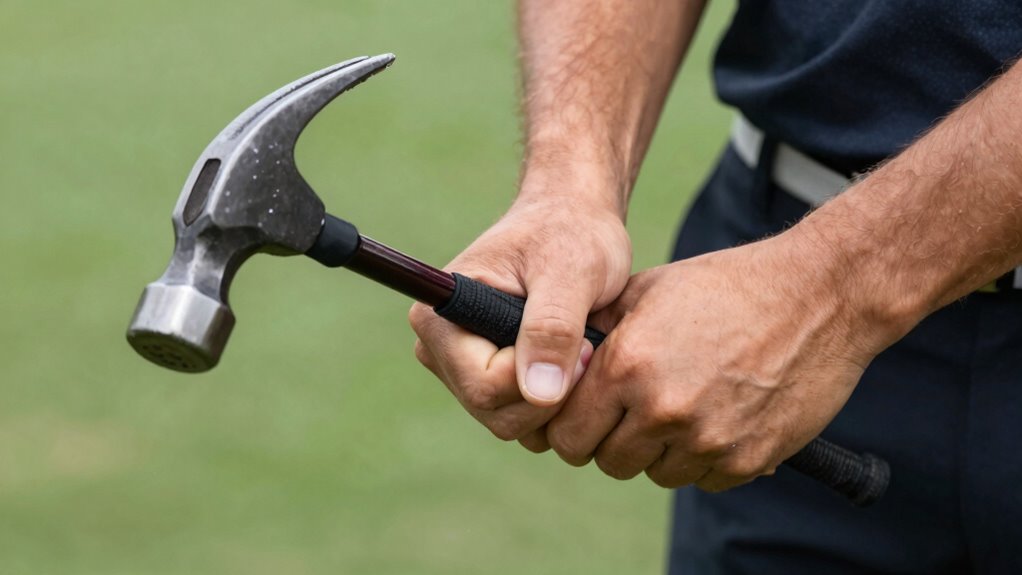
If you’re struggling with grip issues during your workouts, a simple correction can make a big difference: the hammer grip fix. Sometimes, your grip can feel awkward or unstable, leading to inefficient swings and even risking injury. The key lies in understanding wrist alignment and grip pressure. Properly aligning your wrists ensures that force transfers smoothly from your hands to the implement, giving you more control. When your wrists are aligned correctly, you reduce strain and prevent unwanted movement, making every swing more precise.
Start by focusing on your wrist position. Instead of letting your wrists bend or collapse under pressure, aim to keep them straight and neutral. Think of your wrists as a solid hinge—flexible enough to move but stable enough to support your grip. As you grasp the implement, imagine pushing your knuckles slightly upward, maintaining a firm and aligned wrist. This simple adjustment helps distribute force evenly, reducing fatigue and the chance of wrist strain. When your wrists stay aligned, your grip pressure naturally becomes more consistent. You shouldn’t squeeze too tightly, which can cause tension and reduce control, nor should you grip too loosely, risking slippage. Find that balance where your grip pressure feels firm but relaxed. Developing awareness of your grip can also help prevent muscle fatigue, allowing you to perform for longer periods without discomfort. Paying attention to your grip can also improve your overall technique, ensuring each swing is as effective as possible. Incorporating wrist stability exercises into your routine can further enhance your control and prevent injury over time.
Next, consider how you hold the tool. The hammer grip involves wrapping your fingers around the handle with your thumb resting either on the side or wrapping over your fingers. Keep your grip firm but not tight. A grip that’s too tight increases grip pressure unnecessarily, leading to fatigue and less fluid motion. Conversely, a loose grip decreases control, making swings less precise. Adjust your grip so that the handle feels secure without squeezing the life out of it. You want to maintain a light but firm hold that allows your wrists to stay aligned and your movements to flow smoothly. Developing this consistent grip pressure is essential for optimal performance. Practicing this correction consistently will help you develop muscle memory, making wrist alignment and ideal grip pressure second nature. Over time, you’ll notice that every swing feels more controlled, with less effort and more accuracy. This small tweak can transform your technique and help prevent common issues like wrist pain or unstable movements. Remember, the goal is to create a balanced, efficient grip that supports your natural swing. By paying attention to wrist alignment and grip pressure, you’ll release better control and improve your overall performance, making every workout more effective and enjoyable.
Products Worth Considering

Dyson Ball Animal 3 Corded Upright Vacuum

iRobot Roomba 105 Vac Robot Vacuum

Levoit Eleva 300X HEPA Air Purifier for Home and Bedroom
As an affiliate, we earn on qualifying purchases.
Frequently Asked Questions
Does the Hammer Grip Suit All Swing Types?
The hammer grip doesn’t suit all swing types, as grip variations influence your swing’s feel and control. If you have a more aggressive or natural swing, this grip might feel unnatural or cause discomfort. You should experiment with different grip adjustments to find what works best. Ultimately, making swing adjustments based on your unique style helps improve consistency and control, but the hammer grip may not be ideal for everyone.
How Long Does It Take to Master the Grip?
It typically takes several weeks of consistent training to master the hammer grip, but the exact duration varies with your grip evolution and dedication. You’ll notice improvements as you practice regularly, refining your control and comfort. Keep focusing on proper technique, and over time, your training duration will shorten. Patience is key—stay committed to your swing, and mastery will come naturally as your skills develop.
Can the Grip Improve Accuracy Instantly?
Yes, adjusting your grip can improve accuracy instantly. When you focus on proper hand alignment and maintain consistent grip pressure, your control increases immediately. Ensuring your hands are correctly aligned helps you swing more predictably, while appropriate grip pressure prevents tension that can cause mishits. Practice these small adjustments, and you’ll notice better accuracy right away, making each swing feel smoother and more controlled.
Is This Grip Recommended for Beginners or Advanced Players?
Studies show that grip versatility can improve swing consistency across skill levels. You’ll find that this grip is recommended for both beginners and advanced players, as it helps address common beginner challenges like control and stability. Starting with this grip allows you to develop proper mechanics early on, making it easier to progress. Its adaptability means you won’t outgrow it as your skills improve, providing a solid foundation for continuous improvement.
Are There Any Common Mistakes to Avoid With This Grip?
Yes, there are common mistakes to avoid with this grip. First, make sure your grip positioning is firm but not too tight, as clutching too tightly can hinder wrist flexibility. Avoid locking your wrists, which limits fluid movement and control. Keep your wrists flexible and relaxed to maintain smooth swings. Also, check that your grip isn’t too high or low on the handle, which can affect balance and accuracy.
Conclusion
By adopting the hammer grip fix, you’ll notice improved control and accuracy with every swing. Imagine a golfer struggling with inconsistent shots finally finding their rhythm after adjusting their grip—suddenly, their drives become more precise and confident. This simple tweak can transform your game, turning frustration into consistent success. So, give the hammer grip fix a try today and experience the difference it makes in your swing and overall performance.