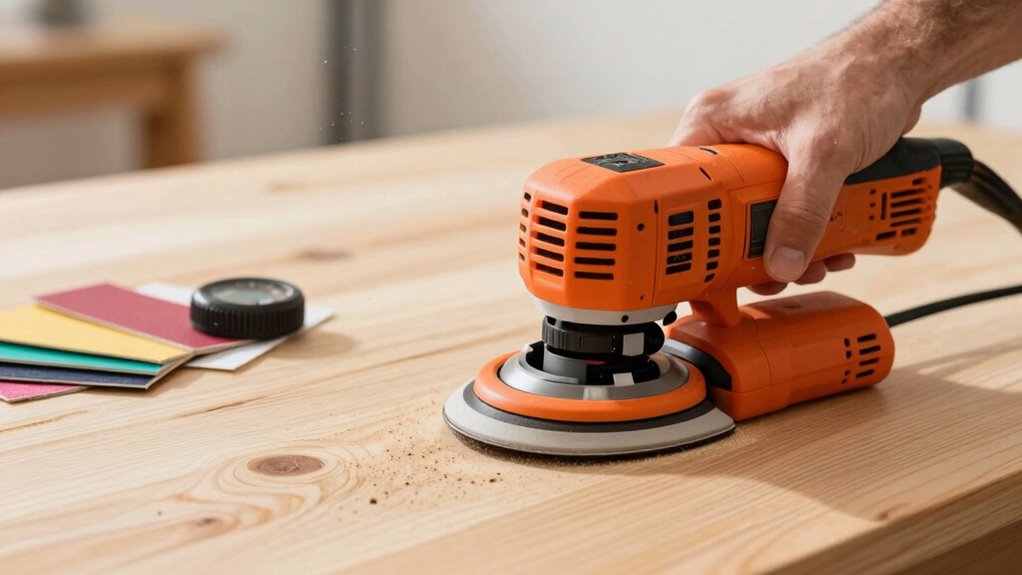

To pick better sanding speeds for wood, paint, and drywall, start by considering the material and desired finish. Use moderate speeds for wood to balance removal and control, and lower speeds for paint to avoid burning or peeling. For drywall, higher speeds work best to smooth rough patches. Adjust your sander gradually and test on small areas to find the most effective setting. Keep control and safety in mind as you fine-tune your approach for top results.

Get business pricing on tools and workshop supplies
- Business-only prices and quantity discounts
- Tax-exempt purchasing
- Multiple users, one account, clear invoices
Key Takeaways
- Match sanding speed to material type; use moderate for wood, lower for paint, higher for drywall.
- Test on small, hidden areas to determine optimal speed before full sanding.
- Adjust speed gradually based on material response to avoid damage.
- Use lower speeds on delicate or painted surfaces to prevent burning or peeling.
- Maintain steady movement and avoid staying in one spot to prevent gouges or uneven finishes.

Choosing the right sanding speed is vital for achieving a smooth finish and preventing damage to your workpiece. When you pick the correct speed, you ensure that your project progresses efficiently, and you minimize risks associated with improper handling. Higher speeds can remove material quickly, but they also generate more heat and dust, which can compromise your work if not managed carefully. Conversely, slower speeds give you more control, especially on delicate surfaces like painted wood or drywall. The key is to match your sanding speed to the material you’re working with and the finish you desire. Understanding the appropriate sanding speed for different materials helps you avoid common mistakes and achieve professional results.
Choosing the right sanding speed prevents damage and ensures a smooth, professional finish.
Sanding safety should always be your top priority. Operating at an appropriate speed helps reduce dust and debris that can clog your equipment or pose health hazards. Wearing proper protective gear, such as a dust mask and goggles, is essential regardless of the speed you choose. Also, be mindful of your workspace; a well-ventilated area prevents dust buildup and keeps your environment safe. When you maintain your equipment properly, it runs more smoothly and safely, avoiding overheating or malfunctioning that could occur at high speeds. Regularly inspect your sander for worn parts, clean filters, and ensure your power cords and switches are in good condition. Proper equipment maintenance extends the lifespan of your tools and keeps you safe during operation. Additionally, understanding the power settings of your sander can help you better control the operation and adapt to different tasks. Being aware of adjustable controls allows you to fine-tune your sanding process for better results. It’s also beneficial to learn about material-specific techniques to optimize your approach for each surface type.
Different materials require different sanding speeds. For wood, a moderate speed often balances material removal with control, giving you a fine finish without gouging the surface. When sanding paint, especially on furniture or trim, lower speeds help prevent burning or peeling the paint. For drywall, a higher speed can be effective for smoothing rough patches, but you should keep the sander moving steadily to avoid creating uneven spots or gouges. If you’re working on delicate surfaces, like varnished wood or freshly painted walls, start with a lower speed and increase gradually if needed. Additionally, understanding the proper technique for each material can significantly improve your results and reduce the risk of damage. Always test your chosen speed on a small, inconspicuous area before tackling the entire project. Practicing at different speeds and observing the outcomes will help you develop an intuitive sense of what works best for each specific task.
As an affiliate, we earn on qualifying purchases.
Frequently Asked Questions
How Do Sanding Speeds Affect Dust Production?
Sanding speeds directly impact dust production by influencing how much debris becomes airborne. Higher speeds generate more dust, making dust control harder and reducing efficiency. To optimize your sanding process, choose speeds that balance effective material removal with minimal dust creation. Slower speeds produce less dust, helping you keep your workspace cleaner and safer. Adjusting sanding speeds accordingly guarantees better dust control and enhances overall efficiency during your project.
Can Incorrect Speeds Damage the Sanding Equipment?
Yes, incorrect speeds can damage your sanding equipment. If you set the speed too high or too low, it puts unnecessary strain on the motor and components. Proper speed adjustments are essential to avoid overheating, wear, and potential failure. Always follow the manufacturer’s guidelines for your sanding equipment, making sure you select the right speed for the material and task. This helps prolong your tool’s lifespan and guarantees safe, effective sanding.
Are There Different Speeds for Handheld Versus Stationary Sanders?
Yes, handheld and stationary sanders often have different speed ranges due to sander ergonomics and design. Handheld models usually operate at lower speeds to guarantee control and reduce fatigue, while stationary sanders can handle higher speeds for efficient material removal. To optimize performance, use speed adjustment techniques suited to each type, adjusting according to the material and task to prevent damage and achieve a smooth finish.
How Do Sanding Speeds Influence Finish Quality?
Sanding speeds directly impact your finish quality by affecting finish smoothness and surface consistency. Higher speeds remove material faster but can cause roughness or unevenness if not controlled properly. Lower speeds give you more control, resulting in a smoother, more consistent surface. Adjusting the speed based on the material and project guarantees you achieve a polished finish, reducing the risk of gouges or imperfections that compromise your work’s overall quality.
What’s the Best Speed for Sanding Delicate Surfaces?
Think of delicate surfaces like a fine tapestry—use a gentle touch. For ideal surface texture and tool ergonomics, keep your sanding speed slow, around 500-1000 RPM. This prevents gouging or uneven finishes and reduces vibration, making the task easier on your hands. A slow speed allows you to control pressure precisely, preserving the surface’s integrity, just like a master painter would carefully brush each stroke.
As an affiliate, we earn on qualifying purchases.
Conclusion
Choosing the right sanding speed is like tuning a musical instrument—you need the perfect pitch to hit the right note. When you match your tool’s speed to the material, you’ll sand smoothly and efficiently, avoiding damage or frustration. Think of it as finding the sweet spot in a dance—balance is key. With a little practice, you’ll master the rhythm of sanding, turning a mundane task into a satisfying performance.
As an affiliate, we earn on qualifying purchases.
As an affiliate, we earn on qualifying purchases.
Fall Picks
fall essentials
As an affiliate, we earn on qualifying purchases.