The best October lawn care products depend on what your lawn needs most: fall feeding, weed control, or help with disease. My best overall pick is Simple Lawn Solutions 16-4-8 Balanced NPK Liquid Lawn Fertilizer, a more balanced choice for lawns that need nutrients without the high nitrogen emphasis of a 28-0-0 formula. Scotts DiseaseEx stands out for lawns facing disease pressure, while Scotts Liquid Turf Builder with Plus 2 Weed Control combines feeding and weed treatment in one application. The main tradeoff is whether to use a targeted product or a combination formula, and whether its nutrients and treatment timing suit your grass type. Read on for the full breakdown and a guide to matching a product with your October lawn needs.

Get tools and workshop supplies delivered free — and shop member deals
- Fast, free delivery on millions of items
- Access to Prime Big Deal Days deals on October 6–7
- Prime Video, Amazon Music and more included
Complete the kit

Key Takeaways
- Balanced feeding leads this lineup: The 16-4-8 fertilizer is my best overall choice for a broader nutrient profile, while the 28-0-0 option is more narrowly focused on nitrogen.
- Combination products trade control for simplicity: Scotts Southern Triple Action and Liquid Turf Builder with Plus 2 combine lawn feeding with pest or weed treatment, but a single-purpose product may better fit a specific problem.
- Timing and target matter more than the October label: DiseaseEx, Drive XLR8, and the weed-control options address different problems and should not be treated as interchangeable fall applications.
- Liquid formats favor convenient application: Several fertilizers and weed treatments come as liquids, while DiseaseEx and Southern Triple Action are granular options that may suit buyers who prefer spreading dry products.
- Sunday’s two-packs are not identical choices: Lawn Kickstart and Green Machine pair products, while Green Machine alone focuses on fertilizer coverage; check the stated coverage and lawn needs before choosing.




| October lawn care product | Brand | Coverage |
|---|---|---|
| Simple Lawn Solutions Maximum | — | Up to 3,200 square feet with a hose-end sprayer |
| Scotts Turf Builder Southern T | Scotts | 4,000 square feet |
| BASF Drive XLR8 Crabgrass Herb | BASF | — |
| Scotts Liquid Green Max Lawn F | Scotts | Up to 2,000 square feet |
| Scotts DiseaseEx Lawn Fungicid | Scotts | Up to 5,000 square feet |
| Simple Lawn Solutions 16-4-8 B | Simple Lawn Solutions | — |
| Simple Lawn Solutions 3-18-18 | Simple Lawn Solutions | Up to 3,200 sq ft |
| Spectracide Weed Stop for Lawn | Spectracide | 8,000 sq ft |
| Scotts Liquid Turf Builder wit | Scotts | — |
| Sunday Lawn Kickstart and Gree | Sunday | 10,000 sq ft |
| Sunday Green Machine Liquid La | Sunday | Up to 10,000 sq. ft. |
More Details on Our Top Picks
Simple Lawn Solutions Maximum Green & Growth 28-0-0 Liquid Lawn Fertilizer, 1 Quart
For an October lawn that looks pale because it lacks nitrogen, I rank Maximum Green & Growth ahead of the more color-focused Scotts Liquid Green Max: its 28-0-0 formula supplies a concentrated nitrogen boost, with 70% quick-release and 30% slow-release nitrogen to pair a faster response with continued feeding. The hose-end sprayer can cover up to 3,200 square feet, more area than Green Max’s stated 2,000 square feet per bottle. It also suits all grass types and can be applied with several kinds of sprayers or a watering can. The tradeoff is that this is not a general cure for a tired-looking lawn: visible greening depends on nitrogen deficiency, and adequate watering is needed for nutrient uptake. I would choose it for targeted feeding, not as a replacement for diagnosing other causes of poor color.
Pros:- Combines quick-release and slow-release nitrogen
- Suitable for all grass types
- Covers up to 3,200 square feet with a hose-end sprayer
- Can be applied with a hose-end, backpack, or pump sprayer, or a watering can
Cons:- Greening response depends on the lawn having a nitrogen deficiency
- Requires adequate watering for proper nutrient absorption
Best for: Lawn owners who have identified nitrogen deficiency and want a concentrated liquid feed for a range of grass types.
Not ideal for: People seeking a weed, pest, or disease treatment, or anyone whose lawn’s poor color has not been linked to low nitrogen.
- NPK ratio:28-0-0
- Nitrogen blend:70% quick-release, 30% slow-release
- Volume:32 fluid ounces (1 quart)
- Coverage:Up to 3,200 square feet with a hose-end sprayer
- Suitable for:All grass types; select garden and ornamental plants
- Application methods:Hose-end sprayer, backpack sprayer, pump sprayer, or watering can
- Made in:United States
Our verdict“Choose this for an October nitrogen boost across a sizable lawn, but only when low nitrogen is the problem you need to address.”
Scotts Turf Builder Southern Triple Action Lawn Fertilizer, Weed Killer, and Fire Ant Control, 13.32 lb
I give Scotts Turf Builder Southern Triple Action a distinct October role: it combines feeding with listed weed control and fire ant prevention and control for lawns with several concerns at once. Unlike Simple Lawn Solutions Maximum Green & Growth, which focuses on nitrogen, this granular treatment also targets specified weeds and offers fire ant control for up to six months. Its stated coverage is 4,000 square feet, and it is suited to St. Augustine, Centipede, Zoysia, and Carpet grasses. That regional focus is also its main limitation: it is not the pick for other grass types, and its application routine takes planning. The treated area must be watered immediately, and people and pets must stay off until watering is complete and the surface is dry. I’d choose it for a compatible Southern lawn needing bundled treatments, not for a simple fertilizer-only job.
Pros:- Combines fertilizer, listed weed control, and fire ant treatment
- Covers 4,000 square feet per bag
- Provides fire ant prevention and control for up to six months
- Targets listed pests including armyworms, fleas, and chinch bugs
Cons:- Suitable only for the listed Southern grass types
- Requires immediate watering after application
- People and pets must stay off the treated area until watering is complete and the surface is dry
Best for: Owners of St. Augustine, Centipede, Zoysia, or Carpet grass who want to address feeding, listed weeds, and fire ants in one treatment.
Not ideal for: People with grass types outside the listed Southern varieties, or households unable to keep people and pets off the area through watering and drying.
- Brand:Scotts
- Weight:13.32 lb
- Form:Granule
- Coverage:4,000 square feet
- Suitable grasses:St. Augustine (including Floratam), Centipede, Zoysia, and Carpet
- Fire ant control:Prevents and kills fire ants for up to 6 months
- Listed weeds controlled:Dollarweed, dandelion, clover, oxalis, plantain, chickweed, and henbit
- Listed pests prevented:Armyworms, fleas, mole crickets, chinch bugs, sod webworms, and ticks
Our verdict“Pick this for a compatible Southern lawn with several listed weed and pest concerns, provided you can follow the watering and re-entry directions.”
BASF Drive XLR8 Crabgrass Herbicide Concentrate, 64 oz
When crabgrass is the specific October problem, I place BASF Drive XLR8 ahead of broad feeding options such as Scotts Liquid Green Max: this is a concentrated herbicide, not a fertilizer, and its purpose is weed control. The quinclorac formula is labeled for crabgrass and other grassy and broadleaf weeds in residential and commercial turf, with up to 30 days of residual control. Becoming rainfast in less than an hour can also suit a treatment window when weather is unsettled, though the label still governs application. Compared with Scotts DiseaseEx, which targets lawn diseases, Drive XLR8 addresses weeds rather than fungal problems. The tradeoff is more hands-on preparation: it requires careful mixing and label-compliant application, and state restrictions or protective equipment requirements may apply. I’d select it for a weed-focused treatment, not general October lawn feeding.
Pros:- Controls crabgrass and a range of other grassy and broadleaf weeds
- Provides up to 30 days of residual control
- Rainfast in less than an hour
- Labeled for warm-season and cool-season turf
Cons:- Requires careful mixing and application according to the label
- State restrictions may apply
- Protective equipment may be required
Best for: Homeowners or turf managers targeting crabgrass and other listed weeds who are prepared to mix and apply a concentrate according to its label.
Not ideal for: Buyers who want a ready-to-spray fertilizer or a treatment for lawn disease, or who cannot meet local restrictions and label safety requirements.
- Brand:BASF
- Active ingredient:Quinclorac 18.92%
- Form:Liquid concentrate
- Volume:64 fluid ounces
- Item weight:4.2 lb
- Residual control:Up to 30 days
- Rainfast:Less than 1 hour
- Pack quantity:1 bottle
Our verdict“Choose Drive XLR8 for a targeted, label-directed weed treatment rather than a general-purpose October lawn product.”
Scotts Liquid Green Max Lawn Food, 32 oz
Scotts Liquid Green Max is the color-first option in this group: its fertilizer and iron supplement can deepen lawn color in as little as three days, making it better suited to a quick visual lift than the nitrogen-focused Simple Lawn Solutions Maximum Green & Growth. The difference is practical: Green Max combines fertilizer with iron, while Maximum Green & Growth emphasizes a 28-0-0 nitrogen blend and covers a larger stated area per bottle. Green Max covers up to 2,000 square feet with a hose-end sprayer and works on multiple grass types. October timing comes with a limitation, though: the product information calls for regular application from early spring through late fall, and advises against spraying when heavy rain is expected. I’d choose it when color is the priority and conditions permit, not as a one-time fix for every lawn issue.
Pros:- Combines fertilizer with an iron supplement
- Can deepen lawn color in as little as three days
- Suitable for multiple grass types
- Hose-end spray application covers up to 2,000 square feet
Cons:- Product guidance calls for regular application from early spring through late fall
- Should not be applied when heavy rain is expected
- Covers less area per bottle than Simple Lawn Solutions Maximum Green & Growth
Best for: Lawn owners seeking a liquid fertilizer and iron treatment for a quicker color boost across up to 2,000 square feet.
Not ideal for: Buyers who need weed or disease control, need more coverage from one bottle, or expect heavy rain around application time.
- Brand:Scotts
- Product type:Liquid lawn fertilizer and iron supplement
- Application method:Spray
- Coverage:Up to 2,000 square feet
- Suitable for:Multiple grass types
- Liquid volume:32 fluid ounces
- Item weight:2 pounds
- Number of items:1
Our verdict“Choose Green Max for a fast color-focused feed on a manageable lawn when the forecast allows a suitable application window.”
Scotts DiseaseEx Lawn Fungicide, 10 lb
For an October lawn showing signs of fungal disease, I rank Scotts DiseaseEx above the fertilizer options because its job is prevention and control—not feeding or cosmetic greening. It targets 26 listed lawn diseases, including brown patch, rust, and powdery mildew, and can start working within 24 hours with control lasting up to four weeks when used as directed. That makes it a more focused choice than Scotts Turf Builder Southern Triple Action, which bundles fertilizer, listed weed control, and fire ant treatment rather than targeting lawn disease. DiseaseEx also covers up to 5,000 square feet per 10-pound bag and is listed for all grass types when used as directed. Its tradeoff is that correct application depends on following spreader settings and directions; this is not a general treatment for every patchy or discolored lawn.
Pros:- Prevents and controls 26 listed lawn diseases
- Begins working within 24 hours
- Provides control for up to four weeks
- Treats up to 5,000 square feet per 10-pound bag
Cons:- Application requires following spreader settings and directions
- Targets listed diseases rather than weeds, insects, or nutrient deficiencies
Best for: Lawn owners addressing or seeking to prevent one of the listed diseases across a range of grass types.
Not ideal for: People looking for fertilizer, weed control, or fire ant treatment, or anyone unable to follow the product’s spreader settings and directions.
- Brand:Scotts
- Weight:10 lb
- Coverage:Up to 5,000 square feet
- Diseases controlled:26 listed lawn diseases
- Time to start working:Within 24 hours
- Control duration:Up to 4 weeks
- Active ingredient:Azoxystrobin
- Suitable for:All grass types when used as directed
Our verdict“Choose DiseaseEx when a listed lawn disease is the October priority and you can apply the granules according to directions.”
Simple Lawn Solutions 16-4-8 Balanced NPK Liquid Lawn Fertilizer, 32 oz
For lawns that are still actively growing in October, I’d favor this 16-4-8 balanced blend when the goal is general feeding rather than a specialized root-focused treatment. Its nitrogen supports greening, while phosphorus and potassium broaden the formula’s role; seaweed and fish emulsion are also included. Compared with Simple Lawn Solutions 3-18-18, this is the more general-purpose choice, not a high-phosphorus, high-potassium supplement. It suits a broad range of listed grass types, which makes it easier to match to mixed or less common lawns. The tradeoff is that the supplied details give no specific application rate, and the lawn needs sufficient watering to help nutrients absorb. I’d skip it if you need a clearly stated coverage figure or a fall-specific formula.
Pros:- Balanced 16-4-8 blend supplies nitrogen, phosphorus, and potassium
- Includes seaweed and fish emulsion
- Suitable for a wide range of listed grass types
- Ready-to-use sprayer supports straightforward application
Cons:- Supplied product details do not state an application rate or coverage
- Lawn needs sufficient watering to help nutrients absorb
- Not specifically formulated for October or dormant turf
Best for: Homeowners with actively growing lawns who want one balanced liquid feed for a listed warm- or cool-season grass type.
Not ideal for: Buyers who need a stated application rate or coverage estimate, or those seeking a specialized high-potassium root-support formula.
- Brand:Simple Lawn Solutions
- NPK ratio:16-4-8
- Nitrogen:16%
- Phosphorus:4%
- Potassium:8%
- Unit count:31.9 fluid ounces
- Additional ingredients:Seaweed and fish emulsion
- Listed grass types:Bermuda, St. Augustine, Zoysia, Buffalo, Centipede, Florida Palmetto, Bahia, Fescue, Ryegrass, and Kentucky Bluegrass
Our verdict“Choose this for a broad, balanced feed on actively growing grass, but pick the 3-18-18 formula if root-focused support is your priority.”
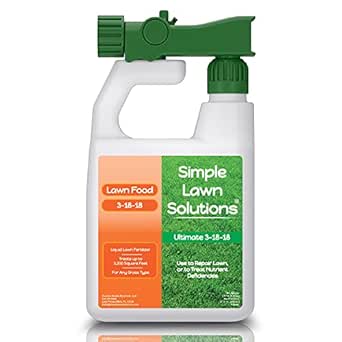
Simple Lawn Solutions 3-18-18 Liquid Lawn Fertilizer, 32 fl oz
I’d place this 3-18-18 formula in a different lane from a standard October lawn feed: it supplies comparatively little nitrogen and emphasizes phosphorus and potassium for root development and turf vigor. That makes it a better fit for a lawn care program that already has regular feeding covered, rather than a standalone greening treatment. Against Simple Lawn Solutions 16-4-8, this gives up the stronger nitrogen contribution in favor of a more root-oriented nutrient balance. The hose-end sprayer and listed coverage of up to 3,200 square feet make application more defined than the 16-4-8 product’s supplied details. Its main limitation is seasonal: the product is intended for actively growing turf, so it is not a good choice for dormant grass or as a blanket late-fall application without checking local timing and grass needs.
Pros:- High-phosphorus, high-potassium 3-18-18 formula supports root development and turf vigor
- Hose-end sprayer simplifies application
- Listed coverage reaches up to 3,200 square feet
- Suitable for several listed grass types
Cons:- Only 3% nitrogen, so it is not a strong choice for a quick green-up
- Intended for actively growing turf
- Designed to complement, not replace, a regular lawn fertilizer program
Best for: Lawn owners with actively growing listed grasses who already follow a regular fertilizer program and want a supplemental root-focused feed.
Not ideal for: Buyers seeking a nitrogen-led October greening treatment, or anyone planning to apply fertilizer to dormant turf.
- Brand:Simple Lawn Solutions
- NPK ratio:3-18-18
- Nitrogen:3%
- Phosphorus:18%
- Potassium:18%
- Volume:32 fl oz
- Coverage:Up to 3,200 sq ft
- Application:Hose-end sprayer
Our verdict“Pick this as a targeted supplement for actively growing turf, not as your main October fertilizer or a quick green-up product.”
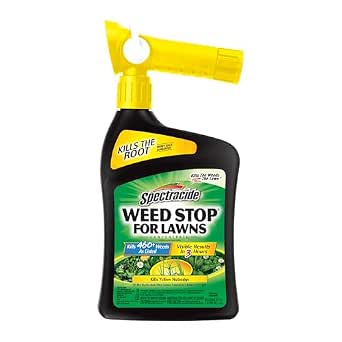
Spectracide Weed Stop for Lawns Ready-to-Spray Concentrate, 32 oz
When October lawn work is mainly about removing established broadleaf weeds, this is the most weed-focused pick in the group. Spectracide lists control for 460+ weed types, with visible results in as little as three hours and coverage up to 8,000 square feet. Unlike Scotts Liquid Turf Builder with Plus 2 Weed Control, it is not presented as a combined fertilizer-and-weed-control treatment, so it makes more sense when feeding is handled separately. The hose-attached ready-to-spray format reduces mixing steps, but weed control is less forgiving than routine lawn feeding: application must stay within the specified temperature range, and misuse can injure grass. The listed warning about zoysia emerging from dormancy is especially relevant in October. I’d check the label against your grass type and current conditions before spraying.
Pros:- Controls more than 460 listed weed types
- Designed to kill weeds down to the roots
- Visible results may appear in as little as three hours
- Hose-end ready-to-spray format covers up to 8,000 square feet
Cons:- Must be applied within the specified temperature range
- Improper use can injure lawns, including zoysia emerging from dormancy
- Does not provide the fertilizer component included in Scotts Liquid Turf Builder with Plus 2 Weed Control
Best for: Homeowners with listed lawn grasses and a broad mix of actively growing weeds who want a hose-end herbicide without added fertilizer.
Not ideal for: People unsure of their grass type, lawns outside the label’s temperature range, or zoysia lawns emerging from dormancy.
- Brand:Spectracide
- Volume:32 fl oz
- Form:Liquid
- Coverage:8,000 sq ft
- Listed weed types:460+
- Visible results:As little as 3 hours
- Active ingredients:2,4-D, mecoprop-P, dicamba, sulfentrazone
- Item weight:2.4 lb
Our verdict“Choose Spectracide for broad listed weed control when your grass and October conditions match the label, and feed the lawn separately.”
Scotts Liquid Turf Builder with Plus 2 Weed Control, 32 fl. oz.
For someone who wants to feed actively growing turf and treat listed broadleaf weeds in one pass, this 25-0-2 spray combines a nitrogen boost with weed control. That makes it more convenient than using Spectracide Weed Stop and a separate fertilizer, though Spectracide is the more weed-specialized option and lists a wider range of controlled weeds. Coverage depends on lawn type: up to 6,000 square feet for warm-season lawns and 4,000 for cool-season lawns, so I’d check the lower figure if you maintain a cool-season yard. It works best while weeds are actively growing and needs 48 hours without watering, which can be awkward during unsettled October weather. I’d choose it for a timely combined treatment, not for dormant turf or a schedule that requires immediate irrigation.
Pros:- Combines nitrogen lawn feeding and listed broadleaf weed control
- Hose-end applicator makes application straightforward
- Covers up to 6,000 square feet on warm-season lawns
- Targets weeds such as dandelions and clover
Cons:- Coverage drops to 4,000 square feet for cool-season lawns
- Works best when weeds are actively growing
- Requires 48 hours without watering
Best for: Owners of actively growing lawns who want a single hose-end application to feed grass and treat listed broadleaf weeds.
Not ideal for: Cool-season lawn owners needing greater coverage, or anyone unable to keep the lawn unwatered for 48 hours after application.
- Brand:Scotts
- Liquid volume:32 fluid ounces
- NPK:25-0-2
- Applicator:Hose-end
- Warm-season coverage:Up to 6,000 sq ft
- Cool-season coverage:Up to 4,000 sq ft
- Target weeds:Listed broadleaf weeds, including dandelions and clover
- Watering restriction:No watering for 48 hours after application
Our verdict“Choose this for a convenient combined feed-and-weed treatment on actively growing turf if your weather allows the 48-hour watering hold.”
Sunday Lawn Kickstart and Green Machine Liquid Lawn Fertilizer, 2-Pack
This two-product set is the better fit for buyers who want separate feeding options across the growing season rather than one balanced October treatment. Kickstart is 22-0-2 and Green Machine is 22-0-3; both supply nitrogen, while the product description also lists iron, seaweed, and potassium to support greening and lawn resilience. By comparison, Simple Lawn Solutions 16-4-8 provides phosphorus as part of a single balanced blend, while Sunday’s listed formulas contain no phosphorus. The included hose-end sprayer and stated 10,000-square-foot coverage make the kit convenient for larger areas, but the recommended 4–6-week schedule is tied to the growing season and temperature guidance. I wouldn’t treat the two-pack as an automatic October application: whether to feed depends on whether your grass is still actively growing.
Pros:- Includes two formulas: Kickstart 22-0-2 and Green Machine 22-0-3
- Nitrogen and listed iron support lawn growth and greening
- Hose-end sprayer is included
- Listed coverage reaches 10,000 square feet
Cons:- Use is limited to the growing season and recommended temperature range
- Both listed formulas contain no phosphorus
- Sprayer may vary from listing images
Best for: Homeowners with larger lawns who want two nitrogen-led liquid feeds and a hose-end sprayer for use during the growing season.
Not ideal for: Buyers seeking a phosphorus-containing balanced formula, a one-time October treatment, or a product for dormant grass.
- Brand:Sunday
- Items:2
- Formulas:Kickstart 22-0-2; Green Machine 22-0-3
- Form:Liquid
- Application method:Hose-end sprayer
- Coverage:10,000 sq ft
- Liquid volume:84.6 fl oz
- Application interval:Every 4–6 weeks during the growing season
Our verdict“Choose this multi-feed kit for a larger, actively growing lawn when you want scheduled nitrogen-led applications rather than a single balanced October feed.”
Sunday Green Machine Liquid Lawn Fertilizer, 2-Pack, Covers 10,000 Sq. Ft.
For October lawns that are still actively growing, I’d choose this for straightforward, hose-end feeding across a broad area. Its 22-0-3 formula supplies nitrogen for green growth and potassium, iron, and seaweed as supporting ingredients; the included sprayer avoids mixing fertilizer in a separate spreader. The 10,000-square-foot stated coverage also gives it a scale advantage over Scotts Liquid Green Max, which is presented as a smaller 32-ounce product. Unlike Scotts Turf Builder Southern Triple Action, Green Machine is focused on feeding rather than combining fertilizer with weed and fire-ant control. That simpler purpose is useful when the lawn needs nutrients, but it won’t address those pest problems. I’d skip it when growth has slowed for the season: applications are intended every 4 to 6 weeks during active growth, and the listing gives conflicting total-volume figures.
Pros:- Stated coverage of up to 10,000 square feet suits larger lawns.
- Hose-end sprayer makes application simpler than measuring and mixing a concentrate.
- 22-0-3 formula includes nitrogen and potassium, with iron and seaweed also listed.
- Liquid form is suited to repeat feeding during active growth.
Cons:- Requires repeat applications every 4 to 6 weeks while grass is actively growing.
- Does not combine feeding with weed or insect control like Scotts Turf Builder Southern Triple Action.
- Product listing conflicts on total volume, stating both 84 oz and 84.6 fl oz.
Best for: Homeowners with a large lawn that is still actively growing in October who want hose-end application without separate mixing.
Not ideal for: People whose grass has stopped growing for the season, or buyers seeking a combined fertilizer and weed-control treatment.
- Brand:Sunday
- Formula:22-0-3 NPK
- Key ingredients:Nitrogen, seaweed, iron, and potassium
- Pack size:2 bottles
- Bottle size:42.3 oz each
- Coverage:Up to 10,000 sq. ft.
- Application method:Hose-end sprayer
- Recommended interval:Every 4 to 6 weeks during active growth
Our verdict“Choose Green Machine for convenient, broad-coverage feeding while your lawn is still growing in October, but skip it if you need weed control or the season’s growth has ended.”

How We Picked
I compared these products by the October jobs they can actually help with: supplying nutrients, controlling weeds, addressing crabgrass, managing disease, and simplifying multiple treatments. I gave more weight to fit for a specific lawn need, clarity of use, and flexibility than to the number of claims on a label. Since these products have different active purposes and application formats, I did not treat a fertilizer, herbicide, and fungicide as direct substitutes.
The ranking favors options with a useful role for a broad range of fall lawn-care decisions, then places more specialized or combination products according to who benefits from their tradeoffs. Grass type, label directions, application timing, and existing lawn treatments can change which product is suitable, so buyers should confirm those details before applying anything. The list is a comparison of the products named, not a claim that every lawn needs all of them in October.
| October lawn care product | Brand |
|---|---|
| Simple Lawn Solutions Maximum | — |
| Scotts Turf Builder Southern T | Scotts |
| BASF Drive XLR8 Crabgrass Herb | BASF |
| Scotts Liquid Green Max Lawn F | Scotts |
| Scotts DiseaseEx Lawn Fungicid | Scotts |
| Simple Lawn Solutions 16-4-8 B | Simple Lawn Solutions |
| Simple Lawn Solutions 3-18-18 | Simple Lawn Solutions |
| Spectracide Weed Stop for Lawn | Spectracide |
| Scotts Liquid Turf Builder wit | Scotts |
| Sunday Lawn Kickstart and Gree | Sunday |
| Sunday Green Machine Liquid La | Sunday |
Factors to Consider When Choosing Best October Lawn Care Products
October lawn care is not one universal treatment plan. I would start with the problem the lawn has now, then match the product and application method to the grass, weather, and label directions rather than buying several formulas at once.
Start With the Lawn’s Actual October Need
Before choosing a product, distinguish between thin growth, visible weeds, crabgrass, and signs of fungal disease. A fertilizer will not solve a weed problem, and a weed killer will not replace nutrients a lawn may need. Combination products can save an application when their listed targets match the yard, but they may add treatments the lawn does not need. Check the product label for the weeds, diseases, or grass types it covers rather than relying on broad phrases such as lawn food or weed control. If the issue is unclear, identify the grass and the problem before treating the whole yard. This prevents using a product simply because it is marketed for fall.
Match Fertilizer Strength to Your Lawn Plan
Fertilizer numbers describe the relative nitrogen, phosphorus, and potassium content, not a guarantee that a formula fits every lawn. A high-nitrogen product and a balanced formula serve different nutrient plans, so do not assume the strongest nitrogen emphasis is always best for October. Soil conditions and local lawn recommendations can influence whether added phosphorus or potassium is appropriate. Check the label for the application rate and how much area the container covers; concentrate size alone does not tell you how many applications you can make. Avoid stacking fertilizers close together unless the directions and your lawn plan support it. A targeted feeding schedule is more useful than applying extra product to chase fast color.
Check Grass Type and Local Application Timing
Grass species affect which products are suitable and when fall treatments make sense. Warm-season lawns, cool-season lawns, and mixed lawns can respond differently to fertilizer and weed-control applications. October weather also varies widely, so a calendar date by itself is not a reliable application signal. Read the label for temperature, watering, mowing, and reseeding instructions, especially before applying herbicides. If you are unsure which grass grows in your yard, identify it before selecting a treatment. Following the product’s specific timing guidance can help avoid lawn injury and wasted applications.
Choose Liquid or Granular Based on Application Needs
Liquid products can be convenient when the formula is ready to spray or connects to a hose, but buyers still need to follow dilution and coverage instructions. Concentrates may require separate equipment and careful measuring, which can make them less convenient for a small or first-time application. Granular products call for an appropriate spreader and even coverage; uneven spreading can leave visible differences or concentrate product in spots. Think about the size and shape of the lawn, the tools you own, and whether you can apply the product consistently. Do not choose a format only because it seems faster: the right application method is the one you can carry out accurately. Also check whether the product requires watering in or a dry period after application.
Decide Whether a Combination Product Is Worth It
Combination formulas can reduce the number of separate applications, but that convenience only helps when every included treatment matches a current need. A product that pairs fertilizer with weed or pest control may be a poor fit if your lawn needs only one of those functions. Separate products give you more control over timing and target, though they can require more planning and separate application steps. Avoid combining treatments on your own unless the labels allow it. Compare the active purpose, coverage, and restrictions rather than counting the number of functions advertised. For a minor, clearly defined issue, a targeted product may be the simpler choice.
Plan for Coverage, Storage, and Repeat Treatments
Look at stated coverage before buying, especially for multi-bottle packs or products intended for larger lawns. A package may provide convenience without being the right amount for your yard, and leftover concentrate needs storage according to its label. Check whether the directions permit repeat applications and how long to wait between treatments. Applying more often than directed can harm turf and may conflict with other lawn products. Keep a record of what you apply and when, particularly if you use fertilizer, herbicide, and fungicide in the same season. This makes it easier to avoid accidental overlap and plan the next treatment responsibly.
Frequently Asked Questions
Should I fertilize my lawn in October or use a weed-control product?
Choose based on the lawn’s current need, not the month alone. Fertilizer addresses nutrient supply, while herbicides target specified weeds, and a combination product is useful only when both functions suit your yard. Confirm that the formula is labeled for your grass type and that local conditions fit its application directions. If weeds are the only concern, a fertilizer-heavy combination may not be the best match. If the lawn needs feeding and has listed weeds, a combination option may reduce separate applications.
Can I apply fertilizer and weed killer together in October?
Some products combine those functions, but that does not mean separate fertilizer and herbicide products can always be applied together. Follow each label’s instructions for timing, temperature, watering, mowing, and any limits on other treatments. Applying separate products too close together can create overlap or conflict with label directions. Check whether the weed treatment is appropriate for your grass and the weeds present. When the directions do not clearly allow a combined schedule, use the products separately according to their labels or seek local lawn-care guidance.
Is a high-nitrogen fertilizer always the best fall choice?
No. A high-nitrogen formula and a balanced NPK formula offer different nutrient profiles, and the right choice depends on your lawn plan and soil conditions. More nitrogen is not automatically better, particularly if the lawn does not need it or the timing is unsuitable for the grass type. Check the package directions and local recommendations before applying, and avoid layering another fertilizer on top without accounting for the nutrients already supplied. A soil test can help guide fertilizer selection when nutrient needs are uncertain.
How do I choose between a liquid and granular lawn treatment?
Base the choice on your equipment, lawn size, and ability to apply the product evenly. Ready-to-spray liquids can reduce measuring steps, while concentrates may offer more control but require accurate dilution and suitable equipment. Granular products need a spreader and careful coverage to avoid uneven treatment. Compare the label’s coverage and application directions rather than assuming one format is inherently easier or more effective. If you are new to lawn products, choose the format whose instructions and equipment you can manage reliably.
Do I need both a fungicide and a fertilizer for fall lawn care?
Not necessarily: they address different lawn conditions. Fertilizer supplies nutrients, while a fungicide is intended for specified disease concerns and should be used according to its label. A lawn without relevant disease pressure may not need fungicide, and a fertilizer will not replace disease treatment. Identify the problem before buying, then check that the product covers the issue and is suitable for your grass and application conditions. Avoid applying multiple products just because they appear together in a fall roundup.
Conclusion
For a broad fall feeding choice, I recommend Simple Lawn Solutions 16-4-8 Balanced NPK Liquid Lawn Fertilizer as the best overall pick; buyers seeking a lower-complexity fertilizer option can compare it with Scotts Liquid Green Max and the Sunday Green Machine two-pack. For value-minded shoppers, my pick is Spectracide Weed Stop Ready-to-Spray when the main need is labeled weed control and a ready-to-spray format suits the yard. Buyers seeking a more specialized or premium-style treatment should look at BASF Drive XLR8 for its crabgrass-focused role, or Scotts DiseaseEx when lawn disease is the concern. For beginners, Scotts Liquid Green Max is a straightforward fertilizer option to compare against more specialized concentrates and combination treatments. For specific needs, choose Southern Triple Action for its bundled treatment role, 3-18-18 for a distinct nutrient profile, or Sunday Lawn Kickstart and Green Machine when the two-product pairing fits your plan. I would buy for the lawn problem and label fit first, then choose the format and coverage that suit the yard.
Fall yard work Picks
leaf blowers
As an affiliate, we earn on qualifying purchases.