
The best wireless lavalier microphones make it easier to record clear speech without holding a mic or staying close to a camera. DJI Mic Mini is my best overall pick for its flexible kit options, while the Hollyland Lark M2 stands out for creators who want a compact system with receiver choices. For a simpler phone-first setup, the MAYBESTA 2-Pack is a straightforward alternative. The main tradeoffs are phone compatibility, one- versus two-person recording, and whether you need a receiver and charging case or just a plug-in adapter. Read on for the full breakdown and help matching a system to your recording setup.

Get business pricing on tools and workshop supplies
- Business-only prices and quantity discounts
- Tax-exempt purchasing
- Multiple users, one account, clear invoices
Complete the kit


Key Takeaways
- DJI Mic Mini and Hollyland Lark M2 lead the more adaptable creator kits; the right choice depends on receiver bundle and device setup, not the name alone.
- Several listings offer multiple receiver or bundle configurations, especially the DJI and Hollyland models, so check the exact package rather than assuming every kit includes the same parts.
- Two-transmitter sets are the practical choice for interviews and co-hosted videos; single-person creators may prefer a simpler, lighter phone-oriented kit.
- The TONOR systems stand apart from tiny phone mics by offering bodypack, headset, or handheld microphone options, making them better suited to presentations and events than pocketable creator setups.
- Low-cost mini sets such as wedaniya, Labstandard, MAYBESTA, Bulatry, and PQRQP can suit casual mobile recording, but connection type and device compatibility deserve more scrutiny than broad compatibility claims.
| TONOR UHF Wireless Microphone System with Bodypack, Lavalier, and Headset Mics |  | Best for PA and Venue Use | Wireless technology: UHF | Wireless range: 200 ft / 60 m | Adjustable frequencies: 15 | VIEW ON AMAZON | See Our Full Breakdown |
| TONOR Wireless Microphone System with Handheld, Headset, and Lavalier Mics |  | Best Multi-Mic Kit for Group Events | Operating range: 200 ft / 60 m | Number of channels: 20 | Receiver connection: 6.35 mm audio cable | VIEW ON AMAZON | See Our Full Breakdown |
| wedaniya Wireless Mini Lavalier Microphone 2-Pack with USB-C & Lightning Receivers |  | Best for Quick Phone Setup | Model: WM189 | Connectors: USB Type-C and Lightning | Compatible devices: Android, iOS, laptops, smartphones, and tablets | VIEW ON AMAZON | See Our Full Breakdown |
| Labstandard Dual Wireless Lavalier Microphone Set for iPhone and USB-C Devices |  | Best for Two-Person Interviews | Microphone quantity: 2 | Microphone type: Lavalier, mini | Connectors: Lightning and USB Type-C | VIEW ON AMAZON | See Our Full Breakdown |
| Wireless Lavalier Microphone System for iPhone, Android, and PC |  | Best for Cross-Device Recording | Wireless technology: 2.4 GHz | Connectors: USB-C and Lightning | Microphone form: Lavalier | VIEW ON AMAZON | See Our Full Breakdown |
| MAYBESTA Wireless Mini Lavalier Microphone, 2-Pack |  | Best Value for Simple Two-Person Phone Recording | Microphone type: Mini lavalier | Connectivity: Wireless, 2.4 GHz | Connectors: Lightning or USB Type-C | VIEW ON AMAZON | See Our Full Breakdown |
| DJI Mic Mini Wireless Microphone Kit (2 Transmitters + Mobile Receiver) |  | Best for Long Recording Sessions | Transmitters: 2 | Transmitter weight: 10 g each | Maximum transmission range: Up to 300 m | VIEW ON AMAZON | See Our Full Breakdown |
| DJI Mic Mini Wireless Microphone System with 2 Transmitters, 1 Receiver, and Charging Case |  | Best for Travel and Extended Shoots | Transmitters: 2 | Transmitter weight: 10 g each | Audio sampling rate: 48 kHz | VIEW ON AMAZON | See Our Full Breakdown |
| DJI Mic Mini Wireless Microphone System (2 Transmitters + 1 Receiver) |  | Best for DJI Osmo Creators | Transmitters: 2 | Transmitter weight: 10 g each | Transmission range: Up to 400 m | VIEW ON AMAZON | See Our Full Breakdown |
| Mini Mic Pro Wireless Lavalier Microphone for iPhone and Android | 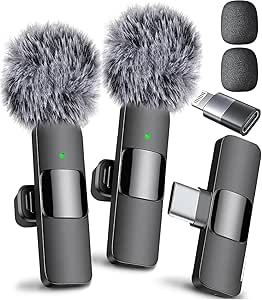 | Best for Wind-Exposed Phone Recording | Microphone configuration: 2 lavalier microphones and 1 receiver | Connectivity: Wireless | Connectors: Lightning and USB Type-C adapters | VIEW ON AMAZON | See Our Full Breakdown |
| Hollyland Lark M2 Wireless Lavalier Microphone |  | Best Compact Pick | Microphone weight: 9 g | Audio format: 48 kHz/24-bit | Wireless range: Up to 1,000 ft line of sight | VIEW ON AMAZON | See Our Full Breakdown |
| Hollyland Lark M2 Wireless Microphone (2 TX + 3 RX + Charging Case) – 48kHz/24-bit Audio, 300m Range, Noise Cancelling, 40h Battery | 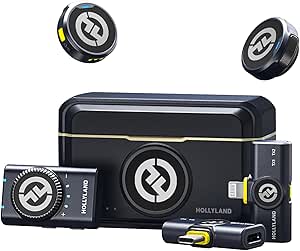 | Best Multi-Device Kit | Included components: 2 transmitters, 3 receivers, charging case | Audio format: 48 kHz/24-bit | Frequency range: 20 Hz–20 kHz | VIEW ON AMAZON | See Our Full Breakdown |
| Hollyland LARK A2 Wireless Microphone System (2 Transmitters, 1 Receiver, Charging Case) |  | Best for Audio Safeguards | Included components: 2 transmitters, 1 receiver, charging case | Audio quality: 48 kHz/24-bit; ≥68 dB SNR | Noise cancellation: AI-powered, 3 adjustable levels | VIEW ON AMAZON | See Our Full Breakdown |
| Bulatry 2-Pack Wireless Mini Lavalier Microphone for iPhone and Android – 65 ft Range, Noise Reduction, 6-Hour Battery |  | Best Simple Phone Pair | Microphones included: 2 | Compatibility: iPhone with Lightning and Android with USB-C | Wireless range: Up to 65 ft (20 m) | VIEW ON AMAZON | See Our Full Breakdown |
| PQRQP 3-in-1 Professional Wireless Lavalier Microphone for iPhone, Android, Camera – Mini Mic, Crystal Clear Sound for Recording & Live Streaming – Elegant Black |  | Best No-App Setup | Receiver type: 3-in-1 universal receiver | Connector: 3.5 mm; not compatible with laptop audio input | Compatibility: iPhone, including iPhone 15; Android smartphones, laptops, cameras | VIEW ON AMAZON | See Our Full Breakdown |
| wireless lavalier microphone | Battery life |
|---|---|
| TONOR UHF Wireless Microphone | — |
| TONOR Wireless Microphone Syst | — |
| wedaniya Wireless Mini Lavalie | Up to 6 hours |
| Labstandard Dual Wireless Lava | About 6 hours |
| Wireless Lavalier Microphone S | 6 hours per microphone |
| MAYBESTA Wireless Mini Lavalie | — |
| DJI Mic Mini Wireless Micropho | — |
| DJI Mic Mini Wireless Micropho | — |
| DJI Mic Mini Wireless Micropho | Up to 10 hours per transmitter and receiver |
| Mini Mic Pro Wireless Lavalier | Up to 6 hours per charge |
| Hollyland Lark M2 Wireless Lav | Up to 10 hours continuous; up to 30 hours with charging case |
| Hollyland Lark M2 Wireless Mic | Up to 40 hours for camera version; up to 10 hours with ENC off |
| Hollyland LARK A2 Wireless Mic | 7–9 hours per transmitter; up to 42 hours total with case |
| Bulatry 2-Pack Wireless Mini L | Up to 6 hours continuous use |
| PQRQP 3-in-1 Professional Wire | Up to 7 hours continuous use |
More Details on Our Top Picks
TONOR UHF Wireless Microphone System with Bodypack, Lavalier, and Headset Mics
This TONOR is the strongest fit here when a lavalier needs to feed a mixer, amplifier, or PA system rather than a phone. Its UHF link, 200-foot stated range, and 15 adjustable frequencies suit presentations and events where the speaker may move around and wireless interference is a concern. The included headset mic gives it a useful alternative when a lavalier is awkward to position. Compared with the wedaniya WM189, this system is built for venue audio connections, not direct USB-C or Lightning recording. That specialization brings tradeoffs: the receiver needs external sound equipment, and the bodypack runs on two AA batteries that are not included. Its receiver also offers a more limited 6–8 hours of battery life than a setup intended for longer sessions.
Pros:- Includes both lavalier and headset microphones for different hands-free setups
- UHF operation with 15 adjustable frequencies helps when wireless channels are crowded
- Stated 200-foot range allows movement across a venue
- Rechargeable receiver is rated for 6–8 hours of use
Cons:- Requires a mixer, amplifier, speaker, or PA system to produce sound
- Bodypack requires two AA batteries, which are not included
- Receiver battery life is shorter than options intended for extended recording sessions
Best for: Presenters, instructors, and event hosts who need a hands-free microphone connected to a mixer, powered speaker, or PA system.
Not ideal for: Phone-based creators or anyone seeking a self-contained recording setup; it uses a 6.35 mm receiver connection and needs external audio equipment.
- Wireless technology:UHF
- Wireless range:200 ft / 60 m
- Adjustable frequencies:15
- Receiver connector:6.35 mm jack
- Microphone formats:Bodypack, lavalier, and headset
- Receiver battery life:6–8 hours
- Bodypack power:2 AA batteries, not included
- Signal-to-noise ratio:60 dB
Our verdict“Choose this TONOR when you need a flexible lavalier-and-headset system for PA equipment, not a plug-in mic for phone recording.”
TONOR Wireless Microphone System with Handheld, Headset, and Lavalier Mics
For events that may call for a lavalier one moment and a handheld mic the next, this TONOR brings multiple microphone formats into one receiver system. The package lists two handheld mics, two bodypacks, and two each of the headset and lavalier mics, making it more adaptable for shared presentations than the single-bodypack TONOR UHF system. Automatic pairing and 20 channels are aimed at reducing setup friction, while the 200-foot stated range supports movement in larger rooms. This is still venue gear, not a direct-to-phone lavalier kit like the Labstandard set: it connects by 6.35 mm audio cable to a mixer, amplifier, or powered speaker. Its main drawback is power planning—each mic or bodypack needs two AA batteries, and the batteries are not included.
Pros:- Package includes handheld, headset, and lavalier microphones for varied event needs
- 20 channels offer more frequency options than the 15 listed for the TONOR UHF system
- Automatic pairing can simplify setup
- Stated 200-foot operating range suits larger rooms and outdoor events
Cons:- Connects to audio equipment through a 6.35 mm cable rather than directly to a phone
- Batteries are not included, and each microphone or bodypack requires two AA batteries
- The receiver-based setup is bulkier and less suited to quick mobile recording than the wedaniya WM189
Best for: Churches, event organizers, and meeting hosts who need several microphone styles and multiple users covered by one receiver system.
Not ideal for: Solo mobile creators who record directly to a phone, or buyers who want rechargeable transmitters and a compact kit.
- Operating range:200 ft / 60 m
- Number of channels:20
- Receiver connection:6.35 mm audio cable
- Included microphone formats:Handheld, headset, and lavalier
- Package microphone quantities:2 handheld mics, 2 headset mics, and 2 lavalier mics
- Polar pattern:Unidirectional (cardioid)
- Signal-to-noise ratio:60 dB
- Power:2 AA batteries per microphone or bodypack; not included
Our verdict“Pick this kit for events needing several mic styles and users, provided you already have compatible sound equipment and spare AA batteries.”
wedaniya Wireless Mini Lavalier Microphone 2-Pack with USB-C & Lightning Receivers
The wedaniya WM189 is a straightforward choice for creators who want to clip on a mic and record to a phone without an app or Bluetooth pairing. Its USB-C and Lightning receivers cover many Android and Apple devices, and the two-mic package is better suited to interviews than a single-person setup. Real-time headphone monitoring gives speakers a way to check audio while recording, while noise-reduction modes and included windshields can help in less controlled surroundings. Compared with the Labstandard set, wedaniya specifies a quick one-hour charge and a lightweight design under one ounce; Labstandard instead lists a very low latency figure. The WM189’s tradeoff is its receiver-dependent connection: it is not a universal Bluetooth mic, and the plastic enclosure may be less reassuring for frequent travel.
Pros:- USB-C and Lightning receivers support a range of phones, tablets, and laptops
- Plug-and-play setup avoids apps and Bluetooth pairing
- Real-time headphone monitoring and multiple audio modes add recording control
- Under-one-ounce design and one-hour charging time suit mobile use
Cons:- Requires its specific receiver dongles rather than connecting as a universal Bluetooth microphone
- Plastic enclosure may be less durable-feeling than metal venue systems such as the TONOR UHF
- Battery life is up to six hours per charge
Best for: Mobile interviewers and social video creators who want a lightweight two-mic kit with direct USB-C and Lightning receivers and simple setup.
Not ideal for: Buyers who need a universal Bluetooth connection, a rugged metal build, or substantially longer recording time than six hours.
- Model:WM189
- Connectors:USB Type-C and Lightning
- Compatible devices:Android, iOS, laptops, smartphones, and tablets
- Number of channels:2
- Signal-to-noise ratio:70 dB
- Battery life:Up to 6 hours
- Charging time:1 hour
- Weight:Under 1 oz
Our verdict“Choose the WM189 for lightweight phone interviews and fast dongle-based setup, but skip it if you need a rugged or Bluetooth-based system.”
Labstandard Dual Wireless Lavalier Microphone Set for iPhone and USB-C Devices
The Labstandard set is tailored to two-person recordings: it supplies two wireless lavalier microphones and lists compatibility with Lightning and USB-C devices. Its omnidirectional pickup can capture voices without requiring a speaker to address the mic from one precise angle, a practical advantage in conversational interviews. The stated 0.008-second latency also targets close audio-video synchronization. Compared with the wedaniya WM189, Labstandard emphasizes its low-latency claim, while wedaniya offers more detail on monitoring modes and a one-hour charging time. Labstandard lists about six hours of battery life, so it is better suited to shorter sessions than a full day of recording. The listing calls its connectivity Bluetooth while also describing phone receiver connectors, so buyers should check that the included receiver arrangement matches their device before relying on it.
Pros:- Two microphones support interviews and other two-person recordings
- Lightning and USB-C connectors cover common Apple and USB-C devices
- Omnidirectional pickup suits conversational recording
- Lists 0.008-second latency for audio-video synchronization
Cons:- About six hours of battery life may not cover extended recording days
- Connectivity details are unclear because the listing names Bluetooth and receiver connectors
- The available description provides less setup and monitoring detail than the wedaniya WM189
Best for: Two-person interviewers and livestreamers using an iPhone, iPad, or USB-C device who prioritize a dual-mic setup and stated low latency.
Not ideal for: Creators who need clearly documented connection details, long all-day battery life, or a receiver setup confirmed for a particular device.
- Microphone quantity:2
- Microphone type:Lavalier, mini
- Connectors:Lightning and USB Type-C
- Pickup pattern:Omnidirectional
- Latency:0.008 seconds
- Battery life:About 6 hours
- Compatibility:iPhone, iPad, and USB-C devices
- Weight:0.05 kg
Our verdict“Consider Labstandard for short two-person mobile recordings if its receiver connection is confirmed for your device.”
Wireless Lavalier Microphone System for iPhone, Android, and PC
This dual-lavalier kit is the most broadly aimed option in this group for creators who move between phones and computers. Its USB-C and Lightning connectors are listed for iPhone, Android, iPad, Windows, and Mac, while the 2.4 GHz link avoids the venue-style receiver and PA connections used by the TONOR systems. Each mic is rated for six hours, and the system supports use while charging, which can help during longer livestreams or interviews near a power source. Compared with the wedaniya WM189, this listing gives broader computer compatibility and charging-use support; wedaniya specifies real-time monitoring and a one-hour recharge. The tradeoffs are that some Android devices may need OTG enabled, and the plastic enclosure may be less durable-feeling than a metal-bodied system.
Pros:- USB-C and Lightning connectors support a broad range of listed phones, tablets, and computers
- Two microphones make it suitable for interviews
- Use while charging can extend recording sessions near a power source
- Automatic pairing and included windshields and adapters simplify setup
Cons:- Some Android devices may require OTG to be enabled for pairing
- Plastic enclosure may be less durable-feeling than metal alternatives
- Six-hour battery rating per microphone still requires charging for longer sessions
Best for: Creators who record interviews, livestreams, or video across iPhone, Android, and computer devices and want a dual-mic kit that can operate while charging.
Not ideal for: Android users who cannot enable OTG when needed, or buyers who require a metal enclosure and a venue-grade PA connection.
- Wireless technology:2.4 GHz
- Connectors:USB-C and Lightning
- Microphone form:Lavalier
- Pickup pattern:Omnidirectional
- Wireless range:Up to 20 m
- Battery life:6 hours per microphone
- Signal-to-noise ratio:65 dB
- Compatible devices:iPhone, Android, iPad, Windows, and Mac
Our verdict“Choose this system if you need two lavaliers across phone and computer workflows, especially when charging during a session is useful.”
MAYBESTA Wireless Mini Lavalier Microphone, 2-Pack
The MAYBESTA set is a straightforward choice for recording two speakers on compatible phones, tablets, or laptops without adding an app-based setup. Its two clip-on microphones and plug-and-play operation suit casual interviews, vlogs, and remote content where quick setup matters more than a detailed control system. Like the Mini Mic Pro, it includes Lightning and USB-C connectivity, but MAYBESTA’s listed specs do not give a battery runtime or wireless range, so it is harder to plan longer shoots or distance-heavy recordings. Omnidirectional pickup captures voices from around each mic, while noise reduction and a mute function add useful basic control. I’d choose it for uncomplicated, short sessions; creators who need a known runtime or wind protection should look at the Mini Mic Pro instead.
Pros:- Includes two mini lavalier microphones for recording two speakers.
- Plug-and-play setup avoids a separate app.
- Lightning and USB-C connector options cover many phones and tablets.
- Noise reduction and a mute function provide basic recording control.
Cons:- Battery runtime is not specified, making session planning difficult.
- Wireless range is not listed.
- The connector version must match the recording device.
Best for: Two-person creators using a compatible phone or tablet who want a simple, app-free setup for short interviews and vlogs.
Not ideal for: Creators planning long sessions or recording far from the receiver, because the listed data does not specify battery runtime or wireless range.
- Microphone type:Mini lavalier
- Connectivity:Wireless, 2.4 GHz
- Connectors:Lightning or USB Type-C
- Polar pattern:Omnidirectional
- Signal-to-noise ratio:80 dB
- Special features:Mute function, noise reduction, plug and play
- Power source:Battery powered
Our verdict“Choose MAYBESTA for uncomplicated two-person phone recordings, but pick the Mini Mic Pro if a stated battery runtime and wind-protection accessories matter more.”
DJI Mic Mini Wireless Microphone Kit (2 Transmitters + Mobile Receiver)
This DJI Mic Mini kit pairs two 10 g transmitters with a mobile receiver, making it a strong fit for interviews or livestreams where both speakers need discreet mics and long sessions are common. Its stated up to 11.5 hours of operating time gives it an advantage over the Mini Mic Pro’s up-to-six-hour figure, while two noise-cancellation levels let you choose between lighter processing and stronger background-noise control. The claimed 300 m range is useful on paper, but actual performance can depend on the recording environment, so I wouldn’t choose it solely for distant shooting. Compared with the charging-case DJI system, this version lists a simpler mobile-focused kit and does not claim the same case-based battery total or 400 m range. It is not waterproof, which limits outdoor use in wet conditions.
Pros:- Two lightweight 10 g transmitters are discreet on clothing.
- Up to 11.5 hours of operating time suits extended recordings.
- Basic and Strong noise cancellation levels offer a choice of processing.
- USB-C compatibility includes phones, PCs, and tablets.
Cons:- The kit is not waterproof.
- The 300 m maximum range may vary with recording conditions.
- The listed kit does not include a charging case.
Best for: Interviewers and livestreamers who use USB-C-compatible phones, computers, or tablets and need two lightweight mics for extended sessions.
Not ideal for: Creators who record in rain or require a charging case, a stated 48-hour total battery figure, or the longer listed range of the other DJI Mic Mini system.
- Transmitters:2
- Transmitter weight:10 g each
- Maximum transmission range:Up to 300 m
- Maximum operating time:Up to 11.5 hours
- Noise cancellation:Basic and Strong levels
- Receiver:Mobile receiver
- Compatibility:iPhone 15, 16, and 17 series; Android phones, PCs, and tablets via USB-C
Our verdict“Pick this DJI kit for long, two-person USB-C recordings; choose the charging-case DJI system if longer overall power between charging opportunities is your priority.”
DJI Mic Mini Wireless Microphone System with 2 Transmitters, 1 Receiver, and Charging Case
For creators who need two lavaliers ready across a full day of recording, this DJI Mic Mini stands out for its charging case and up to 48 hours of battery life. That total is a different advantage from the separate DJI Mic Mini kit’s stated 11.5 hours of operating time: here, the case helps recharge the transmitters and receiver between sessions. The 10 g transmitters stay discreet, while two noise-cancellation levels and automatic audio limiting give the setup more flexibility when voices or surroundings change. Its 48 kHz audio specification and 120 dB SPL maximum input level also support detailed capture and louder sources. The 400 m range is a stated maximum, not a guarantee in every location. This bundle makes less sense if you only need a basic mobile kit and won’t use the case or extra battery capacity.
Pros:- Charging case supports up to 48 hours of stated battery life.
- Two 10 g transmitters are light and discreet.
- Automatic audio limiting helps manage sudden loud sounds.
- Two noise-cancellation levels suit different recording environments.
Cons:- The 400 m maximum transmission range depends on conditions.
- The charging case adds equipment to carry.
- The extensive battery capacity may be unnecessary for short, occasional recordings.
Best for: Mobile journalists, interviewers, and event creators who record with two speakers across multiple sessions and value recharging between takes.
Not ideal for: Occasional solo creators who want the simplest low-bulk setup and have little use for a charging case or extended battery capacity.
- Transmitters:2
- Transmitter weight:10 g each
- Audio sampling rate:48 kHz
- Maximum sound pressure level:120 dB SPL
- Maximum transmission range:Up to 400 m
- Battery life with charging case:Up to 48 hours
- Noise cancellation:Basic and Strong levels
- Included:2 transmitters, 1 receiver, charging case, and accessories
Our verdict“Choose this bundle for two-person creators who want substantial between-session battery support, rather than the simpler DJI mobile kit’s more limited listed runtime.”
DJI Mic Mini Wireless Microphone System (2 Transmitters + 1 Receiver)
This receiver-based DJI Mic Mini is the clearest fit for creators already working with compatible DJI Osmo cameras and gimbals. Its transmitters can connect directly to select Osmo devices without a receiver, which can simplify a compact camera setup; it also includes a receiver for other supported workflows. At 10 g per transmitter, the mics are unobtrusive, and up to 10 hours of battery life per unit supports a substantial recording day. The stated 400 m range and two noise-cancellation levels make it more capable on paper than the 300 m mobile-receiver kit, though range still varies with conditions. Unlike the charging-case version, this listing does not claim up to 48 hours of total battery life. It is also not waterproof, and its magnets warrant care around pacemakers and magnetic storage media.
Pros:- Direct connection works with select DJI Osmo devices without a receiver.
- Two 10 g transmitters are unobtrusive on camera.
- Up to 10 hours of battery life per unit supports extended shoots.
- Two noise-cancellation levels accommodate different environments.
Cons:- The system is not waterproof.
- Magnets may interfere with pacemakers and magnetic storage media.
- No charging case or 48-hour combined battery figure is listed.
Best for: Creators using compatible DJI Osmo devices who want discreet two-person audio and the option of direct connection without a receiver.
Not ideal for: People recording in wet conditions, those who need a charging case for longer combined runtime, or anyone who must avoid equipment containing magnets.
- Transmitters:2
- Transmitter weight:10 g each
- Transmission range:Up to 400 m
- Battery life:Up to 10 hours per transmitter and receiver
- Noise cancellation:Basic and Strong levels
- Compatible devices:DJI Osmo Nano, Osmo 360, Osmo Mobile 7P, Osmo Action 5 Pro, Osmo Action 4, and Osmo Pocket 3
- Operating temperature:-10°C to 45°C (14°F to 113°F)
Our verdict“Choose this version if direct compatibility with your listed DJI Osmo device is the priority; the charging-case DJI system suits creators who value longer combined battery life.”
Mini Mic Pro Wireless Lavalier Microphone for iPhone and Android
The Mini Mic Pro is a practical pick for phone creators who need more than a bare-bones wireless mic: the kit includes USB-C and Lightning adapters, plus foam and dead-cat wind covers for recording outdoors. Those accessories give it a clear edge over the MAYBESTA set, whose listing emphasizes plug-and-play use but does not specify wind protection or a battery runtime. Mini Mic Pro’s up to six hours per charge gives buyers a planning figure, though it trails the longer stated operating time of the DJI Mic Mini mobile kit. Its two lavalier microphones and receiver can support two-person capture, while one-touch recording and a battery indicator keep operation simple. The stated 80 g weight may matter to buyers seeking the lightest possible kit, and the warranty details are limited.
Pros:- Includes both Lightning and USB-C adapters.
- Foam and dead-cat tips help protect recordings from wind.
- Up to six hours of battery life is specified.
- Plug-and-play setup requires no app or Bluetooth connection.
Cons:- Up to six hours per charge is shorter than the DJI Mic Mini mobile kit’s stated runtime.
- The listed warranty information is limited.
- The stated 80 g weight may be less appealing to buyers prioritizing minimal carry weight.
Best for: Phone-based vloggers and interviewers who switch between Lightning and USB-C devices and need included wind covers for outdoor voice recording.
Not ideal for: Creators recording beyond six hours without a charging break or those prioritizing the lightest possible equipment and clearly specified warranty coverage.
- Microphone configuration:2 lavalier microphones and 1 receiver
- Connectivity:Wireless
- Connectors:Lightning and USB Type-C adapters
- Microphone pattern:Omnidirectional
- Battery life:Up to 6 hours per charge
- Weight:80 g
- Dimensions:3 x 0.5 x 0.25 inches
- Included wind protection:2 foam tips and 2 dead-cat tips
Our verdict“Choose the Mini Mic Pro for a versatile phone kit with wind covers, but opt for the DJI Mic Mini mobile kit if longer stated runtime matters more.”
Hollyland Lark M2 Wireless Lavalier Microphone
The Hollyland Lark M2 is my compact pick for creators who want a small clip-on mic without giving up high-resolution recording. At just 9 g, it is suited to discreet on-camera use, while factory pairing keeps setup simpler than systems that require more configuration. Its 48 kHz/24-bit audio and adjustable noise cancellation give it more control than the basic phone-focused Bulatry 2-Pack. The stated range reaches 1,000 ft only with a clear line of sight, so I would not choose it on that figure alone for crowded or obstructed locations. Battery life is up to 10 hours per charge, with up to 30 hours using the case. Phone recording controls can also depend on whether the device supports volume-button control.
Pros:- Lightweight 9 g microphone is discreet to wear
- 48 kHz/24-bit audio recording
- Up to 30 hours of use with the charging case
- One-click noise cancellation with Strong and Low app settings
Cons:- The 1,000 ft range is a line-of-sight specification, not a guarantee in obstructed spaces
- Phone recording control depends on device support for volume-button controls
Best for: Mobile creators who want a discreet, lightweight mic for compatible phones, cameras, or computers and value quick setup.
Not ideal for: Creators who need dependable range through walls or phone recording controls that work the same way on every device.
- Microphone weight:9 g
- Audio format:48 kHz/24-bit
- Wireless range:Up to 1,000 ft line of sight
- Battery life:Up to 10 hours continuous; up to 30 hours with charging case
- Signal-to-noise ratio:70 dB
- Maximum sound pressure level:115 dB
- Noise cancellation:One-click control; Strong and Low levels available in app
- Connectivity:USB-C version for compatible Android phones, iPhone 15 and later, action cameras, and computers
Our verdict“Choose the Lark M2 if a discreet fit, quick pairing, and adjustable noise control matter more than universal phone controls.”
Hollyland Lark M2 Wireless Microphone (2 TX + 3 RX + Charging Case) – 48kHz/24-bit Audio, 300m Range, Noise Cancelling, 40h Battery
This Lark M2 bundle is the most adaptable choice here for creators switching among phones, cameras, and other recording setups: it includes two transmitters and three receiver connection options, plus a charging case. Like the other Lark M2, it records at 48 kHz/24-bit and lists a 300 m line-of-sight range; its larger receiver selection is the practical distinction, not a different audio format. The listed battery life reaches 40 hours for the camera version, although the transmitter is also described as requiring a C-size battery, a detail buyers should verify for their exact kit. Noise cancellation is manually toggled rather than automatic, and mono/stereo switching works only with the 3.5 mm receiver connection. Compared with the Lark A2, this bundle favors connection flexibility over its AI-focused audio tools.
Pros:- Two transmitters support recording two speakers
- Three receiver connection types cover 3.5 mm, Lightning, and USB-C setups
- 48 kHz/24-bit audio with 70 dB signal-to-noise ratio
- Charging case supports up to 40 hours of listed camera-version battery life
Cons:- Noise cancellation requires manual toggling
- Mono/stereo switching is limited to the 3.5 mm receiver connection
- Product data also lists a C-size transmitter battery, so the power setup should be checked for the specific version
Best for: Video creators who record with both a camera and mobile devices and want receiver options for different connection types.
Not ideal for: Buyers who want automatic noise handling, straightforward mode switching across connections, or a kit with no battery-type ambiguity.
- Included components:2 transmitters, 3 receivers, charging case
- Audio format:48 kHz/24-bit
- Frequency range:20 Hz–20 kHz
- Transmission range:Up to 300 m (1,000 ft) line of sight
- Battery life:Up to 40 hours for camera version; up to 10 hours with ENC off
- Signal-to-noise ratio:70 dB
- Maximum sound pressure level:115 dB
- Connector types:3.5 mm, Lightning, USB-C
- Channels and pickup pattern:2 channels; omnidirectional
Our verdict“Pick this Lark M2 bundle if your recording devices vary and the included receiver options matter more than automatic audio adjustments.”
Hollyland LARK A2 Wireless Microphone System (2 Transmitters, 1 Receiver, Charging Case)
The Hollyland LARK A2 earns its place for creators who want help managing sudden changes in speaking volume. Its AI auto-limit and safety track are aimed at reducing clipping when a voice gets louder unexpectedly, a useful distinction from the manual noise-cancellation controls on the Lark M2. The system also includes three adjustable noise-cancellation levels and offers up to 42 hours with its case, making it better suited to long or unpredictable recording days than the six-hour Bulatry pair. The tradeoff is that full AI Voice Tuning depends on the HollyAudio app, and the product data notes specific C batteries for the transmitters despite listing USB-C charging. Its 200 m range is substantial, though shorter than the Lark M2’s stated line-of-sight maximum.
Pros:- AI auto-limit and safety track help manage sudden loud sounds
- Three adjustable noise-cancellation levels
- Up to 42 hours of total battery life with the case
- Two transmitters support two-person recordings
Cons:- Full AI Voice Tuning requires the HollyAudio app
- Product data mentions specific C batteries for transmitters, which may add replacement hassle
- 200 m stated range is shorter than the Lark M2’s 300 m line-of-sight claim
Best for: Interviewers and mobile video creators recording changing voices who want clipping protection and multiple noise-control settings.
Not ideal for: Users who want all audio features without an app or who prefer a simple, clearly specified charging arrangement.
- Included components:2 transmitters, 1 receiver, charging case
- Audio quality:48 kHz/24-bit; ≥68 dB SNR
- Noise cancellation:AI-powered, 3 adjustable levels
- Battery life:7–9 hours per transmitter; up to 42 hours total with case
- Quick charge:5 minutes of charging for 1 hour of use
- Transmission range:Up to 200 m (650 ft)
- Transmitter weight:8.5 g each
- Wireless frequency:2.4 GHz
- Compatibility:iPhone, Android, laptop, tablet, action camera
Our verdict“Choose the LARK A2 if protection against sudden peaks and adjustable noise control matter more than the Lark M2’s longer stated range.”
Bulatry 2-Pack Wireless Mini Lavalier Microphone for iPhone and Android – 65 ft Range, Noise Reduction, 6-Hour Battery
The Bulatry 2-Pack is a straightforward fit for phone-first creators who need two small clip-on mics and Lightning or USB-C connections in one kit. Its 65 ft range is far shorter than the Hollyland options’ line-of-sight claims, but that can be a sensible match for close-range interviews, short social videos, or indoor recording where the speaker stays near the phone. Three recording modes add some flexibility, including mute, noise cancellation, and echo. At up to six hours per charge, it has less endurance than the PQRQP system’s listed seven hours and falls well behind the Lark M2 kits with charging cases. It also has no built-in recording memory, so the phone must remain connected throughout a session.
Pros:- Two 10 g microphones are light enough for extended wear
- Lightning and USB-C compatibility supports a range of phones
- Three modes include mute, noise cancellation, and echo
- Listed charging time is under one hour
Cons:- Six-hour maximum battery life is shorter than the PQRQP and Hollyland options
- 65 ft range is limited compared with the Lark M2 systems
- No built-in recording memory; it must stay connected to a device
Best for: Phone-based interviewers and social video creators who need two lightweight mics with Lightning and USB-C receiver options.
Not ideal for: Creators recording long sessions, working far from the phone, or needing backup audio stored on the microphone.
- Microphones included:2
- Compatibility:iPhone with Lightning and Android with USB-C
- Wireless range:Up to 65 ft (20 m)
- Battery life:Up to 6 hours continuous use
- Charging time:Under 1 hour
- Weight per microphone:10 g
- Recording modes:Mute, noise cancellation, echo
- Latency:0.0009 seconds
- Included accessory:Storage pouch
Our verdict“Pick the Bulatry pair for nearby, phone-based two-person recordings when light weight and connector choice matter more than long runtime.”
PQRQP 3-in-1 Professional Wireless Lavalier Microphone for iPhone, Android, Camera – Mini Mic, Crystal Clear Sound for Recording & Live Streaming – Elegant Black
The PQRQP is the easiest match in this group for buyers who want automatic pairing without an app. Its 3-in-1 universal receiver is intended to cover phones, cameras, and other listed devices, while the 65 ft transmission range suits close-range livestreams, vlogs, and interviews. That range is much shorter than the Hollyland Lark M2 systems, but the PQRQP’s appeal is a simpler setup rather than extended wireless reach or advanced recording controls. Its seven-hour battery life gives it a small endurance advantage over the Bulatry pair, though neither offers the long case-supported runtime of the Hollyland kits. Check your connection before buying: the listed 3.5 mm connector is not compatible with laptop audio input, and some Android phones require manual OTG activation.
Pros:- Automatic pairing without app or Bluetooth setup
- 3-in-1 universal receiver is intended for multiple device types
- Seven-hour continuous-use battery life exceeds the Bulatry pair’s listed runtime
- Active noise reduction supports voice recording in noisy settings
Cons:- Listed 3.5 mm connector cannot be used for laptop audio input
- Some Android devices require manual OTG activation
- 65 ft range is much shorter than the Hollyland Lark M2’s line-of-sight claim
Best for: Creators who want a quick-pairing mic for phone, camera, or livestream use and do not want to manage an app.
Not ideal for: Laptop users relying on the laptop’s audio input or Android users who need a setup that never requires manual OTG activation.
- Receiver type:3-in-1 universal receiver
- Connector:3.5 mm; not compatible with laptop audio input
- Compatibility:iPhone, including iPhone 15; Android smartphones, laptops, cameras
- Transmission range:Up to 65 ft
- Battery life:Up to 7 hours continuous use
- Microphone type:Mini omnidirectional lavalier
- Noise reduction:Active noise reduction
- Pairing:Automatic; no app required
- Color:Black
Our verdict“Choose the PQRQP for app-free, quick-pairing phone or camera recording, but skip it if laptop input compatibility is central.”

How We Picked
I compared the 15 listed systems around the decisions that affect a wireless lavalier purchase: device compatibility, receiver type, number of transmitters, portability, and the intended recording setting. I also looked at stated capabilities such as range, battery life, noise reduction, and audio format where the product listing supplied them. A feature mattered most when it changed how a buyer could record—for example, a second transmitter for interviews or a multi-receiver bundle for switching between phone and camera setups.
The ranking favors kits with a clear use case and useful flexibility, while separating compact phone-first microphones from larger presentation systems. DJI Mic Mini and Hollyland Lark M2 rank highly because their listed bundles support more varied creator setups; the TONOR models fill a different role with bodypack and headset options. Simpler mini kits remain relevant for basic phone recording, but receive less emphasis where listings provide fewer details about controls, audio specifications, or exact compatibility. Bundle contents can differ between similarly named products, so I treat each listed configuration as its own choice rather than assuming interchangeable parts.
Factors to Consider When Choosing Wireless Lavalier Microphones
Before choosing a wireless lavalier microphone, I would start with the recording setup rather than the feature list. A kit built for a phone may be awkward with a camera, and a system designed for a stage may be more gear than a casual creator needs. These factors can help narrow the options before comparing individual models.
Match the receiver to the device you actually record on
Check the physical connection on your phone, camera, or computer before buying, not just a listing’s broad compatibility wording. USB-C and Lightning receivers solve different phone-connection problems, while a camera setup may call for a separate receiver output and cable. If you switch between devices, confirm whether the kit includes the needed receivers or only supports optional accessories. A connector adapter may fit physically without providing reliable audio routing, so compatibility should be confirmed for the exact device model. Choosing a kit around your most-used device usually avoids extra adapters and setup steps.
Decide whether you need one voice or two
A second transmitter is useful for interviews, co-hosted videos, and conversations where both speakers need consistent mic placement. It does not automatically mean the recording app will create separate audio tracks, so check the receiver and app workflow if you need to edit each voice independently. For solo videos, two transmitters can add charging and storage tasks without improving the result. Also think about whether both people can wear a mic openly or whether clothing placement needs to be discreet. Match the transmitter count to the people you record most often, not the occasional special project.
Treat range claims as a best-case reference
Published range figures are usually measured under favorable conditions and may not reflect a busy venue, crowded street, or room with many walls. For seated interviews and close-up phone video, stable connection at short distances matters more than a long advertised maximum. If you record while moving away from the camera, keep a line of sight where possible and make a short recording test at your actual working distance. Avoid placing a phone or receiver behind the operator’s body if the setup allows a clearer path. Buyers filming events should favor dependable placement and monitoring habits over range numbers alone.
Know what noise reduction can and cannot fix
Noise-reduction features may reduce steady background sounds, but they cannot make every noisy recording sound natural or remove speech that overlaps with the speaker. Aggressive processing can change voice tone, so the option to adjust or disable it is useful when recording in a quiet room. Mic placement has a large effect: a lav clipped too low or rubbing against fabric can sound worse than moderate room noise. Wind, clothing friction, and echo each need different solutions, and a noise-reduction label does not cover all three. For important recordings, capture a short test and listen back with headphones before the full session.
Compare the full kit, not just the microphone
Receivers, charging cases, adapters, cables, clips, and storage pieces shape how easy a system is to use day to day. A charging case can simplify travel and keeping transmitters ready, while a bare-bones set may be lighter and less involved for occasional phone clips. For multiple camera types, a kit with several receiver options may prevent buying separate systems later. Read the exact bundle description closely because products with similar names can ship with different receivers or accessories. A feature you will use every week can justify a larger kit; accessories that remain in the box do not.
Choose a workflow you can monitor and maintain
Wireless audio can fail quietly: a transmitter may be muted, out of battery, or disconnected while the video keeps recording. Look for a setup whose connection and power status are easy to check, and build a quick sound check into your routine. Keep transmitters charged before shoots and store clips and cables together so small accessories are not lost. For longer sessions, confirm that the battery plan covers recording time with room for setup and retakes. Buyers who record only short social clips can favor quick plug-in simplicity, while event and interview users benefit from a more deliberate monitoring routine.
Frequently Asked Questions
Can I use one wireless lavalier microphone with both an iPhone and an Android phone?
Sometimes, but the connector and included receiver determine whether it will work directly. A kit listing both USB-C and Lightning receivers is more convenient for switching between phone types than a set with only one plug. Phone model and operating-system support can still affect recognition, so check the manufacturer’s compatibility details for your exact device. If a listing only says it works with phones, do not assume every adapter or connection method is included. Test the connection and record a short clip before relying on it for an interview or event.
Is a two-transmitter kit necessary for recording an interview?
It is usually the simplest arrangement when both speakers need their own mic and may move independently. A single transmitter can work if only one person needs close-mic audio or if the other speaker is recorded with a separate microphone. Check whether the receiver can handle both transmitters at once and how it outputs their audio to your recording device. Some workflows combine voices into one track, which can limit editing later. If separate control matters, confirm the recording app and receiver support that workflow before buying.
Should I choose a phone plug-in mic or a receiver-based system?
A plug-in receiver can make phone recording fast because it reduces cables and setup steps. A receiver-based kit may be a better fit if you also record with a camera, want more flexible placement, or need a bundle with multiple receiver types. The smallest setup is not always the easiest if the phone connection blocks a port you need or makes the receiver awkward to use with a case. Think through where the phone sits during recording and how you will monitor audio. For a single phone and casual clips, simplicity may matter most; for a mixed-device workflow, flexibility often earns its extra setup.
Do the listed range and battery figures tell me how a mic will perform on a shoot?
They are useful for comparing stated specifications, but they do not guarantee the same results in every recording environment. Walls, other wireless devices, body placement, and recording conditions can affect connection stability and usable runtime. A long range is less helpful if the receiver is obstructed, while a battery figure may not account for repeated pairing or standby time. For your first shoot, test at the distance and in the setting you expect to use, then leave time for charging and retakes. If the listing does not state a figure, treat that as missing information rather than assuming it matches another model.
What should I check before choosing between similarly named DJI or Hollyland bundles?
Compare the exact item configuration, not just the product family name. The listed DJI options differ by receiver and charging-case bundle, and the Hollyland Lark M2 listings also distinguish receiver combinations and included accessories. Check transmitter count, which devices the receiver connects to, whether a case is included, and any stated audio or range specifications. Those details can change how well the kit fits a phone-only workflow versus a phone-and-camera setup. If a detail is not clear in the listing, verify it before purchase rather than treating another bundle’s specifications as shared.
Conclusion
For most creators choosing among these wireless lavalier microphones, I would start with DJI Mic Mini as the best overall because its different listed kits offer useful ways to match the receiver bundle to a recording setup. The best premium-leaning choice is the Hollyland Lark M2, especially for buyers who want a compact system and a bundle with multiple receiver options. For best value in a simple phone-first setup, compare the MAYBESTA, wedaniya, Labstandard, Bulatry, and PQRQP listings against your device connector and included accessories rather than relying on broad compatibility claims. Beginners may prefer a straightforward plug-in mini kit for short solo clips, while presenters and event users should look at the TONOR systems for their bodypack, headset, or handheld options. If you record two people, prioritize a confirmed two-transmitter configuration; if you switch among devices, choose the exact kit with the receivers you need.