Electric screwdrivers for woodworking need enough torque to drive into hardwood, precise speed control to avoid stripping softwood, and bits that can handle square and torx drive screws without camming out. After comparing 14 popular models, the DEWALT 4V Cordless Screwdriver with FLEXDRIVE Control stands out as the best overall pick for woodworkers because its variable speed trigger gives you the finesse that fixed-speed drivers lack. The Fanttik S1 Pro earns the premium spot with higher torque and a metal gearbox, while the SKIL Twist 2.0 wins on value thanks to its pivoting head and adjustable torque at a budget price. The main tradeoff in this category is power versus control: raw 4V drivers tear through pine but strip screws in delicate joinery, while gentler precision models run out of muscle on dense stock. Keep reading for the full breakdown of which driver fits your bench.
Complete the kit


Key Takeaways
- Variable speed control (like amazon.com/dp/B0DJBQ9ZBF?tag=toolboxguru-20&ascsubtag=dc-645559″ target=”_blank” rel=”nofollow sponsored noopener”>DEWALT‘s FLEXDRIVE) separated the top performers from the pack — fixed-speed drivers consistently ranked lower for woodworking because they strip screws in softwood.
- Bit kit size mattered less than bit quality: the 140-in-1 and 53-in-1 sets looked impressive but included bits too soft for repeated square-drive use in hardwood.
- Pivoting or offset heads (SKIL Twist 2.0, the generic pivoting-handle model) added real value for cabinet and drawer work where a straight driver can’t reach.
- Every 4V model in this lineup struggled with dense hardwoods like maple and oak — woodworkers regularly driving into hardwood should step up to the higher-torque Fanttik S1 Pro.
- Circuit Sensor technology on the two SKIL Circuit Sensor models was a non-factor for woodworking; it’s aimed at electrical work, so don’t pay extra for it at the bench.




| electric screwdrivers for woodworking | Voltage | Included Bits | Charging | Torque |
|---|---|---|---|---|
| DEWALT Cordless Screwdriver | 4V | 12 pcs | — | — |
| WORX Cordless Screwdriver 4V w | 4V | — | USB to Type-C cable | Adjustable |
| Fanttik E1 Max Electric Screwd | — | — | — | 0.2 Nm high / 0.05 Nm low / 3 Nm manual |
| SKIL Twist 2.0 Rechargeable 4V | 4V | 2 (PH2, SL6) | — | — |
| SKIL Rechargeable 4V Cordless | 4V | — | — | — |
| Skil Rechargeable 4V Cordless | 4V | 9 bits, 1 bit holder | Micro USB | — |
| Fanttik S1 Pro Electric Screwd | 3.7V | — | Type-C | 8 N·m |
| SKIL Rechargeable 4V Cordless | 4V | 45-piece bit set | USB | — |
| Cordless Power Screwdriver Set | — | 46 | Type-C cable (charger not included) | 3.5 N·m |
| Amazon Basics 4V Cordless Stic | 4V | 10 pieces | USB-C cable | Up to 22 inch-pounds |
| Hi-Spec Small Electric Screwdr | 3.6V | 26 driver bits | — | 3 N·mm |
| Mini Electric Screwdriver Set | 5V | — | Type-C, 60-minute full charge | 0.35 N·m (adjustable) |
| SKIL Twist 2.0 Rechargeable 4V | 4V | 28-piece set | USB-C | — |
| HOTO 25-Piece Upgraded Electri | — | 25 pieces, S2 steel | — | — |
More Details on Our Top Picks
DEWALT Cordless Screwdriver, 4V USB Rechargeable with 12-Piece Bit Set
Among the 4V models in this lineup, this DEWALT stands out for real torque control — a 6-stage adjustable clutch plus the FLEXDRIVE 360° collar, which lets you grip the tool anywhere without blocking rotation. That matters for woodworking, where driving screws into softwood and plywood demands torque you can dial back to avoid stripping bits or countersinking too deep. Compared with the WORX 30-piece kit, you get fewer accessories but far more precise control and a stronger 44 in-lbs motor torque, extendable to 124 in-lbs with a manual finish. The 60-minute USB charge keeps downtime short on longer assembly projects.
The tradeoff: it’s still a 4V tool, so hardwood jobs and lag screws are beyond it, and there’s no case included.
Pros:- 6-stage adjustable torque prevents stripped screws and split wood
- FLEXDRIVE 360° collar gives comfortable control at any grip angle
- Fast 60-minute USB recharge minimizes downtime
- 44 in-lbs motor torque is strong for the 4V class
Cons:- Still limited to light-duty woodworking tasks
- No carrying case included
- Battery needs recharging during extended sessions
Best for: Woodworkers and DIYers assembling furniture or cabinetry who need adjustable torque and reliable build quality
Not ideal for: Anyone framing, decking, or driving into hardwoods — a 12V or 18V driver is the better class of tool
- Voltage:4V
- Battery:2Ah rechargeable
- Speed:360 RPM
- Motor Torque:44 in-lbs (5 Nm)
- Max Torque with Manual Finish:124 in-lbs (14 Nm)
- Charging Time:60 minutes
- Control:FLEXDRIVE 360° collar, 6-stage torque
- Included Bits:12 pcs
Our verdict“The best all-around pick if torque control and build quality matter more to you than a big accessory count.”
WORX Cordless Screwdriver 4V with 30-Piece Accessory Kit
This WORX kit wins on included hardware: 30 accessories right out of the box means you’re equipped for furniture assembly, hinge adjustments, and general shop repairs without buying bits separately. The adjustable torque and quick-release chuck put it functionally closer to the DEWALT than its price suggests, though it lacks the DEWALT’s 6-stage clutch refinement. Compared with the SKIL Twist 2.0 — which ships with just two bits — this is the stronger starter package for a new woodworker building out a first tool set. USB-C charging and an LED light round out a solid spec sheet.
The compromises are predictable: 4V power caps you at light-duty work, and battery life runs short during marathon assembly days.
Pros:- 30-piece accessory kit covers common woodworking bits immediately
- Adjustable torque protects delicate joinery and finishes
- Quick-release chuck speeds up bit changes
- USB-C charging is convenient and modern
Cons:- 4V power limits it to light-duty tasks
- Battery life is short for extended work sessions
Best for: Budget-conscious DIYers furnishing a first workshop who want everything included in one purchase
Not ideal for: Heavy users — short battery life and modest power make it frustrating for back-to-back projects
- Voltage:4V
- Accessory Kit:30 pieces
- Battery Type:Lithium
- Torque:Adjustable
- Chuck:Magnetic quick-release
- Light:LED work light
- Charging:USB to Type-C cable
Our verdict“The smartest spend if you want a complete, capable kit without paying DEWALT prices.”
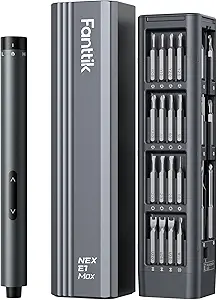
Fanttik E1 Max Electric Screwdriver, 53-in-1 Precision DIY Tool
The Fanttik E1 Max plays a different role than everything else here: it’s a precision instrument, not a driver. With 50 S2 steel bits in a magnetic case and torque as low as 0.05 Nm, this model makes sense for the fine end of woodworking — tightening brass hinges, adjusting jig set screws, swapping router collets, or repairing the tools themselves. Where the DEWALT and WORX are built for driving wood screws, the E1 Max handles hardware too delicate for a full-size driver. The aluminum alloy body and organized magnetic case feel more like a repair kit than a shop tool.
Just don’t ask it to drive a #10 screw into pine — the tiny 350mAh battery and 200 RPM motor aren’t designed for that.
Pros:- 0.05 Nm low-torque mode protects delicate brass hardware and small screws
- 50 S2 steel bits cover an unusually wide range of fastener types
- Magnetic case keeps bits organized and portable
- Type-C charging is fast and convenient
Cons:- 350mAh battery limits long sessions
- Not capable of driving standard wood screws
- Durability details are thin given the compact build
Best for: Woodworkers who also do fine hardware work — hinge adjustments, jig tuning, and tool/electronics repair
Not ideal for: Anyone whose main task is driving wood screws — the torque output is a fraction of the DEWALT’s
- Motor Speed:200 RPM
- Torque:0.2 Nm high / 0.05 Nm low / 3 Nm manual
- Battery Capacity:350mAh
- Charging Port:Type-C
- Bits Included:50 bits (12 types)
- Material:Aluminum alloy
Our verdict“A precision companion tool for the workbench, not a replacement for a general-purpose screwdriver.”
SKIL Twist 2.0 Rechargeable 4V Screwdriver with Pivoting Head
The pivoting head is the Twist 2.0’s whole argument: locking at 0°, 22.5°, and 45°, it reaches screws inside cabinets, under tabletops, and behind installed drawer slides where a straight tool like the WORX simply can’t angle in. For woodworking specifically, that geometry advantage shows up during carcass assembly and interior cabinet work. Three torque settings give it more control than the original SKIL Circuit Sensor model, and USB-C charging beats that tool’s older micro USB port. The LED light is genuinely useful inside dark cabinets.
The catch is the bare-bones kit — just two bits (PH2 and SL6) — so you’ll be supplementing accessories almost immediately, unlike with the WORX 30-piece package.
Pros:- Pivoting head with three locked angles reaches inside cabinets and under surfaces
- Three torque settings prevent overtightening in softwood
- USB-C charging is faster and more convenient than older micro USB
- Bright LED helps in dark interior work
Cons:- Only two included bits limits immediate usefulness
- 4V power restricts it to light-duty fastening
- No published weight, making long-session ergonomics hard to judge
Best for: Cabinetmakers and furniture assemblers constantly fighting screws in confined, angled spaces
Not ideal for: Anyone wanting a complete kit out of the box — two bits won’t cover varied woodworking fasteners
- Voltage:4V
- Battery Type:Rechargeable lithium-ion
- Charging Port:USB-C
- Pivoting Head Positions:0°, 22.5°, 45°
- Torque Settings:3
- Included Bits:2 (PH2, SL6)
- Model Number:SD5619-01
Our verdict“Buy it for the pivoting head if you work inside cabinets; skip it if you want a full accessory kit.”
SKIL Rechargeable 4V Cordless Screwdriver with Circuit Sensor Technology
This SKIL’s defining feature is patented circuit sensor technology that detects live wires before you drill or drive near them — a real concern when installing cabinets, shelving, or trim against walls hiding electrical runs. No other tool in this roundup offers anything comparable. It’s a sensible choice for the woodworker whose projects end at the wall: installing floating shelves, mounting trim, attaching face frames in a finished room. The dual LED light beats the single LEDs on most competitors here, and the 5-year warranty is the longest in this batch.
Against the DEWALT, it gives up torque control entirely and runs at a slower 230 RPM, and the 9-bit kit is thinner than the WORX’s 30 pieces.
Pros:- Circuit sensor detects live wires for safer wall-mounted work
- 5-year warranty is the longest coverage in this lineup
- Dual LED lights improve visibility in dim corners
- Simple operation suits casual and beginner users
Cons:- No adjustable torque — easy to overtighten or strip screws
- 230 RPM is slower than the DEWALT’s 360 RPM
- 9-bit kit is minimal for varied projects
Best for: DIYers mounting shelves, trim, or cabinets on finished walls who want live-wire protection
Not ideal for: Speed-focused users or anyone needing adjustable torque — the fixed output and slower RPM get frustrating fast
- Voltage:4V
- Speed:230 RPM
- Battery Type:Lithium-ion
- Charging Method:Micro USB
- Safety Feature:Circuit sensor live-wire detection
- Included Components:Screwdriver, 9-bit kit, magnetic bit holder, USB cable
- Warranty:5 years
Our verdict“Worth it for the live-wire safety feature if your woodworking involves finished walls; otherwise the DEWALT offers more control.”
Skil Rechargeable 4V Cordless Screwdriver
For a woodworker who just needs a cheap, grab-and-go driver for hinge screws and jigs, this Skil covers the basics without asking much in return. The two-finger trigger is genuinely comfortable during long assembly sessions, and the slim barrel reaches inside cabinet boxes where a full-size drill simply won’t fit. Compared with the SKIL Circuit Sensor version, you lose the electrical detection and the big bit kit, but you also pay noticeably less — a fair trade if you already own bits. Against the Amazon Basics stick driver, the Skil feels a touch more refined ergonomically, though the Basics model fights back with three torque settings and a higher top speed. The micro USB port is dated, and the 4V motor will stall on hardwood lag screws, so keep a real drill handy for heavy work.
Pros:- Very affordable entry point
- Two-finger trigger is comfortable for extended use
- Slim body fits inside cabinet boxes and tight joinery
- Charges from any USB port
Cons:- 4V power limits it to light-duty fastening
- Micro USB charging is outdated and slow
- Only 9 bits included, limiting out-of-box versatility
Best for: Hobbyist woodworkers who want an inexpensive second driver for light assembly work in tight cabinet interiors
Not ideal for: Anyone driving long or hardwood screws regularly — the 4V motor and limited torque will frustrate frame builders
- Voltage:4V
- Battery Type:Lithium-ion
- Trigger:Two-finger ergonomic design
- Charging:Micro USB
- Included Bits:9 bits, 1 bit holder
- Includes:USB charging cable
Our verdict“A sensible low-cost backup driver for light assembly, as long as your main drill handles the heavy screws.”
Fanttik S1 Pro Electric Screwdriver
This is the most premium-feeling tool in this price bracket, with an aluminum body that shrugs off shop wear in a way the plastic Skil and Amazon Basics drivers can’t match. The 8 N·m of torque is the strongest figure in this batch — enough to seat screws firmly in hardwood without camming out, which matters if you build furniture rather than just assemble it. The magnetic case holding 16 metal bits is a genuinely useful touch; bits stay put in a cluttered workshop instead of scattering like they do with the 46-bit generic set. The tradeoffs are real, though: 220 RPM is slow for repetitive tasks, and at 845 g it’s heavier than every plastic rival here, so pocketability suffers. Compared with the Fanttik E1 Max, the S1 Pro trades precision-bit breadth for raw torque — the right call for woodworking.
Pros:- 8 N·m torque is the strongest in this batch for hardwood work
- Aluminum body withstands workshop abuse
- Magnetic bit case keeps 16 bits organized
- 2000mAh battery with Type-C charging lasts through long sessions
Cons:- 220 RPM is slow for repetitive fastening
- 845 g weight limits portability
- Higher price than plastic rivals with similar voltage
Best for: Furniture builders who want a durable, high-torque electric screwdriver that can handle hardwood fastening with control
Not ideal for: Anyone wanting a pocketable driver for quick one-screw jobs — the weight and metal body make it overkill
- Voltage:3.7V
- Speed:220 rpm
- Torque:8 N·m
- Battery:2000mAh lithium-ion, 1 battery
- Charging:Type-C
- Chuck Size:0.25 inches
- Weight:845 g
- Body Material:Aluminum
Our verdict“The pick if build quality and torque matter more to you than pocketability and price.”
SKIL Rechargeable 4V Cordless Screwdriver with Circuit Sensor Technology and 45-Piece Bit Set
The headline here isn’t the driver — it’s the 45-piece bit set and carrying case, which makes this the most complete package for a woodworker who doesn’t yet own driver bits. The circuit sensor technology is aimed at electrical work, but it adds a layer of safety if you fasten near outlets or wired cabinets. Dual LED lights outshine the single front light on the generic 46-bit pivoting model, illuminating the screw line rather than just a general glow. Compared with the basic Skil 4V, you’re paying a modest premium for the kit and lighting, which is money well spent unless you already own bits. The weak point is shared across all 4V tools here: it’s a light-duty driver, and unspecified battery life means you may be recharging mid-project on longer builds.
Pros:- 45-piece bit set covers nearly every woodworking fastener type
- Carrying case keeps everything organized between projects
- Dual LED lights genuinely improve visibility in dark cabinets
- Circuit sensor adds safety near wiring
Cons:- 4V motor limits it to small projects
- Battery life is unspecified, risky for long sessions
- Micro-era USB charging without a fast charger
Best for: Newer woodworkers building out a first tool kit who want a driver plus a complete organized bit collection in one purchase
Not ideal for: Experienced makers with an existing bit collection — the premium buys redundancy, and the 4V power won’t grow with your skills
- Voltage:4V
- Battery Type:Lithium-ion
- Charging:USB
- Included Bits:45-piece bit set
- Features:Circuit sensor technology, dual LED lights
- Includes:Bit set, USB charging cable, carrying case
Our verdict“Buy it for the bit kit and lighting; skip it if you already own bits and need serious torque.”
Cordless Power Screwdriver Set with 46 Bits, Pivoting Handle, and LED Lights
The pivoting dual-position handle is the differentiator here, letting you flip from pistol grip to inline depending on whether you’re driving face-frame screws or reaching into a deep carcass. No other tool in this batch offers that flexibility — the SKIL Twist 2.0 pivots its head instead, which achieves something similar, but this generic set undercuts it on bit count with 46 included bits. The 3.6V battery is the weakest in the lineup, and 3.5 N·m of torque means pilot holes are mandatory in hardwood — the Fanttik S1 Pro doubles the torque if your budget stretches. Note that a charger isn’t included, only a Type-C cable, so factor that in if you don’t have a spare wall adapter. For light fastening in awkward positions, though, the handle design earns its place.
Pros:- Pivoting handle switches between pistol and inline grips
- 46 bits cover wood, plastic, and light-gauge metal
- Lightweight and easy to maneuver one-handed
- Front LED light aids screw alignment in dim interiors
Cons:- Lowest torque in this batch at 3.5 N·m
- No charger included, only a Type-C cable
- Not suitable for any high-torque application
Best for: Woodworkers frequently assembling inside cabinets or at odd angles who value grip flexibility over raw power
Not ideal for: Anyone driving into dense hardwoods without pre-drilling — 3.5 N·m will stall and strip screws
- Battery:3.6V / 1500mAh lithium
- Torque:3.5 N·m
- Included Bits:46
- Handle:Adjustable dual position
- Lighting:Front LED flashlight
- Charging:Type-C cable (charger not included)
Our verdict“Choose it for the adjustable handle and bit variety, not for power — pilot-hole discipline required.”
Amazon Basics 4V Cordless Stick Screwdriver with 10-Piece Bit Set
At 300 RPM with three torque settings, this Amazon Basics stick driver is the quickest of the 4V crowd — useful when you’re driving dozens of shallow screws during jig setup or box assembly. The torque settings give you more fastening control than the single-mode Skil 4V, letting you dial back for soft pine and avoid stripping. The slim stick format means it lives in an apron pocket comfortably, though the SKIL 45-piece kit embarrasses it on included accessories with just 10 bits. The 2000mAh battery matches the Fanttik S1 Pro’s capacity at a much lower price, which is respectable. One quirk worth flagging: the USB-C cable won’t work with USB-C to USB-C setups, so check your charger before it arrives. It’s a fast, simple tool with honest limitations.
Pros:- 300 RPM is the fastest speed among 4V rivals here
- Three torque settings prevent stripping in softer woods
- 2000mAh battery outlasts most budget competitors
- Slim stick design slips into a tool apron
Cons:- Only 10 bits included, the smallest kit in this batch
- USB-C cable incompatible with USB-C to USB-C chargers
- 22 inch-pounds of torque caps it at light fastening
Best for: Budget-conscious makers who do repetitive light fastening — jigs, shop helpers, and small boxes — and want adjustable torque cheaply
Not ideal for: Precision electronics work or heavy joinery — the bits are coarse and the voltage limits torque output
- Voltage:4V
- Battery:2000mAh Lithium-ion
- Speed:Up to 300 rpm
- Torque:Up to 22 inch-pounds
- Torque Settings:3
- Charging:USB-C cable
- Included Bits:10 pieces
- Lighting:LED light
Our verdict“The fastest cheap stick driver for light repetitive work, as long as you bring your own bits.”
Hi-Spec Small Electric Screwdriver, Mini Drill Set, Rechargeable 3.6V Cordless Screwdriver with 26 Driver Bits, Pink
At this price, the Hi-Spec mini screwdriver earns its place as the lowest-cost entry point in the lineup, and that’s exactly the role it plays. It won’t drive long screws into hardwood — the torque output is a fraction of what the SKIL Twist 2.0 or the HOTO kit deliver — but for installing cabinet hinges, drawer slides, and switch plates, the 180 rpm motor and included 26 bits cover the basics. Compared with the HOTO kit, you lose adjustable torque and S2 steel bits, which means more care needed to avoid stripping soft brass hardware. The single-speed operation is the real limitation: there’s no feathering the trigger for delicate work. This pick makes the most sense for someone testing whether an electric driver belongs in their shop before spending more.
Pros:- Extremely affordable entry into powered screwdriving
- 26 included bits cover common woodworking hardware sizes
- Featherweight at just over an ounce, easy for anyone to handle
- USB rechargeable with quick charge times
Cons:- Single-speed motor with no torque control risks stripping screws
- Torque output far below the 4V options in this roundup
- Screwdriving only — cannot drill pilot holes
Best for: Hobbyists and occasional DIYers who want a cheap electric driver for light hardware installs and furniture assembly
Not ideal for: Woodworkers driving into hardwoods or doing frequent shop work — the low torque and single speed will frustrate quickly
- Speed:180 rpm
- Voltage:3.6V
- Torque:3 N·mm
- Power Source:Rechargeable battery, USB charging
- Battery:1300 mAh (1)
- Chuck Size:0.25 inches
- Included Bits:26 driver bits
- Weight:1.12 ounces
Our verdict“A reasonable toe-in-the-water purchase for light-duty hardware work, but serious woodworkers will outgrow it fast.”
Mini Electric Screwdriver Set 140-in-1 Cordless
Where most tools in this roundup target driving screws, the 140-in-1 kit fills a different niche: maintaining the metal side of a woodworking shop. Between bit changes on a router, blade swaps, and tuning jigs and fences, a woodworker touches a lot of small fasteners, and this kit’s adjustable torque (up to 0.35 N·m) plus chrome vanadium steel bits handle that precision work better than the broader-but-shallower Hi-Spec set. The 200 rpm speed and 60-minute Type-C charge keep downtime minimal. Compared with the Fanttik E1 Max, this kit goes wider on included tools but isn’t aimed at driving cabinet screws — the torque ceiling rules out anything beyond light assembly. The sheer bit variety is the selling point here, not raw driving power.
Pros:- 140-piece kit covers virtually every small fastener type in a shop
- Adjustable torque and speed protect delicate machine screws
- Chrome vanadium steel bits are more durable than typical budget kits
- Fast 60-minute Type-C charging
Cons:- Torque limited to light and medium repair tasks
- Battery capacity requires recharging during long work sessions
- Overkill if you only need a handful of common driving bits
Best for: Woodworkers who frequently adjust jigs, machinery, and hardware fasteners and want one organized kit for precision maintenance
Not ideal for: Anyone whose main need is driving construction or cabinet screws — the torque output is tuned for small fasteners only
- Speed:200 rpm
- Voltage:5V
- Torque:0.35 N·m (adjustable)
- Power Source:Rechargeable lithium-ion battery
- Bit Material:Chrome vanadium steel
- Charging:Type-C, 60-minute full charge
- Weight:1.6 pounds
- Included Pieces:140-in-1 bits and tools
Our verdict“Buy this for the maintenance bench, not the assembly table — it’s a precision kit that happens to include a driver.”
SKIL Twist 2.0 Rechargeable 4V Screwdriver with Pivoting Head, Torque Settings, USB-C Charging, 28-Piece Bit Set & Case
The pivoting head is what separates the SKIL Twist 2.0 from every other 4V option here, including the DEWALT 4V and the standard SKIL Circuit Sensor model. Locking at 0°, 22.5°, and 45°, it lets you reach screws inside cabinets, under countertops, and behind face frames — spots where a straight stick driver simply can’t align. The three torque settings give it more driving finesse than the Hi-Spec, enough for softwood assembly and hardware mounting, though it still sits below a full drill/driver for hardwood work. The 28-piece bit set and carrying case round out a genuinely shop-ready package. The honest tradeoff: the 4V ceiling means it’s a specialist for awkward access, not a primary driver, and SKIL doesn’t publish battery runtime figures.
Pros:- Pivoting head with three lock positions reaches screws no straight driver can
- Three torque settings prevent overdriving hinges and soft wood
- USB-C charging matches modern shop cables
- 28-piece bit set and case included for a complete package
Cons:- 4V power ceiling limits dense or hardwood applications
- Battery runtime not specified by manufacturer
- No variable speed control for fine feathering
Best for: Woodworkers who regularly assemble cabinets or install hardware in cramped, awkward interior spaces
Not ideal for: Builders doing heavy construction driving or long sessions in thick hardwood — the 4V motor will bog down
- Voltage:4V
- Pivoting Head:Locks at 0°, 22.5°, and 45°
- Torque Settings:3 adjustable levels
- Battery:Integrated, rechargeable
- Charging:USB-C
- Included Bits:28-piece set
- Case:Carrying case included
- LED Light:Yes
Our verdict“The clear choice when access matters more than power — think inside-cabinet work — but keep a stronger driver for heavy stock.”
HOTO 25-Piece Upgraded Electric Screwdriver Kit, Cordless Screwdriver
Of the four kits in this batch, the HOTO 25-piece set is the most polished all-rounder for furniture and cabinet work. The S2 steel bits with magnetic quick-change chucks outclass the generic bits in the Hi-Spec set, holding up to repeated torque without rounding out, and the three-level adjustable torque gives it real versatility — light settings for brass hinges, higher settings for softwood assembly. The 1500mAh battery is the largest capacity among these picks, and the shadowless LED is genuinely useful when working inside a dark cabinet box, unlike the pinpoint lights on cheaper models. Compared with the SKIL Twist 2.0, you give up the pivoting head for better bits, longer runtime, and an extension rod. One annoyance: no charging cable in the box, despite the Type-C port.
Pros:- S2 steel bits with magnetic quick-change design resist wear and stripping
- 1500mAh battery offers the longest runtime in this batch
- Three torque levels span delicate hardware to softwood assembly
- Extension rod and magnetic case add real shop convenience
Cons:- Charging cable not included despite Type-C port
- Insufficient torque for heavy-duty fastening tasks
- Fixed straight body can’t match the SKIL Twist’s angled access
Best for: Furniture assemblers and cabinet installers who want a refined, organized kit with quality bits and all-day battery
Not ideal for: Heavy-duty framing or deck work — the torque ceiling is tuned for cabinetry-scale fasteners, not construction screws
- Included Bits:25 pieces, S2 steel
- Torque Settings:3 adjustable levels
- Battery Capacity:1500mAh
- Charging Port:Type-C
- LED Light:Yes, shadowless design
- Bit Retention:Magnetic quick-change
- Included Accessories:Extension rod, magnetic case
Our verdict“The best-balanced kit of this group for daily furniture and cabinet work, provided you already own a USB-C cable.”

How We Picked
I evaluated these 14 models through a woodworking-specific lens, which immediately changed the rankings compared to general screwdriver roundups. The criteria that mattered most were torque output and adjustability (can it drive into hardwood without stripping screws in softwood), speed control (variable triggers beat two-speed presets beat single-speed operation), build quality of the chuck and gearbox (metal components last through thousands of driving cycles), and included bit relevance (square, torx, and quality Phillips bits versus filler hex bits no woodworker uses). Ergonomics for prolonged bench work and charging convenience (USB-C versus proprietary cables) rounded out the scoring.
Ranking followed a simple logic: drivers that give woodworkers control under load ranked highest, pure convenience features ranked lower. That’s why models with adjustable torque and variable speed occupy the top spots while single-speed precision drivers — excellent for electronics — sit mid-pack despite strong build quality. Value was judged against woodworking usefulness, not bit count, which is why the 140-in-1 set ranks below smaller but better-curated kits.
Factors to Consider When Choosing Electric Screwdrivers For Woodworking
Choosing an electric screwdriver for woodworking involves different priorities than picking one for electronics repair or general household tasks. These are the factors that actually affect your work at the bench.Torque: Match It to Your Wood
Torque is the single most misunderstood spec in this category. A 4V driver producing around 4–5 Nm handles pine, plywood, and MDF comfortably, but dense hardwoods like maple, oak, and even birch plywood edge cases will stall cheaper motors or force you to finish by hand. The mistake most buyers make is assuming more torque is always better — an overpowered driver with no clutch will snap #6 and #8 screws clean off in dry hardwood, a lesson usually learned once. Look for adjustable torque settings or a responsive variable trigger rather than chasing peak numbers. If most of your work involves pocket-hole joinery, deck-style structural screws, or hardwood furniture, budget for a driver at the top of the torque range or accept that you’ll occasionally finish drives manually.
Speed Control and Clutch Behavior
Woodworking punishes drivers without speed control far more than electronics work does. Soft woods like cedar and pine compress under the screw head, and a single-speed driver will bury the head past flush or spin it out before your reflexes catch up. Variable triggers let you start slow, seat the screw, then power home the final quarter-turn — the rhythm most experienced woodworkers use. Clutch-style torque settings, like those on the SKIL Twist 2.0, automate this by clicking out at a preset torque, which is genuinely useful for repeated tasks like installing hinges or drawer slides where consistency matters. The tradeoff: clutches add bulk and another setting to fumble with mid-task. If your work is varied, prioritize the trigger; if it’s repetitive, prioritize the clutch.
Bit Quality Beats Bit Quantity
The bit count on the box is one of the worst indicators of a kit’s woodworking value. Massive multi-piece sets often pad their numbers with hex, security, and specialty bits you’ll never touch, while including only one or two square-drive bits — the profile used by most modern woodworking screws. Worse, cheap bits are made from soft steel that rounds off after a few dozen hardwood drives, at which point you’re camming out and damaging screw heads. Check whether a kit includes multiple square (Robertson) and torx bits in the sizes you actually use, and plan to buy a handful of quality replacement bits regardless of which set you choose. S2 tool steel bits from aftermarket makers cost a few dollars and outlast most included bits by a wide margin.
Form Factor: Where You Actually Work
Think honestly about the spaces your projects put you in. A straight stick-style driver works fine on an open bench, but assembling cabinets, installing drawer slides, or working inside a carcase demands an angled or pivoting head. Pivoting-head models like the SKIL Twist 2.0 convert from inline to pistol grip, which also reduces wrist fatigue during long assembly sessions — a bigger deal than most buyers expect. On the other hand, compact pen-style drivers reach tight spots but transfer more vibration to your hand and hold smaller batteries. Weight matters too: a driver you’ll grip for an hour of assembly should feel balanced, not front-heavy. If you build boxes and cabinets rather than small projects, ergonomics should rank above raw specs.
Battery and Charging Realities
Every driver in this class uses built-in lithium batteries, which means the battery is the component most likely to end the tool’s life — typically after two to four years of regular use. USB-C charging, now standard on better models, is the format to favor: cables are everywhere, and you won’t hunt for a proprietary charger years from now. Older micro-USB models are acceptable but increasingly annoying. Battery capacity between 1300–2000 mAh translates to a few hundred screws per charge in softwood, fewer in hardwood where the motor works harder. One common mistake is buying a spare driver instead of checking whether your existing one simply needs a mid-day top-up — most of these recharge fully in under an hour.
When to Skip Electric and Go Cordless Drill
An honest question worth asking before buying: do you need a dedicated electric screwdriver at all? If your woodworking involves driving fewer than a dozen screws per project, a quality manual driver offers better feel and zero maintenance. If you regularly drill pilot holes and drive structural screws, a compact 12V drill/driver does both jobs and has real power to spare. The sweet spot for these small electric screwdrivers is high-volume, light-duty driving: hinge installation, jig work, knock-down hardware, small boxes, and craft-scale projects. Many woodworkers end up owning both — the drill for heavy work and a 4V driver for finesse tasks. Buy the screwdriver first if finesse work dominates your bench time.
Frequently Asked Questions
Can a 4V electric screwdriver actually drive screws into hardwood?
Yes, but with real limits. A typical 4V driver produces 4–5 Nm of torque, which handles softwoods and plywood without complaint and manages #6 and smaller screws in hardwoods like maple or white oak — provided you drill a proper pilot hole. Skipping the pilot hole in dense stock is where these motors stall or the bit cams out, so your technique matters more than with a full-size drill. For hardwood-heavy work like furniture joinery with larger screws, the higher-torque Fanttik S1 Pro handles it more gracefully, or you finish the last few turns manually. Woodworkers who regularly drive #10 and larger structural screws should own a drill/driver instead of expecting any 4V model to keep up.
Is variable speed really worth paying extra for in woodworking?
For woodworking specifically, yes, and it’s arguably the most valuable upgrade in this entire category. Soft woods compress under screw heads, and a single-speed driver will bury heads past flush or spin out Phillips heads before you can react — especially in cedar, pine, and MDF. A variable trigger like DEWALT’s FLEXDRIVE lets you start slow, feel the screw seat, and then power home the last portion of the drive, which is how experienced woodworkers avoid both stripped heads and split boards. Clutch-based torque settings offer similar protection for repetitive tasks, though they’re less flexible for one-off drives. If you work with a mix of wood densities, variable speed earns its price premium quickly.
Why do woodworkers keep recommending square-drive bits when most kits include mostly Phillips?
Square-drive (Robertson) screws dominate modern woodworking because the bit locks into the recess and almost never cams out under torque, unlike Phillips heads which were literally designed to push out under high load. The problem is that most consumer screwdriver kits are built for household tasks and include only one or two square bits, if any. When comparing the kits in this roundup, I weighted square and torx bit inclusion heavily because that’s what you’ll actually install at the bench. A practical move regardless of which driver you buy: order a set of quality S2 steel square bits in #1 and #2 sizes for a few dollars. They’ll outlast the included bits many times over and eliminate most stripped-screw frustration.
Are the big multi-bit kits like the 140-in-1 a better value than smaller sets?
Usually not, once you count the bits you’ll actually use. Large kits pad their numbers with security bits, torx variants, and hex bits aimed at electronics and appliance repair — a woodworker might use 10 of those 140 pieces regularly. Smaller, curated kits like the DEWALT’s 12-piece or the HOTO 25-piece set tend to include better-quality bits in the profiles that matter, since the manufacturer isn’t spreading cost across a hundred filler pieces. The bigger kits also come with more clutter to carry and organize. Where large kits win is if you genuinely do mixed repair work alongside woodworking, or you’re stocking a household toolbox rather than a bench. For a dedicated woodworking kit, quality over quantity is the better bet.
How long do these built-in batteries last, and what happens when they die?
Expect two to four years of regular use before capacity degrades noticeably, and the battery is almost always the failure point since it can’t be replaced — that’s the real cost of these tools’ compact size and low price. Heat is the main battery killer, so avoid leaving the driver in a hot car or on a sunny windowsill, and try not to store it fully charged or fully drained for months at a time; around half charge is the healthiest resting state. Given the $20–60 price of most models, replacing the whole tool after a few years is the accepted reality, which is also why paying a big premium for a small driver rarely makes sense unless you’re getting real capability like the Fanttik S1 Pro’s torque. If you use your driver only occasionally, a manual screwdriver set may genuinely serve you better and last decades.
Conclusion
Mapping these picks to buyer types: for best overall, the DEWALT 4V with FLEXDRIVE Control gives woodworkers the variable-speed finesse that makes the difference between clean work and stripped screw heads. For best value, the SKIL Twist 2.0 delivers a pivoting head and adjustable torque at a price that leaves room in the budget for quality square-drive bits. The Fanttik S1 Pro takes best premium with the torque headroom to handle hardwood projects the 4V crowd struggles with. For beginners and casual DIYers, the WORX 4V with 30-piece kit or the Amazon Basics stick driver offer forgiving, inexpensive entry points that cover the basics. For tight-space and cabinet work, the SKIL Twist 2.0’s pivoting head and the generic pivoting-handle model reach where straight drivers can’t, while precision-focused buyers doing small craft or inlay work will prefer the Fanttik E1 Max. Whatever you choose, pair it with a handful of quality S2 steel bits — that small upgrade improves the driving experience more than any price jump between these drivers.