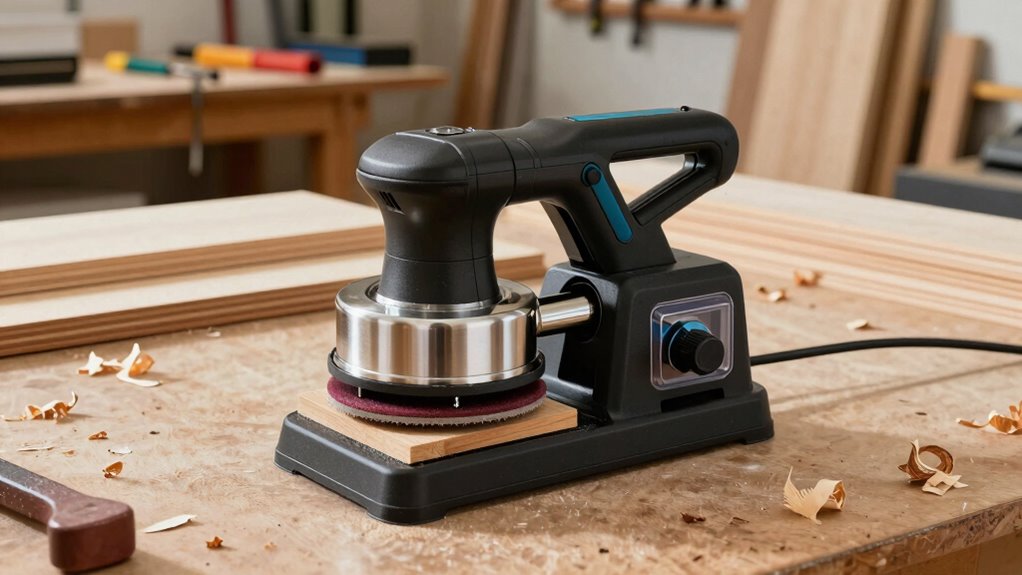

The best overall drum sander in this lineup is the JET JWDS-1632, which pairs a useful 16-inch capacity with a stand and SandSmart auto-feed control. For wider stock, the JET JWDS-2244 offers a 22-inch working width, while the JET JWDS-1020 is a more compact benchtop choice. The main tradeoff is straightforward: wider machines handle larger panels more easily, but take up more space and call for a bigger investment in shop capacity. Benchtop models save room, though their narrower working widths limit what can pass through in one setup. Read on for how these nine drum sanders compare and which one fits your work.

Get business pricing on tools and workshop supplies
- Business-only prices and quantity discounts
- Tax-exempt purchasing
- Multiple users, one account, clear invoices
Complete the kit


Key Takeaways
- The JET JWDS-1632 is the strongest all-around fit for many shops because it combines a 16-inch capacity, a dedicated stand, and SandSmart auto-feed control without moving up to a wide-format machine.
- Working width separates the lineup more than brand alone. The 10-inch benchtop models suit smaller stock, while the JET 25-inch and VEVOR 22-inch models are aimed at wider boards and panels.
- JET offers the broadest range of shop formats, from the compact JWDS-1020 to the wide JWDS-2550, plus an oscillating 16-inch option for buyers seeking a different sanding action.
- VEVOR’s 16-inch and 22-inch machines include stands and extension tables, making them appealing when a larger-format setup matters, though buyers should compare their requirements for capacity and controls against the JET alternatives.
- The JWDS-1632OSC is a specialized choice, not a direct substitute for every standard drum sander. Its oscillating action makes it distinct, while the standard JWDS-1632 is the more straightforward general-purpose pick.
| VEVOR 16-Inch Drum Sander with Stand and Extension Tables |  | Best Value for Wide-Board Shop Work | Sanding width: Up to 16 inches | Board thickness: 1/32–3 inches | Motor power: 1.5 HP | VIEW ON AMAZON | See Our Full Breakdown |
| JET JWDS-1020 10-Inch Benchtop Drum Sander, 1 HP, 115V |  | Best Benchtop Pick for Smaller Shops | Motor power: 1 HP | Voltage: 115 V | Maximum board thickness: 3 in | VIEW ON AMAZON | See Our Full Breakdown |
| VEVOR 22-Inch Drum Sander with Stand and Extension Tables |  | Best for Thick, Wide Stock | Maximum board width: 22 in | Board thickness capacity: 1/32–4 in | Motor power: 1.75 HP | VIEW ON AMAZON | See Our Full Breakdown |
| JET JWDS-1836 18-Inch Drum Sander with Open Stand |  | Best for Controlled, Repeatable Sanding | Sanding width: 18 in | Motor power: 1-3/4 HP | Voltage: 115 V | VIEW ON AMAZON | See Our Full Breakdown |
| JET JWDS-2550 25-Inch Drum Sander with Open Stand |  | Best for the Widest One-Pass Capacity | Sanding width: 25 in | Motor power: 1-3/4 HP | Voltage: 115 V | VIEW ON AMAZON | See Our Full Breakdown |
| JET JWDS-2244 22-Inch Drum Sander with Open Stand, 1-3/4 HP, 115V |  | Best for Wide Panels | Sanding width: 22 inches | Motor power: 1-3/4 HP | Voltage: 115V | VIEW ON AMAZON | See Our Full Breakdown |
| VEVOR 10-Inch Benchtop Drum Sander, 1 HP, Dual Motor |  | Best for Compact-Capacity Projects | Sanding width: Up to 10 inches | Workpiece thickness: 1/32–3 inches | Motor power: 1 HP | VIEW ON AMAZON | See Our Full Breakdown |
| JET JWDS-1632OSC 16-Inch Oscillating Drum Sander, 1.5 HP, 115V |  | Best for Reducing Scratch Patterns | Drum type: Oscillating | Drum width: 16 inches | Horsepower: 1.5 HP | VIEW ON AMAZON | See Our Full Breakdown |
| JET JWDS-1632 16-Inch Drum Sander with Stand and SandSmart Auto-Feed Control |  | Best for Two-Pass Panel Capacity | Motor power: 1.5 HP | Voltage: 115 V | Amperage: 14 A | VIEW ON AMAZON | See Our Full Breakdown |
| drum sander | Voltage | Weight | Motor power | Maximum rotational speed |
|---|---|---|---|---|
| VEVOR 16-Inch Drum Sander with | 110 V | 193.4 lb | 1.5 HP | 1720 rpm |
| JET JWDS-1020 10-Inch Benchtop | 115 V | 73 lb | 1 HP | 1720 rpm |
| VEVOR 22-Inch Drum Sander with | 110 V | 230.2 lb | 1.75 HP | 1440 rpm |
| JET JWDS-1836 18-Inch Drum San | 115 V | 164 lb | 1-3/4 HP | 1725 rpm |
| JET JWDS-2550 25-Inch Drum San | 115 V | 234 lb | 1-3/4 HP | 1725 rpm |
| JET JWDS-2244 22-Inch Drum San | 115V | 177 pounds | 1-3/4 HP | 1725 rpm |
| VEVOR 10-Inch Benchtop Drum Sa | 110 V | 130.2 pounds | 1 HP | — |
| JET JWDS-1632OSC 16-Inch Oscil | 115 V | 227 pounds | — | — |
| JET JWDS-1632 16-Inch Drum San | 115 V | 156 pounds | 1.5 HP | — |
More Details on Our Top Picks
VEVOR 16-Inch Drum Sander with Stand and Extension Tables
The VEVOR MS3140 is a practical choice for woodworkers who need more capacity than a benchtop machine without stepping up to a 22-inch footprint. Its 16-inch sanding width, variable conveyor speed, and extension tables support wider panels and longer stock, while the 4-inch dust port gives a shop collector a clear connection point. Compared with the JET JWDS-1836, it offers less sanding width and lacks a stated load-monitoring system, but its board-thickness range reaches 3 inches and its included wheels help with repositioning. The tradeoff is substantial: at 193.4 pounds, it is not a machine to move casually, even with casters. I’d shortlist it for a workshop that needs stand-mounted capacity and adjustable feed without requiring the broadest pass width.
Pros:- Variable conveyor speed lets the operator adapt feed to different stock and sanding needs.
- Extension tables support long workpieces as they enter and leave the drum.
- 4-inch dust port provides a standard connection for shop dust collection.
- Caster assembly makes a heavy stand-mounted machine easier to reposition.
Cons:- The 16-inch capacity is narrower than the VEVOR 22-Inch and JET 18-Inch models in this group.
- At 193.4 pounds, it is difficult to move without using its wheels.
- The listed 1.5 HP motor offers less power than the 1.75 HP JET JWDS-1836.
Best for: Small professional or serious hobby shops that regularly sand boards up to 16 inches wide and want extension tables and casters included.
Not ideal for: Woodworkers who need to sand panels wider than 16 inches in one pass or move the machine often; its 193.4-pound weight makes frequent repositioning a chore.
- Sanding width:Up to 16 inches
- Board thickness:1/32–3 inches
- Motor power:1.5 HP
- Maximum rotational speed:1720 rpm
- Voltage:110 V
- Dust collection port:4 inches
- Weight:193.4 lb
- Dimensions:42.9 × 40.7 × 45.3 in
Our verdict“Choose the VEVOR MS3140 if you want a stand-mounted 16-inch drum sander with adjustable feed and included support tables, but do not need the wider capacity of the larger machines.”
JET JWDS-1020 10-Inch Benchtop Drum Sander, 1 HP, 115V
The JET JWDS-1020 suits a shop that needs controlled drum sanding but cannot spare floor space for a stand-mounted machine. Its variable-speed feed gives the operator a way to slow the work for demanding stock, and the self-cooling aluminum drum helps limit heat buildup during sanding. The 4-inch dust hood and toolless abrasive fasteners also make routine setup and cleanup more manageable. Unlike the VEVOR 16-Inch MS3140, this is a compact benchtop model rather than a mobile floor machine; its 73-pound weight is easier to place on a sturdy bench, though not effortless to carry. The 20-inch maximum width requires two passes, so it is less convenient for broad panels. I’d choose it for smaller projects and limited shop space, not production sanding.
Pros:- Compact benchtop format takes less floor space than the stand-mounted options.
- Variable-speed feed offers control over how quickly stock passes beneath the drum.
- Self-cooling aluminum drum helps reduce heat buildup on the workpiece.
- Toolless abrasive fasteners simplify changing sanding strips.
Cons:- Reaching the 20-inch maximum width requires two passes, increasing handling and alignment work.
- At 73 pounds, it is heavy enough to make frequent lifting or bench changes awkward.
- Its 1 HP motor is less powerful than the 1.5 HP and 1.75 HP stand-mounted models listed here.
Best for: Hobby woodworkers with a sturdy bench and limited floor space who mainly sand narrower boards, small panels, and project parts.
Not ideal for: Shops that frequently process wide panels in a single pass or need a floor-standing machine ready for heavy, repetitive workloads.
- Motor power:1 HP
- Voltage:115 V
- Maximum board thickness:3 in
- Maximum sanding width:20 in with two passes
- Maximum rotational speed:1720 rpm
- Dust port diameter:4 in
- Weight:73 lb
- Dimensions:26.85 × 17.9 × 17.87 in
- Warranty:5 years; 2 years for commercial or industrial use
Our verdict“Pick the JWDS-1020 when compact benchtop use matters more than one-pass capacity for wide boards.”
VEVOR 22-Inch Drum Sander with Stand and Extension Tables
Among these five options, the VEVOR MS3156 stands out for pairing a 22-inch capacity with support for stock up to 4 inches thick. That combination suits woodworkers dealing with substantial boards who want variable conveyor speed and extension tables to help manage long pieces. Its 1.75 HP dual-motor arrangement separates sanding power from conveyor control, while the 4-inch port is ready to connect to dust collection. Compared with the VEVOR MS3140, it handles wider and thicker work, but takes up more room and weighs 230.2 pounds. The JET JWDS-2550 offers an even wider 25-inch sanding width, making this VEVOR a middle ground rather than the widest choice. I’d favor it when the 4-inch thickness range matters more than easy relocation.
Pros:- 22-inch sanding width accommodates broader stock than the VEVOR MS3140 and JET JWDS-1836.
- 4-inch maximum board thickness suits substantial lumber.
- Dual motors provide separate sanding and conveyor functions.
- Extension tables support long workpieces, while casters aid repositioning.
Cons:- At 230.2 pounds, it is the second-heaviest model in this five-product group.
- Its 22-inch capacity is narrower than the JET JWDS-2550’s 25-inch width.
- The large stand and extension tables require considerable shop space.
Best for: Woodworkers who routinely sand stock up to 22 inches wide and 4 inches thick, and have a dedicated area for a heavy floor-standing machine.
Not ideal for: Small workshops with tight floor space or buyers who need to move their sander frequently; its 230.2-pound weight and large footprint work against portability.
- Maximum board width:22 in
- Board thickness capacity:1/32–4 in
- Motor power:1.75 HP
- Maximum rotational speed:1440 rpm
- Voltage:110 V
- Dust collection port:4 in
- Weight:230.2 lb
- Dimensions:48.8 × 41.9 × 45.7 in
Our verdict“Choose the VEVOR MS3156 if you need 22-inch width and 4-inch-thick stock capacity, and can dedicate space to a heavy machine.”
JET JWDS-1836 18-Inch Drum Sander with Open Stand
The JET JWDS-1836 is a strong fit for shops that value feed control and setup refinement as much as sanding width. Its SandSmart load monitoring watches motor load to help prevent overloads, while the toolless parallelism adjustment makes conveyor alignment less of a chore. Variable feed speed adds control across different workpieces, and the shaped dust hood directs debris toward a 4-inch port. Compared with the VEVOR MS3140, this JET has a more powerful 1-3/4 HP motor and a monitoring system, but it weighs less at 164 pounds and sands up to 18 inches wide. The VEVOR 22-inch model is a better match for wider stock; this JET trades that capacity for a more setup-focused feature set. It still needs dust collection and a permanent home.
Pros:- SandSmart load monitoring helps prevent motor overload during sanding.
- Toolless conveyor-bed parallelism adjustment simplifies alignment.
- Variable-speed feed supports different stock and sanding demands.
- Open stand includes a storage shelf and has a smaller footprint than the JET JWDS-2550.
Cons:- Its 18-inch capacity is narrower than the VEVOR MS3156 and JET JWDS-2550.
- The 164-pound machine is not convenient to lift or relocate frequently.
- The 4-inch dust port requires a compatible dust-collection system.
Best for: Cabinetmakers and serious hobbyists who want an 18-inch sanding width, variable feed, and load monitoring for repeatable shop work.
Not ideal for: Buyers who need to sand panels wider than 18 inches in one pass or lack a dust collector and room for a floor-standing sander.
- Sanding width:18 in
- Motor power:1-3/4 HP
- Voltage:115 V
- Amperage:15 A
- Maximum rotational speed:1725 rpm
- Feed rate:Up to 10 ft/min
- Dust port diameter:4 in
- Weight:164 lb
- Dimensions:50 × 20 × 39.75 in
Our verdict“Choose the JWDS-1836 for an 18-inch floor-standing sander with load monitoring and easy alignment adjustments, rather than maximum width.”
JET JWDS-2550 25-Inch Drum Sander with Open Stand
The JET JWDS-2550 is the capacity pick here: its 25-inch sanding width gives it an advantage over the 22-inch VEVOR MS3156 when broad panels need to pass beneath the drum. SandSmart load monitoring helps guard against motor overload, and the tool-free conveyor parallelism adjustment reduces the friction of alignment work. The balanced aluminum drum and shaped dust hood address heat and debris management, while the open stand includes a shelf and pre-drilled caster holes. Those features come with a major space and handling cost: at 234 pounds, it is the heaviest of these five products, and its stand footprint is 24 × 50 inches. Compared with the JET JWDS-1836, it buys 7 inches of additional width but is substantially heavier. I’d reserve it for shops whose workload justifies that capacity.
Pros:- 25-inch sanding width is the broadest in this five-product group.
- SandSmart load monitoring helps protect the motor from overload.
- Tool-free conveyor-bed adjustment makes parallelism changes easier.
- Pre-drilled caster holes and a storage shelf add practical stand features.
Cons:- At 234 pounds, it is heavier than the other four listed models.
- Its 24 × 50-inch stand footprint takes substantial floor space.
- The 1-3/4 HP motor is the same rating as the narrower JET JWDS-1836 despite the wider sanding capacity.
Best for: Furniture and cabinet shops that regularly sand panels up to 25 inches wide and can leave a heavy sander installed in a dedicated work area.
Not ideal for: Small-shop owners, occasional users, or anyone who needs to relocate a sander often; its 234-pound weight and broad stand demand space and planning.
- Sanding width:25 in
- Motor power:1-3/4 HP
- Voltage:115 V
- Phase:1 phase
- Amperage:15 A
- Maximum rotational speed:1725 rpm
- Dust port:4 in
- Weight:234 lb
- Stand footprint:24 × 50 in
Our verdict“Pick the JWDS-2550 when 25-inch sanding capacity is worth the added weight and shop space required.”
JET JWDS-2244 22-Inch Drum Sander with Open Stand, 1-3/4 HP, 115V
The 22-inch sanding width makes this JET a practical step up when a 16-inch machine would force too many passes across wide panels. Its 1-3/4 HP motor and variable-speed conveyor suit varied stock and project sizes, while Sandsmart monitors motor load to help reduce overloads during demanding passes. Compared with the JET JWDS-1632, it covers more width in one pass, but its 177-pound weight takes more planning if your shop layout changes often. Tool-free bed-parallelism adjustment is useful for keeping setup manageable, and the integrated hood routes debris to a 4-inch port. That port still needs a compatible dust collection system; this is not a self-contained dust solution. I’d choose it over a compact benchtop sander for wider work, provided I had the floor space and extraction to match.
Pros:- 22-inch sanding width reduces the number of passes on wide panels.
- Sandsmart load monitoring helps guard against motor overload.
- Variable-speed conveyor feed adapts to different sanding tasks.
- Tool-free bed adjustment and an integrated dust hood simplify setup.
Cons:- At 177 pounds, it is difficult to reposition without planning.
- The 4-inch dust port requires a compatible dust collection system.
Best for: Woodworkers who regularly sand panels wider than 16 inches and have a fixed shop space with 4-inch dust collection.
Not ideal for: Small-shop users who need to move or store their sander often, or anyone without a dust collector.
- Sanding width:22 inches
- Motor power:1-3/4 HP
- Voltage:115V
- Amperage:15 A
- Maximum rotational speed:1725 rpm
- Dust collection port:4 inches
- Weight:177 pounds
- Warranty:5 years; 2 years for commercial or industrial use
Our verdict“Choose this JET over the narrower JWDS-1632 when wide panels are routine and your shop can accommodate its weight and dust collection needs.”
VEVOR 10-Inch Benchtop Drum Sander, 1 HP, Dual Motor
The VEVOR MS3126 offers a 10-inch sanding capacity in a smaller-format design, making it better suited to narrow boards and shop projects than the wider JET JWDS-2244. Its dual-motor system separates sanding from conveyor movement, and the variable-speed feed gives the operator control over how quickly stock passes through. The stated thickness range of 1/32 to 3 inches also gives it room for thin pieces that need careful handling. Despite its benchtop category, it weighs 130.2 pounds, so it is not an easy lift-on, lift-off tool; check your bench and placement plan before buying. The 4-inch dust port and included adapter support extraction, but a dust collector is still required. I’d pick it for a dedicated station handling narrower work, not as a substitute for a wide-panel machine.
Pros:- Accepts workpieces up to 10 inches wide and 3 inches thick.
- Dual motors separate sanding and conveyor functions.
- Variable-speed conveyor supports controlled feed.
- Includes a 4-inch dust port adapter.
Cons:- Its 130.2-pound weight makes frequent relocation impractical.
- A compatible dust collector is needed for dust extraction.
- Its 10-inch capacity is far narrower than the JET JWDS-2244.
Best for: Woodworkers with a sturdy, permanent bench who mainly sand boards up to 10 inches wide, including thin stock.
Not ideal for: Anyone who needs to sand wide panels or expects a lightweight benchtop machine that can be carried and stored easily.
- Sanding width:Up to 10 inches
- Workpiece thickness:1/32–3 inches
- Motor power:1 HP
- Motor configuration:Dual motor system
- Voltage:110 V
- Amperage:4 A
- Dust collection port:4 inches
- Weight:130.2 pounds
Our verdict“Choose the VEVOR for a fixed workstation focused on narrow stock, but select a wider floor model if panel capacity matters.”
JET JWDS-1632OSC 16-Inch Oscillating Drum Sander, 1.5 HP, 115V
The JWDS-1632OSC earns its place through its oscillating drum, which moves across the work as it sands and is designed to reduce visible scratch patterns. That makes it a more finish-focused choice than the non-oscillating JET JWDS-1632, which offers broader two-pass capacity for panels up to 32 inches but does not list drum oscillation. The OSC model pairs that motion with automatic feed control that adjusts conveyor speed based on motor load, helping manage changing sanding demands. Its 16-inch drum width suits many cabinet parts and moderate panels, though it does not match the 22-inch JWDS-2244 for one-pass width. At 227 pounds, it is also the heaviest of these four options, so placement should be treated as a long-term decision. Dust extraction requires a 4-inch collector connection.
Pros:- Oscillating drum is designed to minimize visible scratch patterns.
- Automatic feed control responds to motor load.
- Tool-free bed-parallelism adjustment eases setup.
- Dust hood directs debris toward a 4-inch collection port.
Cons:- At 227 pounds, it is difficult to move once installed.
- Requires a dust collection system connected to its 4-inch port.
- Its 16-inch width is narrower than the JET JWDS-2244.
Best for: Furniture and cabinet makers who prioritize a cleaner-looking sanding finish on work up to 16 inches wide.
Not ideal for: Buyers who need the widest one-pass capacity, frequently move equipment, or lack a suitable dust collection system.
- Drum type:Oscillating
- Drum width:16 inches
- Horsepower:1.5 HP
- Voltage:115 V
- Amperage:14 A
- Maximum conveyor speed:10 ft/min
- Dust collection port:4 inches
- Weight:227 pounds
- Warranty:5 years; 2 years for commercial or industrial use
Our verdict“Pick the JWDS-1632OSC over the standard JWDS-1632 when reducing visible sanding marks matters more than lower weight or wider two-pass capacity.”
JET JWDS-1632 16-Inch Drum Sander with Stand and SandSmart Auto-Feed Control
The JWDS-1632 balances a 16-inch one-pass width with the ability to sand panels up to 32 inches wide in two passes, giving it more reach than the VEVOR MS3126 without moving up to a 22-inch machine. Its SandSmart auto-feed control adjusts conveyor speed according to drum motor load, which helps regulate feed when sanding demands change. The included steel stand and 80-grit abrasive mean the core setup is supplied, while tool-free conveyor tracking and parallelism adjustments make alignment less involved. Unlike the oscillating JWDS-1632OSC, this model does not list an oscillating drum, so buyers focused on minimizing visible scratch patterns may prefer that version. Dust collection performance depends on the connected system, and optional casters and extension tables add setup choices rather than coming standard. It is a sensible middle ground for panel work if a two-pass process is acceptable.
Pros:- Handles workpieces up to 16 inches wide in one pass or 32 inches in two.
- SandSmart adjusts feed rate in response to sanding load.
- Includes an open steel stand and 80-grit abrasive.
- Tool-free conveyor tracking and bed-parallelism adjustments simplify alignment.
Cons:- Two-pass sanding takes more handling than the wider JET JWDS-2244.
- Dust collection performance depends on the connected collector.
- Casters and infeed/outfeed tables are sold separately.
Best for: Small-shop furniture makers who need to sand panels up to 32 inches wide in two passes and want a stand included.
Not ideal for: Woodworkers who need wide panels sanded in one pass, want an oscillating drum, or expect casters and extension tables in the package.
- Motor power:1.5 HP
- Voltage:115 V
- Amperage:14 A
- Recommended circuit:20 A
- Maximum feed rate:10 FPM
- Maximum workpiece width:16 inches in one pass; 32 inches in two passes
- Dust collection port:4 inches
- Weight:156 pounds
- Warranty:5 years
Our verdict“Choose the JWDS-1632 for adaptable panel capacity and an included stand, unless one-pass width or oscillating-drum finishing is your priority.”

How We Picked
I ranked these drum sanders by how well their capacity, feed setup, and footprint match real shop needs—not by width alone. I weighed usable sanding width against the space and handling demands of a larger machine, then looked at details that affect repeatability, including motor and feed specifications where provided, stands, extension tables, and SandSmart control. A wide sander can process broader stock, but it is not automatically the best choice for a small shop or mostly narrow parts.
The ranking favors versatile machines that offer a practical balance of capacity and usability, followed by models that excel for a more specific need, such as compact benchtop work, wider panels, or oscillating sanding. JET’s range includes more clearly differentiated sizes and control options, while VEVOR’s stand-equipped models offer wider-format alternatives. I treat missing or differing specifications cautiously and do not assume that similar widths mean equal performance; buyers should verify fit, available space, and required accessories before choosing.
Factors to Consider When Choosing Drum Sander
Picking a drum sander starts with the work you actually make, not the largest capacity on the spec sheet. These factors help connect machine size and setup to the results you need from a drum sander.
Match Working Width to Your Typical Stock
Start by measuring the widest boards and panels you expect to sand regularly, then choose a capacity that handles that work with a sensible margin. A 10-inch model may suit trim, narrower boards, and smaller furniture parts, but sanding wider pieces in multiple passes can leave uneven thickness or visible differences between passes. Wider machines reduce that constraint, yet they bring a larger footprint and may be unnecessary if most of your stock is narrow. Do not choose based on an occasional oversized panel alone; consider whether jointing, panel assembly, or another process can handle that rare job. Also check whether your work can be fed consistently through the machine at the width you need. Capacity should solve a recurring workflow problem, not just look impressive on paper.
Plan the Machine’s Footprint and Support
A drum sander needs more than a spot for its main body: allow room to feed long stock in and out, stand beside the machine, and reach controls. Benchtop models can work well in a compact shop, but the bench must be stable and positioned to support the workpiece. Stand-equipped machines reduce the need to design a separate base, while extension tables can help support stock near the infeed and outfeed. Those tables do not remove the need for clear floor space around long boards. Measure your shop with the longest parts you expect to run, and include room for dust collection and routine maintenance. A machine that fits on paper can still be awkward if you cannot handle material safely.
Understand Feed Control and Surface Consistency
Feed speed affects how quickly stock moves through the sander and how much control you have over a pass. Features such as SandSmart auto-feed control may help manage the feed when sanding demands rise, which can be useful for repeat work or less uniform material. A control feature does not replace shallow passes, careful stock preparation, or attention to the machine’s instructions. Avoid assuming that a more powerful motor alone guarantees a better finish; drum setup, abrasive condition, feed rate, and material all affect results. For occasional hobby use, a simpler feed arrangement may be enough if you are willing to work patiently. For repeated batches, prioritize predictable control and a setup you can reproduce.
Choose Standard or Oscillating Action for the Work
Most options here use a conventional drum-sanding approach, while the JET JWDS-1632OSC adds oscillation. That distinction matters because the sanding action can affect how the abrasive contacts the work and whether a specialized model suits your process. Do not pick oscillation simply because it sounds more advanced; first check that its format and capacity match the stock you handle. If you want a straightforward general-purpose machine, a standard drum sander is the simpler comparison point. Buyers with a particular finish or sanding concern should look for clear manufacturer guidance on what the oscillating action is designed to address. A specialized feature only pays off when it supports a task you regularly perform.
Account for Dust Collection and Abrasive Upkeep
Drum sanding creates fine dust, so plan for a suitable dust-collection connection and a collection system that fits your shop. Before buying, check the machine’s dust port details and compare them with your extractor or collector; do not assume an existing hose will connect without an adapter. Abrasive condition also shapes both finish quality and workload, since worn or loaded paper can cut poorly and encourage excessive pressure or extra passes. Find out how the abrasive attaches, what sizes or formats the machine needs, and how easily you can replace it. Keep the surrounding area accessible so cleaning and routine checks do not become a chore. Budget time and storage for abrasives alongside the machine itself.
Pay for Capacity You Will Use
Moving up to a wider sander makes sense when wider stock is a regular part of your work or repeated passes are slowing production. It is a weaker choice when the extra capacity rarely gets used, especially if the machine crowds out other essential shop tools. A compact benchtop model can be a sensible entry point for small projects, while a stand-equipped mid-size machine may provide a better balance for a growing workshop. Premium features such as advanced feed control or oscillation should earn their place by addressing a specific task, not by adding complexity without a clear benefit. Compare the full setup, including stand, tables, dust collection, and operating space. The right spend is the one that removes a recurring limit without creating a new shop bottleneck.
Frequently Asked Questions
Should I choose a 10-inch benchtop drum sander or a wider floor model?
Choose a 10-inch benchtop model if your stock is usually narrow, floor space is tight, and you can provide a stable bench with adequate infeed and outfeed support. A wider floor model is the better fit when broad boards or panels are a routine part of your work, since it can reduce the need for multiple passes. Multiple passes on wide stock can make consistent thickness harder to maintain. Do not base the decision only on occasional projects that exceed your normal workload. Measure your usual stock and available shop space before deciding which constraint matters more.
Is an oscillating drum sander a better choice than a standard drum sander?
Not automatically; the oscillating JET JWDS-1632OSC is a distinct option for buyers who want that sanding action, while a standard model is a more direct choice for general-purpose drum sanding. The useful choice depends on the work you do and the manufacturer’s guidance for the oscillating model. Compare capacity, setup, and controls as well as the sanding motion. If you do not have a specific reason to seek oscillation, a standard machine may be easier to match to your needs. Check the machine’s documentation before treating oscillation as a substitute for other sanding methods.
Do I need auto-feed control for a drum sander?
Auto-feed control is most appealing when you want help managing feed during changing sanding demands or when you repeat similar work. The JET JWDS-1632 includes SandSmart auto-feed control, which helps distinguish it from simpler options in this group. It is not a replacement for taking appropriate passes, keeping the abrasive in good condition, or following the operating instructions. For occasional small projects, a basic machine may be adequate if you are comfortable controlling the process yourself. For frequent use, compare the control features with your workflow rather than treating them as a guarantee of finish quality.
Will a drum sander replace a thickness planer?
A drum sander and a thickness planer serve different roles, so buyers should not assume one will replace the other for every task. A drum sander is useful for controlled sanding and refining surfaces, while a planer is commonly chosen for removing material and bringing stock to thickness more quickly. The better tool depends on how much material you need to remove and what surface result the job calls for. If you expect to dimension rough lumber, a drum sander may be slow for that workload. Consider the full sequence of milling and finishing steps before buying one tool as a substitute for another.
What should I check before ordering a stand-equipped drum sander?
Confirm the machine’s full footprint, the space needed for stock to travel through it, and whether the included stand and tables suit your shop layout. Check electrical requirements against the outlet you plan to use; the listed JET models include both 115V and other stated configurations, so verify the exact model details. Review dust-port compatibility, abrasive requirements, and any assembly or setup needs. A stand can simplify placement, but it does not guarantee that the machine will fit through doorways or work comfortably in a crowded shop. Measure access routes and operating space before arranging delivery.
Conclusion
For the broadest mix of useful capacity and control, I would choose the JET JWDS-1632 as the best overall. Buyers focused on a wider workpiece should compare the JET JWDS-2244 with the VEVOR 22-inch, while the JET JWDS-2550 is the lineup’s widest listed option and makes the most sense for shops with regular large-panel work and room to spare. For a compact entry into drum sanding, the JET JWDS-1020 is my pick for beginners; the VEVOR 10-inch benchtop model is another compact alternative to compare. I would call the VEVOR 16-inch a value-oriented option for buyers who want a stand-equipped mid-size setup, but I would verify the specifications and support needs that matter to your shop before choosing. For a specialized sanding approach, consider the JET JWDS-1632OSC; for frequent repeat work, favor the standard JWDS-1632 with SandSmart control. Match the machine to your normal stock and available space, rather than paying for capacity you are unlikely to use.