Choosing the right portable solar generator kits requires balancing energy capacity against portability, a tradeoff that defines this entire category. My top recommendation is the Jackery Solar Generator 1000 v2 with 200W Solar Panel for its reliable LiFePO4 battery chemistry and fast charging speeds, making it ideal for serious campers. For those needing heavy-duty home backup, the BLUETTI Elite 200 V2 offers superior capacity and expandability, while the ZeroKor 100W serves as an excellent entry-level option for light digital device charging. Readers should continue reading to understand which kit fits their specific power demands, from weekend trips to extended off-grid stays.

Get business pricing on tools and workshop supplies
- Business-only prices and quantity discounts
- Tax-exempt purchasing
- Multiple users, one account, clear invoices
Complete the kit


Key Takeaways
- LiFePO4 battery chemistry has become the standard for long-term reliability, outlasting older lithium-ion models by hundreds of cycles.
- Solar panel wattage matters less than panel efficiency and portability; smaller, high-efficiency panels often charge faster in real-world conditions than bulky, low-efficiency ones.
- Weight is the primary limiting factor for portability, with kits under 20 lbs suitable for hiking and those over 30 lbs better suited for car camping.
- Charging speed varies drastically between AC and solar inputs, with many budget kits taking over 10 hours to fully charge via solar alone.
- Expandable capacity is a key differentiator in premium models, allowing users to add extra battery modules as their power needs grow.
| ZeroKor 100W Portable Power Station with 40W Foldable Solar Panel |  | Best Lightweight Starter Kit | Power station output: 100W | Solar panel: 40W monocrystalline; 22.8% conversion efficiency | AC outlets: 2; 100W maximum | VIEW ON AMAZON | See Our Full Breakdown |
| MARBERO 155Wh Portable Power Station with 30W Solar Panel |  | Best for Weather-Conscious Day Trips | Capacity: 155Wh (42,000mAh) | Solar panel: 30W; 23% conversion efficiency | Solar panel water resistance: IP65 | VIEW ON AMAZON | See Our Full Breakdown |
| ZeroKor 300W Portable Power Station with 40W Solar Panel |  | Best Budget-Class 300W Kit | Power station output: 300W | Battery capacity: 280Wh | Solar panel: 40W | VIEW ON AMAZON | See Our Full Breakdown |
| Jackery Explorer 300 Portable Power Station with 40W Solar Panel |  | Best for Long-Term Battery Cycling | Battery capacity: 292Wh | Peak output: 600W | Battery chemistry: LiFePO4 | VIEW ON AMAZON | See Our Full Breakdown |
| Jackery Solar Generator 1000 v2 with 200W Solar Panel |  | Best High-Capacity Kit | Battery capacity: 1,070Wh | Battery type: LFP | AC output: 1,500W | VIEW ON AMAZON | See Our Full Breakdown |
| Jackery HomePower 3600 Plus Portable Power Station with Two 200W Solar Panels |  | Best for Expandable Home Backup | Battery capacity: 3,584Wh | AC output: 3,600W | Expandable capacity: Up to 21kWh per unit; up to 43kWh with multiple units | VIEW ON AMAZON | See Our Full Breakdown |
| OUPES Mega 1 Solar Generator with 240W Solar Panel |  | Best Expandable Mid-Size Kit | Battery capacity: 1,024Wh | Battery chemistry: LiFePO4 | AC output: 2,000W | VIEW ON AMAZON | See Our Full Breakdown |
| MARBERO M823 Portable Power Station with 60W Foldable Solar Panel, 237Wh, 300W |  | Best Compact Camping Kit | Battery capacity: 237Wh / 64,000mAh | Peak output: 375W | Solar panel: 60W foldable | VIEW ON AMAZON | See Our Full Breakdown |
| UDPOWER S1200 1190Wh Solar Generator Kit with 120W Solar Panel |  | Best for Sensitive Electronics | Battery capacity: 1,190Wh | Battery type: LiFePO4 | Battery cycle life: 4,000+ cycles | VIEW ON AMAZON | See Our Full Breakdown |
| MARBERO M82 88Wh Portable Power Station with 21W Solar Panel |  | Best Ultralight Essentials Kit | Capacity: 88Wh | Solar panel output: 21W | Running wattage: 80W | VIEW ON AMAZON | See Our Full Breakdown |
| Jackery Solar Generator 1000 v2 with 100W Solar Panel |  | Best Balanced Kit | Battery capacity: 1,070Wh | Battery type: Lithium iron phosphate (LFP) | AC output: 1,500W | VIEW ON AMAZON | See Our Full Breakdown |
| ZeroKor 300W Portable Power Station with 60W Solar Panel | 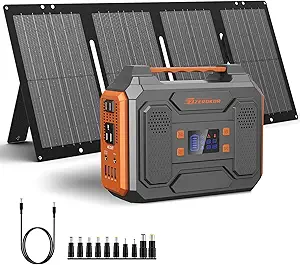 | Best Small-Device Starter Kit | Power station output: 300W | Solar panel output: 60W | Solar panel cell type: Monocrystalline | VIEW ON AMAZON | See Our Full Breakdown |
| ZeroKor 300W Portable Solar Power Station with 40W Foldable Solar Panel |  | Best Compact Budget-Style Kit | Battery capacity: 280Wh | Battery type: Lithium-ion | Maximum output: 300W | VIEW ON AMAZON | See Our Full Breakdown |
| BLUETTI Elite 200 V2 Solar Generator with Two 200W Solar Panels, 2073.6Wh |  | Best High-Capacity Kit | Battery capacity: 2,073.6Wh | Battery type: LiFePO4 | Solar panels included: 2 × 200W | VIEW ON AMAZON | See Our Full Breakdown |
| portable solar generator kit | Weight | Battery capacity | Solar panel | AC outlets |
|---|---|---|---|---|
| ZeroKor 100W Portable Power St | About 3.3 lb | — | 40W monocrystalline; 22.8% conversion efficiency | 2; 100W maximum |
| MARBERO 155Wh Portable Power S | 3.7 lb | — | 30W; 23% conversion efficiency | 2 × 100W |
| ZeroKor 300W Portable Power St | — | 280Wh | 40W | 2 × 110V; 300W maximum |
| Jackery Explorer 300 Portable | 12.9 lb | 292Wh | 40W | — |
| Jackery Solar Generator 1000 v | 23.8 lb | 1,070Wh | 200W | — |
| Jackery HomePower 3600 Plus Po | 77.2 lbs | 3,584Wh | — | — |
| OUPES Mega 1 Solar Generator w | 27.8 lbs | 1,024Wh | — | — |
| MARBERO M823 Portable Power St | — | 237Wh / 64,000mAh | 60W foldable | 2 pure sine wave |
| UDPOWER S1200 1190Wh Solar Gen | 25.8 lbs | 1,190Wh | 120W foldable, IP65 | — |
| MARBERO M82 88Wh Portable Powe | 2.3 lbs | — | — | — |
| Jackery Solar Generator 1000 v | 31.7 lbs | 1,070Wh | 100W | — |
| ZeroKor 300W Portable Power St | — | — | — | 2, 300W maximum |
| ZeroKor 300W Portable Solar Po | — | 280Wh | 40W foldable panel | 2 × 110V, 300W maximum |
| BLUETTI Elite 200 V2 Solar Gen | 53.4 lbs | 2,073.6Wh | — | 4 |
More Details on Our Top Picks
ZeroKor 100W Portable Power Station with 40W Foldable Solar Panel
The ZeroKor 100W is the smallest, lightest kit here, making it a practical choice when portability matters more than running household gear. At about 3.3 pounds, it is easier to pack than the MARBERO 155Wh kit, while its included 40W panel gives campers a way to top up small devices away from an outlet. Multiple output types cover phones, tablets, and cameras, but the 100W ceiling rules out most appliances and limits what its AC outlets can handle. The MARBERO offers stated battery capacity and an IP65-rated panel, while this ZeroKor listing emphasizes low weight and compact size. I’d choose it for light-duty charging, not extended backup: the panel junction box is not waterproof, and the unit needs periodic recharging during storage.
Pros:- At about 3.3 pounds, it is the lightest option in this group.
- Includes a 40W foldable monocrystalline solar panel.
- AC, DC, USB-A, QC USB, and USB-C outputs accommodate several small-device types.
- Battery protection features and an SOS flashlight add practical camp and emergency functions.
Cons:- The 100W maximum output excludes higher-draw appliances.
- The solar panel junction box is not waterproof.
- The unit requires regular recharging during storage.
Best for: Solo campers and travelers who want a very lightweight kit for phones, cameras, and other low-power electronics.
Not ideal for: Buyers who need to run appliances, depend on a clearly stated larger battery capacity, or leave the solar panel exposed to wet weather.
- Power station output:100W
- Solar panel:40W monocrystalline; 22.8% conversion efficiency
- AC outlets:2; 100W maximum
- Other outputs:DC, USB-A, QC USB, USB-C
- Charging methods:Wall outlet, car, or solar panel
- Weight:About 3.3 lb
- Dimensions:7.6 × 3.7 × 6.1 in
- Battery protection:Short-circuit, over-current, over-voltage, overload, and overheating protection
Our verdict“Choose this kit for compact, low-power device charging on trips where minimal weight matters more than battery capacity or appliance support.”
MARBERO 155Wh Portable Power Station with 30W Solar Panel
The MARBERO 155Wh kit is a sensible step up from the tiny ZeroKor 100W when you want a stated battery capacity and several devices connected at once. Its 155Wh capacity, two 100W AC outlets, USB-C, USB-A, and DC connections suit day trips and modest emergency charging, though the outlet rating still calls for low-draw equipment. The included panel is only 30W, so its listed 6–7-hour solar charging time makes replenishing the station a gradual process rather than a quick turnaround. Its IP65-rated panel is a useful distinction from the ZeroKor 100W kit, whose panel junction box is not waterproof; that rating applies to the panel, not the whole power station. The 3.7-pound weight remains manageable, but buyers prioritizing faster solar input should look at kits with larger panels.
Pros:- 155Wh capacity is specified, helping buyers gauge small-device backup needs.
- The included 30W solar panel is rated IP65.
- Multiple AC, USB, and DC outputs support charging several device types.
- Three flashlight modes include steady, SOS, and strobe.
Cons:- The 30W panel and listed 6–7-hour solar charge time make recharging slow.
- Each AC outlet is rated at 100W, limiting appliance choices.
- At 3.7 pounds, it is heavier than the ZeroKor 100W kit.
Best for: Campers and emergency-kit owners who want a compact station with stated capacity, varied ports, and a panel rated IP65.
Not ideal for: People who need to recharge quickly from solar or run appliances that draw more than 100W.
- Capacity:155Wh (42,000mAh)
- Solar panel:30W; 23% conversion efficiency
- Solar panel water resistance:IP65
- AC outlets:2 × 100W
- Ports:1 QC3.0 USB-A, 2 standard USB-A, 1 USB-C, 3 DC outputs, 1 car port
- Solar charging time:6–7 hours
- Weight:3.7 lb
- Dimensions:8.14 × 3.77 × 7.08 in
- Flashlight modes:Steady, SOS, and strobe
Our verdict“Pick the MARBERO for compact, low-draw backup and a panel with an IP65 rating, but skip it if quick solar replenishment is a priority.”
ZeroKor 300W Portable Power Station with 40W Solar Panel
Compared with the ZeroKor 100W, this 300W model supports a broader range of small electronics and low-draw gear, and its 280Wh capacity gives it more stored energy for a campsite or short outage. The 40W panel is included, along with a bag, so the kit is oriented toward portable trips rather than a fixed backup setup. Two 110V AC outlets join DC, USB, and QC3.0 outputs, while the reading and SOS flashlight adds a useful non-charging function. The tradeoff is that the panel remains modest beside the station’s capacity: solar replenishment will take patience, and devices above 300W may damage the unit. The Jackery Explorer 300 also offers 300W output, but this ZeroKor listing emphasizes its included 40W panel and 280Wh capacity; it is not a fit for high-wattage appliances.
Pros:- 300W maximum output is more versatile than the ZeroKor 100W for low-draw equipment.
- 280Wh capacity provides more stored energy than the MARBERO 155Wh kit.
- Includes a 40W solar panel kit and a bag.
- AC, DC, USB, and QC3.0 outputs cover a range of small devices.
Cons:- Appliances above 300W may damage the unit.
- The included 40W panel is modest for replenishing a 280Wh battery.
- The provided product data does not specify the station’s weight or dimensions.
Best for: Campers and road-trippers who want a 300W-class station with a stated 280Wh capacity and an included solar panel for small-device charging.
Not ideal for: Buyers who need to run high-draw appliances or want a faster solar recharge than a 40W panel can provide.
- Power station output:300W
- Battery capacity:280Wh
- Solar panel:40W
- AC outlets:2 × 110V; 300W maximum
- Other outputs:1 DC port, 3 USB ports, 1 QC3.0 USB port
- Runtime:7 hours
- Frequency:60Hz
- Included components:Power station, AC adapter, 12V car charging cable, cigarette lighter, user manual, 40W solar panel kit
Our verdict“Choose this ZeroKor when you want more capacity and output than entry-level kits offer, while keeping expectations to small devices and low-draw gear.”
Jackery Explorer 300 Portable Power Station with 40W Solar Panel
The Jackery Explorer 300 pairs a 292Wh battery with 300W rated output, landing in a similar power class to the ZeroKor 300W but with a stated LiFePO4 lifespan of over 4,000 cycles to 70% capacity. That chemistry makes it a stronger candidate for frequent use over the years, not just occasional camping. Its 100W USB-C PD port is especially useful for charging compatible devices directly, while two AC outlets, USB-A, and a car port round out the connections. The compromise is portability: at 12.9 pounds, it is much heavier than the roughly 3-pound kits, and the included 40W panel is listed as taking about 7.5 hours to reach 80% capacity. I’d favor it over the ZeroKor 300W for cycle-life credentials, but not for lighter packing or faster solar input.
Pros:- LiFePO4 battery is rated for over 4,000 cycles to 70% capacity.
- 292Wh capacity and 300W rated output suit many small electronics.
- 100W USB-C PD port can charge compatible devices directly.
- Integrated handle supports carrying the 12.9-pound station.
Cons:- Heavier than the ZeroKor 300W and other compact kits in this group.
- The included 40W panel takes about 7.5 hours to reach 80% capacity.
- The station and solar panel may ship separately.
Best for: Frequent campers and outage-prepared households who value a long-cycle-life battery and a 100W USB-C PD port.
Not ideal for: Ultralight backpackers or buyers who want quick solar charging from the included panel.
- Battery capacity:292Wh
- Peak output:600W
- Battery chemistry:LiFePO4
- Charge cycles:Over 4,000 to 70% capacity
- Solar panel:40W
- Ports:2 AC outlets, 1 USB-C PD port (100W), 2 USB-A ports, 1 car port (120W)
- Weight:12.9 lb
- Dimensions:15.43 × 9.92 × 11.89 in
Our verdict“Choose the Explorer 300 if repeated use and LiFePO4 cycle life matter more than low carry weight or fast solar charging.”
Jackery Solar Generator 1000 v2 with 200W Solar Panel
Among these five kits, the Jackery Solar Generator 1000 v2 is the clear choice for buyers who need to power more than personal electronics. Its 1,070Wh LFP battery, 1,500W AC output, and 3,000W surge capacity put it well ahead of the 300W ZeroKor and Explorer 300 for compatible appliances and longer backup sessions. The included 200W panel also gives it a stronger solar input starting point than their 40W panels, though actual charging depends on sunlight and conditions. Three AC outlets and two USB-C ports help serve several devices at once. The size and 23.8-pound weight make it less convenient for frequent carrying, and its one-hour charging claim depends on enabling emergency charging in the app. The panel and station may also arrive separately.
Pros:- 1,070Wh capacity provides far more stored energy than the other four kits here.
- 1,500W AC output and 3,000W surge capacity support a wider range of compatible loads.
- Includes a 200W solar panel, larger than the 30W and 40W panels in the smaller kits.
- LFP battery is rated to retain over 70% capacity after 4,000 cycles.
Cons:- At 23.8 pounds, it is much less convenient to carry than the compact kits.
- One-hour charging requires enabling emergency charging in the app.
- The solar panel and generator may ship separately.
Best for: Road-trippers and households seeking substantial portable backup for compatible appliances, multiple devices, and longer outages.
Not ideal for: Backpackers or buyers who need a lightweight kit, and anyone unwilling to use the app for emergency fast charging.
- Battery capacity:1,070Wh
- Battery type:LFP
- AC output:1,500W
- Surge capacity:3,000W
- Solar panel:200W
- Weight:23.8 lb
- Dimensions:12.87 × 8.82 × 9.72 in
- Charging time:1 hour with emergency charging enabled; 1.7 hours by default
- Ports:3 AC, 2 USB-C, 1 USB-A, 1 DC car port
Our verdict“Choose the 1000 v2 when capacity and appliance support outweigh the extra carrying weight and app-dependent fast-charging setup.”
Jackery HomePower 3600 Plus Portable Power Station with Two 200W Solar Panels
The Jackery HomePower 3600 Plus is the lineup’s capacity leader for buyers who want a portable solar kit to cover more than phones and campsite lights. Its 3,584Wh battery and 3,600W AC output can handle larger loads than the OUPES Mega 1, while expansion to 21kWh per unit leaves room to build a more substantial backup setup. AC, solar, gas-generator, and hybrid charging give it more recharge paths than smaller kits, and the claimed two-hour hybrid charge is useful when an outage makes sunlight unreliable.
The tradeoff is portability: at 77.2 pounds, its wheels and telescopic handle help with rolling but do not make it easy to lift. The 240V output also requires parallel operation, and the station and panels may arrive separately. I’d choose it for expandable backup, not frequent carry-in camping.
Pros:- 3,584Wh capacity and 3,600W AC output support larger loads than the OUPES Mega 1.
- Expandable storage reaches 21kWh per unit, with further capacity possible using multiple units.
- AC, solar, gas-generator, and hybrid charging offer several ways to restore power.
- Wheels and a telescopic handle make moving the 77.2-pound unit easier across level ground.
Cons:- At 77.2 pounds, it is much less convenient to lift and transport than the smaller kits.
- 240V output requires parallel operation rather than coming from one unit alone.
- The station and solar panels may ship separately and arrive at different times.
Best for: Households seeking a high-capacity, expandable backup system for appliances and longer outages, with space to roll the unit into position.
Not ideal for: Campers who regularly lift their power station into a vehicle, or buyers who need 240V output from a single unit.
- Battery capacity:3,584Wh
- AC output:3,600W
- Expandable capacity:Up to 21kWh per unit; up to 43kWh with multiple units
- Battery type:LFP
- Charging options:AC, solar, gas generator, and hybrid AC+DC
- Hybrid charging time:2 hours (0–100%, stated)
- Weight:77.2 lbs
- Dimensions:19.3 × 15.2 × 12.2 in
- Warranty:5 years
Our verdict“Choose the HomePower 3600 Plus for expandable, high-output backup when capacity matters more than easy lifting.”
OUPES Mega 1 Solar Generator with 240W Solar Panel
The OUPES Mega 1 offers a useful middle ground: a 1,024Wh LiFePO4 battery, 2,000W AC output, and an included 240W panel give it a broader job range than small emergency kits without the bulk of the Jackery HomePower 3600 Plus. It can also expand to 5,120Wh with an additional B2 battery, making it a better fit for buyers who want to add storage later rather than start with a heavy, high-capacity system.
Its 20ms UPS switch and Wi-Fi/Bluetooth monitoring add practical backup and status-checking features, while simultaneous AC and solar input can raise charging speed to 2,200W. The solar panel’s stated five-to-eight-hour recharge window depends on sunlight, though, and full expansion requires buying another battery. At 27.8 pounds, it is manageable for some RV setups but still heavier than compact kits such as the MARBERO M823.
Pros:- Included 240W panel provides a stronger solar starting point than the UDPOWER S1200’s 120W panel.
- 2,000W AC output can run a wider range of appliances than compact power stations.
- Expandable to 5,120Wh with an additional B2 battery.
- 20ms UPS switching and app connectivity support monitoring and backup use.
Cons:- Solar recharge time is listed as five to eight hours and varies with sunlight.
- Reaching 5,120Wh requires an additional B2 battery.
- At 27.8 pounds, it is less convenient for carry-heavy trips than the MARBERO M823.
Best for: RV owners and outage-conscious buyers who want a panel-included kit with meaningful output and the option to add battery capacity later.
Not ideal for: Ultralight campers or buyers who need the full 5,120Wh capacity without purchasing an extra battery.
- Battery capacity:1,024Wh
- Battery chemistry:LiFePO4
- AC output:2,000W
- Included solar panel:240W monocrystalline
- Solar recharge time:5–8 hours, depending on sunlight
- Maximum charging speed:2,200W with simultaneous solar and AC input
- Expandable capacity:Up to 5,120Wh with B2 battery
- UPS switch time:20ms
- Weight:27.8 lbs
Our verdict“Pick the OUPES Mega 1 if you want a capable panel-included kit with a clear path to add storage later.”
MARBERO M823 Portable Power Station with 60W Foldable Solar Panel, 237Wh, 300W
The MARBERO M823 is a compact solar kit for small electronics and modest campsite needs, not a scaled-down home backup system. Its 237Wh capacity and 300W device limit make it more capable than the 88Wh MARBERO M82 for longer phone, light, or accessory use, while the included 60W foldable panel gives it a more substantial solar input than the M82’s 21W panel. Multiple USB formats, DC output, and two pure sine wave AC outlets also let it serve a mix of devices.
That versatility has a firm ceiling: the product warns that devices over 300W may damage the unit, so appliances and high-draw tools are out. Its lithium-ion battery is also far smaller than the LiFePO4 packs in the OUPES Mega 1 and UDPOWER S1200. I’d favor it for light, portable use, but skip it if overnight power or appliance backup is the goal.
Pros:- Includes a 60W foldable solar panel, larger than the MARBERO M82 kit’s 21W panel.
- Multiple USB, DC, and AC output types accommodate varied small devices.
- Two pure sine wave AC outlets offer an option for compatible low-wattage electronics.
- Built-in flashlight includes flashlight, strobe, and SOS modes.
Cons:- The 237Wh capacity is not suited to extended backup or high-energy loads.
- Devices over 300W may damage the unit, ruling out many appliances.
- Its lithium-ion battery lacks the stated cycle-life figures provided for the OUPES Mega 1 and UDPOWER S1200.
Best for: Campers and road-trippers who need a small, panel-included source for phones, lights, cameras, and other low-wattage devices.
Not ideal for: Buyers powering refrigerators, cooking appliances, power tools, or any device above the stated 300W limit.
- Battery capacity:237Wh / 64,000mAh
- Peak output:375W
- Solar panel:60W foldable
- Solar conversion rate:21.5–23.5%
- AC outlets:2 pure sine wave
- USB-C:1 port, 18W PD
- DC output:12–16.8V / 10A; 14A maximum
- Flashlight modes:Flashlight, strobe, and SOS
Our verdict“Choose the M823 for light camping power and a useful included panel, but not for appliance backup.”
UDPOWER S1200 1190Wh Solar Generator Kit with 120W Solar Panel
The UDPOWER S1200 suits buyers who value connection options and rapid backup switching in a mid-size kit. Its 1,190Wh LiFePO4 battery is slightly larger than the OUPES Mega 1’s 1,024Wh pack, and the stated 4,000-plus-cycle life gives it a clear longevity claim. Five AC outlets, two 100W USB-C ports, four USB-A ports, and DC connections make it easier to power several devices at once than the smaller MARBERO M823.
The sub-0.01-second UPS transfer is its standout detail for compatible critical electronics, but buyers should check device requirements rather than assume every system will be protected. Its 120W panel is half the OUPES kit’s stated panel wattage, so solar replenishment may be slower in similar conditions. The power station and panel also ship separately, and the panel has a shorter warranty than the station.
Pros:- 1,190Wh LiFePO4 battery is larger than the OUPES Mega 1’s 1,024Wh capacity.
- Sub-0.01-second UPS transfer is suited to compatible equipment needing rapid backup switching.
- A wide selection of AC, USB, and DC ports supports multiple connected devices.
- Foldable IP65-rated 120W solar panel is included.
Cons:- The included 120W panel has lower stated output than the OUPES Mega 1’s 240W panel.
- The power station and panel may ship separately.
- The solar panel warranty is one year, compared with five years for the power station.
Best for: Remote workers, RV users, and households seeking multiple device connections and fast UPS switching for compatible electronics.
Not ideal for: Buyers prioritizing faster solar input, a single-delivery kit, or equal-length warranties for the station and panel.
- Battery capacity:1,190Wh
- Battery type:LiFePO4
- Battery cycle life:4,000+ cycles
- AC output:1,200W
- Peak output:1,800W
- Solar panel:120W foldable, IP65
- UPS transfer time:<0.01 seconds
- Weight:25.8 lbs
- Warranty:5 years for power station; 1 year for solar panel
Our verdict“Pick the S1200 for its fast UPS transfer, LiFePO4 battery, and broad port selection, while accepting a smaller panel and split warranty.”
MARBERO M82 88Wh Portable Power Station with 21W Solar Panel
At 2.3 pounds, the MARBERO M82 is the easiest kit here to pack for a day trip, roadside emergency bag, or lightweight camping setup. Its 88Wh capacity, 80W running output, and 21W foldable panel are aimed at phones, small electronics, and other modest loads. That makes it a different proposition from the MARBERO M823: the M823 weighs more, but its 237Wh capacity and 60W panel offer substantially more room for charging and solar input.
The M82’s AC, DC, and USB connections plus built-in electrical protections add flexibility for its size. Still, the 80W running limit excludes many appliances, and the 21W panel will take patience to replenish the battery in usable sunlight. Its 120W surge rating does not change the lower running-wattage limit. I’d treat this as a lightweight device-charging kit, not a dependable source for extended off-grid power.
Pros:- At 2.3 pounds, it is much easier to carry than the MARBERO M823 or larger kits.
- Includes a 21W foldable solar panel and adapters for charging flexibility.
- AC, DC, and USB ports cover a range of small-device needs.
- Built-in protections cover overcharging, overloads, overvoltage, and short circuits.
Cons:- The 80W running output limits it to low-wattage devices.
- The 88Wh capacity offers little reserve for longer trips or extended backup.
- The included 21W panel has lower output than the M823’s 60W panel.
Best for: Minimalist campers and road-trippers who want a very light kit for phones and small electronics, with a panel for occasional recharging.
Not ideal for: Buyers who need to run appliances, charge several high-draw devices, or rely on rapid solar replenishment.
- Capacity:88Wh
- Solar panel output:21W
- Running wattage:80W
- Surge power:120W
- AC voltage:110V
- Total power outlets:8
- Weight:2.3 lbs
- Dimensions:6.5 × 3.2 × 4.6 in
Our verdict“Choose the M82 when low weight matters most and your power needs stay within its 80W running limit.”
Jackery Solar Generator 1000 v2 with 100W Solar Panel
The Jackery Solar Generator 1000 v2 balances useful capacity with a more manageable carry weight than the much larger BLUETTI Elite 200 V2. Its 1,070Wh LFP battery and 1,500W AC output can handle a wider range of camping appliances and backup needs than the 300W ZeroKor kits, while the included 100W panel gives you a starter path to solar recharging. The tradeoff is that the panel is modest for a battery this size, so replenishing it from sunlight can take time. At 31.7 lbs, it is portable for car camping but not an effortless backpacking choice. App controls add charging modes, though the fastest stated AC charge requires enabling emergency charging, and the station and panel ship separately.
Pros:- 1,070Wh LFP battery and 1,500W AC output cover more demanding uses than 300W-class kits
- Includes a 100W solar panel for renewable recharging
- App provides emergency, quiet, and energy-efficiency charging modes
- Rated for 4,000 charge cycles while retaining over 70% capacity
Cons:- The 100W panel is relatively small for replenishing a 1,070Wh battery
- One-hour AC charging requires emergency charging to be enabled in the app
- The power station and solar panel ship separately
Best for: Car campers and households seeking a mid-capacity kit that can run common appliances and recharge devices without the bulk of a 2,000Wh-class station.
Not ideal for: Backpackers who need a light carry, or off-grid users who want faster solar replenishment from the included panel.
- Battery capacity:1,070Wh
- Battery type:Lithium iron phosphate (LFP)
- AC output:1,500W
- Surge peak:3,000W
- Solar panel:100W
- Ports:3 AC, 2 USB-C, 1 USB-A, 1 DC car port
- Weight:31.7 lbs
- Charging time:1 hour with emergency charging enabled; defaults to 1.7 hours
Our verdict“Choose this Jackery for a capable, car-camping-friendly kit with meaningful appliance output, but look to the BLUETTI Elite 200 V2 for substantially more capacity and solar-panel wattage.”
ZeroKor 300W Portable Power Station with 60W Solar Panel
For a modest camping setup focused on phones, lights, and other low-wattage gear, this ZeroKor 300W kit includes a more substantial panel than the 40W panel paired with the ZeroKor R200. Its 60W monocrystalline panel also has USB outputs, giving buyers more ways to charge compatible devices directly. The station supports AC, car, and solar recharging, and its flashlight includes reading and SOS modes—practical extras for a compact kit. The firm limit is output: appliances drawing over 300W are outside its intended range, so this is not a smaller substitute for the Jackery 1000 v2. The panel’s junction box is not waterproof, and the battery needs periodic charging and discharging to avoid protection mode.
Pros:- Includes a foldable 60W monocrystalline solar panel
- Supports AC outlet, car, and solar recharging
- Multiple station ports and panel USB outputs offer flexible charging options
- Flashlight has reading and SOS modes, with several built-in electrical protections
Cons:- 300W maximum output rules out many higher-draw appliances
- Solar panel junction box is not waterproof
- Battery requires periodic charging and discharging to avoid protection mode
Best for: Campers and occasional outage planners who mainly need to recharge phones, tablets, lights, and other devices rated at 300W or less.
Not ideal for: Buyers who need to run kitchen appliances or other loads above 300W, or who will leave the solar panel exposed to wet weather.
- Power station output:300W
- Solar panel output:60W
- Solar panel cell type:Monocrystalline
- Solar panel conversion efficiency:20.5%
- AC outlets:2, 300W maximum
- USB ports:3, up to 5V/3A
- DC port:9V–12.6V, 10A maximum
- Recharging methods:AC outlet, solar panel, 12V car port
Our verdict“Pick this over the ZeroKor R200 if you want the stronger included panel for small devices, but choose the Jackery 1000 v2 if your kit needs to power appliances.”
ZeroKor 300W Portable Solar Power Station with 40W Foldable Solar Panel
The ZeroKor R200 keeps the kit simple: a 280Wh lithium-ion station, a foldable 40W panel, and AC, DC, and USB outputs for small electronics. Against the ZeroKor 300W kit with a 60W panel, this version offers less solar input, so it makes more sense for light, occasional charging than for trying to refill the station quickly off-grid. Its 300W ceiling is shared by both ZeroKor options, meaning neither is suited to higher-draw appliances; the R200’s smaller battery also leaves less stored energy for extended use. A built-in light with reading and SOS modes adds useful camp functionality. Choose it for basic device charging and a compact set of included accessories, not as a substitute for the higher-capacity Jackery 1000 v2.
Pros:- Includes a foldable 40W solar panel
- Provides AC, DC, USB, and QC 3.0 outputs
- Built-in flashlight offers reading and SOS modes
- Includes short-circuit, over-current, over-voltage, and overload protection
Cons:- 280Wh capacity limits how long it can supply power between recharges
- 40W panel offers less solar input than the 60W panel in the other ZeroKor 300W kit
- 300W maximum output excludes many appliances
Best for: Light-pack car campers and day-trip users who want a small station for phones, lights, and other low-power devices.
Not ideal for: People planning multi-day off-grid use, needing to run appliances over 300W, or wanting a panel with more solar input.
- Battery capacity:280Wh
- Battery type:Lithium-ion
- Maximum output:300W
- Solar panel:40W foldable panel
- AC outlets:2 × 110V, 300W maximum
- Other ports:1 DC port, 3 USB ports, 1 QC 3.0 USB port
- Frequency:60Hz
- Included components:Power station, AC adapter, 12V car charging cable, cigarette lighter, user manual, solar panel kit
Our verdict“Choose the R200 for basic device charging in a compact kit, while the 60W-panel ZeroKor is the stronger pick for buyers prioritizing solar input.”
BLUETTI Elite 200 V2 Solar Generator with Two 200W Solar Panels, 2073.6Wh
The BLUETTI Elite 200 V2 is the capacity leader in this group, pairing a 2,073.6Wh LiFePO4 battery with two 200W solar panels. That solar setup is a much stronger match for extended off-grid use than the single 100W panel included with the Jackery 1000 v2, while 2,600W continuous output supports a broader range of appliances than either ZeroKor 300W station. It can also support up to nine devices, making it a better fit for shared camp power or substantial home backup. Those gains come with a clear portability cost: at 53.4 lbs, it is heavy to move frequently. The panels ship separately, so the kit may not arrive as one ready-to-carry package. Its larger format suits vehicle-based trips better than walk-in campsites.
Pros:- 2,073.6Wh LiFePO4 battery provides the largest stated capacity in this batch
- Two included 200W solar panels offer more panel capacity than the other kits here
- 2,600W continuous output and 3,900W power lifting output handle higher-demand loads
- Rated for over 6,000 battery cycles and has a UPS transfer time of 15 ms or less
Cons:- Weighs 53.4 lbs, making frequent carrying difficult
- Solar panels ship separately
- Its size and capability may be excessive for buyers who only need to charge small devices
Best for: RV travelers and households seeking high-capacity backup, stronger appliance support, and substantial included solar generation.
Not ideal for: Backpackers, frequent solo movers, or anyone who needs a light, grab-and-go station; its 53.4 lb weight is a significant burden.
- Battery capacity:2,073.6Wh
- Battery type:LiFePO4
- Solar panels included:2 × 200W
- Continuous AC output:2,600W
- Power lifting output:3,900W
- AC outlets:4
- Maximum devices supported:9
- Weight:53.4 lbs
- Battery cycle life:Over 6,000 cycles
Our verdict“Choose the BLUETTI for vehicle-based trips or home backup where capacity and solar input matter more than easy lifting.”

How We Picked
I evaluated these portable solar generator kits based on four primary criteria: energy density, charging efficiency, build durability, and system scalability. Energy density determines how much power you can store relative to weight, a critical factor for anyone hauling gear. I prioritized models using Lithium Iron Phosphate (LiFePO4) batteries over older Lithium-ion NMC cells due to their superior cycle life and thermal stability, which directly impacts long-term value.
Charging efficiency was assessed by analyzing the maximum input wattage of the solar panels and the generator’s ability to handle simultaneous AC and solar charging. I also considered the practicality of the included panels, favoring foldable designs with integrated kickstands or stands that simplify setup in variable terrain. Finally, I ranked products based on the balance between initial cost and long-term utility, ensuring that budget options didn’t sacrifice essential safety features like battery management systems (BMS).
Factors to Consider When Choosing Portable Solar Generator Kits
Selecting a solar generator involves more than just comparing watt-hours. Here are the critical factors that distinguish a suitable kit from a costly mistake.
Battery Chemistry and Lifespan
Most modern kits now use Lithium Iron Phosphate (LiFePO4) cells, which offer 3,000+ charge cycles compared to 500-800 for standard Lithium-ion NMC. This means a LiFePO4 unit can last a decade of regular use, whereas an NMC unit might degrade significantly after just a few years. If you plan to use the kit weekly for camping or emergency prep, paying a premium for LiFePO4 is financially sound. However, if you only need power for rare emergencies, a cheaper NMC model might suffice, provided you store it correctly to prevent battery degradation. Always check the manufacturer’s stated cycle life before purchasing, as this metric is the true indicator of long-term durability.
The Portability vs. Capacity Tradeoff
There is a direct correlation between capacity and weight; you cannot have a high-capacity unit that is also light enough to carry comfortably on a hike. Kits under 15 lbs typically offer under 200Wh, enough for charging phones and cameras but not appliances. Units around 30-40 lbs often reach 1,000Wh, sufficient for running small fridges or CPAP machines overnight. For car camping, weight matters less, so prioritize capacity. For backpacking or festival use, prioritize weight and consider bringing smaller, lighter panels. Trying to compromise by buying a mid-weight unit often results in a device that is too heavy to carry easily and too small to run essential appliances.
Solar Panel Efficiency and Setup
Not all solar panels are created equal, even if they have the same rated wattage. Monocrystalline panels generally offer higher efficiency than polycrystalline ones, meaning they generate more power in lower light conditions. The physical design also matters: panels with integrated kickstands and durable, weather-resistant coatings save you from carrying extra accessories and worrying about rain. A 100W panel that is bulky and difficult to angle towards the sun will yield less energy than a 60W panel that is easy to position optimally. Look for panels with MC4 connectors and built-in MPPT controllers if the generator doesn’t have one, as this ensures the panel operates at its peak voltage.
Charging Speeds and Pass-Through Power
Pass-through charging allows you to use the generator while it is being charged by solar or AC power. Not all models support this, and those that do may limit the output wattage to protect the battery. If you need to run a continuous load like a CPAP machine or a small refrigerator, verify that the unit supports pass-through charging at your required wattage. Additionally, check the AC charging speed; some budget models take 8-10 hours to fully charge from a wall outlet, which is inconvenient if you need to top up quickly between uses. Fast-charging capabilities are a significant convenience factor that often justifies a higher price point.
Expandability and Future-Proofing
Some premium models allow you to connect additional battery modules to increase capacity. This feature is valuable if your power needs might grow over time, such as adding a larger appliance or extending your off-grid duration. However, expansion modules are often expensive and may require specific cables or adapters. If you are a beginner or have fixed power needs, this feature is unnecessary and adds complexity. Advanced users should check if the expansion modules maintain the same battery chemistry and voltage stability as the main unit. Without proper expandability, you might find yourself buying an entirely new system in two years because the original kit no longer meets your demands.
Frequently Asked Questions
Can I run a refrigerator with a portable solar generator kit?
Yes, but you need a kit with at least 500-1,000Wh of capacity and a pure sine wave inverter rated for at least 1,000W. Small kits like the ZeroKor 100W or MARBERO 155Wh cannot handle the startup surge of a refrigerator compressor. For reliable fridge operation, look for models like the Jackery 1000 v2 or BLUETTI Elite 200 V2, which have sufficient capacity to run a standard 12V fridge for 24-48 hours. Always check the specific power consumption of your appliance before buying, as older fridges may have higher surge watts than modern energy-efficient models.
How long does it take to charge a solar generator using only solar panels?
Charging time depends on the panel wattage, battery capacity, and sunlight intensity. A 1,000Wh generator with a 200W panel might take 6-8 hours of direct, full sun to charge fully. In cloudy conditions or during early morning/late evening, charging times can double or triple. Many users find that relying solely on solar is too slow for daily use, so they use AC charging to fill the battery before a trip and use solar to top it up during the day. Kits with high-efficiency MPPT controllers will charge faster than those with basic PWM controllers, so check the controller type if solar charging is your primary method.
Are portable solar generators safe to use indoors?
Yes, unlike gas generators, portable solar generators produce no carbon monoxide or fumes, making them safe for indoor use. However, you should still ensure the unit is placed on a hard, flat surface to prevent overheating and blockage of ventilation fans. Never cover the unit while it is charging or discharging, as the battery management system needs to dissipate heat. While safe, always follow the manufacturer’s guidelines regarding maximum ambient temperatures, as extreme heat can degrade the battery or trigger safety shut-offs. Keep the unit away from water sources to prevent electrical hazards, as most models are not waterproof.
What is the difference between a solar panel and a solar generator?
A solar panel is just the photovoltaic component that converts sunlight into electricity; it cannot store power or provide AC outlets. A solar generator is a complete system that includes a battery, an inverter, and usually a solar panel. The battery stores the energy generated by the panel, and the inverter converts the stored DC power into AC power for your devices. You cannot use a solar panel alone to power most household electronics because they require a stable AC current and a buffer for variable sunlight. Buying a kit ensures that the panel and generator are compatible and optimized for efficient charging.
Do I need a pure sine wave inverter in my solar generator?
Yes, for almost all modern electronics and appliances, a pure sine wave inverter is necessary. Modified sine wave inverters can cause buzzing in audio equipment, overheating in motors (like refrigerators and fans), and reduced efficiency in sensitive electronics like laptops and medical devices. Most reputable brands now include pure sine wave inverters as standard, but very cheap, older models may still use modified sine waves. If you plan to run anything with a motor or sensitive circuitry, avoid kits without pure sine wave output. This feature protects your expensive gear and ensures appliances run efficiently and quietly.
Conclusion
Choosing the right portable solar generator kits depends entirely on your specific power requirements and how you plan to transport the unit. For most users seeking a balance of power, reliability, and portability, the Jackery Solar Generator 1000 v2 is the best overall choice due to its robust LiFePO4 battery and fast charging capabilities. If you need heavy-duty home backup or off-grid living support, the BLUETTI Elite 200 V2 offers the capacity and expandability required for high-demand scenarios. For beginners or those on a tight budget, the ZeroKor 100W or MARBERO 155Wh provide sufficient power for charging phones, tablets, and laptops without the bulk or cost of larger systems. Consider the weight limits you can physically handle and the specific appliances you need to run, as these two factors will narrow down the best option for your lifestyle.