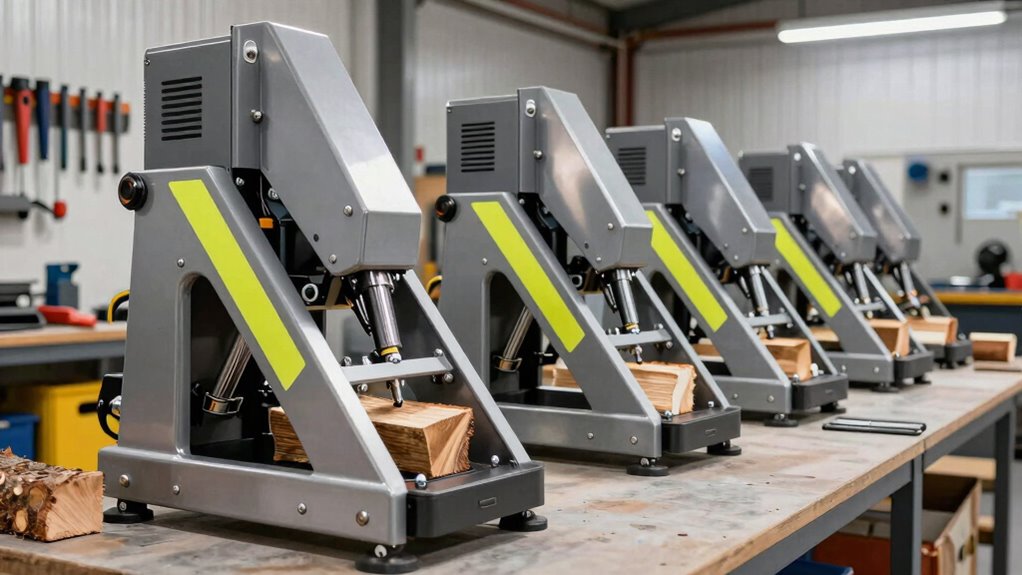

A wood splitter kindling machine is the fastest way to turn awkward logs into neat, burn-ready kindling without swinging an axe near your hands. After comparing 11 of the most popular options, the Kindling Cracker King XL earns my best overall pick for its oversized 9-inch opening and near-indestructible cast iron build, while the AMSXNOO Slide Hammer Splitter stands out as the best value for occasional users and the PowerSmart 6.5-Ton Electric Splitter is the clear choice if you process serious volume. The main tradeoff in this category is simple: manual splitters are cheap, quiet, and safe but demand physical effort, while electric hydraulic units chew through knotty hardwood with almost no labor but cost more and need a power outlet. Keep reading for the full breakdown of which machine fits your firewood routine.

Get business pricing on tools and workshop supplies
- Business-only prices and quantity discounts
- Tax-exempt purchasing
- Multiple users, one account, clear invoices
Complete the kit


Key Takeaways
- Manual slide-hammer and wall-mounted designs dominated the safety conversation: every model that keeps hands away from the blade edge ranked above basic free-standing units for households with kids or beginners.
- Cast iron construction was the single biggest durability differentiator — the Kindling Cracker King XL and the standalone Cast Iron Manual Splitter shrugged off sledgehammer abuse that would bend lighter steel-tube designs.
- Opening size determines what you can actually split: 3-inch models like the Speed Force only handle small billets, while 9-inch openings (King XL) accept full rounds, making them far more versatile for one-tool households.
- The PowerSmart 6.5-Ton electric splitter is the only true volume machine in the lineup — everyone else splits kindling one piece at a time, which is fine for a fireplace but painful for wood-stove households.
- Wall-mounted dual-handle models trade portability for stability and leverage, making them the smart pick for a fixed workshop wall but a poor match for anyone who splits at the woodpile or camps.
| AMSXNOO Manual Inertia Slide Hammer Wood Splitter – Kindling Splitter (Small) |  | Best for Portable Manual Splitting | Brand: AMSXNOO | Material: 45 manganese steel | Total length: 96 cm | VIEW ON AMAZON | See Our Full Breakdown |
| PowerSmart 6.5-Ton Electric Log Splitter |  | Best for Powered Home Firewood | Motor: 15 amps, 3450 rpm | Splitting force: 6.5 tons | Maximum log length: 20 inches | VIEW ON AMAZON | See Our Full Breakdown |
| Cast Iron Manual Kindling Splitter |  | Best Value in a Compact Hammer-Driven Design | Manufacturer: CANICCO | Model: XH-PCQV1 | Material: Cast iron | VIEW ON AMAZON | See Our Full Breakdown |
| Kindling Cracker Original Firewood Kindling Splitter – 6.5in Opening |  | Best for Safer, Controlled Kindling Splits | Brand: Kindling Cracker | Material: Cast iron | Opening diameter: 6.5 inches | VIEW ON AMAZON | See Our Full Breakdown |
| Kindling Cracker King XL Cast Iron Kindling Splitter, 9-Inch Opening |  | Best for Larger Logs in a Manual Safety-Ring Splitter | Material: Cast iron | Inside diameter: 9 inches | Height: 17 inches | VIEW ON AMAZON | See Our Full Breakdown |
| XCZNAGS Wall Mounted Wood Splitter – Dual-Handle Manual Kindling Splitter with 6-Tooth Clamping |  | Best for Adjustable Control | Material: High-carbon steel | Clamping system: Six-tooth; holds firewood up to 12 inches long | Handles: Replaceable short 5.9-inch and long 15.7-inch handles | VIEW ON AMAZON | See Our Full Breakdown |
| Wall-Mounted Manual Kindling Splitter |  | Best for Longer Softwood Pieces | Material: Carbon steel | Mounting: Wall-mounted | Operation: Manual lever | VIEW ON AMAZON | See Our Full Breakdown |
| Speed Force Firewood Kindling Log Splitter with Safety Cover, 3-Inch |  | Best Compact Stump-Mounted Pick | Material: Nodular cast iron | Finish: All-weather powder coating | Blade: Hand-ground | VIEW ON AMAZON | See Our Full Breakdown |
| Wall-Mounted Manual Wood Splitter with Dual Handles |  | Best for a Simple Fixed Setup | Type: Manual wood splitter | Mounting: Wall-mounted | Handles: Dual | VIEW ON AMAZON | See Our Full Breakdown |
| Cast Iron Kindling Splitter with 3 lb Sledge Hammer, Medium-Sized |  | Best Complete Hammer-Driven Set | Material: Cast iron | Splitter weight: 7.5 pounds | Height: 9.8 inches | VIEW ON AMAZON | See Our Full Breakdown |
| KABIN Kindle Quick Compact Manual Log Splitter |  | Best Portable Pick | Material: Cast steel with black all-weather coating | Tool weight: 5.5 pounds | Item weight: 6.03 pounds | VIEW ON AMAZON | See Our Full Breakdown |
| wood splitter kindling machine | Material | Weight | Dimensions | Mounting |
|---|---|---|---|---|
| AMSXNOO Manual Inertia Slide H | 45 manganese steel | 16 pounds | — | — |
| PowerSmart 6.5-Ton Electric Lo | — | 108 pounds | 37.4 x 10.6 x 18.1 inches | — |
| Cast Iron Manual Kindling Spli | Cast iron | 7.3 pounds | 6.1 x 9.8 x 8.3 inches | Base plate with 4 screws |
| Kindling Cracker Original Fire | Cast iron | — | — | Freestanding or bolt holes for permanent mounting |
| Kindling Cracker King XL Cast | Cast iron | — | — | — |
| XCZNAGS Wall Mounted Wood Spli | High-carbon steel | 9.08 pounds | 15.35 × 4.13 × 4.76 inches | — |
| Wall-Mounted Manual Kindling S | Carbon steel | 8.16 pounds | 22.83 × 16.14 × 4.72 inches | Wall-mounted |
| Speed Force Firewood Kindling | Nodular cast iron | 3.30 pounds | 3 × 2.5 × 7 inches | Four base holes; screws included |
| Wall-Mounted Manual Wood Split | — | — | 15.35 × 3.94 × 4.76 inches | Wall-mounted |
| Cast Iron Kindling Splitter wi | Cast iron | — | — | — |
| KABIN Kindle Quick Compact Man | Cast steel with black all-weather coating | — | — | Bolt holes in base for anchoring to stump or surface |
More Details on Our Top Picks
AMSXNOO Manual Inertia Slide Hammer Wood Splitter – Kindling Splitter (Small)
The AMSXNOO Small uses a gravity driven slide hammer, so splitting relies on repeated downward impacts rather than an axe swing. That can suit someone who wants a manual tool with a guided motion for routine backyard or campsite kindling. Its 45 manganese steel tip and rubber grips give it a more substantial build than a compact fixed wedge such as the Cast Iron Manual Kindling Splitter, which instead requires a separate hammer. The tradeoff is weight: at 16 pounds, this is not an especially light carry for camping, and manual impacts can bog down on knotty or oversized logs. Choose it for manageable wood and portability between nearby work areas; choose the PowerSmart 6.5-Ton Electric Log Splitter for a powered approach to larger home firewood batches.
Pros:- Slide hammer action avoids the full swinging motion of an axe.
- Hardened 45 manganese steel splitting tip.
- Rubber grips support a steadier hold.
- Manual operation suits outdoor locations without power.
Cons:- At 16 pounds, it may be cumbersome to carry.
- Manual impacts may struggle with large or knotty logs.
Best for: Campers and homeowners who want a manual, guided splitter for manageable kindling and can carry a 16-pound tool.
Not ideal for: People splitting large, knotty logs or seeking a lightweight tool for long-distance carrying.
- Brand:AMSXNOO
- Material:45 manganese steel
- Total length:96 cm
- Splitting tip length:16 cm
- Handle spacing:34 cm
- Weight:16 pounds
- Size:Small
Our verdict“Pick the AMSXNOO for guided manual splitting of ordinary kindling when portability matters more than low weight or powered capacity.”
PowerSmart 6.5-Ton Electric Log Splitter
For buyers whose kindling starts as a steady supply of home firewood, the PowerSmart 6.5-Ton brings hydraulic force that manual options in this group cannot match. It accepts logs up to 20 inches long and 10 inches in diameter, making it a more practical fit for routine processing than the Kindling Cracker Original, whose 6.5-inch opening limits log size. That capacity comes with a slower 20-second cycle and a 108-pound frame, so this is a stationary work-area tool, even with transport wheels. Its electric motor also ties use to a suitable power source. I’d choose it for light-duty household batches; for occasional small pieces and no need for powered splitting, the compact cast iron manual splitters are simpler to store.
Pros:- 6.5-ton hydraulic force handles more substantial logs than manual kindling splitters.
- Accepts logs up to 20 inches long and 10 inches in diameter.
- Transport wheels help reposition the 108-pound unit.
- Two-year warranty is specified.
Cons:- A 20-second cycle slows repeated splitting.
- At 108 pounds, it is not easy to carry or move over rough ground.
- Light-duty design may not suit high-volume or demanding work.
Best for: Homeowners with access to electricity who regularly split moderate-size logs for fireplace or stove kindling.
Not ideal for: Campers, buyers without a convenient power source, or anyone who needs rapid splitting of heavy daily volumes.
- Motor:15 amps, 3450 rpm
- Splitting force:6.5 tons
- Maximum log length:20 inches
- Maximum log diameter:10 inches
- Cycle time:20 seconds
- Dimensions:37.4 x 10.6 x 18.1 inches
- Weight:108 pounds
- Warranty:2 years
Our verdict“Choose the PowerSmart when powered capacity for regular home firewood matters more than speed, portability, or off-grid use.”
Cast Iron Manual Kindling Splitter
This CANICCO cast iron splitter is a compact fixed-blade option for buyers who already have a hammer and want a dedicated kindling station. At 7.3 pounds and under 10 inches in each listed dimension, it is easier to store than the PowerSmart 6.5-Ton Electric Log Splitter, while its open design accommodates varied log shapes without a narrow safety ring. The difference is in how it works: you position wood on the hand-ground blade and supply each strike yourself, whereas the AMSXNOO Manual Inertia Slide Hammer incorporates its own striking motion. Its base plate can be screwed down for a stable setup, but that means choosing a mounting spot, and the included safety cover does not remove the need for care around the exposed blade. The listing gives conflicting weight figures; the supplied specs say 7.3 pounds.
Pros:- Compact dimensions make storage straightforward.
- Cast iron body has a powder-coated finish.
- Base plate supports screw-down mounting.
- Open layout accepts different log shapes.
Cons:- Requires a separate hammer and repeated manual strikes.
- Exposed blade calls for careful placement and handling.
- Description gives conflicting weight figures.
Best for: Occasional fireplace and outdoor-cooking users who have a hammer and want a small splitter they can secure to a work surface.
Not ideal for: Buyers who want a hands-free striking mechanism, a contained safety-ring design, or verified weight information.
- Manufacturer:CANICCO
- Model:XH-PCQV1
- Material:Cast iron
- Weight:7.3 pounds
- Dimensions:6.1 x 9.8 x 8.3 inches
- Blade width:6.1 inches
- Mounting:Base plate with 4 screws
- Included accessory:Black safety cover
Our verdict“Choose this compact cast iron splitter if you already own a hammer and want a mountable kindling station for occasional use.”
Kindling Cracker Original Firewood Kindling Splitter – 6.5in Opening
The Kindling Cracker Original centers its appeal on a fixed wedge inside a 6.5-inch safety ring: the log goes inside, while hands stay above the striking area. Compared with the open-blade Cast Iron Manual Kindling Splitter, this layout offers more separation between hands and wedge during a strike. It also avoids the powered setup and footprint of the PowerSmart 6.5-Ton Electric Log Splitter, though a mallet or hammer is still required for every split. The ring sets a firm size limit, so this is for kindling pieces that fit rather than larger rounds. Its one-piece Australian cast iron construction has no joints or moving parts, but the heavy frame is less convenient to carry between campsites or storage areas. It makes most sense as a stable household or outdoor station for repeated small splits.
Pros:- Safety ring separates hands from the fixed wedge.
- One-piece cast iron construction has no moving parts or joints.
- Can stand freely or be bolted to a stump or workbench.
- Suitable for indoor and outdoor kindling preparation.
Cons:- Logs must fit within the 6.5-inch opening.
- Requires a separate mallet or hammer.
- Heavy cast iron is less convenient to transport.
Best for: Households that regularly make small kindling and want a fixed-wedge design that keeps hands away from the splitting point.
Not ideal for: People splitting logs wider than the 6.5-inch opening or needing a light, self-contained portable tool.
- Brand:Kindling Cracker
- Material:Cast iron
- Opening diameter:6.5 inches
- Included component:Funnel
- Construction:Single piece
- Origin:Australian made
- Mounting:Freestanding or bolt holes for permanent mounting
Our verdict“Pick the Original for a stable, hand-protecting setup when your logs fit its opening and you have a striking tool.”
Kindling Cracker King XL Cast Iron Kindling Splitter, 9-Inch Opening
The Kindling Cracker King XL takes the safety-ring approach of the Original and gives it a 9-inch opening and 17-inch height, making it the better match when rounds are too wide or long for the Original’s 6.5-inch ring. The larger frame can accept more substantial pieces for kindling, while the fixed wedge keeps hands away from the splitting point during strikes. It remains a manual tool: a mallet, hammer, or piece of wood must provide the impact. That makes it less suited to frequent heavy batches than the powered PowerSmart 6.5-Ton Electric Log Splitter, which handles specified log lengths and diameters with hydraulic force. Against the Original, the XL trades easier sizing for a larger cast iron frame that is less convenient to move and store. I’d choose it when ring clearance is the deciding factor.
Pros:- 9-inch inside diameter fits larger logs than the Kindling Cracker Original.
- 17-inch height accommodates longer pieces.
- Safety ring keeps hands away from the fixed wedge.
- One-piece cast iron frame has no welds, joints, or moving parts.
Cons:- Requires a separate striking tool or suitable piece of wood.
- Large cast iron frame may be heavy to move and store.
- Manual strikes are slower for repeated high-volume splitting.
Best for: Firewood users whose kindling logs exceed the Original’s 6.5-inch opening and who want a manual safety-ring splitter.
Not ideal for: Buyers who prioritize compact storage, easy carrying, or powered throughput for frequent large batches.
- Material:Cast iron
- Inside diameter:9 inches
- Height:17 inches
- Construction:Single piece; no welds, joints, or moving parts
- Minimum operating temperature:-94°F (-70°C)
- Splitting mechanism:Fixed wedge and safety ring
- Striking method:Mallet, hammer, or piece of wood
Our verdict“Choose the King XL when larger log clearance matters and manual, safety-ring splitting fits your pace.”
XCZNAGS Wall Mounted Wood Splitter – Dual-Handle Manual Kindling Splitter with 6-Tooth Clamping
The XCZNAGS wall-mounted splitter stands out for buyers who want to adjust how they apply force while making kindling. Its two replaceable handles offer a shorter option for control and a longer one for added leverage, while the six-tooth clamp holds wood up to 12 inches long. That gives it a more configurable setup than the single-lever Gardgoing Wall-Mounted Manual Kindling Splitter, which takes logs up to 13.8 inches. The tradeoff is a shorter stated log limit and a dry-softwood focus; the listing says it may struggle with hardwood. At 9.08 pounds, it can stay installed in a compact spot, but wall mounting makes it a poor choice for splitting in different locations. I’d choose it for controlled, stationary kindling work, not varied or heavy-duty firewood splitting.
Pros:- Two handle lengths let buyers choose between control and leverage
- Six-tooth clamp holds firewood up to 12 inches long
- Compact wall-mounted body keeps the tool in a fixed workspace
- Includes mounting screws and gloves
Cons:- Best suited to dry softwood and may struggle with hardwood
- Wall mounting limits use to one location
- Maximum stated log length is shorter than the Gardgoing model’s 13.8 inches
Best for: Homeowners who split dry softwood kindling in one fixed location and want a choice of handle length
Not ideal for: People who split hardwood, oversized logs, or need a portable splitter for campsites
- Material:High-carbon steel
- Clamping system:Six-tooth; holds firewood up to 12 inches long
- Handles:Replaceable short 5.9-inch and long 15.7-inch handles
- Blade adjustment:180 degrees
- Dimensions:15.35 × 4.13 × 4.76 inches
- Weight:9.08 pounds
- Included:Gloves and mounting screws
- Model:PC01
Our verdict“Choose this for a wall-mounted dry-softwood splitter when adjustable leverage matters more than portability or hardwood capacity.”
Wall-Mounted Manual Kindling Splitter
For dry-softwood kindling, the Gardgoing wall-mounted splitter has the longest stated log length among these two wall-mounted lever models: 13.8 inches, compared with 12 inches for the XCZNAGS. Its raised base helps steady a piece as the manual lever works, and a locking pin secures the mechanism when it is stored. The 180-degree rotation adds flexibility to the installation and working position, though the product data doesn’t give the adjustable handle choices listed for the XCZNAGS. This is still a niche tool: the maker advises against hardwood and oversized logs, and its larger dimensions call for planning a suitable mounting spot. I’d favor it when longer dry softwood is the priority; buyers wanting a compact body and two handle lengths should compare the XCZNAGS instead.
Pros:- Stated maximum log length of 13.8 inches
- Raised base helps keep logs stable during splitting
- Locking pin secures the splitter when not in use
- Manual lever works without electricity
Cons:- Not recommended for hardwood
- Cannot accommodate oversized thick logs
- Wall mounting and its 22.83 × 16.14-inch footprint require a planned workspace
Best for: Homeowners who regularly split dry softwood pieces up to 13.8 inches and have a suitable wall mounting location
Not ideal for: People who split hardwood or thick oversized logs, or want a splitter they can carry between locations
- Material:Carbon steel
- Mounting:Wall-mounted
- Operation:Manual lever
- Rotation:180 degrees
- Maximum log length:13.8 inches
- Recommended wood:Dry softwood
- Dimensions:22.83 × 16.14 × 4.72 inches
- Weight:8.16 pounds
Our verdict“Pick the Gardgoing for longer dry-softwood pieces and a fixed setup, but choose another tool for hardwood or portable use.”
Speed Force Firewood Kindling Log Splitter with Safety Cover, 3-Inch
The Speed Force 3-inch splitter is the most compact option here for someone who wants a simple splitting head anchored to a stump or other solid base. At 3.30 pounds, it is easier to move and store than the 7.5-pound BAYQISI cast iron splitter, though both require a secure mounting surface. Its nodular cast iron body, all-weather powder coating, hand-ground blade, and angled fins are intended to support straightforward kindling work and reduce jams. The included safety cover adds a practical storage feature. Unlike the wall-mounted XCZNAGS, this design does not give a stated log-length limit or clamping system, and the product data makes no claims about how it handles different wood types. I’d pick it for basic, anchored kindling preparation, while buyers who want a lever or defined log capacity should look elsewhere.
Pros:- Light 3.30-pound body is easier to store and reposition than the BAYQISI splitter
- Angled fins are designed to help reduce jams
- All-weather powder coating protects the cast iron finish
- Includes a safety cover and mounting screws
Cons:- Requires a stump or other stable anchor
- No stated performance guidance for different wood types
- No log capacity or dimensions for supported wood are provided
Best for: Campers and homeowners who want a light splitting head they can secure to a stump for basic kindling tasks
Not ideal for: Buyers who need a lever-operated splitter, stated log capacity, or documented suitability for hardwood
- Material:Nodular cast iron
- Finish:All-weather powder coating
- Blade:Hand-ground
- Dimensions:3 × 2.5 × 7 inches
- Weight:3.30 pounds
- Mounting:Four base holes; screws included
- Safety cover:Included
Our verdict“Choose the Speed Force for compact, anchored kindling work when you don’t need a lever or a stated log capacity.”
Wall-Mounted Manual Wood Splitter with Dual Handles
The YCNNU dual-handle splitter suits buyers who want a wall-mounted kindling tool with a straightforward listed feature set. Its dual handles and compact 15.35 × 3.94 × 4.76-inch body put it in the same general format as the XCZNAGS, but its product data does not specify handle lengths, a clamp, or a blade adjustment. That makes it harder to judge how much control or log stability it offers compared with the XCZNAGS’s six-tooth clamping system. At 8.6 pounds, it is a fixed manual tool, so the user supplies the effort and the installation determines where it can be used. I’d consider it for basic kindling work when the listed dual-handle setup is enough; buyers who want defined log capacity or safety features should favor products with those details stated.
Pros:- Wall-mounted design keeps the tool in a fixed workspace
- Dual handles provide a two-handle configuration
- Compact listed dimensions suit installations with limited space
Cons:- Manual operation requires physical effort
- Product details do not state maximum log size or wood type
- No clamping or blade adjustment details are provided
Best for: Homeowners looking for a compact, wall-mounted manual splitter for occasional kindling preparation
Not ideal for: Buyers who need stated log capacity, a documented clamping system, or portability between work areas
- Type:Manual wood splitter
- Mounting:Wall-mounted
- Handles:Dual
- Dimensions:15.35 × 3.94 × 4.76 inches
- Item weight:8.6 pounds
- Manufacturer:YCNNU
- Model:PC01
Our verdict“Consider the YCNNU for a basic fixed kindling station, but choose the XCZNAGS if you want specified clamping and handle options.”
Cast Iron Kindling Splitter with 3 lb Sledge Hammer, Medium-Sized
The BAYQISI cast iron splitter is the clearest choice in this group for buyers who want a dedicated hammer-driven setup: it includes a 3-pound sledge hammer, mounting screws, and a rubber blade sleeve. Its one-piece cast iron construction avoids welded joints, while the axe-shaped edge is intended to help split dry logs for fireplaces, campsites, and other fires. Compared with the lighter Speed Force, this is a heavier assembly at 10.36 pounds overall, so it is less convenient to move but comes with the hammer needed for its style of operation. The tradeoff is that it must be mounted securely and is specified for dry logs; the listing says it cannot split wet wood. I’d choose it over a wall-mounted lever model when a stump-mounted hammer setup fits the workspace.
Pros:- One-piece cast iron construction has no welded parts
- Includes a 3-pound sledge hammer and four mounting screws
- Rubber blade sleeve helps cover the cutting edge during storage
- Axe-shaped cutting edge is designed for splitting dry logs
Cons:- Specified for dry logs and cannot split wet wood
- Requires secure mounting to a stable surface
- 10.36-pound item weight makes it less convenient to carry than the Speed Force
Best for: Campers and homeowners who want a stump-mounted splitter with its own hammer for dry-log kindling
Not ideal for: People who need to split wet wood, avoid swinging a hammer, or move the tool frequently
- Material:Cast iron
- Splitter weight:7.5 pounds
- Height:9.8 inches
- Item weight:10.36 pounds
- Included hammer:3-pound sledge hammer
- Included accessories:Four installation screws
- Blade safety:Rubber blade sleeve
Our verdict“Choose the BAYQISI if you want a complete hammer-driven kit for dry logs and have a stable stump or base for mounting.”
KABIN Kindle Quick Compact Manual Log Splitter
Most kindling splitters in this roundup force a choice between stability and portability, but the KABIN Kindle Quick splits the difference better than anything else here. At roughly 6 pounds with built-in carrying handles, it travels to a campsite or cabin in a way the Kindling Cracker King XL — a far heavier cast iron unit — simply cannot. Compared with the wall-mounted options like the XCZNAGS Dual-Handle Splitter, this model needs no permanent installation; the bolt holes in the base let you anchor it to a stump when you need stability, then unbolt and go. The wide opening also takes thicker logs than smaller slide-hammer tools such as the AMSXNOO. The tradeoff is real, though: you supply all the force yourself, and without a solid anchor it can wobble mid-swing.
Pros:- Built-in handles and light weight make it genuinely portable
- Wide opening accepts thicker logs than compact slide-hammer splitters
- Angled teeth are designed to reduce jamming mid-split
- Bolt holes allow anchoring to a stump for a stable, semi-permanent setup
- All-weather coating stands up to outdoor storage and transport
Cons:- Entirely manual operation — every split depends on your swing and stamina
- Requires a stump or separate anchor for mounting, which isn’t included
Best for: Campers, cabin owners, and anyone who needs a kindling splitter they can move between locations rather than permanently install
Not ideal for: Buyers who want a set-it-and-forget-it workstation — without a stump or anchor to bolt it to, it lacks the stability of fixed wall-mounted splitters
- Material:Cast steel with black all-weather coating
- Tool weight:5.5 pounds
- Item weight:6.03 pounds
- Package dimensions:11.89 x 8.27 x 7.6 inches
- Mounting:Bolt holes in base for anchoring to stump or surface
- Portability:Built-in carrying handles
- Operation:Manual with mallet or hammer (not included)
Our verdict“This is the pick for anyone splitting kindling in more than one place, as long as they have something solid to bolt it down to and don’t mind supplying the muscle.”

How We Picked
I evaluated each wood splitter kindling machine against four buyer-relevant criteria. Safety design came first, because the entire point of these tools is replacing risky axe swings — models with blade guards, clamping teeth, or slide-hammer actions scored higher than open-blade rings. Splitting capacity was next: I compared opening diameter, accepted log length, and whether the tool handles dense hardwoods or only soft pine billets. Build quality followed, with cast iron weighted above welded steel tube since cracked welds are the most common failure mode in this category. Finally, I weighed usability and value — mounting requirements, physical effort per piece, and whether the price matches the workload it can realistically handle.
The ranking logic favors tools that do one job exceptionally well over do-everything compromises. Manual units are ordered by capacity and safety engineering, the lone electric model is placed where its power justifies its footprint, and budget picks are only included when their tradeoffs (smaller openings, lighter build) are ones a real buyer would accept. Every product here has meaningful drawbacks, and I state them plainly so you can match the weaknesses to your own situation rather than buying blind.
| wood splitter kindling machine | Mounting |
|---|---|
| AMSXNOO Manual Inertia Slide H | — |
| PowerSmart 6.5-Ton Electric Lo | — |
| Cast Iron Manual Kindling Spli | Base plate with 4 screws |
| Kindling Cracker Original Fire | Freestanding or bolt holes for permanent mounting |
| Kindling Cracker King XL Cast | — |
| XCZNAGS Wall Mounted Wood Spli | — |
| Wall-Mounted Manual Kindling S | Wall-mounted |
| Speed Force Firewood Kindling | Four base holes; screws included |
| Wall-Mounted Manual Wood Split | Wall-mounted |
| Cast Iron Kindling Splitter wi | — |
| KABIN Kindle Quick Compact Man | Bolt holes in base for anchoring to stump or surface |
Factors to Consider When Choosing Wood Splitter Kindling Machine
Before picking a specific model, it helps to understand what actually separates a satisfying kindling machine from one that gathers dust in the shed. These are the factors that shaped my rankings — and the mistakes I see buyers make most often.Manual vs. Electric: Match the Tool to Your Volume
The biggest decision is effort versus throughput. A manual splitter produces maybe 20–40 pieces of kindling per session before fatigue sets in — perfectly fine if you feed a fireplace a few evenings a week. But if you run a wood stove as primary heat and burn kindling daily through winter, a hydraulic unit like the PowerSmart pays for itself in saved time and shoulder strain. A common mistake is buying manual because it’s cheaper, then resenting the tool every cold morning. Be honest about how many fires you actually light per week before choosing. Households that light one to three fires weekly almost never justify an electric machine’s cost, storage footprint, and cord requirements.
Opening Size: The Spec Most Buyers Get Wrong
Manufacturer opening sizes — 3 inches, 6.5 inches, 9 inches — tell you the maximum log diameter, but buyers forget that knotty hardwood rounds often need to be halved first with a full-size splitter or maul. A 3-inch opening forces you into extra prep work; a 9-inch opening accepts most direct-from-the-pile rounds. My advice: measure the diameter of the logs you currently have stacked, then buy one size up. If your rounds routinely exceed 7 inches, no manual kindling machine alone will complete the job, and you’ll want either the King XL or a two-tool setup. Undersized openings are the number-one reason manual splitters get abandoned in garages.
Material and Construction Quality
Cast iron and mild steel behave very differently under repeated sledgehammer strikes. Cast iron models hold their edge geometry for years and can’t flex out of alignment, but they crack if dropped on frozen ground or struck wildly off-center. Welded steel designs are lighter and cheaper, but budget welds at the blade-to-base joint are the classic failure point after a season or two of hard use. Look for thick mounting plates, reinforced weld beads, and replaceable or re-sharpenable blades. Weight itself is a feature on free-standing units — a 15-pound base barely walks across the floor, while an 8-pound one needs a bolt-down or sandbag to stay put mid-swing.
Mounting and Stability Requirements
Wall-mounted dual-handle models and free-standing base models suit completely different workspaces. Wall mounts deliver excellent leverage and zero floor movement, but only if you can anchor into solid studs or masonry — drywall alone will not hold up under splitting forces. Free-standing splitters work anywhere, including at the woodpile or campsite, but the cheapest ones tip or slide unless screwed to a stump or platform. Think about where splitting will actually happen, not where it sounds convenient. If that location changes week to week, portability beats leverage every time, and a mounting plate becomes a liability rather than a feature.
Safety Features That Actually Matter
The core safety value of any kindling machine is hand-to-blade separation, but designs achieve it differently. Slide-hammer actions and safety covers physically block the strike zone; ring-style splitters rely on technique, keeping hands above the blade at all times. Households with teenagers helping with fire prep, or anyone with declining grip strength, should prioritize tools with guards or clamping teeth over bare rings. Also check whether the tool needs a separate sledgehammer — bundled sledges are usually lighter (3 lb range) and safer for novices than the 8 lb mauls seasoned splitters already own. The best safety feature is the one that matches the least experienced person who will use the tool.
Total Cost of Ownership Beyond the Sticker
Manual splitters look cheap until you add the sledgehammer, mounting hardware, and possibly a chopping block. Electric splitters look expensive until you subtract the axe-handle replacements, chiropractor visits, and hours of labor. Factor in maintenance too: hydraulic units need fluid checks and winter storage considerations, while cast iron models need nothing more than an occasional rust wipe-down and blade touch-up. A well-built manual splitter routinely lasts a decade or more, so a modest price difference up front spread over ten winters is trivial. The real cost question is whether the tool fits your workflow — an unused splitter at any price is the most expensive kind.
Frequently Asked Questions
Can a manual kindling splitter handle hardwoods like oak and hickory, or only softwoods?
Manual splitters handle hardwoods, but with real limits. Straight-grained oak and ash split cleanly through even a 6.5-inch ring splitter with a few solid sledge strikes, but twisted grain, knots, and rounds over about 6 inches will fight you and can stall a lighter tool entirely. Dense species like hickory and elm with interlocking grain are honestly better handled by a hydraulic unit like the PowerSmart 6.5-Ton. If your woodpile is mostly hardwood, favor the heaviest cast iron option you can mount securely — the King XL with its 9-inch opening and solid casting handles gnarly rounds far better than thin-wall steel designs. For softwood-dominant households, nearly any manual model will feel effortless.
Is a wall-mounted splitter or a free-standing splitter the better choice?
It depends entirely on where you split and how permanent that spot is. Wall-mounted dual-handle models give superior stability and let you use body weight instead of arm strength, which matters if you split several times a week — but they demand solid anchoring into studs or concrete, and they’re useless at the woodpile or a campsite. Free-standing models, especially heavy cast iron ones, work anywhere you can place a flat surface and can travel to the wood rather than hauling wood to them. Renters and anyone without a garage wall should rule out wall mounts immediately. If you have a dedicated workshop or basement wood corner, the wall mount’s leverage advantage wins.
What size sledgehammer should I use with a ring-style kindling splitter?
For most ring and blade-style manual splitters, a 3-to-4 pound sledge is the sweet spot — heavy enough to drive the wood through on contact, light enough to stay accurate strike after strike. Bundled options like the Cast Iron Kindling Splitter with 3 lb Sledge include exactly this weight for good reason. Going up to a 6 or 8 pound maul increases force but dramatically raises the risk of off-center strikes, which is how blades chip and bases crack. Longer handles (around 24 to 30 inches) give better swing mechanics than short-handled club hammers. Never use a splitting maul or axe on these tools; the geometry is wrong and glancing blows become dangerous.
Are electric log splitters like the PowerSmart overkill just for kindling?
For pure kindling duty on a small scale, yes — a manual splitter does that job for a fraction of the cost, noise, and storage space. The PowerSmart 6.5-Ton earns its place when kindling is only part of the workload: it also halves full rounds into billet sizes that manual splitters can then finish, eliminating the maul work entirely. Electric units also suit anyone with shoulder, elbow, or back issues who physically cannot swing a sledge repeatedly. The honest break-even is around four-plus fires per week or any household processing its own firewood from raw rounds. Below that threshold, the electric machine’s 50-plus pounds of steel will mostly occupy garage space.
How do I keep a cast iron kindling splitter from rusting outdoors?
Cast iron will surface-rust quickly outdoors, though cosmetic rust doesn’t harm splitting performance — the blade keeps working regardless. To slow it down, wipe the tool dry after use, apply a light coat of food-safe mineral oil or paste wax to the blade and ring every few weeks, and store it under cover or bring it inside between seasons. Avoid paint-on coatings on the striking surfaces, since repeated sledge impacts will chip them into the kindling. If rust does build up, a wire brush and re-oiling restores the surface in minutes. Many owners simply accept the patina on shop-stored units and reserve protective effort for tools kept on covered porches.
Conclusion
The right wood splitter kindling machine comes down to your fire habits, your woodpile, and your walls. For most households, the Kindling Cracker King XL is the best overall pick — its 9-inch opening and cast iron build handle nearly any round you’ll feed it, and it will outlast every other manual tool on this list. Budget-conscious buyers and occasional fire-lighters get the best value from the AMSXNOO Slide Hammer Splitter, whose self-contained action needs no sledgehammer and no mounting. The PowerSmart 6.5-Ton Electric is the premium volume play for wood-stove households processing their own firewood. Beginners and families should start with the Kindling Cracker Original, whose simple, guard-assisted design forgives imperfect technique. For specific needs: the XCZNAGS Wall-Mounted model suits a fixed workshop with its clamping teeth and dual-handle leverage, the KABIN Kindle Quick is the travel and campsite pick, and the Cast Iron Kindling Splitter with bundled 3 lb sledge is the ready-to-work starter kit for anyone building a splitting setup from scratch. Match the tool to the hands that will use it, and you’ll never dread kindling prep again.