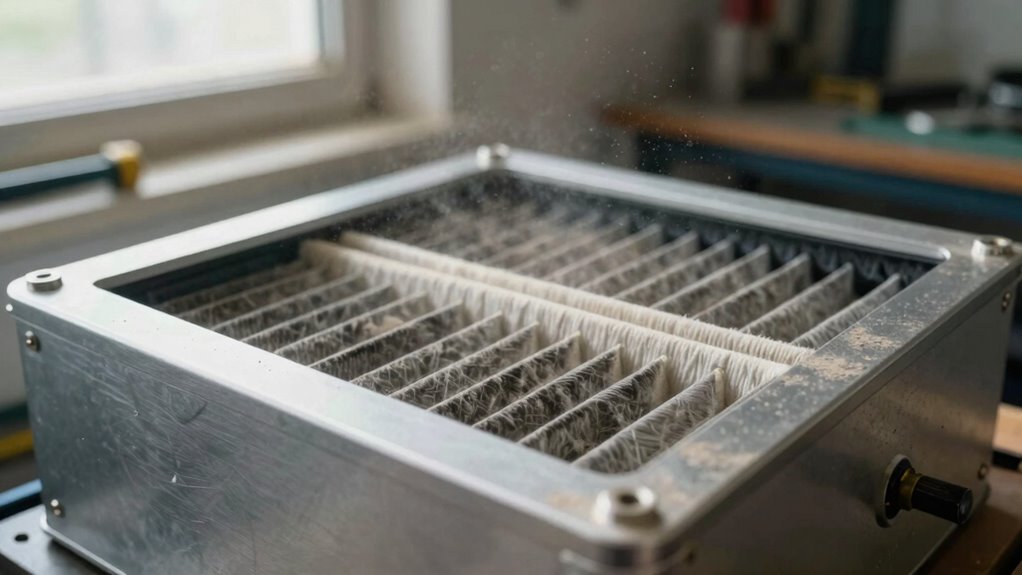
When it comes to woodworking, controlling dust and airborne particles is essential for safety and air quality. The best woodworking air cleaners are designed to filter out fine dust, fumes, and odors, helping you maintain a healthier workspace. The ABESTORM 360 Degree Intake Air Filtration System stands out as the top overall pick thanks to its high CFM and comprehensive coverage. The ALORAIR Hanging Intake Air Filtration System offers convenient operation for garage setups, while the DeWalt Dust Collector provides a reliable option for those prioritizing durability. Keep reading to see how these options and others compare, and find the perfect fit for your workshop needs.

Get business pricing on tools and workshop supplies
- Business-only prices and quantity discounts
- Tax-exempt purchasing
- Multiple users, one account, clear invoices
Complete the kit


Key Takeaways
- High CFM ratings, like those from ABESTORM and AlorAir, are critical for large workshops and heavy dust loads.
- Built-in ionizers and multiple filtration stages significantly improve air quality, especially in tight or high-dust environments.
- Hanging or tabletop designs offer different convenience levels; choose based on your workspace layout and mobility needs.
- Price varies widely, with premium units offering more advanced features and durability, but many budget options still deliver solid performance.
- Ease of maintenance and filter replacement are often overlooked but crucial for ongoing effectiveness and safety.
| ABESTORM 360 Degree Intake Air Filtration System – 1350 CFM for Woodworking and Dust Collection |  | Best Overall for Large Workshops | Dimensions: 20.5 x 20.5 x 9.8 inches | Electrical Requirements: 115V, 60Hz, 1.5A | Air Flow: 1050 to 1350 CFM | VIEW ON AMAZON | See Our Full Breakdown |
| ALORAIR Hanging Intake Air Filtration System for Woodworking, 2-Stage, 580/780 CFM, Remote Control, Suitable for Garage, Workshop, Home Use |  | Best for Versatile, Space-Saving Filtration | Airflow: 580/780 CFM | Dimensions: 18.35″L x 18.35″W x 8.8″H | Electrical Requirements: 115V, 60Hz, 0.6A | VIEW ON AMAZON | See Our Full Breakdown |
| Abestorm 360 Degree Intake Air Filtration System for Woodworking, Built-in Ionizer, 1350 CFM, MERV-11 Filter |  | Best for Odor and Dust Removal in Large Spaces | Power Source: 115V, 60Hz | Air Flow: 1050-1350 CFM | Coverage Area: 1700 sq ft | VIEW ON AMAZON | See Our Full Breakdown |
| ALORAIR 580/780 CFM 2-Stage Air Filtration System for Woodworking |  | Best Compact Performance for Small Spaces | Air Flow: 580/780 CFM | Size: 14.57 x 9.45 x 11.81 inches | Weight: 17.4 lbs | VIEW ON AMAZON | See Our Full Breakdown |
| DeWalt Air Filtration System Dust Collector for Woodworking DWXAF101 |  | Best for Fine Dust and Regulatory Compliance | Filtration System: 2-stage (cotton pre-filter and H11 HEPA | Particle Capture Efficiency: Over 95% of 0.3 μm particles | Timer Settings: 1H, 2H, 4H, 8H | VIEW ON AMAZON | See Our Full Breakdown |
| WEN 3410 3-Speed Remote-Controlled Air Filtration System (300/350/400 CFM), Black | 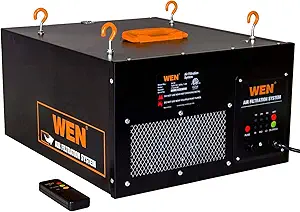 | Best Overall for Versatile and User-Friendly Filtration | Filter: 1-micron filter and 5-micron pre-filter | Dimensions: 17″ L x 20.5″ W x 10″ H | Electrical Requirements: 120V, 60 Hz, 1A | VIEW ON AMAZON | See Our Full Breakdown |
| AlorAir 360 Degree Intake Air Filtration System (1050/1350 CFM) with Vortex Fan, Built-in Ionizer, Dust Collector for Woodworking and Garage |  | Best for Large Workshops Needing High Airflow and Odor Control | CFM: 1050/1350 | Dimensions: 20.5″L x 20.5″W x 9.8″H | Electrical Requirements: 115V, 60Hz, 1.5A | VIEW ON AMAZON | See Our Full Breakdown |
| ALORAIR 360 Degree Intake Air Filtration System for Woodworking (1050/1350 CFM) with Vortex Fan |  | Best for Comprehensive Filtration in Large Spaces | CFM: 1050/1350 | Dimensions: 20.5″L x 20.5″W x 9.8″H | Electrical Requirements: 115V, 60Hz, 1.5A | VIEW ON AMAZON | See Our Full Breakdown |
| Abestorm Tabletop Dust Collector with Dual-Sided Intake for Woodworking |  | Best for Small Workshops and Portability | Dimensions: 11.81”×11.81”×13.78” | Speed Settings: 2 (850 CFM, 1050 CFM) | Electrical Requirements: 115V, 0.59A | VIEW ON AMAZON | See Our Full Breakdown |
| Abestorm 270 Degree Intake Air Filtration System with Ionizer, 780 CFM, Remote Control, for Workshops and Garage |  | Best for Quiet, Efficient Dust Management in Medium Spaces | Airflow: 580-780 CFM | Dimensions: 18.35″L×18.35″W×8.82″H | Filtration Technology: MERV-11 | VIEW ON AMAZON | See Our Full Breakdown |
| woodworking air cleaner | Noise Level | Dimensions | Electrical Requirements | Coverage Area |
|---|---|---|---|---|
| ABESTORM 360 Degree Intake Air | 60 to 69 dBA | 20.5 x 20.5 x 9.8 inches | 115V, 60Hz, 1.5A | up to 1700 sq ft |
| ALORAIR Hanging Intake Air Fil | below 50 dBA | 18.35"L x 18.35"W x 8.8"H | 115V, 60Hz, 0.6A | up to 800 sq.ft |
| Abestorm 360 Degree Intake Air | 60-69 dBA | — | — | 1700 sq ft |
| ALORAIR 580/780 CFM 2-Stage Ai | under 58 dBA | — | — | — |
| DeWalt Air Filtration System D | — | — | — | — |
| WEN 3410 3-Speed Remote-Contro | 50 to 60 dB | 17" L x 20.5" W x 10" H | 120V, 60 Hz, 1A | — |
| AlorAir 360 Degree Intake Air | 60-69 dB | 20.5"L x 20.5"W x 9.8"H | 115V, 60Hz, 1.5A | up to 1700 sq.ft |
| ALORAIR 360 Degree Intake Air | 60-69 dB | 20.5"L x 20.5"W x 9.8"H | 115V, 60Hz, 1.5A | up to 1700 sq.ft |
| Abestorm Tabletop Dust Collect | — | 11.81”×11.81”×13.78” | 115V, 0.59A | — |
| Abestorm 270 Degree Intake Air | <50dBA | 18.35"L×18.35"W×8.82"H | — | up to 800 sq.ft. |
More Details on Our Top Picks
ABESTORM 360 Degree Intake Air Filtration System – 1350 CFM for Woodworking and Dust Collection
This model stands out for its impressive airflow capacity up to 1350 CFM and a 360-degree intake, making it ideal for large woodworking spaces. Compared to the AlorAir 360 Degree Intake Air Filtration System, it offers similar airflow but adds remote control convenience and easier mobility. However, it falls short in meeting California’s air cleaner regulations, which could be a concern for compliance-focused users. The high airflow helps clear dust quickly but results in noise levels around 60-69 dBA, which might be disruptive in quieter environments. Its straightforward installation and lightweight design make it suitable for workshop owners needing effective dust extraction without complex setup. This pick is best for large workshops where maximum airflow and coverage are priorities, and noise is a secondary concern.
Pros:- High airflow capacity up to 1350 CFM for rapid dust clearance
- 360-degree intake for comprehensive dust extraction
- Remote control operation for ease of use
- Lightweight and easy to move around
Cons:- Does not meet California air cleaner regulations
- Can be noisy at higher speeds
- Limited regional availability due to shipping restrictions
Best for: Workshop owners with large spaces needing high airflow and comprehensive dust removal
Not ideal for: Small garages or workshops in California requiring regulatory compliance
- Dimensions:20.5 x 20.5 x 9.8 inches
- Electrical Requirements:115V, 60Hz, 1.5A
- Air Flow:1050 to 1350 CFM
- Coverage Area:up to 1700 sq ft
- Noise Level:60 to 69 dBA
- Filter Type:MERV-11
Our verdict“This system suits large workshops demanding high airflow despite noise and regulatory limitations.”
ALORAIR Hanging Intake Air Filtration System for Woodworking, 2-Stage, 580/780 CFM, Remote Control, Suitable for Garage, Workshop, Home Use
This system makes a strong case for versatility, with a portable, hanging design and dual-stage filtration that can reach 780 CFM, outperforming smaller units like the WEN 3410 in airflow efficiency. Its ability to be hung or placed on a workbench allows flexible placement in tight spaces and improves airflow direction. The high-efficiency filters remove up to 90% of dust particles, making it suitable for users concerned about indoor air quality. However, it doesn’t comply with California regulations, which might restrict some users. Noise remains below 50 dBA, making it suitable for quieter environments, and the remote control plus timer add user convenience. This pick is best for hobbyists or small workshops needing effective, adaptable dust control without bulk.
Pros:- Portable with hanging or surface placement options
- Effective filtration capturing up to 90% of dust particles
- Quiet operation under 50 dBA
- Remote control and timer for convenience
Cons:- Not compliant with California air regulations
- Limited to 580/780 CFM, less suitable for very large spaces
- Filters require regular replacement for consistent performance
Best for: Home workshop owners or hobbyists prioritizing space-saving and flexible installation
Not ideal for: Large commercial shops requiring maximum airflow capacity
- Airflow:580/780 CFM
- Dimensions:18.35″L x 18.35″W x 8.8″H
- Electrical Requirements:115V, 60Hz, 0.6A
- Coverage Area:up to 800 sq.ft
- Noise Level:below 50 dBA
- Filtration Efficiency:90% of 3-10um particles
Our verdict“This system excels for small to medium workshops seeking adaptable, effective air filtration with minimal noise.”
Abestorm 360 Degree Intake Air Filtration System for Woodworking, Built-in Ionizer, 1350 CFM, MERV-11 Filter
This version of the Abestorm system combines high airflow with an ionizer, making it especially effective at removing odors alongside dust, which sets it apart from models like the ALORAIR 580/780. It offers flexible installation choices—ceiling hanging, surface placement, or screw-in ceiling—adding versatility to different workshop layouts. The built-in ionizer helps improve air quality by reducing odors, a feature absent in many other units. However, it doesn’t meet California’s strict regulations, which could be a concern for compliance. It generates noise levels around 60-69 dBA, which might be noticeable in quiet environments. The filters are replaceable and designed for long-term use, but frequent replacements increase ongoing costs. This makes it suitable for large workshops where odor control alongside dust extraction is desired.
Pros:- Effective 360-degree filtration with built-in ionizer for odor removal
- Versatile installation options for different setups
- Remote and touch controls for easy operation
- Large coverage area up to 1700 sq ft
Cons:- Does not meet California air cleaner regulations
- Noise level could be disruptive in quiet settings
- Filter replacements can be frequent and costly
Best for: Workshop owners needing strong dust and odor removal in large, well-ventilated spaces
Not ideal for: Regulation-restricted environments or small workshops with noise sensitivities
- Power Source:115V, 60Hz
- Air Flow:1050-1350 CFM
- Coverage Area:1700 sq ft
- Noise Level:60-69 dBA
- Particle Retention Size:1 micron
- Filter Type:MERV-11
Our verdict“Ideal for large workshops that need comprehensive dust and odor control despite regulatory and noise considerations.”
ALORAIR 580/780 CFM 2-Stage Air Filtration System for Woodworking
The ALORAIR 580/780 CFM model excels in delivering high airflow in a compact, portable form, standing out for users who need powerful filtration in tight spaces. Its size—just over 14 inches wide—makes it ideal for small workshops or garages where space is limited, contrasting with bulkier units like the ABESTORM 360. The two-stage filtration system with MEVR 13 filters ensures effective removal of 3-10 micron particles, suitable for general woodworking dust. Its quiet operation under 58 dBA and easy-to-use controls make it suitable for continuous use without disturbance. However, the filters may require frequent replacement, adding ongoing costs, especially in heavily used shops. It lacks smart connectivity features, so automation isn’t available. This pick is best for users who need a high-performance, space-efficient unit for smaller to medium-sized areas.
Pros:- Compact and lightweight for easy mobility
- Powerful 2-stage airflow suitable for medium spaces
- High-efficiency filtration reduces indoor pollutants
- Quiet operation and simple controls
Cons:- Frequent filter replacements needed in active use
- Limited coverage area, not ideal for large workshops
- No smart features or automation options
Best for: Small workshop owners or hobbyists needing portable, high-capacity filtration
Not ideal for: Large commercial workshops or spaces requiring maximum airflow across multiple zones
- Air Flow:580/780 CFM
- Size:14.57 x 9.45 x 11.81 inches
- Weight:17.4 lbs
- Filtration:MEVR 13, 3-10um particles
- Noise Level:under 58 dBA
- Timer:1-2 hours
Our verdict“This system offers strong filtration in a small footprint, perfect for smaller workshops with space constraints.”
DeWalt Air Filtration System Dust Collector for Woodworking DWXAF101
The DeWalt DWXAF101 combines a two-stage filtration system—including a cotton pre-filter and H11 HEPA filter—that captures over 95% of 0.3 μm particles. This makes it a superior choice for users concerned with fine dust, outperforming many basic units like the WEN 3410. Its multiple modes and timers provide flexible operation, while ceiling mounting options save space and keep the workspace uncluttered. The washable pre-filter reduces ongoing costs, and the three-year warranty adds peace of mind. The main tradeoff is its requirement for ceiling mounting space, which can limit placement options in smaller or low-ceiling workshops. Also, it’s generally more expensive than simpler dust collection systems, but the enhanced filtration justifies the cost for sensitive environments or professional use.
Pros:- Highly effective 2-stage filtration capturing over 95% of fine dust
- Multiple modes and timers for flexible operation
- Ceiling mount design saves workspace floor space
- Long warranty for durability
Cons:- Requires ceiling mounting space which may not be available
- Higher upfront cost compared to basic units
- Maintenance involves filter replacement indicators
Best for: Professionals needing high-efficiency filtration and space-saving ceiling mounting
Not ideal for: DIY hobbyists with limited ceiling space or budget constraints
- Filtration System:2-stage (cotton pre-filter and H11 HEPA
- Particle Capture Efficiency:Over 95% of 0.3 μm particles
- Timer Settings:1H, 2H, 4H, 8H
- Modes:HI, MID, LO, AUTO
- Mounting:Ceiling-mounted with hooks & chains
- Warranty:3 years
Our verdict“This system is ideal for professional workshops prioritizing fine dust removal and space efficiency despite higher costs.”
WEN 3410 3-Speed Remote-Controlled Air Filtration System (300/350/400 CFM), Black
This pick stands out for its balance of functionality and convenience, featuring three adjustable speeds, a remote control, and a programmable timer that make it easy to operate from anywhere in your shop. Compared with the larger AlorAir 360 Degree Intake, the WEN 3410 is more suitable for small to medium workshops where space is limited, but it may be noisier at higher speeds. Its effective filtration with replaceable 1-micron and 5-micron filters ensures good dust removal, though its noise level of 50-60 dB could be noticeable during prolonged use. This model is ideal for hobbyists or small shop owners who prioritize ease of use and flexible control without needing the highest airflow capacity.
Pros:- Remote control for effortless operation from anywhere
- Adjustable airflow speeds with a programmable timer
- Effective filtration with replaceable filters
Cons:- Noise level may be noticeable at higher speeds
- Size may be bulky for very small spaces
Best for: Woodworkers requiring a flexible, easy-to-operate system for small to medium spaces
Not ideal for: Large professional shops needing extremely high airflow or continuous heavy-duty operation
- Filter:1-micron filter and 5-micron pre-filter
- Dimensions:17″ L x 20.5″ W x 10″ H
- Electrical Requirements:120V, 60 Hz, 1A
- Air Flow:300/350/400 CFM
- Coverage:up to 400 sq ft
- Noise Level:50 to 60 dB
Our verdict“This is a solid choice for hobbyists or small workshops valuing convenience and adjustable control.”
AlorAir 360 Degree Intake Air Filtration System (1050/1350 CFM) with Vortex Fan, Built-in Ionizer, Dust Collector for Woodworking and Garage
The AlorAir 1350IG excels in large spaces with its impressive 1050/1350 CFM airflow, making it ideal for sizable workshops and garages. Its 360-degree intake and vortex fan design outperform smaller models like the WEN 3410 in terms of sheer capacity, but the tradeoff is increased noise levels around 60-69 dB, which might be disruptive in quieter environments. The built-in ionizer enhances dust and odor removal, though it makes maintenance more involved and it’s not compliant with California air quality regulations. This system is well-suited for professional or serious hobbyist users who need robust, large-area air cleaning, accepting the tradeoff of higher noise and maintenance requirements.
Pros:- High airflow capacity suitable for large spaces
- Effective dust and odor removal with built-in ionizer
- Portable with hook and chain for versatile placement
Cons:- Not compliant with California air quality regulations
- Noise level may be loud in quiet environments
- Requires regular filter maintenance
Best for: Large workshop owners needing high airflow and odor reduction
Not ideal for: Small workshops or users sensitive to noise or regulatory restrictions in California
- CFM:1050/1350
- Dimensions:20.5″L x 20.5″W x 9.8″H
- Electrical Requirements:115V, 60Hz, 1.5A
- Coverage Area:up to 1700 sq.ft
- Noise Level:60-69 dB
- Particle Removal Efficiency:90% of 3-10um, 85% of 1um
Our verdict“This is ideal for large, busy workshops where high capacity and odor control outweigh noise and maintenance considerations.”
ALORAIR 360 Degree Intake Air Filtration System for Woodworking (1050/1350 CFM) with Vortex Fan
The ALORAIR 1350 CFM system offers a 360-degree air intake that ensures thorough coverage across large woodworking areas, matching the capacity of the AlorAir 1350IG but with a focus on versatility and ease of placement. Its vortex fan delivers strong airflow, maintaining high static pressure, and its design allows for hanging or bench placement with hooks and chains. While its filtration efficiency is comparable, it shares the same drawbacks of higher noise levels (60-69 dB) and the need for periodic filter replacement. This model makes the most sense for users who prioritize comprehensive coverage and flexibility in setup, accepting the noise as part of effective large-space air quality management.
Pros:- 360-degree intake for thorough coverage
- Strong vortex fan maintains high airflow
- Flexible installation options with hanging or bench placement
Cons:- Not compliant with California regulations
- Noise may be disruptive in quiet settings
- Regular filter maintenance required
Best for: Workshop owners seeking a versatile, high-capacity filtration system that can be hung or placed on a bench
Not ideal for: Quiet environments or users in regions with strict California air quality regulations
- CFM:1050/1350
- Dimensions:20.5″L x 20.5″W x 9.8″H
- Electrical Requirements:115V, 60Hz, 1.5A
- Coverage Area:up to 1700 sq.ft
- Noise Level:60-69 dB
- Filtration Efficiency:90% of 3-10um, 85% of 1um
Our verdict“This system is perfect for large workshops needing comprehensive, flexible air filtration with high airflow capacity.”
Abestorm Tabletop Dust Collector with Dual-Sided Intake for Woodworking
The Abestorm Tabletop Dust Collector offers a compact, portable solution with dual-sided intake and high CFM options of 850 and 1050, making it suitable for small workshops or hobbyist setups. Its sleek metal housing and handle facilitate easy transport and placement, unlike larger systems such as the ALORAIR 360 models. The inclusion of a MERV-13 filter and a timer function adds convenience, but the limited to two speed settings and the need to replace filters every six months are notable tradeoffs. This unit is ideal for users who want effective dust collection without occupying significant space or sacrificing mobility, though it isn’t designed for large-scale or continuous heavy-duty use.
Pros:- High CFM options for effective dust collection
- Portable with handle and compact design
- Includes timer and safety features
Cons:- Limited to 2 speed settings
- Filter replacement every 6 months
- Not suitable for large or heavily dusty shops
Best for: Home workshop users needing a portable, effective dust collector on a small scale
Not ideal for: Large professional workshops or users requiring continuous high CFM operation
- Dimensions:11.81”×11.81”×13.78”
- Speed Settings:2 (850 CFM, 1050 CFM)
- Electrical Requirements:115V, 0.59A
- Filter:MERV-13, lasts up to 6 months
- Additional Features:Piano key switch, timer up to 120 mins, auxiliary outlet
Our verdict“This dust collector is perfect for small workshops prioritizing portability and reliable dust removal on a limited scale.”
Abestorm 270 Degree Intake Air Filtration System with Ionizer, 780 CFM, Remote Control, for Workshops and Garage
The Abestorm 270 Degree Intake system employs a three-sided intake design with an ionizer, making it highly effective for spaces up to 800 sq.ft. Its remote control adds convenience, while the quiet operation (<50 dBA) suits environments where noise reduction is important. Compared with larger systems like the AlorAir 1350IG, it offers less airflow but excels in quiet performance and ease of use. The regular filter replacement every 4-6 months is a manageable tradeoff for its quiet, efficient operation. It’s best suited for hobbyists or small workshop owners who value quiet, effective dust control without extensive setup or high capacity needs.
Pros:- Quiet operation (<50dBA)
- Smart remote control with touch panel
- Effective dust capture with 90% efficiency for fine particles
Cons:- Regular filter replacement every 4-6 months
- Limited to 800 sq.ft. spaces
- Setup can be complex for some users
Best for: Workshop or garage users seeking quiet, effective air filtration in medium-sized spaces
Not ideal for: Large workshops or users needing maximum airflow or removal of heavy dust loads
- Airflow:580-780 CFM
- Dimensions:18.35″L×18.35″W×8.82″H
- Filtration Technology:MERV-11
- Particle Capture Efficiency:90% of 3-10um particles
- Coverage Area:up to 800 sq.ft.
- Noise Level:<50dBA
Our verdict“This system offers a balanced mix of quiet operation and effective dust filtration for medium-sized workshops or garages.”

How We Picked
The products in this roundup were evaluated based on their airflow capacity (CFM), filtration efficiency, build quality, ease of use, and maintenance requirements. Priority was given to units that could handle the dust loads typical of woodworking shops, ensuring they provide enough airflow to keep air clean without being overly loud or complicated to operate. We also considered features like ionizers, remote control, and installation options, as these enhance usability. The ranking reflects a balance of performance, value, and user convenience, with top picks excelling in multiple categories while acknowledging tradeoffs like price or noise levels.Factors to Consider When Choosing Woodworking Air Cleaner
Choosing the right woodworking air cleaner involves several key considerations beyond just airflow capacity. Focus on the size of your workspace and dust load to match the CFM rating appropriately. Filters with high MERV ratings and features like ionizers can significantly improve air quality but may come with higher costs and maintenance needs. Ease of installation and noise levels also matter, especially if your shop is in a shared space or small garage. Understanding these factors helps avoid common mistakes, such as underestimating the needed airflow or selecting units that are difficult to operate and maintain.Airflow Capacity (CFM)
The airflow capacity, measured in cubic feet per minute (CFM), determines how much air the cleaner can process each minute. For larger workshops or spaces with heavy dust production, units with 1000+ CFM are generally recommended. Smaller or hobbyist shops might find 300-600 CFM sufficient. Overestimating your needs can lead to unnecessary expense, while underestimating can result in poor air quality. Match the CFM to your workspace size and dust load for the most effective results.Filtration Efficiency and Filters
Effective filtration is vital for removing fine dust particles that can harm your lungs. HEPA filters are ideal for capturing airborne particles as small as 0.3 microns, while MERV ratings indicate overall filter efficiency. Higher-rated filters offer better air purity but may reduce airflow and increase maintenance frequency. Consider units with multi-stage filtration, including pre-filters and ionizers, for optimal air cleaning. Keep in mind that filters need regular replacement to maintain performance.Design and Usability
The design of your air cleaner should match your workspace layout. Portable units with caster wheels or hanging models provide flexibility, while tabletop units suit small or dedicated workbenches. Ease of operation—such as remote controls, timers, and simple filter access—can save time and frustration. Noise levels also matter; quieter models enable comfortable working conditions, especially in shared spaces. Evaluate your specific setup to select a design that integrates seamlessly into your workflow.Maintenance and Operating Costs
Regular filter replacement and cleaning are essential to keep the air cleaner functioning properly. Some units feature reusable filters, reducing long-term costs, while others require frequent disposable filter changes. Consider the availability and price of replacement filters, as well as the effort involved in maintenance. A model with straightforward access and clear maintenance indicators can prevent neglect and ensure consistent air quality. Budgeting for ongoing costs is important when choosing a unit.Additional Features and Considerations
Features like built-in ionizers, remote controls, and multiple fan speeds can enhance usability and air quality. Ionizers can capture smaller particles but may produce ozone, so check if this feature is safe for your environment. Adjustable fan speeds allow you to balance noise and filtration power, especially during different phases of your work. Also, consider the noise level—quiet units are preferable if you spend long hours nearby. These extras can justify higher prices but look for models that offer reliable performance without excessive complexity.Frequently Asked Questions
How do I determine the right CFM for my woodworking shop?
Calculating the appropriate CFM depends on your workspace size and dust load. As a general rule, for a typical 200-300 square foot shop with standard ceiling heights, a unit with at least 600-1000 CFM is recommended. Larger spaces or heavy dust production require even higher airflow. To be precise, multiply your room’s volume (length x width x height) by a recommended air exchange rate (usually 4-6 times per hour), then divide by 60 to get the needed CFM. Matching the unit to these calculations ensures effective dust removal and safer air quality.
Are HEPA filters necessary for woodworking air cleaners?
Yes, HEPA filters are highly effective at capturing the tiny particles created during woodworking, including fine dust and allergens. They are especially valuable if you have respiratory sensitivities or allergies. While MERV-rated filters can remove larger particles, HEPA filters are the gold standard for ensuring the cleanest air possible. Keep in mind that HEPA filters can be more expensive and may slightly reduce airflow, so choosing a model with sufficient capacity is important to maintain performance.
Can I use a household air purifier for woodworking dust?
Most household air purifiers lack the airflow capacity and filtration efficiency needed for woodworking dust. They are typically designed for smaller rooms and lower levels of airborne particles. For woodworking, a dedicated air cleaner with high CFM and HEPA or MERV filters is necessary to manage the volume and size of dust produced. Using a standard household purifier may lead to inadequate filtration, leaving harmful particles in the air, so investing in a specialized unit is advisable for safety and effectiveness.
How often should I replace the filters in my woodworking air cleaner?
The frequency of filter replacement depends on usage and dust levels. Generally, pre-filters should be checked and cleaned every 1-3 months, while HEPA or MERV filters may need replacement every 6-12 months. Heavy use or high dust loads can shorten this interval. Regularly inspecting filters for dirt buildup and following the manufacturer’s recommendations helps maintain optimal performance. Proper maintenance ensures the air cleaner continues to protect your health and maintain air quality efficiently.
Is noise level a concern with woodworking air cleaners?
Yes, noise can be a significant factor, especially if you spend long hours working in your shop. Many high-capacity units operate at louder volumes, which can be distracting or uncomfortable. Look for models that specify noise ratings or feature multiple fan speeds, allowing you to run them quietly during detailed work. Some units are designed with sound-dampening features, making them more suitable for prolonged use. Balancing performance with noise levels helps maintain a comfortable working environment.
Conclusion
For most users, the ABESTORM 360 Degree Intake Air Filtration System offers the best overall performance, combining high airflow with effective filtration and ease of maintenance, making it suitable for serious hobbyists and small professional shops. Budget-conscious buyers should consider the WEN 3410 or AlorAir 580/780 CFM units, which deliver solid performance at lower prices. For those seeking premium features and maximum durability, the AlorAir Vortex Fan System with advanced filtration and ionizers is a worthwhile investment. Beginners or hobbyists might prefer tabletop or smaller units, while large or dust-heavy workshops benefit from higher capacity, high-CFM models. Tailor your choice to your space, budget, and dust management needs to ensure a safer, cleaner woodworking environment.
Fall Picks
fall essentials
As an affiliate, we earn on qualifying purchases.